French priest interviews Hitler's willing executioners in Ukraine | |
 | |
| By Cnaan Liphshiz | |
| |
Tags: jewish world, Holocaust  | |
 | |
Read All at : | |
French priest interviews Hitler's willing executioners in Ukraine - Haaretz - Israel News

French priest interviews Hitler's willing executioners in Ukraine | |
| |
| By Cnaan Liphshiz | |
| |
| Tags: jewish world, Holocaust | |
| | |
Read All at : | |
U.S. Jews seek clues to Obama Israel policy in Netanyahu visit
| |
| |
| By Natasha Mozgovaya | |
| |
| Tags: AIPAC, benjamin netanyahu | |
| | |
Read All at : | |
What worries me more are the movies and plays that subtly and inexorably shift the civilian point of view, movies which glamorize Arab tyrants and terrorists and demonize Israeli soldiers, “settlers” and politicians. Gradually, almost imperceptibly, ordinary people have come to believe that the Muslim world is peaceful, friendly, safe; that its “rough edges” are due to it’s having formerly been oppressed by Europe; that Islamist terrorism has probably been caused by the United States’ invasion of Afghanistan, Iraq, and Pakistan; that much of this is Israel’s fault—or rather, that much of this may now be solved if only America sacrifices Israel for the sake of world peace, including its own survival.
Read All at :
From Aish by Ruchama King Feuerman
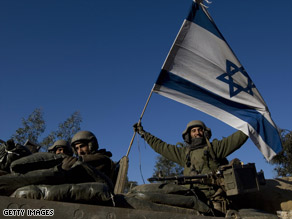
The Six Day War had ended. The generals assembled the commanders and foot soldiers for a customary review and analysis of the battle. After the military questions had been asked, and the investigative committee was about to disperse, a commanding officer pointed to one of the soldiers. "Wait a minute. I have a question for you. Yes, you, the soldier who put up the flag on the Temple Mount."
The soldier nodded.
"Where did you get an Israeli flag, and why did you put it up?"
The soldier spread out his hands and smiled, a gesture that indicated that here was more than just a one sentence response. He told the following story:
The night before the Old City was liberated, a contingent of soldiers fighting near the Old City took cover in a shelter in a Jerusalem neighborhood. Hordes of children, mothers, old men and women packed inside the bunker alongside the soldiers. People looked frightened and bereft. The government had imposed a news black-out so that the Arab countries wouldn't be able to figure out their positions. And the news -- originating from Jordan, Egypt and Syria -- was enough to induce hysteria: calls from Saudi King Faisal for the total elimination of Israel, calls from every Arab country to push the fledgling country into the sea.
Things looked so bad, Israelis famously converted public parks into mass graves, in preparation for the expected casualties. (Israel's Chief of Staff, Yitzchak Rabin, had even suffered a nervous breakdown.)
As the soldier sat there in the bunker, hopeless and uncertain, he saw an old woman slowly make her way over to him. "Excuse me," she said, standing at his side. She held a satchel in her arms.
He lifted his eyes. "Yes, Doda. Tell me, what is it?"
"Tomorrow you'll go to the Old City and you'll go to the Kotel."
He shook his head at the absurdity. He said, "No, we won't." There were no army plans to liberate the Old City. First, they were fighting just to hold their positions. Also, overtaking the Old City would entail hand-to-hand combat which was greatly feared: Many people would die. Moreover, any bombardment of the Old City might demolish even more of the holy sites than had already been destroyed by the Jordanians. He tried to explain all of this.
The old woman looked at him, steady-eyed. "No, you will go," she said, not as if she were trying to convince him, but as if relaying simple facts.
He shrugged. An old woman's delusions. He wasn't going to argue with her.
Before he turned away, she said, "I have a favor to ask you." She reached into her satchel and took out an Israeli flag. From the way she touched it, it was clear the flag had some personal meaning for her. Had she made it? Perhaps it had been draped over a loved one's grave? But what was she now saying? "When you go, please take this flag, and when you get to the Temple Mount, I want you to hang it up there." She held out the flag.
The soldier repeated, "We're not going into the Old City."
"You're going," she said. Again, she held out her arm.
A thought struck him. "I can't take it," he told her. "It's against army regulations."
"It'll be all right. Just take it."
"I'll get in trouble. You're only allowed to carry a few specified items."
Please," she said hoarsely. "Do me this favor."
He shrugged again. Why was he arguing with this old woman? Let him take the flag, let him make an old woman feel good. He could always get rid of it later.
The next day, the Israeli army, contrary to everyone's expectations, took the Old City. Sure enough, the soldier's unit ended up at the Temple Mount. As he and the other soldiers came close to the Western Wall, he suddenly remembered the flag and the old woman's words. Yes, he would do it, he would! He enlisted two buddies, and together they draped the flag over the grating on the upper left most side of the Kotel, and there they hoisted and hung the Israel flag.
The commanding officer conducting the investigation said to the soldier, "And what were you thinking when you put up that flag?"
The soldier said, "I was thinking that this was the answer to 2,000 years of Jewish suffering."
And so ends the story of the soldier, our hero.
But there's an unsung hero, too. What about the old woman who supplied the flag? One wishes the investigating officers had tracked her down. What did she have in mind as she entered a shelter with an Israeli flag in her satchel? And who was she, anyway? The only identifying feature is that she was old and carried a bag. But her advanced age already tells us plenty: that she knew something about Jewish history, probably having personally lived through it...World War I, Arab attacks, the Holocaust, the War of Independence, 1956. What hadn't she seen?
There, in Israel's darkest moment, outnumbered and surrounded by enemies, terrified that the next morning there will be no Israel, the old woman sees what no one else can see, what no one else is capable of conceiving. She insists on her vision, she practically browbeats the soldier into carrying out her plan. We'll never know how she knew, only that, like many Jewish women before her -- the Matriarchs, the midwives in Egypt, the righteous women in the desert -- she just knew. There are two kinds of prophecy. One that predicts the future, and one that makes the future.
taken from: For Zion's Sake
In explaining the rejection of Stirling's play, the festival's development
coordinator Madeline Heneghan said: "The program is planned months in
advance." The request was "unrealistic at this point", she added.
Exposing Obama’s PSYOPS Agents and Tactics
Psychological Operations (PSYOP, PSYOPS) are techniques used to influence a target audience's value systems, belief systems, emotions, motives, reasoning, and behavior. PSYOPS tactics are used on target audiences in order to induce confusion, or reinforce attitudes and behaviors favorable to the originator's objectives.
Read All at :
 This is probably an accurate take on what Israeli Prime Minister Binyamin Netanyahu will tell President Obama when the two meet in Washington on Monday:
 Read All at :Netanyahu's job will be to convince Obama that the Iranian problem cannot be finessed in such a way. Success must be defined as the dismantling of Iran's nuclear program and enrichment capability. While Iran obviously will not abandon its program unless forced to do so, it is still possible to avoid military action by imposing the "crippling sanctions" that Secretary Clinton discussed during her recent Congressional testimony.
 The Wall Street Journal reported on Friday that the United States and the Europeans have placed an early October deadline to determine whether 'engagement' with Iran is working. But don't get your hopes up. They're not going to attack Iran if engagement doesn't work. Just some more ineffective sanctions.
 They also are developing specific benchmarks to gauge Iranian behavior. Those include whether Tehran is willing to let United Nations monitors make snap inspections of Iranian nuclear facilities that are now off-limits, and whether it will agree to a "freeze for freeze" -- halting uranium enrichment in return for holding off on new economic sanctions -- as a precursor to formal negotiations.
The moves are partly driven by concerns in Israel and among Washington's Arab allies that Tehran could drag out negotiations indefinitely while advancing its nuclear program, the officials said.Read ALL AT :
 It couldn't happen to a nicer bunch of people than the 'Palestinians.'
I grow weary, disconsolate.
More than seven years ago, when I first sounded the alarm about the new anti-Semitism, I was given a massive brush off by some of the same Jewish organization leaders who are, only now, screaming “gevalt” from the rooftops.
Read All at :
Chesler Chronicles » Consolation in a Time of Madness
This week’s parshah deals primarily with laws that relate to an individual’s estate in the land of Israel. When the Jews finally conquered and inherited the land of Israel, each of the twelve tribes was given its own portion throughout the country. And within every tribe, every person inherited their own particular portion of the land. In this week’s parshah we learn about different situations in which one must, for certain reasons, sell his portion (either land, or his house) to another. The Torah tells us:
Read All at :
Max Julius in Haaretz puts the Guardianistas in a context I hadn't thought of: the snotty Englishmen who can't really be cajoled to take the natives seriously when they act out:
These modern-day British imperialists, the vast majority of whom are on the
left, by the way, see Palestinian terror as a sort of ineffectual
temper-tantrum; much as their forebears in African and the subcontinent saw
their subjects' occasional acts of hostility toward them as childlike bouts of
rage. The fact that Hamas' plots are so regularly thwarted by Israel, which
often responds with far greater force, only goes to further the sense these
Britons have of the group as something that only seems malignant to those
without a true understanding of the Arab: Their poor American cousins and, of
course, the hysterical, persecution-obsessed Eastern European Jews who now call
themselves Israelis.

 I could have called this post the Obama administration's double standard on terrorists, but in all fairness the same double standard has been adopted at least going back to the Nixon administration. Here's an excerpt.
 Israel Matzav: The American double standard on terroristsObama said in Sderot that he would not tolerate rocket attacks that endangered his own daughters. If Samir Kuntar's beating-death victim had been Malia or Sascha Obama, rather than 4-year-old Einat Haran, and Abbas celebrated the killing, would Obama treat Abbas as a moderate peacemaker and negotiate with him? We all know the answer.
Read All at :
 Here's Charles Krauthammer's take on whether Israel will attack Iran to prevent it from getting nuclear weapons.
 Read All at :I think everybody understands that any Israeli government, even the previous, the more dovish, if you like, Ehud Olmert, the government in Israel, would have attacked if nothing is done by the end of this year.
It's not about the new prime minister. It's about Israel itself. No government will tolerate a nuke in the hands of Iran.
The only question is, does Israel have the capacity to actually destroy this nuclear capacity on the part of Iran enough to set it back about half a decade? If it doesn't, then it would be a futile and dangerous act.
 American President Barack Obama has warned Israeli Prime Minister Binyamin Netanyahu not to surprise him by striking Iran (Hat Tip: Gateway Pundit).
 U.S. President Barack Obama has sent a message to Prime Minister Benjamin Netanyahu demanding that Israel not surprise the U.S. with an Israeli military operation against Iran. The message was conveyed by a senior American official who met in Israel with Netanyahu, ministers and other senior officials. Earlier, Netanyahu's envoy visited Washington and met with National Security Adviser James Jones and with Secretary of State Hillary Clinton, and discussed the dialogue Obama has initiated with Tehran.
The message from the American envoy to the prime minister reveals U.S. concern that Israel could lose patience and act against Iran. It is important to the Americans that they not be caught off guard and find themselves facing facts on the ground at the last minuteRead All at :
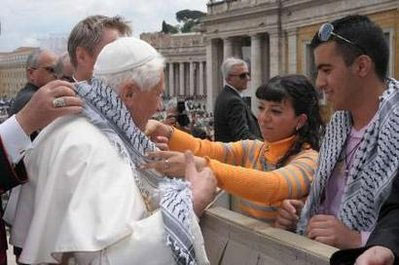
While the Pope's speech at Yad Vashem left much to be desired, he had no such restraint when speaking at a "Palestinian" refugee camp. Speaking before Israeli officials, government representatives and Holocaust survivors at the Yad Vashem memorial in Jerusalem, the Pope could not bring himself to mention the words "Nazis", "murdered" or "six million", nor did he apologize for the silence of the Vatican during the war, and its apathy to the plight of the Jews. The chairman of the Yad Vashem Council, Rabbi Yisrael Meir Lau, who is a Holocaust survivor, expressed disappointment at the pope's speech, saying that "there certainly was no apology expressed here. Something was missing. There was no mention of the Germans or the Nazis who participated in the butchery, nor a word of regret," Lau said. "If not an apology, then an expression of remorse."
Despite this, the Pope did not hold back in his call for an Arab terror state in the heart of the land of Israel and the return of the Jewish people to exile. Speaking before Fatah arch-terrorist Mahmoud Abbas, the Pope declared his support for "a sovereign Palestinian homeland in the land of... [their] forefathers". He used the opportunity to criticize Israel over erecting a security fence designed to prevent Islamic suicide bombers from blowing up Jewish men, women and children in cafes, restaurants and discotheques, a security fence only made necessary by relentless Islamic terror. Abbas, who is constantly referred to as a "moderate" in the West, used the opportunity to lament "the Nakba [catastrophe] 61 years ago" ie. the founding of the State of Israel. Straight from Yad Vashem, the Pope allowed himself to be used as propaganda for those who seek to delegitimize and demonize the Jewish State. PA spokesmen used the Pope's visit to reiterate the Arab "right of return", the flooding of Israel by Arab refugees with the intention of demographically destroying the state.
The Pope's pilgrimage is a case study in hypocrisy, falsehoods and lies. The Pope may have cried crocodile tears at Yad Vashem but he is far from expressing remorse over the Holocaust. His Church has been consistent in whitewashing its wartime record, reinstating Holocaust-denying bishops, promoting ludicrous and obscene comparisons between the Nazis and the IDF, as well as supporting the Durban II conference, in which a Holocaust-denying and genocide-enabling leader was the keynote speaker. The Pope has launched a campaign to exonerate Pope Pius XII, the Pope who closed his eyes as the Jews of Rome were round up from beneath his window, without hurting Jewish sensitivities. The Pope caused a huge scandal when he lifted the excommunication against a bishop who stated that there is no proof that gas chambers ever existed, and only relented after international outcry. Cardinal Renato Martino, the head of the Vatican Council for Justice and Peace and a former Holy See envoy to the United Nations, provoked an uproar when he repeated the revisionist libel that Gaza today resembles a Nazi concentration camp. In addition to this damning record of Holocaust-denial, obfuscation and unwillingness to confront the past, he met with Fatah leader Mahmoud Abbas, whose doctoral dissertation questions the veracity of the Holocaust and argues that Zionist leaders collaborated with the Nazis in the extermination of European Jewry. He writes in his thesis: "It seems that the interest of the Zionist movement, however, is to inflate this figure [of Holocaust deaths] so that their gains will be greater. This led them to emphasize this figure [six million] in order to gain the solidarity of international public opinion with Zionism. Many scholars have debated the figure of six million and reached stunning conclusions—fixing the number of Jewish victims at only a few hundred thousand."" This "moderate" Holocaust denier was also involved in the 1972 murder of Israeli athletes at the Munich Olympics, and countless other terrorist attacks.
The Vatican has consistently promoted the internationalization of Jerusalem and taken a pro-"Palestinian" stance. It was only in 1993 that the Vatican recognized Israel. The reason for this hostility is that the State of Israel and Jewish sovereignty over Jerusalem poses a tremendous theological problem for Catholicism. Church doctrine taught for millenia that Jews were "the witness", cursed to wander without a home as proof of their rejection of Jesus, and that they would never return to Israel. In 1948, and then again in 1967, an enormous issue was raised for theologians. By expressing support for a "Palestinian" state in the "land of their forefathers", the Pope is continuing this same deadly replacement theology. One would think that the supreme pontiff of the Catholic Church would at least have a cursory knowledge of Scriptures, which says quite clearly that the Land of Israel belongs to the Jewish people. He must certainly be aware that there has never in history been a sovereign "Palestinian" state, nor was there ever a distinct "Palestinian" people, culture or entity. In fact, the "Palestinian people" were invented only in 1967 when it became apparent to the Arabs that a new strategy had to be devised to throw the Jews into the sea. Certainly the world's oldest people, with ties going back to the Bible, over 3500 years ago, should not be expected to give up its homeland to make room for the world's newest people, an artificial entity created 42 years ago. The people today referred to as "Palestinians" are squatters and invaders, having arrived in the 1900s from Jordan, Egypt, the Maghreb and Syria, attracted by the increased living standards caused by renewed Jewish settlement in Israel.
The Vatican has a lot of chutzpah. The original Jewish olim from Eastern Europe left for Israel because Church-taught hatred had made life so miserable for the Jewish people. During our entire sojourn in Catholic lands, we never had a moment of rest as we were persecuted and oppressed. The Church taught that Jews were wicked, sons of satan, and forced them to wear distinctive clothing and live in ghettos. Thousands of Jews perished at the hands of crusading swords or on the racks of the Inquisition. Entire communities in France and Germany were wiped out during the Crusades as mobs burst into Jewish homes and demanded: "Kiss the cross or kiss the sword!" The Holocaust, the most horrendous crime humanity ever committed, was only possible because of the two-thousand years of Christian anti-semitism. After watching the Oberammergau Passion Play in 1934, Hitler said out loud: "Perhaps I am rendering to Christianity the best service ever!" Having left, for the most part, Catholic lands for our own soils, the Pope has now followed us, demanding that we give up our land. Jews left Christendom yet Christendom has chased after us, pointing us back to the exile, to subjugation and lowliness.
I would like to point the pontiff to the Book of Joel. He would be wise to read and digest the fourth chapter, which speaks of the fate of those who divide up G-d's land. "For behold, in those days and in that time when I return the captivity of Judah and Jerusalem, I will gather all the nations and I will take them down to the Valley of Jehoshaphat, and I will contend with them there concerning My people and My heritage, Israel, which they scattered among the nations, and My land they divided... And Egypt shall become desolate, and Edom shall be a desert waste, because of the violence done to the children of Judah, because they shed innocent blood in their land. But Judah shall remain forever, and Jerusalem throughout all generations. Now should I cleanse, their blood I will not cleanse, when the Lord dwells in Zion." 61 years after the return of Jewish independence, and 62 after the liberation of Jerusalem, Judea and Samaria, the world still disputes our rights to our home. We must not fear since even when Edom ie. the Church and the West will be a "desert waste", "Judah will remain forever!" Pope may come and go, but the Jewish people are firmly planted in their homeland.
taken from: For Zion's Sake (http://masada1234.blogspot.com/2009/05/papal-bull.html)
Barak advocates what he calls a "multi-layered" missile defense, with a
combination of complementary systems affording protection against attacks from
just a few kilometers to over 1,000 miles. Ideally, the Phalanx would cover
threats up to around 12 kilometers; the Iron Dome, being developed by Israel
Defense Industries' Rafael and scheduled for operational deployment early next
year, would deal with Qassams and Katyushas fired from between 4 and 40
kilometers; the American-made Patriot Advanced Capabilities or PAC-2 already in
operation, and David's Sling (a.k.a. Magic Wand), being developed jointly by
Rafael and Raytheon and scheduled for deployment in 2012-13, would meet
medium-range threats like the Iranian-made Fadjr 3 and 5, Zelzal 2 or the Syrian
Scud-C from 40 to several hundred kilometers; and the Arrow, which could also
provide cover against the Zelzal or the Scuds, would take it from there for
longer-distance missiles, like the Shihab.Barak sees the creation of an anti-projectile shield around Israel as a "strategic goal." Not only would it protect civilians and strategic installations, but the knowledge that their missiles might be intercepted could deter potential aggressors from using them.
An effective missile shield could also give Israeli policy-makers added
options: For example, they might feel more confident about withdrawing from the
West Bank if they believed strategic installations like Ben-Gurion Airport were
adequately protected against rocket attack.
UNIVERSAL TORAH: BEHAR-BECHUKOSAI
By Rabbi Avraham Greenbaum
Parshas BEHAR, Leviticus 25:1-26:2
THE LAND BELONGS TO G-D
"To G-d belongs the land and its fullness, the earth and its inhabitants." (Psalms 24:1). "The heavens, the heavens belong to G-d, but the earth He GAVE TO THE SONS OF ADAM. The dead will not praise G-d nor all who go down to desolation. But we will praise G-d from now and forever! Halleluyah!" (Psalms 115:16-17).
Our present parshah, BEHAR, and its "sister", next week's parshah of BECHUKOSAI, which in some years is read on the same Shabbat, explain under what conditions the Earth and its treasures are given in trust to the sons of man, and when the trust is taken back by its rightful Owner -- if men breach the deed of trust, which is the Torah, G-d's Covenant.
The social, economic, ecological and environmental lessons of BEHAR are particularly urgent today, when men act as lords of the Earth, owning and controlling vast tracts, depleting and destroying her gifts, despoiling her of her treasures for their own short-sighted gain and pleasure, without ever pausing to consider: Who really owns all this? For what purpose did He make it? On the contrary, the Torah commands us to appoint seasons and special years in which we all reflect on Who owns everything and learn to respect His creation.
BEHAR continues with the theme of the cycle of time, which was also central in last week's parshah of EMOR in the section dealing with the annual cycle of festivals (Leviticus Ch. 23). The section in EMOR began with the first of all of G-d's "appointed seasons", the Holy Shabbat, which is the crown of G-d's Covenant. BEHAR takes the concepts of "Six days of work, one day of rest" a level higher, dealing with the cycle of years, which is measured in circuits of 7 x 7 Sabbaticals, followed by the fiftieth Jubilee year.
Our parshah of BEHAR thus begins with the Shemittah cycle in which the land is to be worked and tilled for six years, after which it is to be left "fallow" throughout the seventh year. The Torah gives us a picture of an idyllic world in which independent owner-farmers are raising their wheat and grains for bread and tending their vineyards for wine. After all their gifts to the poor and tithes to the priests and Levites etc. during the six years of labor, they are to go a step further in the seventh year, giving their very fields and vineyards back to their true Owner. In the seventh year, they are not allowed to work their own land. Instead, they must open their gates to everyone so that all can have a share in the fruits from the holy Table of G-d -- the produce of Israel in the Shemittah year has a special sanctity. Even the animals have their share in the fruits of the Shemittah year -- for like us, they too are G-d's guests on His amazing Earth. The Shemittah cycle is a fundamental rhythm in time designed to help us constantly keep in mind that G-d is the true Owner -- of all the world around us and of our very selves.
The fifty-year Jubilee cycle takes us to even higher levels of this awareness. The Jubilee cycle is like a gracious cosmic game in which even the losers eventually get to go back and have a fresh to start all over again -- because G-d, the true Owner and Master of all the land and its inhabitants, is truly compassionate. Even in the idyllic world of independent land-owners, one tends to be more successful, while another is less successful. In time, one is forced to sell his land and even his house. Then he falls into debt, and eventually he becomes enslaved. In the Jubilee year, signaled by the trumpeting of the Shofar of Freedom on Yom Kippur of that year, all the slaves go free and all the fields and orchards go back to their original owners.
In our parshah, the Torah sets forth the code of laws applying to ownership of land in particular, and also of other forms of property, and under what conditions. The laws in our parshah include those of sale, and of business honesty and integrity. The forms of property include people's own selves: under the law of slavery, one person might become the "property" of someone else, whether in the legal or economic sense, or in the spiritual sense, where a person may even fall so low as to sell himself to some form of idolatry.
Rashi on Leviticus 26:1 explains the "moral logic" underlying the sequence of laws set forth in our parshah: "At first the Torah warns about the observance of the Sabbatical year. But if a person is greedy for money and falls under suspicion of violating the Sabbatical year, he ends up selling his possessions. That is why the Torah juxtaposes here the laws of sale, including the sale of moveable articles. If the person still does not repent, he ends up selling his hereditary land. If he still does not repent, he ends up selling his house. If he still does not repent, he has to borrow on interest. in the end he sells his very self, not just to an Israelite, but even to an idol-worshipper."
Yet even the most degraded goes free in the Jubilee year, in which the blast of the Sinai trumpet of Freedom on the Day of At-One-ment signifies that all the debts have been paid through the redemptive power of Binah, the Fiftieth Gate. This theme of freedom in our parshah is particular relevant to us in the present season, as we count the days of the Omer in the seven-fold count of the days and weeks leading up to the Fiftieth Day, the Day of the New Offering, season of the Giving of the Torah: Freedom.
At the very heart of the entire system of redemption set forth in the Torah through the festival cycle and through the Sabbatical and Jubilee cycles lies the Shabbat, which is the very essence of the Sinaitic code. When Moses first asked Pharoah to free the Israelites, all he requested was that they should go "into the wilderness" (away from the technology of civilization) in order to liberate themselves from slavery to earthly lords of the land like Pharaoh. The commandment of Shabbat was given at Marah (Exodus 15:25), prior to the Giving of the Torah at Sinai. The concept of Shabbat is built into the concept of the Manna, which appeared for six days of the week with a double-portion on the sixth day. Shabbat is the fourth commandment. Immediately after the Ten Commandments in Exodus ch. 20, the Torah begins MISHPATIM with the laws of slavery, which involve the Sabbatical and Jubilee concepts.
Now in BEHAR, as we approach the conclusion of the elaboration of the Sinaitic code (BECHUKOSAI sets the seal on this, while the name of our parshah -- "On the Mount" -- reminds us of Sinai) the Torah returns to the theme of Shabbat as being at the very center of the Covenant. The concluding verse of our parshah is: "Guard My Sabbaths and have reverence for My Sanctuary, I am Hashem" (Leviticus 26:2). The entire time-scheme set forth in BEHAR -- the Shemittahs and Jubilee year -- is founded on the concept of Shabbat. Then in the following parshah, BECHUKOSAI, we see that the vengeance of the Covenant is built around a structure of seven-fold punishments for the spiral of sin caused by the violation of the Shabbat.
It is a strange irony that the observance of the Shabbat as set forth in the Shulchan Aruch, the practical Code of Jewish law, is something that most of the contemporary world finds impossible to accept. While the entire world accepts the concept of the Work and Leisure cycle, the world is unable to accept that a person may voluntarily take upon himself to abstain from all kinds of activities on the Sabbath day, and so too in the Sabbatical year, in order to show that he takes upon himself the Kingdom of Heaven, the world of the true Sabbath.
No serious political or intellectual commentator today would take seriously the idea that the complete observance of Shabbat and Shemittah, including abstinence by Israelites from the 39 prohibited labors on Shabbat and all the prohibited labors of Shemittah, could be the key to the redemption of Israel and saving the world ecology.
This contemporary neglect of the concept of Shabas a serious concept is in stark contrast to the centrality of the Shabbat in the prophetic vision of the world of the future, in which the Sanctuary in Yerushalayim is at the very center.
"For so says HaShem to the castrated who will guard My Sabbaths and chose what I desired and who hold by My Covenant. And I have given them in My House and within My walls a place and a name better than sons and daughters, I will give him an eternal name that will never be cut off. And the sons of the strange people who will be attached to HaShem to minister to Him and to love the name of HaShem, to be to Him as servants -- all who keep the Shabbos and do not transgress it, and who hold by My Covenant -- I will bring them to My holy Mountain and make them rejoice in the House of My Prayer, their whole-offerings and peace-offerings will be for favor on My Altar, for My House will be called The House of Prayer for all the peoples. Thus says HaShem, Who gathers the scattered of Israel -- more will I gather upon him and those of his who have already been gathered." (Isaiah 56:7).
In other words, in the world of truth, where everything belongs to G-d (as opposed to the world of the lords of the land, where everything is falsehood) the pride of place goes to those who weekly take on the discipline of Shabbat, abstaining from every form of the 39 forbidden labors as explained by the sages, in order to receive the holiness of the day.
It is in strange contrast that the observance of Shabbat and the Shemittah in the Land of Israel are today matters of contention, with a majority of the population apparently not against blatant violation and defiance of the Shabbat, which is publicly favored by leading judges, politicians and commentators.
In order to save Israel, there needs to be a full-scale international program to explain to Jews, Christians, Muslims and people of other faiths that the observance of Shabbat and Shemittah by true Israelites, with the support of gentiles, is in fact the very key to bringing prosperity and blessing into the entire world.
The observance of Shabbat and of Shemittah is an art-form, in which man submits himself to a code which focuses his mind on the ways we interact with and manipulate the environment on the days of the week and during the non-Sabbatical years.
It is through abstinence from manipulating the environment for one day of the week that we learn how to elevate our activities on the other six days, and we turn our daily work into the work of building a sanctuary of holiness around us here in this world. Observance of Shabbat and Shemittah enhance our respect for the natural world around us and for the various grades and levels of life and being. The Shemittah teaches respect for the environment and ecology.
Shabbat is the key to the entire redemption: "If Israel will keep two Shabbosos, the Son of David will come immediately."
* * *
BECHUKOSAI
Leviticus 26:3-27:34
IF YOU WILL GO IN MY STATUTES
Our parshah, BECHUKOSAI, puts the seal on the book of Leviticus, which is the "heart" of the Torah (Genesis being the "head", Exodus the "arms", Numbers the "legs" and Deuteronomy the "mouth", Malchus). BECHUKOSAI marks the conclusion of G-d's revelation to Moses in the Sanctuary in the camp at Sinai and the sealing of the Sinaitic Covenant, while the coming book of Numbers recounts the journeying of the Children of Israel on their way to the Promised Land.
As the seal on Leviticus, the book of the "heart", BECHUKOSAI addresses the two sides of the heart: love and fear. Our love of G-d is aroused by the promises of blessing if we will GO in His statutes, while our fears are aroused by the dire punishments for failure to do so.
What does it mean to GO in His statutes? This is explained by Rabbi Nachman of Breslov:
The life of Torah and mitzvos should be one of constantly striving to move forward from level to level in our fulfillment of the actual commandments. In every commandment that we carry out, there is a level of meaning that we can grasp within our minds, yet at the same time, the mitzvah has profoundly deeper meaning that is now beyond our grasp. These two levels are those of NA'ASEH ("we will do") and VENISHMA ("we shall hear") respectively. NA'ASEH applies to that which is within our grasp now, the physical mitzvah with its plain intention -- WE WILL DO. We must go ahead and do it now on the simple level even if as yet we do not have deeper understanding, even if the level of VENISHMA, WE SHALL HEAR -- understanding -- is still beyond us. To GO in G-d's statutes means to strive constantly to turn that which is as yet beyond us -- our VENISHMA -- and make it into our NA'ASEH, something that we CAN meaningfully accomplish. This is brought about when we pray to G-d to help us in our practice and to give us deeper understanding. Deeper understanding also depends upon deeper study.
When we thus turn what was our VENISHMA into a new level of NA'ASEH -- because we now incorporate our newly attained, deeper insight into our practice -- we thereby discover that a new level of VENISHMA opens up ahead of us. It is this higher level of VENISHMA that we must now strive to attain and turn into a new, higher level of NA'ASEH for ourselves. We must continue this way striving to go from level to level, constantly integrating new levels of understanding into our practice. Thus we constantly GO from level to level in our practice (Likutey Moharan Part I, Torah 22).
* * *
AND IF NOT.
Rashi in his commentary on BECHUKOSAI explains how the terrible penalties for failure to follow the path of the Torah are built upon a seven-fold schema, because the essential cause of the exile was the violation of the Sabbath and the Sabbatical years. At the very core of the sins that invoke the terrible cycle of punishment are seven basic sins, each of which drags the next in train: (1) Neglect of study. (2) Neglect of practice. (3) Despising others who practice. (4) Hatred of the sages. (5) Preventing others from practicing. (6) Denial of the divine origin of the commandments. (7) Denial of the existence of G-d.
Graphic illustrations of the fulfillment of all of the terrible penalties described in our parshah in actual Jewish history are recounted in the Midrash. The infringement of the seven basic sins causing the exile has been a recurrent theme in all of Jewish history from biblical times until today. The rebellion of the Ten Tribes under Jereboam son of Nevat against the House of David under Rehav'am represented a craving for greater license than was permitted by the House of David, whose royalty depends upon constant study of the Torah and in particular the oral tradition. Under the northen king Ahab [whose influence is said to have been worldwide], hatred and persecution of the sages -- the prophets -- became institutionalized. Later on, the Assyrian King Sennacharib's chief spokesman marching against Jerusalem under Hezekiah was a renegade Jew, Ravshekah.
After the end of the Babylonian exile, the return to the land and the building of the Second Temple, new challenges to the authority of the Torah arose, such as from those who denied the afterlife or the oral law, or denied the giving of the Torah at Sinai. Among the most notorious enemies of the Torah were those who hellenized in the Second Temple period, when it was "politically correct" to be Greek. The festival of Chanukah commemorates the miraculous saving of the authentic Torah pathway from the assault upon it by Greek culture.
Rabbi Moshe ben Maimon, the Rambam (Maimonides) wrote a letter known as IGERET TEIMAN encouraging the Jews of Yemen to remain faithful to the Torah and give their lives if necessary rather than submit to forced conversion by their Moslem rulers. In this letter, Maimonides explains the difference between the assault upon the Torah by Greek thought and the assault upon the Torah by Christianity and Islam.
The Greek philosophers denied the existence of G-d (Level 7) and the revelation at Sinai (Level 6) and accordingly provided justification for preventing Jews from practicing the Torah, e.g. Shabbos, circumcision, etc. (Level 5). leading to open violation and vilification of the Torah by the Hellenists. Greek philosophy was a direct assault upon the Torah, leaving the Jews of the time with a choice -- whether to go after the Torah or after the Greeks.
On the other hand, Christianity and Islam did not blatantly repudiate the entire Torah of Moses. What they did was to establish alternative Torah's that were more acceptable to non-Jews, leaving the Jews of their respective periods with a different kind of choice: whether to remain faithful to the traditional Torah of Moses or to follow an alternative "Torah".
Hatred of the sages of Israel is deeply entrenched in Christianity, because the claims of its founder and his followers about his divinity were a direct assault upon the authority of the sages and an attempt to steal the Torah from its true guardians, the House of David under Hillel (as later handed down in the Mishneh and Talmud). The adherents of the new religion wrote their own "Torah" openly mocking the Torah of Moses, as when their leader is displayed licensing the plucking of grain on the Sabbath for charitable reasons against the protests of the "Pharisees", who are depicted as being mean. In the writings of the new religion, the Pharisees (i.e. the rabbis of the Mishneh) are characterized as the evil face of institutionalized religion. The new religion drew all of its teachings from the Torah, but detached them from the accompanying stringencies of the Law, while attaching them instead to its own devotional system focussing on its own saints and heroes. Particularly after the conversion of Saul (Paul), who was a Pharisee, the new religion institutionalized the systematic vilification of the Torah tradition of the rabbis, turning the written Torah (Torah, Nevi'im & Kesuvim, TaNaCh) into a mere introduction to its own new "Torah" or "Testament", which was meant to replace the Sinaitic Covenant.
Denial of the pathway of the Torah of Sinai -- the written Torah and the oral Torah -- is thus deeply built into the very structure of Christianity, which became the dominant religion in the western and many other parts of the world and one of the main foundations of its culture, together with that of Greece and Rome. As Christianity gained strength, persecution of Torah-observant Jews together with burnings of Torah scrolls and Talmuds became a regular occurrence.
Denial of the Torah given to Moses at Sinai is also inherent in Islam, the founder of which claimed to have supplanted Moses as the ultimate Prophet. The founder of Islam was initially enamored of the Torah of Moses, but wanted to adapt it in his own way. Angered at the stubbornness of the Jews in resisting his changes, he established his own new "Torah" as an alternative to the "old" Torah. Islam saw itself as the stick with which to beat the recalcitrant Jews who despised and neglected their own Torah. In the writings of Islam the "People of the Book" are depicted as renegades to their own teachings.
During the long exile since the destruction of the Second Temple, the Jews who have remained faithful to the Torah of Moses have been surrounded until today by a most formidable cultural assault against their own tradition from the two younger sister religions, Christianity and Islam. This two have gained the ascendancy and taken all the glory, parading their own alternative Torahs in the face of the Torah of Moses.
It is understandable that over the generations, many Jewish souls, subject to this cultural onslaught, have fallen victim to the allurements of the surrounding religions. In addition, since the time of the European renaissance and the "Age of Reason", secularism has become a new alternative to religion of any kind, creating yet another allurement from the stringent code of Judaism, which looks more irrelevant than ever in the modern world.
In this way the Torah of Sinai has been apparently completely marginalized by almost the entire world. The Sinai tradition is guarded by seemingly powerless networks of rabbis and their students, sitting in the Yeshivahs, daily studying the oral tradition as brought down in the Talmud, and by the numerically tiny proportion of the world's population who are Torah-observant.
What is it about the real Torah that makes those who love her cling to her even in the face of adversity on every side? Throughout the generations until today, those who keep the Torah of Moses and abstain from the 39 forbidden labors on the Sabbath have been the butt of every jester and jeerer. Meanwhile Christianity, Islam and every other religion are on the ascendant, including the religion of Satanism and the universal religion of self-indulgence and material consumption.
What love is it that makes those who strive to follow the authentic Torah of Moses continue day after day in the face of all this? How do we keep on GOING in the Torah, even though her face is shrouded in a dark cover -- for in this upside down world, the deeper meaning of the Torah is not revealed?
But if we keep studying the Torah, she will reveal her face to us. The way to keep GOING in the Torah is to GO ON STUDYING the Torah!
In the merit of our study of the book of Leviticus and our on-going study of all the Five Books of Moses, may we be blessed with all the blessings of our parshah: "If you will GO in My statutes."
Shabbat Shalom!!!
Avraham Yehoshua Greenbaum
--AZAMRA INSTITUTE
PO Box 50037 Jerusalem 91500
IsraelWebsite: www.azamra.org
_____________________________
Here's Charles Krauthammer's take on whether Israel will attack Iran to prevent it from getting nuclear weapons. Israel Matzav: Krauthammer on whether Israel will attack Iran to prevent it from getting nuclear weaponsI think everybody understands that any Israeli government, even the previous, the more dovish, if you like, Ehud Olmert, the government in Israel, would have attacked if nothing is done by the end of this year.
It's not about the new prime minister. It's about Israel itself. No government will tolerate a nuke in the hands of Iran.
The only question is, does Israel have the capacity to actually destroy this nuclear capacity on the part of Iran enough to set it back about half a decade? If it doesn't, then it would be a futile and dangerous act.Read All at :


 Posts
All Comments
Posts
All Comments