Showing posts with label Jewish History. Show all posts

Monday, 12 April 2010

Esser Agaroth: When Passover Became A Holiday Again

When Passover Became A Holiday Again

29 of the First Month 5770

Once upon a time, there was a holiday called Pesah (Passover).

It was a joyous time for all Jews. But then the current galuth (exile) came, and things began to change. Jews began to change. They had to adapt and to hide and to assimilate into the cultures of the surrounding goyim, in order to survive.

It was a challenge to wear Jewish clothing and to observce Jewish customs. Jews were beaten up or even killed for being different, eating differently, and dressing differently, and believing different things than their neighbors did. So, gradually they changes their habits, to look and act more like their neighbors.

What choice did they have?

Even those Jews who isolated as much as possible, and who were uncompormising in their loyalty to Torah, were not immune to such changes in practices. Yet their isolation caused another fundamental change in Jewish thinking.

The despair set in. If only we could fill our “mitzvah piggy banks” to a critical mass, Mashiah (The Messiah) would come and save us, take us to Eretz Yisra'el, rebuild our Holy Temple, and all would be well!

We would live happily ever after.

There was no need to learn about the Laws of the Temple. After all, weren't they only relevant to the First and Second Temples? The Ramba”m never intended for us actually to build it, just to have the merit of studying them. After all, EVERYONE knows that RaSh”I said the Temple will fall from the sky,...prefabricated.

There was no need to learn the Laws of Kings and their Wars. Mashiah would know them already, and teach us everything that was necessary. And after all, he will have supernatural powers enabling us to be free from such matters anyway.

All we had to do was to was sit back, learn, say Tehillim (Psalms), and placate the goyim as best we could, and our Hero would eventually come to rescue us (ie. do all the work of redemption).

This focus on only parts of the Torah led to new ideas. If only we were more stringent on this issue or that, Mashiah would come sooner. Some of these stringencies were necessary, keeping Jews far from sin, while residing in a foreign environment, a Jew's natural habitat being Eretz Yisra'el. However, some stringencies began to arise, simply because there was nowhere else for Judaism to go. Moving to Eretz Yisra'el, where most misswoth could be performed, where learning Torah was optimal, and where Jews belonged leHatkhilah was only an impossible dream.

This became the prevailing hashqafah (view), and all Torah learning began to fit into this pre-established rubrick, pertually letting Jews off the hook from being active participants in the redemptive process.

Then came the Maskilim, the academics, the so-called “rationalists,” the ones who were too progressive and enlightened to believe in the “superstitions” of their forefathers, not even entertaining the idea that maybe the Judaism of their fathers and grandfathers was not Judaism lived by HaZa”L (Our Sages, may their memories be for blessings), nor even the Rishonim. Nope. Everything had to go.

At the end of the 1700's, a new strategy arose. Some asked, “Why don't we try chipping away at that 'superstitious' Torah one piece at a time? We'll go after the Oral Torah first, and pretend to believe in God and the Written Torah.” But, this strategy wasn't really a new one. It had already been tried by the Tzadoqim (Saducees). Similar strategies were later attempted by early Christians, altered and refined by keeping a pulse on what was popular, keeping what the Romans and other pagans liked about Judaism, and discarding what was proclaimed to be too difficult or demanding.

Much of this very, pick-and-choose strategy was next incorporated into that of the Jews with “new ideas” of the 1700's. Halachah (Torah Law) quickly lost its status as something binding.

All of these movements of Jews recognized that something was wrong with Judaism. Yet, none of them actually went back to re-examine the Halachah and its supporting sources. Well, one group sort of did, but felt compeled to tweek the conceptualization of the Oral Law first. So, that hardly counts.

Other groups emerged which emphasized person meaning in religious observance, some with more of a “do whatever you want and call it Jewish” attitude than others. Yet by concerning themselves with the selfish feelings of Jews who were lost, angry, or confused, over the search for what was authentically Torah, they sacraficed their heritage to the God of Self, and successfully created something which was still endlessly farther away from Judaism than what was in the hands of the isolationists who valued stringencies, and shunned anything incompatible with their preconceived notions born out of galuth.

The battle between the pseudo-old ideas and the pseudo-new ideas continues, and this Pesah, the following could still be heard:

“I hate Pesah.”

“I hate cleaning for Pesah.”

“There's nothing good to eat during Pesah.”

“I'm always too exhausted to enjoy Pesah.”

“If Passover is an indicator of what the rest of Judaism is supposed to be about, then I want nothing to do with it. I just don't get it.”


Waiting to eat, and thus starving for hours, trying to focus on heavily detailed divrei Torah and complex midrashim, and then told to stuff your dinner down your throats, in order to eat the afikoman before halachic midnight. Where is the simhath yom tov in that?!

However, the solution to the damage done by the pseudo-old ideas does not come from those with the pseudo-new ideas.

The solution is NOT to do whatever we want and ignore the centrality of halachah.

The solution is NOT to pretend to be frumer than frum, so that we can legimize our unsubstantiated leniencies in other areas of Judaism.

The solution is NOT to replace the centrality of halacha with an emphasis on only what is “meaningful,” in other words, make it up according to your feelings, like putting an orange or even a piece of bread on the seder plate.

The solution IS to rediscover what the Halachah (Torah Law) actually is, and then do it.

Unfortunately, both those with the pseudo-old ideas and the pseudo-new ideas are too stuck in their ways. Those who are close-minded close themselves off from authenticity, fooling themselves into believing the notion that the way they look, act, and speak is not so far away from HaZa”L. After all, they believe that their stringencies have made Judaism better than it was. And, although in some ways they deserve credit for the survival of Judaism, the idea that we can now move back to the proper (ie. only) Jewish Homeland, and learn what is proper Jewish dress, observance, and speech is nothing less than heresy. They are too blinded by hashqafah and power to see what is or is not authentic Judaism. They “know better.”

Those who proclaim open mindedness are not really open minded at all. After all, they are enlightened and progressive, and have no desire for authenticity anyway, fooling themselves into the belief that enlightenment and progress, adopted from Western society, IS authentic Judaism. They “know better.”

May the Holy One, Blessed Be He grant guidance to those of His People who are lost.

May He grant all those who had a lousy Pesah this year, the knowledge and courage to have an enjoyable Pesah next year,...like the one I had.


A Pesah which follows a period of SANE cleaning that which is halachicly necessary to clean
(You'd be surprised!)

A Pesah which offers more to eat than eggs, oil, shmaltz, potatoes, carrots, coconut, and preservatives

A Pesah Seder with lively and interesting discussions of Yetziyath Mitzrayim, yet also...

A Pesah Seder in which the meal commences not long after returning home from beth kenesseth (synagogue)

A Pesah Seder in which the meal is relaxed, and not rushed

A Pesah Seder in which guests do not struggle to stay awake, nor are bored out of their minds

A Pesah in which people feel comfortable eating at each other's homes


Then maybe Pesah will become a holiday once again.

בשנה הבאה בירושלים הבנויה

Next Year may we all be celebrating Pesah in a rebuilt Jerusalem!

*********

A version of the Ramba"m's Hagadah may be printed out from Mechon-Mamre.org.

Esser Agaroth: When Passover Became A Holiday Again

Wednesday, 17 March 2010

DoubleTapper: Today in Jewish History

Today in Jewish History

1616: In Holland, under the rule of Prince Maurice of Orange, it is decided that each city could decide for itself whether or not to admit Jews. In those towns where they were admitted they would not be required to wear a badge of any sort identifying them as Jews.

1808: The Infamous Decree (decret infame) of Napoleon canceled all debts owed to Jews by those serving in the military or by women if it was signed without the approval of their husbands or parents. It also abolished freedom of trade of the Jews by forcing them to acquire permits (which were almost never given) from the local prefects, and it prevented Jews from settling in the area of the Upper and Lower Rhine.

1861: The Kingdom of Italy is proclaimed. The ghetto walls came tumbling down and the Jews were fully emancipated. Jews played an active part in the creation of the modern Italian state and they enjoyed a level of social and legal acceptance.

1895: Birthdate of Samuel Horwitz in Brooklyn, New York, this comedic star gained fame as one of the Three Stooges, Shemp Howard.

1902: Theodore Herzl, the founder of modern Zionism, is authorized to obtain three letters of credit, each for a million francs.

1921: At the Cairo Conference attended by Winston Churchill and T.E. Lawrence (better known as “Lawrence of Arabia”) it was agreed that Transjordan (an Arab State) should be separated from Palestine “thus enabling Britain to fulfill its wartime pledges to both the Arabs and the Jews.” The decision reinforced the right for Jews to “be able to settle the land from the Mediterranean to the Jordan, from the Galilee to the Negev.” Then called Palestine, this comprised the area of both Israel and the West Bank today.

1935: The Palestine Maccabee Association announced that it would not participate in the 1936 Olympics to be held in Germany because of that country’s treatment of its Jewish citizens.

1936: In response to the receipt of a copy of Victor Gallancz’s The Yellow Spot: The Extermination of the Jews in Germany from Harold Laski, Churchill wrote Laksi urging the Laborite to find a way to gain support from the Labor Party for the re-armament program designed to thwart the threat of the Nazis.

1936: A mass demonstration of Polish Jews, left-wingers, and liberals protests anti-Semitism in Poland.

1937: The Palestine Post (now the Jerusalem Post) reported that in addition to five young Jews who were murdered by Arabs during the past few days, including: Samuel Gottfried, 26, of Rosh Pina, Palestine.

1937: The Palestine Post (now the Jerusalem Post) reported that The Jewish Agency of Palestine's Executive in London submitted a memorandum to the British government which claimed that the Arab disturbances which began on April 19, 1936, did not end on October 12, 1936, as claimed by the British government and the Arab Higher Committee, but continued uninterruptedly, claiming many Jewish lives.

1939: At a meeting in Tel Aviv, Palestine today, “the National Council of Palestine Jews…decided to a call a 24 hour strike” to start on Monday, March 20th “ “as the first step in its program of ‘drastic political action’ against Great Britain’s plan” for Palestine. “The Council condemned the plan as ‘the liquidation of the Jewish national home and strangulation of the Jewish settlement (in Palestine).’”

1942: The 60,000 Jews in Tunisia are restricted to publishing only one newspaper.

1942: In eastern Poland, the Belzec Concentration Camp opened as 1,500 Jews arrive from the Lviv Ghetto in the western Ukraine. At that time 30,000 Lublin Polish Jews were transported to this death camp.

1942(28th of Adar, 5702): In Pochep, Russia, 1,816 Jewish villagers were massacred in an anti-tank ditch.

1943(10th of Adar II, 5703): More than 1200 Jews from Lvov, Ukraine, were killed at Piaski, Poland, as retribution for the March 16 murder of an SS trooper by a Jewish man. Eleven Jewish policemen were hanged in the ghetto, 1000 Jewish slave laborers were executed, and an additional 200 Jews were murdered.

1947: The Palestine police issued a “broadsheet” today “offering an unspecified reward for information leading to the arrest of 18 wanted men” described as “terrorist chiefs.” The list which includes photos and physical descriptions is in alphabetical order beginning with Menachem Begin (later a Prime minster of Israel) of the Irgun. The penultimate spot on the list goes to Nathan Friedman Yellin, Abrahm Stern’s successor as head of the Stern Gang. The last name on the list is Itshak Yexernitsky who has been captured by the British but has escaped their custody.

1947: Leaders of the Arab League are scheduled to meet in Cairo today where they will map out their propaganda program to oppose the creation of a Jewish state in Palestine and how best to present their case at the upcoming meeting of the United Nations.

1947: “Just before noon today a (British) Army officer blew his whistle” in Jerusalem, Palestine marking the end of martial law in several areas including Mea Shearim.

1950: The Jewish Agency for Palestine (already in the new state of Israel) announced tonight that it was prepared to receive 20,000 refugees from Iraq. This issue has taken on a great deal of urgency for Iraq’s 150,000 Jews, since the Baghdad government has given them a year to leave the country for Israel. As part of the price of departure, the Jews must basically leave behind most of their possessions and wealth for use by the Iraqi’s.

1954(12th of Adar II, 5714): In the Negev, an Israeli bus was attacked by “a group of Arabs who had infiltrated into Israel from Jordan. The driver and ten passengers were killed.

1969: Golda Meir became Prime Minister of Israel. A dedicated Zionist, she devoted her entire life to creating a national homeland for the Jewish people where we could flourish in peace and safety.


DoubleTapper: Today in Jewish History

Tuesday, 16 March 2010

DoubleTapper: Today in Jewish History

Today in Jewish History

597 BCE: The first conquest of Jerusalem by Babylonian King Nebuchadnezzar occurred. In the Bible, the event is recorded in 2 Kings 24:1ff. and in 2 Chronicles 36:5-8. It is also implied in the early chapters of Jeremiah and Ezekiel.

1743: The New-York Weekly Journal reported that a Jewish funeral procession in New York was attacked by a mob. According to "one learned Christian" witness to it, the mob had, "insulted the dead in such a vile manner that to mention all would shock a human ear."

1900: Theodore Herzl, the founder of modern Zionism, in his never ending quest to have the rich and powerful support the creation of a Jewish homeland in Eretz Israel, had a luncheon with Eulenburg-Hertefeld, the German ambassador in Vienna.

1917: Provisional government of Russia voided many anti-Jewish laws and restrictions. This was the so-called Kerensky Government which replaced the Czar. Unfortunately, Kerensky and the forces of democracy were overthrown by Lenin and his Bolsheviks.

1935: Fourteen Jewish American athletes and their manager David White set sail on the SS Conte di Savola. The athletes will participate in the Maccabiah, the Jewish Olympics, scheduled to open in April in Tel Aviv, Palestine. Due to unexpected financial difficulties, it was not known until the last minute if the team would be able to go to Palestine. Thirty teams were expected to compete in the games up from the twenty-five teams that competed in the inaugural Jewish Olympics held in Tel Aviv, Palestine in 1932.

1936: Jews in Palestine protested the worsening conditions under which the Jews of Poland were living. Polish Jews were dealing with everything from a government threat to end Kosher slaughtering to actual Pogroms. The Jewish National Council of Palestine conducted a mass protest meeting and the Jews of Tel Aviv, Palestine shuttered their shops for one day.

1942: The first 1,600 Jews were deported from Lublin to Belzec. Another 10,000 would follow the next week

1943(9th of Adar II, 5703): An SS officer was killed by a Jew named Kotnowski at Lvov. In reprisal, the Germans hung 11 Jewish policemen from the balconies overlooking the main street of the Ghetto. Also over 1,000 Jews were taken away and shot.

1947: The British announce plans to end Martial Law in Tel Aviv, Palestine and adjacent areas effective tomorrow.

1947: An explosion ripped through press room and tourist information center in the Jerusalem, Palestine in the offices of the Jewish agency. While some said the attack was the work of “Jewish terrorists” and highlighted the split between Yishuv and militant extremists, the Irgun denied responsibility and said the attack may have been the work of the British.


DoubleTapper: Today in Jewish History

Sunday, 28 February 2010

Love of the Land: Jewish History Never Ends

Jewish History Never Ends


Daniel Greenfield
Sultan Knish
27 February '10

We all know the famous Santayana quote, "Those who cannot remember the past, are condemned to repeat it." But why is it that we are so forgetful that we cannot remember the past, and thus must keep repeating it, over and over again?

Human self-centeredness convinces us of our own specialness and uniqueness, and all too easily fosters the historically fallacious idea that we are living in a unique time and a special age. That we have left behind history with our progress and our achievements, and with our very existence. That we exist now apart from the great roll of human history. And as soon as we become convinced of this idea, the past comes sneaking up on us, dooming us to repeat it.

That is why it is so very dangerous to forget history, to sacrifice the past to our own egotism, to convince ourselves that it doesn't matter anymore. And that is why so many of the Jewish holidays are historical holidays. To observe the Jewish calendar, is to immerse oneself in Jewish history. Its holidays do not simply link the present to the past, they incorporate the past into the present, making them into one great whole.

In the winter, we rise up against an empire and fight for our freedom. In the early spring we are sentenced to death and fight for our lives in the streets of the Persian Empire. We build pyramids for a Pharaoh, feel the lash on our skin and are led out through the Red Sea by the hand of G-d. In the summer our temples fall and we are led into exile. In the fall, we wait out the desert heat of the Exodus in booths as we prepare for our new life. We cannot let go of history, because we are history. It is the history we have carried with us in our calendar, for our holidays and our history are one.

To observe Purim now and hear the Megillah read, is to bear witness to a planned Holocaust that is aborted at the last minute. Someone who comes to sit and hear the Wannsee Conference take place in Persia, 2500 years ago, understands that the Holocaust was not a new development, but a very old one. That is what too many Jews failed to understand in 1939. It is what too many Jews fail to understand in 2010. Because history has never ended. History never ends until it is done.

(Read full article)


Love of the Land: Jewish History Never Ends

Saturday, 17 October 2009

Israel Matzav: You don't 'get over' 3,000 years of Jewish history

You don't 'get over' 3,000 years of Jewish history

In Friday's New York Times, Roger Cohen (yes, him again) makes many of the same arguments that were made by Haaretz's Gideon Levy three weeks ago in a piece criticizing Prime Minister Netanyahu's references to the Holocaust at the United Nations. Levy had argued that Netanyahu had 'cheapened' the Holocaust by proving that Iranian President Mahmoud Ahmadinejad's Holocaust denial is false. Cohen believes that we should forget about the Holocaust altogether (Hat Tip: Dafoh).

I dealt with Levy's arguments here, and to the extent that Cohen's argument is that we should forget the Holocaust, I respond in the same way I responded to Levy. But Cohen makes other specious arguments that cannot go unchallenged.

Cohen has a misconception as to the nature of the State of Israel and why it exists. Not surprisingly, it's a misconception shared by Barack Obama. Here's what Cohen writes:
More than 60 years after the creation of the modern state, Israel has no established borders, no constitution, no peace. Born from exceptional horror, the Holocaust, it has found normality elusive.
He then goes on to argue that our belief in our own exceptionalism is unrealistic and that we should just accept that we're like everyone else and live like a 'normal' country.

Sixteen years ago, Israel took a huge (and in my view excessive) risk for the sake of trying to live as a 'normal country.' It was called the Oslo Accords. Those who foisted the Oslo Accords and the 'process' that went with them upon us kept telling us that if we did what was asked - gave up our claims to our biblical heartland and heritage, accepted the existence of a second state between the Jordan and the Mediterranean, and reached some accommodation on sharing our capital city and compensating 'Palestinian refugees,' we too would be allowed to live as a normal country without having to send our children to war (or something close to it) an average of once every six years. The conception was dead wrong.

After seven years that saw more Israelis murdered by terror attacks than any previous period in our history (going back to the pre-State era), Ehud Barak went to Camp David and offered Yasser Arafat the deal of his life: All of Gaza; more than 90% of Judea and Samaria; land within the 1949 armistice lines to compensate for the rest of Judea and Samaria (to avoid having to pay for 'relocating' hundreds of thousands of Jews); a shared governance of Jerusalem - including the Temple Mount; and the admission of a limited number of 'refugees' into what was left of Israel with compensation for the rest. Arafat turned down the deal and then unleashed four more years of even worse terror, which only came to a halt when the IDF was redeployed into 'Palestinian' cities.

Lest any of us be mistaken that anything has changed since the Arafat era, the Washington Post reported in May that Ehud Olmert offered Mahmoud Abbas an even better deal than what Ehud Barak offered Yasser Arafat - and Abbas turned it down. The lesson for Israelis ought to be clear: We are not and never will be a 'normal country.'

One reason for that is that, contrary to Cohen's (and Obama's) conception, we were not born out of the Holocaust and the motivating factor for the establishment of the Jewish state was not the Holocaust. The original Zionist idea was that the reason that Jews were persecuted worldwide - and that's been a fact of our lives in some place just about constantly since our First Temple was destroyed some 2,600 years ago - was because we were homeless. The concept was that by giving Jews a place that we could call home, the persecutions would stop. That's why the Zionist movement predates the Holocaust by more than 50 years. The Zionist movement chose to establish its state here in Israel rather than in Uganda or elsewhere, because of our historical connection to this land. Yes, we Jews have a thing about history.

With all of its accomplishments, the Zionist movement has failed to end anti-Semitism. (In fact, it may be argued that the Zionist movement has caused much of the Jewish people to congregate in one place so that we may all be wiped out together, God forbid). There's a reason for that too. God said it would be that way. Read the 26th Chapter of Leviticus (VaYikra) and the 28th Chapter of Deuteronomy (Dvarim) and it's all there in black and white.

But God also promised us something else: The Jewish people will never be destroyed. While the ancient civilizations - the original Egyptians, Greeks, Romans etc. - have all disappeared, Jews and Judaism remain and God has promised that we will remain.

I believe that makes us exceptional.


Israel Matzav: You don't 'get over' 3,000 years of Jewish history

Friday, 4 September 2009

For Zion's Sake: How to Answer the Haters

How to Answer the Haters

One of the most important claims for Israel's defenders, both American Jews and Israelis, is Israel's willingness to compromise for peace. "Israel's greatest desire is peace, and is willing to sacrifice for it", they proudly proclaim, in contrast to the 6 decades of Arab rejectionism. Another essential point cited by supporters of Israel is that Israel is "the only democracy in the Middle-East", after which they go on to list the number of ways in which Israel is similar to the United States.

Israel is certainly the only country in the Middle-East with free elections, freedom of speech and freedom of religion. Despite any problems with Israeli democracy, it is infinitely better than Saudi or Iranian theocracy, Egyptian or Syrian dictatorship or the host of other thuggish regimes that rule the Middle-East. However, if this is the cardinal argument in favor of Israel, then Israel advocates are faced with a terrible dilemma: Israel's Jewish and Zionist character are inherently opposed to true, liberal Western-style democracy. Israel is, by definition, a Jewish state, which means that Jews must be the majority of the population. Israel's people, culture, religion, language, holidays and character are thoroughly Jewish. Even if an Arab has equality before the law and the right to vote, he is automatically culturally alienated from a state which belongs to another people. No Arab can sing Hatikvah with pride, beaming as he recites the words "the soul of a Jew yearns". Neither can he identify with a flag which is designed to resemble the Jewish prayer shawl and that features the Star of David, symbol of the Jewish people. He cannot celebrate Yom HaAztmaut, Israel's Independence Day, as this is the day of his defeat at the hands of the Jews. All lovers of Israel must realize that Israel, as long as it is a Jewish state, can never be a perfect democracy in the sense of Canada or the United States. This is not meant to criticize or deligitimize Israel- it is simply the stating of a fact.

Similarly, Israel can never have a complete separation of Synagogue and State, as is in the United States. Whatever role religion should play in the public sphere, most Israelis agree that it is important for Judaism to play a role in the Jewish State. For the concept of a Jewish state to have any significance, Israel must have some sort of Jewish character.

Here we see the fundamental flaws of liberal Israel advocacy. Israel will never be a perfect democracy, nor will it ever be thoroughly American or Western, if it is to be Jewish. In the same vein, Israelis and American Jews present peace as the most important of Israeli goals, as if Israel without peace is useless. Israel's obsessive compulsion to pursue a reckless policy of appeasement and surrender in the name of "peace" is tauted as proof of Israel's supreme righteousness. From Jewish children in Hebrew schools and summer camps, brainwashed by "peace", to liberal American Jews and Leftist Israelis still enamored by Rabin and Oslo, we are constantly reminded that "Israel is all about peace".

Since the earliest beginnings of Jewish re-settlement in Israel, there has been constant conflict with the Arabs. In the 90 years since the Arab pogroms in the 1920s, the bloodshed has been without respite. Despite the initiatives of various US presidencies, the two sides seem too distant and irreconcilable for a peaceful resolution to the conflict. The Jews and Arabs have far too many differences in terms of culture, collective past and their respective views for the future for any peace agreement in the near future. This being said, is Israel then to be considered a complete failure?

Peace is an important goal for Israel, but it is not the most important goal. The quest for peace does not give Israel its right to exist, nor does its democratic government or Western leanings make it the morally superior party. After all, one could easily establish a democratic, Western regime on the stolen lands of another nation, as was the case in Canada, the United or India, for example. After appropriating native land, it is only natural for this country to seek peace with the conquered.

What gives Israel the moral upper-hand in the conflict is the fact that the Land of Israel belongs indisputably to the Jewish people. It was in the Land of Israel that the Jewish people arose, built two Commonwealths, and fought courageously before being carried away by first the Babylonians and then the Romans. It was the Land of Israel in which Abraham, Isaac and Jacob sojourned, in which David fought and Solomon built, in which Isaiah and Jeremiah prophesied and called the wayward Jews to repent. It was the Land that, upon remembering its glory, the exiled Jews sat down by the rivers of Babylon and wept. It is the Land upon whose agricultural cycle the Jewish calendar and holidays revolve. It is the Land which our Sages taught that the entire Torah rests. Jewish settlement and presence in Israel predates that of the British in Britain, the French in France, or the Romans in Rome. When the Greeks were only beginning to ponder the great philosophical questions, the Jews had already left Egypt, conquered the Land, established Jerusalem as their capital, built the Temple there, split into two kingdoms, been exiled by the Babylonians for 50 years, and returned to rebuild under Ezra and Nehemia.

Read All at :

For Zion's Sake: How to Answer the Haters

Monday, 18 May 2009

A SOLDIER AND AN OLD WOMAN

A Soldier and an Old Woman


From Aish by Ruchama King Feuerman

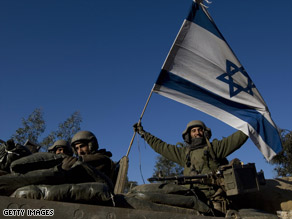
The Six Day War had ended. The generals assembled the commanders and foot soldiers for a customary review and analysis of the battle. After the military questions had been asked, and the investigative committee was about to disperse, a commanding officer pointed to one of the soldiers. "Wait a minute. I have a question for you. Yes, you, the soldier who put up the flag on the Temple Mount."

The soldier nodded.

"Where did you get an Israeli flag, and why did you put it up?"

The soldier spread out his hands and smiled, a gesture that indicated that here was more than just a one sentence response. He told the following story:

The night before the Old City was liberated, a contingent of soldiers fighting near the Old City took cover in a shelter in a Jerusalem neighborhood. Hordes of children, mothers, old men and women packed inside the bunker alongside the soldiers. People looked frightened and bereft. The government had imposed a news black-out so that the Arab countries wouldn't be able to figure out their positions. And the news -- originating from Jordan, Egypt and Syria -- was enough to induce hysteria: calls from Saudi King Faisal for the total elimination of Israel, calls from every Arab country to push the fledgling country into the sea.

Things looked so bad, Israelis famously converted public parks into mass graves, in preparation for the expected casualties. (Israel's Chief of Staff, Yitzchak Rabin, had even suffered a nervous breakdown.)

As the soldier sat there in the bunker, hopeless and uncertain, he saw an old woman slowly make her way over to him. "Excuse me," she said, standing at his side. She held a satchel in her arms.

He lifted his eyes. "Yes, Doda. Tell me, what is it?"

"Tomorrow you'll go to the Old City and you'll go to the Kotel."

He shook his head at the absurdity. He said, "No, we won't." There were no army plans to liberate the Old City. First, they were fighting just to hold their positions. Also, overtaking the Old City would entail hand-to-hand combat which was greatly feared: Many people would die. Moreover, any bombardment of the Old City might demolish even more of the holy sites than had already been destroyed by the Jordanians. He tried to explain all of this.

The old woman looked at him, steady-eyed. "No, you will go," she said, not as if she were trying to convince him, but as if relaying simple facts.

He shrugged. An old woman's delusions. He wasn't going to argue with her.

Before he turned away, she said, "I have a favor to ask you." She reached into her satchel and took out an Israeli flag. From the way she touched it, it was clear the flag had some personal meaning for her. Had she made it? Perhaps it had been draped over a loved one's grave? But what was she now saying? "When you go, please take this flag, and when you get to the Temple Mount, I want you to hang it up there." She held out the flag.

The soldier repeated, "We're not going into the Old City."

"You're going," she said. Again, she held out her arm.

A thought struck him. "I can't take it," he told her. "It's against army regulations."

"It'll be all right. Just take it."

"I'll get in trouble. You're only allowed to carry a few specified items."

Please," she said hoarsely. "Do me this favor."

He shrugged again. Why was he arguing with this old woman? Let him take the flag, let him make an old woman feel good. He could always get rid of it later.

The next day, the Israeli army, contrary to everyone's expectations, took the Old City. Sure enough, the soldier's unit ended up at the Temple Mount. As he and the other soldiers came close to the Western Wall, he suddenly remembered the flag and the old woman's words. Yes, he would do it, he would! He enlisted two buddies, and together they draped the flag over the grating on the upper left most side of the Kotel, and there they hoisted and hung the Israel flag.

The commanding officer conducting the investigation said to the soldier, "And what were you thinking when you put up that flag?"

The soldier said, "I was thinking that this was the answer to 2,000 years of Jewish suffering."

And so ends the story of the soldier, our hero.

But there's an unsung hero, too. What about the old woman who supplied the flag? One wishes the investigating officers had tracked her down. What did she have in mind as she entered a shelter with an Israeli flag in her satchel? And who was she, anyway? The only identifying feature is that she was old and carried a bag. But her advanced age already tells us plenty: that she knew something about Jewish history, probably having personally lived through it...World War I, Arab attacks, the Holocaust, the War of Independence, 1956. What hadn't she seen?

There, in Israel's darkest moment, outnumbered and surrounded by enemies, terrified that the next morning there will be no Israel, the old woman sees what no one else can see, what no one else is capable of conceiving. She insists on her vision, she practically browbeats the soldier into carrying out her plan. We'll never know how she knew, only that, like many Jewish women before her -- the Matriarchs, the midwives in Egypt, the righteous women in the desert -- she just knew. There are two kinds of prophecy. One that predicts the future, and one that makes the future.

taken from: For Zion's Sake

Related Posts Plugin for WordPress, Blogger...