Showing posts with label Peace Process. Show all posts

Wednesday, 5 May 2010

RubinReports: What Do the New Israel-Palestinian Indirect Talks Mean?

What Do the New Israel-Palestinian Indirect Talks Mean?

Please be subscriber 16,130. Just put your email address in the box on the upper right-hand corner of the page.

We depend on your contributions. To make one through PayPal click the Donate button on this page. For more options, including tax-deductible contributions, go HERE.


By Barry Rubin


The question of the day is whether the Israel-Palestinian Authority (PA) indirect talks will make progress in the "peace process" or result in failure. One wonders at this point how many naive people believe that peace is at hand, and how many misled people think that the lack of peace is Israel's fault.

What is needed to understand the issue is precisely what is not presented by policymakers, academics, and all-too-much of the mass media: The PA neither wants nor is capable of delivering a compromise peace agreement.

Radicalism within its ranks, in public opinion, and the ever-present challenge from Hamas ties the hands of leaders who are not so moderate themselves.

Belief that if they continue the struggle or keep saying "no" or subvert Western support for Israel they will get everything they want without giving up much is too tempting.

But can these specific talks at this specific time bring progress or failure?


Depends on what you mean by "progress"; depends on what you mean by "failure."


If one believes there will be a comprehensive peace agreement, then the result will be failure because the PA didn't want a comprehensive agreement to begin with, and both internal politics and intoxication in believing the Obama Administration will give them what they want is going to result in even more intransigence.


If the United States wants to impose a solution, the PA, sensing this will make sure the talks fail, have no incentive to make a deal. And any attempt after that by--let's be honest here--people who really don't understand the issues or how the region's politics work would bring disaster in the longer run.


If, however, one wisely uses the talks to reduce tension betwen the two sides and deal with more immediate problems that can be resolved--economic growth, security cooperation, ways to make the Palestinian Authority more stable politically, better for its people, and able to survive the Hamas challenge--the talks could be beneficial.

From an Obama Administration standpoint, if it takes a bow on its "great" work in getting indirect talks going (after its policy contributed to delaying them so long), it will be happy and find the talks beneficial for itself. It will also believe that the talks will soothe Muslims and Arabs, making its own policy task easier on other issues by getting Arab state support for, say, what the United States is doing with Iran sanctions or Iraq withdrawal or reducing terrorism against Americans. This is doubtful but it will make the administration, and perhaps its constituents, feel better.

If the talks become direct ones, then the world will rejoice, forgetting that this merely returns the situation to what existed--without great progress--in 2008. Indeed, direct Israel-Palestinian talks have been going on now for 17 years, with Israel offering a Palestinian state as an outcome of talks during that entire period, and offering the immediate opportunity for the Palestians to get a state with its capital in east Jerusalem and the equivalent of all the West Bank and Gaza Strip 10 years ago.

And, by the way, when will any Western mainstream media actually report what Israel wants in a peace settlement: security guarantees, dropping of all further Palestinian claims, a non-militarized state without foreign armies on its soil, resettlement of all Palestinian refugees in Palestine, and recognition of Israel as a Jewish state in response to recognition of Palestine as an Arab state? Might these things be just as relevant as Palestinian demands for a state, the dismantlement of Jewish settlements, and territorial demands?

Until Western leaders understand why there hasn't been progress and set their policies accordingly how could there be any real success in resolving this issue?


RubinReports: What Do the New Israel-Palestinian Indirect Talks Mean?

Tuesday, 16 March 2010

Love of the Land: This Land is Mined

This Land is Mined


Richard Fenandez
Belmont Club/Pajamas Media
14 March 2010

The recent exchange of testy words between Washington and Israel over the approval of new construction in East Jerusalem is ostensibly over the fate of the “peace process” now being shepherded by the US. VOA says that “for decades he United States has tried to act as a bridge between Israelis and Arabs. President Barack Obama, following in the footsteps of his predecessors, is looking for ways to end hostilities and bring about a long-elusive peace.”

The announcement of the East Jerusalem construction was said to have undermined Vice President Joe Biden’s diplomatic efforts. “This was supposed to be a period of heightened U.S. diplomacy in the Middle East, with U.S. envoy George Mitchell named as a go-between in indirect talks between Israelis and Palestinians, and Vice President Joe Biden making a high-profile trip this week to Jerusalem.” But what were the odds that Biden’s efforts were actually going anywhere? And if not, then why?

One line of thought is that peace is within reach if only Israel would give way. Andrew Sullivan, for example, lectured Prime Minister Netanyahu about Israel’s aggressive past. Did Netanyahu know, he asks, how much land the Jews have grabbed? Did Netanyahu slaver, he asks, at the prospect of an apartheid state? The Economist points out that Sullivan’s arguments are nonsense, but it too is willing to concede the principle that if Israel gave something back then peace might be attained. Israel must still give; the only question is how much. Tom Friedman also seems to think that Israel has missed the party by “driving around drunk.” Friedman wrote:

(Read full article)


Love of the Land: This Land is Mined

Thursday, 11 March 2010

Love of the Land: Peace Plans and Palestinian Politics

Peace Plans and Palestinian Politics


Rick Richman
Contentions/Commentary
10 March '10

Writing in the widely circulated Israeli newspaper Yisrael Hayom (“Israel Today”), Israeli journalist Dan Margalit reviews the prospects for the new peace process. The article is in Hebrew, but is summarized by the Israel Foreign Ministry:

The author recalls that in 2000, at Camp David, “Ehud Barak agreed to discuss the division of Jerusalem and the Palestinians fled the negotiations,” and adds that “In 2009, Ehud Olmert even offered to soften on the principle against ‘the right of return’ and again they fled.” The paper speculates that “In the current round, Israel is in a more complex position. Benjamin Netanyahu cannot offer Abu Mazen what came up in Ehud Olmert’s plan and if Ramallah rejected the previous move, what will it accept now?” The author notes that the Palestinians will, apparently, proffer a plan of their own in the hope that an Israeli rejection will draw the Obama administration to their side.


Presenting a plan they know Israel will not accept — to generate a condemnation of Israel for not accepting it – would be, in the weird world of the peace process, a step forward: at least the Palestinians would be proffering a plan. The last three times Israel offered the Palestinians a state – at Camp David, in the Clinton Parameters, and in the Olmert offer – the Palestinians rejected the offer without making a counterproposal.

If the process plays out as Margalit predicts, here is one way to determine the seriousness of the Palestinians’ plan: will they release it to their public before July 17? July 17 is the date set for local elections in the West Bank – coincidentally (or maybe not) a week after the four-month period the Palestinians have set for the new indirect talks.

(Read full post)


Love of the Land: Peace Plans and Palestinian Politics

Wednesday, 24 February 2010

Love of the Land: How Does Israel Survive?

How Does Israel Survive?


Jennifer Rubin
Contentions/Commentary
22 February '10

When others, from the safety of distant shores, contemplate what risks Israel should incur on behalf of innocents, or when others tut-tut the assassination of a terrorist, there is a tendency to dance around the central dilemma for the Jewish state—namely, that it is fighting against a “cult of death”:

How are the citizens of the Jewish State—for whom, as for all Jews, the essential (if difficult to fulfill) demand from God is Choose Life And Be Grateful For It; who’d desperately love to be sending their children off to grapple with literature, or physics, or even macramé after high school, but must send them off to grapple instead with an adversary that hides in hospitals and mosques and uses women and children as shields; who mourn as a nation every child of Israel killed in action; who cherish every drop of shed Jewish blood as if it were the living breathing person; whose enemies slosh through the blood of their own fallen brothers as if it were so much rain water—how are Israelis ever going to make peace with people whose death-worship is so wide and so deep that they’ve turned mothers—who’ve felt unborn life fluttering, hiccuping, kicking; and later the indescribable pleasure of the scent and feel of their babies heavy with sleep in their arms; the first enthralling toothless smiles; the first glorious infant belly laughs; heard the أمي, “Ommy!” for the first thrilling time; wiped away the first tears of hurt—into zombies who seek and celebrate the deaths of their own children?


When that asymmetry is resolved, there will be plenty of peace to process. Not before.

Love of the Land: How Does Israel Survive?

Tuesday, 26 January 2010

Love of the Land: The Good Old Days Before Peace

The Good Old Days Before Peace


Khaled Abu Toameh
Hudson New York
26 January '10

Many Jews and Arabs living in this part of the world really miss the good old days before the Middle East peace process began -- before Yasser Arafat and the PLO were brought to the West Bank and Gaza Strip after the signing of the Oslo Accords.

It is time to cry out loudly that this peace process has been nothing but a disaster for both peoples. Has anyone ever noticed that more Jews and Arabs have died since the signing of the Oslo Accords than during the period between 1967 and 1993?

This peace process, correctly dubbed by some as a “war process,” has failed; it is time to try something else.

Real peace between Palestinians and Jews cannot be achieved, at least not in the foreseeable future. The gap between the two sides remains as wide as ever and the two sides do not trust one another at all. Instead of talking about conflict resolution, we should go for conflict management , with good-will gestures from both parties.

(Read full article)

Love of the Land: The Good Old Days Before Peace

Saturday, 23 January 2010

Love of the Land: Masters and donkeys

Masters and donkeys


Sarah Honig
Another Tack/JPost
22 January '10

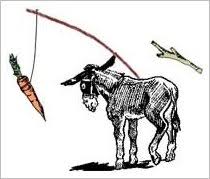
Consciously or otherwise, the carrot-or-stick motif conjures images of masters and the dumb donkeys they try to prod and move along. Those lucky enough to be in position to choose between inducing or punishing are obviously the power-wielding honchos.

Those to be tempted or whacked into submission are clearly the brutish troublesome beasts which must be disciplined - one way or another.

Therefore, when US President Barack Obama's special Mideast envoy fails to object to carrot-and-stick speak - and even bothers to specify one stick's characteristics - he implies that he's in charge, while we, threatened with a severe whack on the rump, are his asses.

So forget the nitty-gritty of George Mitchell's January 7 gibber-jabber in the PBS interview with Charlie Rose about withdrawing loan guarantees if we Israelis don't obey pronto. Plenty of ink has been spilled on whether this constituted a serious signal. The point has been honed that we don't desperately depend on said guarantees, that Israel repays all its debts dutifully and that it can get along just fine, thank you, without Washington's grudging favor.

That's almost the lesser issue.

(Read full article)


Love of the Land: Masters and donkeys

Wednesday, 30 December 2009

Love of the Land: Yehoram Gaon: Proposal for Peace

Yehoram Gaon: Proposal for Peace


Excerpted from Yehoram Gaon Marks 50 Years in Show Biz
by Hana Levi Julian
IsraelNN.com
29 December 09

In an interview with Arutz Sheva, Gaon observes that the current order to freeze Jewish construction in Judea and Samaria is not really feasible. “You cannot freeze settlements – it is impossible to freeze life,” he points out. “If a child is age three, you can’t tell him to stop growing because you want to ‘freeze’ him a few months. It was the state that also sent the settlers to live there [in those communities,],” he says. But he also notes that “on a practical level, I do not approve of angering the entire world. We’re not living alone [on this planet], and we depend on other countries as well.”

His proposal for peace, surprisingly, is to try something not tried before – do nothing. “I recommend something no one has ever done – and I know that unfortunately no one will ever do it. I suggest we take a break,” he says. “For 50 years, no negotiations, and we won’t conduct discussions with committees.

“During that timeout, we build ourselves. Look at how we are battered between ourselves, within our own society. If the Arabs try to attack us – fine. We already know how to protect ourselves, and we will manage.”

After the “break,” says Gaon, “we’ll see how the Arabs will treat us differently. Today, everything is about “now.” Everyone is saying ‘Peace NOW.’ It’s a problematic statement. You want everything now, without waiting. You have to understand that at the moment, there is no one to talk to.

“Sometimes I ask myself whether the hareidi-religious Jews aren’t right, when they argue that it was a mistake to go up to the [Temple Mount]. Maybe just as there are opinions that the Temple will come down from heaven, so too will peace also descend upon us from the sky,” he says hopefully.


Love of the Land: Yehoram Gaon: Proposal for Peace

Saturday, 19 December 2009

Love of the Land: Arab honour and the peace process

Arab honour and the peace process


Ted Belman
Israpundit
19 December 09

Arab honour is at the root of Arab rejectionism and intransigence. It prevents Arabs from accepting blame or compromising. It also prevents Arabs from losing land to Israel or ending the conflict.


Arab honour is closely linked to Islamic concepts of jihad and dhimmitude. Arab honour impells them to seek domination. Failure to dominate, dishonours them. Accepting responsibility is an anathema to their honour..


Muslim violence against the publication in Denmark of cartoons featuring Mohammed is a prime example of their refusal to accept the rule of law or western norms that are at odds with what their honour demands. The same goes for their reaction to Salman Rushdie’s Satanic Verses.

Prof Richard Landes covers this phenomenon in Part III of “Paradigms and the Middle East Conflict.” titled HJP: Honour Jihad paradigm

    “The HJP understands the Arab-Israeli conflict through the prism of honor-shame culture and Islamic jihad. These elements of Arab culture are the main factors that have made it impossible to reach a solution to the conflict. Arab leaders view any compromise with Israel as “losing face,” since such an agreement would mean recognizing as a “worthy foe” an inferior group that should be subject. Such a blow to Arab honor cannot be tolerated for cultural and political reasons: losing face means to feel utter humiliation, to lose public credibility, and to lose power.[..]

    “According to HSJP, the Arab-Israeli conflict is fueled by wounded Arab honor and frustrated religious imperialism.”

Denis Schulz on Honor and Islam writes

    “The less honor reposing in a person or a group, the more angry and violent the response to any challenge, real or imagined, by said person or group.”and “[..]

    ..those who have the least of it spend the most time defending it”.

The peace process, if not the existence of Israel itself, is closely tied to the necessitudes of Arab honour. The Arabs simply refuse to accept responsibility for the problem and therein lies the problem.
Using Shulz’s insight, the bigger the defeat, the greater the need to be fully vindicated.


(Continue article)


Love of the Land: Arab honour and the peace process

Saturday, 5 December 2009

RubinReports: On Israel's Construction Freeze: U.S. Fails to Deliver: Instead of Praising, Europe Demands More

On Israel's Construction Freeze: U.S. Fails to Deliver: Instead of Praising, Europe Demands More

[Please subscribe for more original news and analysis]

By Barry Rubin

Israel acceded to a U.S. request to freeze construction on existing Jewish settlements; the Palestinian Authority (PA) refuses even to negotiate or to give anything in exchange for this concession. Who did Europe reward and was the United States able to mobilize praise for the former or criticism for the latter?

Need you ask?

It is now confirmed that my analysis of the State Department statement on the construction freeze was correct. It was intended as a statement supporting key Israeli demands—recognition of Israel as a Jewish state and changes in the 1967 borders—while also meeting major Palestinian demands, an independent state based on those borders.

Equally unnoticed, however, is the fact that the United States did not even get its European allies to endorse its new position. Once again, despite all the Obama Administration's apologies, flattery, and concessions, it could not even obtain the smallest things in exchange from those given such rewards.

The main U.S. effort was to get the Quartet of mediators (U.S., Europe Union, Russia, and UN) to endorse the new U.S. stance. The proposed statement would have urged resumed negotiations without preconditions to seek an agreement which:

"would fulfill the Palestinian goal of establishing an independent, viable state, based on the 1967 borders, agreed upon exchanges [of territory], and the Israeli goal of a Jewish state with secure and recognized borders that reflect the developments [which occurred on the ground] and which fulfill the Israeli security requirements."

Reportedly, the Russians rejected the Jewish state and reflecting developments on the ground positions. This explains why the Quartet couldn’t issue a statement. But why didn’t the United States obtain the same statement from the European Union alone?

Instead, after making still another unilateral concession, Israel now has to fight off a hostile EU resolution calling for east Jerusalem to be capital of a Palestinian state without any mention of Israeli goals, including mention of west Jerusalem as Israel’s capital, an easy way of making the resolution more even-handed.

So once again Israel is given the message, here reinforced by inept U.S. diplomacy, that the reward for making a concession are demands to make more concessions. This is not, however, to underestimate the importance of the new U.S. position as expressed in Secretary of State Hillary Clinton’s statement. The question, of course, is how long and whether the Obama Administration will stick to its new set of promises.


RubinReports: On Israel's Construction Freeze: U.S. Fails to Deliver: Instead of Praising, Europe Demands More

Saturday, 21 November 2009

Love of the Land: Yad Vashem with an air force

Yad Vashem with an air force


Sarah Honig
"Another Tack"
JPost
19 November 09

One of this country's prominent professional talking heads, who also happens to be a longtime friend, opined in all earnestness when we met the other day that "the most pivotal recent political development" was Tom Friedman's op-ed in The New York Times (November 7) entitled "Call White House, ask for Barack." The broadcaster positively glowed and gloated. From his ultra-leftist standpoint this was a devastating blow to Binyamin Netanyahu and he lustily savored the triumph.

I had to confess my abysmal failure to be wowed. I gave Friedman's supposedly seminal column less than passing attention and couldn't see what the hoopla was about. Friedman is a veteran Jewish Israel-basher, whose career was constructed on his "personal crisis" of disillusionment with the Jewish state. Trashing Israel, after all, is his proven stock-in-trade. So what if Friedman figures there's "no romance, no sex, no excitement, no urgency" to our peace process, "not even a sense of importance anymore"? Big deal. Whoopty-do!

"The Americans are fed up with Bibi. They'll hang him out to dry and ditch the peace process," the media-hotshot retorted with noticeable exasperation.

"What peace process?" I snapped back. "It's a sham. There never was any process to achieve real coexistence, only a pretext to weaken Israel. Some 'useful-fool' Israelis play along for political expedience and others are intimidated to adopt the agenda," I argued. "Please let Washington quit trying to make us more vulnerable. By all means let them leave us alone."

That said, I wasn't optimistic: "It's too good to be true. What have we got to go on? Friedman? Since when does he call the shots?"

My influential colleague was flabbergasted: "Friedman reflects Obama's mood. This is a stern warning for us. At the very least Friedman will sway Obama and then we'll see where that gets us."

I ached to ask which side my famous interlocutor rooted for and whether he gave voice to left-wing wishful thinking, but I controlled myself.

(Read full article)

Love of the Land: Yad Vashem with an air force

Sunday, 15 November 2009

Love of the Land: Peace Process 101

Peace Process 101


Noah Pollak
Contentions/Commentary
14 November 09

In a new National Review piece, Elliott Abrams makes an important observation:

As a result [of Obama's Middle East policy], “world opinion” toward Israel has gone from cool to frigid — in Europe especially. U.N. actions such as the Goldstone Report are one manifestation of this; denunciations of Israel, not to mention efforts to prevent Israeli officials from speaking on campuses and indeed to jail them if they come to Europe, are others. The cause is clear: As the United States, Israel’s closest friend, has backed away from Israel since the Obama inauguration, Europeans have backed even farther. They have seen the American coolness as license, indeed encouragement, to excoriate the Jewish state, and have enthusiastically done so.

This could be called Peace Processing 101, and it is obviously a course nobody in the White House has taken. Israel is a small country surrounded by people who hate and continue trying to destroy her. If Israel is to make concessions or take risks for peace, Israelis must feel secure enough to do so. How is this accomplished? The main way is through the U.S.-Israeli relationship. The closeness of the two countries serves the U.S. strategic objective of compelling the Arabs to abandon their quest for eliminating the Jewish state, and it reduces Israel’s fear of taking risks for peace. This is one of the major factors that led to peace with Egypt and Jordan — not Israeli weakness and isolation, but the Arab perception of Israeli strength.

The paradigm described above is premised on the idea that the Arabs have been the major obstacle to peace in the region. But Obama has taken a new tack. His paradigm, which is to create, as he put it recently, “daylight” between the two countries, is premised on something else; not outright Israeli culpability but certainly a belief that Israel has been a major part of the problem.

Changing the paradigm has been a central objective of many liberals, and certainly of the J Street faction. Instead of achieving peace by assuring Israel of its security, the administration is trying to make peace by causing the Israelis to fear they will be abandoned by the United States if they don’t do the White House’s bidding.

But now we can compare the two paradigms: close alliance versus “daylight.” The latter is already a debacle after only a few months in practice. It is opening the global floodgates of Israel-obsessed criticism. It is making Israelis distrust the U.S. — a development that will translate into a democratic veto over concessions and the deleveraging of U.S. influence. It has forced the Palestinians to compete with the White House in hostility to Israel, humiliating Mahmoud Abbas when the administration chose to retreat. Even the existence of the peace process itself — much less actual peace — depends on Israel’s faith in the United States to help protect it from the maelstrom of condemnation that is the “international community’s” favorite hobby. The only question now is whether Professor Obama is capable of learning anything from the Middle East lesson he is being taught.


Love of the Land: Peace Process 101

Tuesday, 10 November 2009

Love of the Land: Benign Neglect for the Peace Process

Benign Neglect for the Peace Process


Noah Pollak
Contentions/Commentary
08 November 09

Thomas Friedman’s column today is utterly sensible and completely realistic.

The only thing driving the peace process today is inertia and diplomatic habit. …

Right now we want it more than the parties. They all have other priorities today. And by constantly injecting ourselves we’ve become their Novocain. We relieve all the political pain from the Arab and Israeli decision-makers by creating the impression in the minds of their publics that something serious is happening. “Look, the U.S. secretary of state is here. Look, she’s standing by my side. Look, I’m doing something important! Take our picture. Put it on the news. We’re on the verge of something really big and I am indispensable to it.” This enables the respective leaders to continue with their real priorities — which are all about holding power or pursuing ideological obsessions — while pretending to advance peace, without paying any political price.

Let’s just get out of the picture. Let all these leaders stand in front of their own people and tell them the truth: “My fellow citizens: Nothing is happening; nothing is going to happen. It’s just you and me and the problem we own.”

Let me be the first to congratulate Friedman on joining the ranks of us killjoy, spoilsport, wet-blanket neocons, who have been saying exactly this for years — and have been assailed for doing so by people like, oh, Tom Friedman. I recall writing a year ago that the peace process existed to “cater to the illusions of what has become a self-sustaining diplomatic, bureaucratic, and media industry.” It’s nice to have Friedman on our side.


Love of the Land: Benign Neglect for the Peace Process

Monday, 21 September 2009

Love of the Land: Peace Process or War Process?

Peace Process or War Process?


Daniel Pipes
Middle East Quarterly
Fall 2009

Dear Reader:

I have written over 300 pieces on the Arab-Israeli conflict and have been crafting the essay offered below for about a decade. At just over 2,500 words in length, it provides a distillation of my thinking on this topic.

When Barack Obama announced in June 2009 about Israeli-Palestinian diplomacy, "I'm confident that if we stick with it, having started early, that we can make some serious progress this year," he displayed a touching, if naïve optimism.

Indeed, his determination fits a well-established pattern of determination by politicians to "solve" the Arab-Israeli conflict; there were fourteen U.S. government initiatives just during the two George W. Bush administrations. Might this time be different? Will trying harder or being more clever end the conflict?

No, there is no chance whatever of this effort working.

Without looking at the specifics of the Obama approach — which are in themselves problematic — I shall argue three points: that past Israeli-Palestinian negotiations have failed; that their failure resulted from an Israeli illusion about avoiding war; and that Washington should urge Jerusalem to forego negotiations and return instead to its earlier and more successful policy of fighting for victory.

I. Reviewing the "Peace Process"


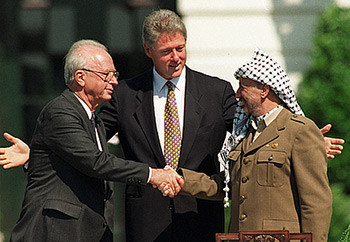
It is embarrassing to recall the elation and expectations that accompanied the signing of the Oslo accords in September 1993 when Israel's prime minister Yitzhak Rabin shook hands on the White House lawn with Yasir Arafat, the Palestinian leader. For some years afterward, "The Handshake" (as it was then capitalized) served as the symbol of brilliant diplomacy, whereby each side achieved what it most wanted: dignity and autonomy for the Palestinians, recognition and security for the Israelis.

President Bill Clinton hosted the ceremony and lauded the deal as a "great occasion of history." Secretary of State Warren Christopherconcluded that "the impossible is within our reach." Yasir Arafat called the signing an "historic event, inaugurating a new epoch." Israel's foreign minister Shimon Peres said one could see in it "the outline of peace in the Middle East."

The press displayed similar expectations. Anthony Lewis, a New York Times columnist, deemed the agreement "stunning" and "ingeniously built." Time magazine made Arafat and Rabin two of its "men of the year" for 1993. To cap it off, Arafat, Rabin, and Peres jointly won the Nobel Peace Prize for 1994.

As the accords led to a deterioration of conditions for Palestinians and Israelis, rather than the expected improvement, these heady anticipations quickly dissipated.

When Palestinians still lived under Israeli control, pre-Oslo accords, they had benefited from the rule of law and a growing economy, independent of international welfare. They enjoyed functioning schools and hospitals; they traveled without checkpoints and had free access to Israeli territory. They even founded several universities. Terrorism declined as acceptance of Israel increased. Oslo then brought Palestinians not peace and prosperity, but tyranny, failed institutions, poverty, corruption, a death cult, suicide factories, and Islamist radicalization. Yasir Arafat had promised to build his new dominion into a Middle Eastern Singapore, but the reality he ruled became a nightmare of dependence, inhumanity, and loathing, more akin to Liberia or the Congo.


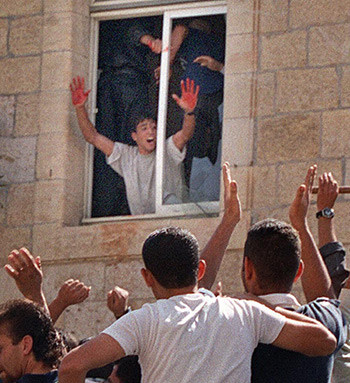
As for Israelis, they watched as Palestinian rage spiraled upward, inflicting unprecedented violence on them; theIsraeli Ministry of Foreign Affairs reports that more Israelis were killed by Palestinian terrorists in the five years after the Oslo accords than in the fifteen years preceding it. If the two hands in the Rabin-Arafat handshake symbolized Oslo's early hopes, the two bloody handsof a young Palestinian male who had just lynched Israeli reservists in Ramallah in October 2000 represented its dismal end. In addition, Oslo did great damage to Israel's standing internationally, resurrecting questions about the very existence of a sovereign Jewish state, especially on the Left, and spawning moral perversions such as the U.N. World Conference against Racism in Durban. From Israel's perspective, the seven years of Oslo diplomacy, 1993-2000, largely undid forty-five years of success in warfare.

Palestinians and Israelis agree on little, but with a near universality they concur that the Oslo accords failed. What is called the "peace process" should rather be called the "war process."

(Full Article)


Love of the Land: Peace Process or War Process?

Monday, 10 August 2009

Israel Matzav: The 'peace process' fundamental assumptions are invalid

The 'peace process' fundamental assumptions are invalid

This article is spot-on except for one small point: The fundamental assumptions behind the 'peace process' were never valid. Yasser Arafat never intended to compromise with Israel. He looked at the history of his organization from his first appearance at the UN in 1975 to the White House lawn in 1993 as proving that the PLO could get its way through the same combination of 'negotiations' and terror that it uses to this day. But other than that, this article is a fair statement of the situation.

The rejection of Olmert’s offer as well as previous offers by former Prime Minister Ehud Barak at Camp David (July 2000) and the Clinton parameters cast a heavy shadow of doubt over fundamental assumptions underlying the Oslo process. Two of these assumptions were:

Read All at :

Israel Matzav: The 'peace process' fundamental assumptions are invalid

Thursday, 23 July 2009

Israel Matzav: 'If 'Palestinians' continue to say no to everything there will not be a solution in 500 years' says...

'If 'Palestinians' continue to say no to everything there will not be a solution in 500 years' says...

... Sultan Abu Al-Einein, Leader of Fatah in Lebanon.

But there's more good stuff too, because he also says that it's unrealistic to expect Israel to take in '7,000,000 refugees.' No kidding.

Let's go to the videotape. A transcript will follow.

See All at :

Israel Matzav: 'If 'Palestinians' continue to say no to everything there will not be a solution in 500 years' says...

Friday, 3 July 2009

Israel Matzav: The 'peace process' is dead - Abu Mazen killed it

The 'peace process' is dead - Abu Mazen killed it

Yossi Alpher - who is definitely not a right-winger - laments that Abu Mazen's interview in the Washington Post in May has severely damaged the 'peace process.'

Every so often, a national leader makes statements in an interview that redefine his position on the world stage. Abbas appears to have done this. Abbas chose to interpret whatever statement of empathy Olmert made about the refugees--the effort the Israeli leader apparently undertook to offer the Palestinians some sort of psychological closure regarding the events of 1948--as acceptance of the right of return, while the Israeli prime minister understood he was saying the opposite and rejecting the right of return. Abbas looks at an offer of virtually the entire territory of the West Bank, internationalization of the disputed holy sites in Jerusalem and (according to him) the right of return, turns it down and says "the gaps were wide".

Read All at :

Israel Matzav: The 'peace process' is dead - Abu Mazen killed it

Sunday, 21 June 2009

Israel Matzav: Being honest with ourselves

Being honest with ourselves

This JPost article by Daniel Gordis should provide you all with some food for thought.

So let's be honest: What would we do?

Are we willing to leave the West Bank, land that is no less ancestrally Jewish and religiously significant than any other part of Israel? If we are committed to staying there permanently, for historical, theological or even security reasons, isn't it time just to say that? Or to annex it and stop pretending we haven't made that decision?

When some of us speak about not making any change until the Palestinians have built a genuinely democratic infrastructure (bottom-up, we call it), are we serious? Or do we simply assume that they'll never accomplish that under present circumstances, so what we're effectively doing is announcing, though not with the "honesty" that Obama is rightly calling for, that we plan to stay, no matter what?

Read All at :

Israel Matzav: Being honest with ourselves
Related Posts Plugin for WordPress, Blogger...