Showing posts with label Arab-Israeli Conflict. Show all posts

Saturday, 8 May 2010

Love of the Land: Either way, you’re dead!

Either way, you’re dead!

We can avoid Iranian nukes by opting for the Auschwitz borders or we can avoid the Auschwitz borders but be bullied by Iranian nukes.


Sarah Honig
Another Tack/JPost
07 May '10

Time to quit quibbling. No pedantic hairsplitting can mitigate the evidence: The Obama administration cynically links Iran to the Arab-Israeli conflict. The premise is simple and chilling. If Israel wants a last-minute, last-ditch, quasi-credible American move to keep Iran from obtaining nukes, it must pay the piper by making hefty concessions to the sham paraded as the Palestinian Authority. Boiled down to its bare essence, the White House diktat means that Israel can maybe extricate itself from existential Iranian threats by submitting itself to existential Iranian-proxy threats.

Had Barack Obama ever read Shalom Aleichem’s autobiography he’d have encountered the author’s harrowing recollection of the story his grandfather told him about “the bird-Jew.” That was how the grandfather referred to Noah, a pious innkeeper who lived in constant dread of the gentile village squire. Trembling, Noah headed for the manor to renew his lease. His timing was off, because the courtyard was full of festive guests ready to go hunting.

The squire, in a jovial mood, agreed to renew the lease if Noah would climb the stable roof and pretend to be a bird, so he could shoot him. Fearful of angering the nobleman, the worst consequence the Jew could imagine, Noah obsequiously did his bidding. He went up and, as ordered, bent forward, flung his arms sideways and assumed a birdlike pose. At that point the squire fired and Noah fell, as any slain bird would.

Although realizing he was about to be put to death anyway, the bird-Jew played along with his executioner, still absurdly terrified of what might happen if he didn’t. Obama is the proverbial squire in our own tale, casting Israel as the latter-day bird-Jew.

Israel is now squarely in Obama’s gun sights. It’s blamed for all Mideast ills. Obama, after all, is the high priest of the political theology of American/Western guilt. Israel embodies Western culpability. If Obama preaches American penance vis-à-vis Arabs/Muslims, Israel obviously must atone in more than words for the sins he ascribes to it.

(Read full article)

Love of the Land: Either way, you’re dead!

Thursday, 15 April 2010

Love of the Land: The Times Makes It Official: Obama Has Shifted U.S. Policy Against Israel

The Times Makes It Official: Obama Has Shifted U.S. Policy Against Israel


Jonathan Tobin
Contentions/Commentary
15 April '10

If there were any lingering doubts in the minds of Democrats who care about Israel that the president they helped elect has fundamentally altered American foreign policy to the Jewish state’s disadvantage, they are now gone. The New York Times officially proclaimed the administration’s changed attitude in a front-page story this morning that ought to send chills down the spine of anyone who believed Barack Obama when he pledged in 2008 that he would be a loyal friend of Israel.

In the view of the paper’s Washington correspondents, the moment that signaled what had already been apparent to anyone who was paying attention was the president’s declaration at a Tuesday news conference that resolving the Middle East conflict was “a vital national security interest of the United States.” Mr. Obama went on to state that the conflict is “costing us significantly in terms of blood and treasure,” thus attempting to draw a link between Israel’s attempts to defend itself with the safety of American troops who are fighting Islamist terrorists in Iraq and Afghanistan and elsewhere in the world. By claiming the Arab-Israeli conflict to be a “vital national security interest” that must be resolved, the “frustrated” Obama is making it clear that he will push hard to impose a solution on the parties.

The significance of this false argument is that it not only seeks to wrongly put the onus on Israel for the lack of a peace agreement but that it also now attempts to paint any Israeli refusal to accede to Obama’s demands as a betrayal in which a selfish Israel is stabbing America in the back. The response from Obama to this will be, the Times predicts, “tougher policies toward Israel,” since it is, in this view, ignoring America’s interests and even costing American lives.

(Read full post)


Love of the Land: The Times Makes It Official: Obama Has Shifted U.S. Policy Against Israel

Wednesday, 17 March 2010

Love of the Land: Jews still owed lion's share of lost property

Jews still owed lion's share of lost property


Bataween
Point of No Return
16 March '10

With thanks: bh

In 1948, Munir Katul, now a retired Oregon urologist, lost his house on what is now Rehov Graetz in the German colony in Jerusalem: his is a sad story of displacement resulting from the Arab-Israeli conflict, repeated many times over in the region. The Jerusalem Post waxes lyrical:

Before he left his one-story, stone house for the last time, he looked down at the Persian rug lining the formal living room where he had played with his brother, George, 18 days earlier, as his father, Jibrail, huddled over the console radio, listened to the UN General Assembly vote on the partition of Palestine.

As he walked from the now empty living room, across the colorful tile porch, and passed the green-shuttered windows to the waiting taxi, he studied the pine trees and green gardens around him in the German Colony.

He remembered how he loved to get lost in all that backyard greenery, with his best friend, Leila Itayyim. After school they played tag and hide-and-seek, built dirt castles, raced their pet turtles and helped hisfather tend the garden. He took one last look at his favorite tree, where he loved to hide high up in the branches to see everything without being seen, and wished he was sitting there instead of leaving.

Two aspects are striking about Munir's story: the first is that his Greek Orthodox parents and grandparents were born in Lebanon and came to Palestine because of the greater economic opportunities, thus giving the lie to the idea that Arabs have always lived in Palestine since 'time immemorial'. Munir's family fled back to Lebanon, yet the component of Munir's identity most important to him today is 'Palestinian'. Even today, aged 72, he chooses to line his hallway with photographs of the house on Rehov Graetz. Is this normal, or has Munir made a fetish of the 'wrong' Israel committed against him? It means that he can never feel at home anywhere else: he is not prepared to abandon his goal of repatriation to his old home in Jerusalem (although, to be fair, he also recognises this might be impractical):

Though it (Lebanon) was the land of his ancestors, everything seemed strange. The Arabic language and dress norms were the same. But below the surface, the customs and behaviors were slightly different. Life in the cosmopolitan city of Beirut was nothing like the warm, friendly, village environment that made Katul feel safe.

The other aspect is that Munir's father convinced himself that sooner or later his home would be caught up in a war zone, although his wife and his Jewish neighbours tried to persuade him to stay. We know that Arabs did choose to stay, and became Israeli citizens:

(Read full post)


Love of the Land: Jews still owed lion's share of lost property

Monday, 1 March 2010

Love of the Land: The Obama-American public Israeli disconnect

The Obama-American public Israeli disconnect


Yoram Ettinger
Op-Ed/JPost
27 February '10

A recent Gallop poll shows that Israel maintains its good standing with the US public, despite Obama’s ‘even-handed’ approach toward the Arab-Israeli conflict, his attempts to force Israel into sweeping concessions, and in defiance of the US media and academia.

The findings of the February 19, 2010 Gallup poll put President Barack Obama at odds with the US public, when it comes to attitudes toward the Jewish state, the Arab-Israeli conflict, Arabs, Muslims and Islamic terrorism.

For example, Israel maintains its traditional spot among the five most favored nations by 67 percent of the US public, despite Obama’s “even-handed” approach toward the Arab-Israeli conflict, in spite of his attempts to force Israel into sweeping concessions, and in defiance of the US “elite” media and academia.

On the other hand, the Palestinian Authority is ranked – along with Iran, North Korea and Afghanistan – at the bottom of the list, favored by only 20% of the US public.

According to an August 10, 2009 Rasmussen poll, Israel is ranked as the third most favorable ally (70%), preceded only by Canada and Britain. The low regard toward Egypt (39%) and Saudi Arabia (23%) demonstrates that Americans remain skeptical – at least since 9/11 – of Arabs and Muslims, even as these countries are portrayed by the media and the administration as supposedly moderate and pro-American.

Moreover, only 21% of adult Americans expect that the US relationship with the Muslim world will improve in a year, while 25% expect that it will get worse.

APPARENTLY, US public attitude towards Arabs and Muslims has hardly been impacted by Obama’s highly-publicized outreach to Muslims, as demonstrated by his speeches at Turkey’s National Assembly in April (“…the Islamic faith has done so much to shape the world, including my own country…”), at Cairo University in June (“Islam has always been a part of America’s story…”) and at the UN General assembly in September (“America has acted unilaterally, without regard for the interests of others…”).

(Read full article)


Love of the Land: The Obama-American public Israeli disconnect

Tuesday, 9 February 2010

Love of the Land: Rami Khouri alarmed at Knesset refugees bill

Rami Khouri alarmed at Knesset refugees bill


Bataween
Point of No Return
08 February '10

Reports that the Knesset is due shortly to pass a bill recognising the rights of Jewish refugees seem to have attracted little media coverage, still less comment. But one man has been sitting up and taking notice - the Palestinian commentator Rami G Khouri, writing in the Beirut Daily Star. This is what he has to say. My comment follows:

"The complexity of applying a single standard of law and morality to both sides – the critical foundation on which any successful diplomacy must proceed in the Palestinian-Israeli and wider Arab-Israeli conflict – was raised in the second development that caught my eye this week: a draft bill in the Israeli Parliament to compensate Jews who were forced out of or who fled Arab countries after the establishment of Israel in 1948.

"Among the arguments for the bill before the Immigration and Absorption Committee on Tuesday were references to a February 2008 US House of Representatives resolution saying that the United States should demand that Jewish refugees be acknowledged and treated in the same way as Palestinian refugees. The Israeli bill also demands compensation for Jewish communal properties, like synagogues and cemeteries.

"The prevalent Israeli aim in this bill is not to resolve all refugee cases fairly, but to claim that a “population exchange” between Palestinians and Jewish Israelis occurred in 1948. The point is to underline that the Palestinians have no more claims as refugees and, therefore, that there is nothing to be resolved.

(Read full article)

Love of the Land: Rami Khouri alarmed at Knesset refugees bill

Wednesday, 20 January 2010

Love of the Land: Ben Wedeman trying to undermine Israel on its Aid to Gaza: But even he has to admit…

Ben Wedeman trying to undermine Israel on its Aid to Gaza: But even he has to admit…


Richard Landes
Augean Stables
14 January '10

Here’s Ben Wedeman in the second week of the war commenting on Israel’s response to the humanitarian crisis in Gaza, by supplying Gazans with aid.

This is a particular gem of MSNM moral and intellectual confusion since his overall thrust is that Israel’s aid is a) just PR for show, b) pretty pathetic given that “ironically, their actually bombing the place,” and c) that no one’s impressed in Gaza since Israel’s to blame for the blockade in the first place. In the process of dismissing Israel’s effort, he makes an error which forces him to correct himself in mid-stream, which then leads him in another direction. The result: a revealing piece of euphemistic nonsense well worth savoring.


Well Israel has allowed a steady number of trucks coming with humanitarian goods uh into Gaza. This rather ironically as they’re actually bombing the place they’re sending food in as well. My understanding is 66 trucks went in today, so they do want to be at least seen as, as uh caring or providing or allowing others to provide humanitarian relief to the civilian population. Uh, but that sort of thing doesn’t necessarily go down very well, because it’s only Israel that controls the crossings, uh, into Gaza, with the exception of the one in Egypt and uh so, therefore if Israel were to cut off the supply altogether, uh, they would depend on Egypt and that’s not a good, uh, place to depend on.

(Read full article)

Love of the Land: Ben Wedeman trying to undermine Israel on its Aid to Gaza: But even he has to admit…

Sunday, 17 January 2010

Love of the Land: Blaming Jews (and Only Jews) for the Arab-Israeli Conflict

Blaming Jews (and Only Jews) for the Arab-Israeli Conflict


DVZ
CAMERA/Snapshots
15 January '10

Walter Brueggemann, a giant in the world of Old Testament theology and interpretation, has affirmed the notion that the Arab-Israeli conflict is solely the fault of the Jews.

Such an assertion will be met with disbelief from admirers his work which includes David’s Truth, his commentaries on Genesis, First and Second Samuel and Message of the Psalms.

Still the fact remains that in Brueggemann’s view, Jewish self-understanding can reasonably be regarded as the root cause of the fighting between Israel and its adversaries in the Middle East.

Brueggeman, an influential Protestant theologian, makes this perfectly clear in his forward to Mark Braverman’s newly released book Fatal Embrace: Christians, Jews, and the Search for Peace in the Holy Land (Synergy Books, 2010). After attesting to Braverman’s bona fides as a “passionate Jew with a long and deep love for Israel,” Brueggemann, writes:

(Read full article)


Love of the Land: Blaming Jews (and Only Jews) for the Arab-Israeli Conflict

Wednesday, 23 December 2009

Love of the Land: Other False Headlines Remain After Guardian Correction

Other False Headlines Remain After Guardian Correction


GI
CAMERA/
Snapshots
23 December 09

As noted below, the reliably anti-Israel Guardian has, to its credit, corrected a misleading headline about Israel, which it blamed on a "serious editing error."

While this is slightly encouraging news, it hardly suggests that the British newspaper is committed to keeping the record clear of outlandishly false headlines. Still unchanged, for example, is the following series of Guardian headlines about the Palestinian "Prisoners' Document":

• "Hamas performs about-turn on Israeli state; Document recognises Israel's right to exist" (6/21/06)
• "Climbdown as Hamas agrees to Israeli state" (6/22/06)
• "Hamas takes step to recognize Israel" (6/28/06)

These headlines are not only broadly false — ever since the Guardian trumpeted Hamas's "climbdown," the terror group has continued to repeatedly and explicitly make clear it does not accept a two-state solution or Israel's right to exist — but are also patently untrue in their more specific context. The "Prisoners Document" discussed in these articles does not "recognize Israel's right to exist," and when Hamas had signed onto the Document, it did not "agree to an Israeli state." This was apparent based on the text of the document itself, and also based on contemporaneous descriptions of the document by Hamas leaders.

It's unfortunately safe to expect that, with respect to the Arab-Israeli conflict, the newspaper we'll continue to see won't be the Guardian that corrected a distorted headline, but the Guardian that so frequently distorts the conflict, and the Guardian whose culture allows an editor to unblinkingly announce that "In Israel they murder each other a great deal" only because "they don't like their political style and what they've got to say."


Love of the Land: Other False Headlines Remain After Guardian Correction

Wednesday, 16 December 2009

Love of the Land: Gaza’s Blue Baby Syndrome and Brittain’s Bad Blood

Gaza’s Blue Baby Syndrome and Brittain’s Bad Blood


Gilead Ini
CAMERA Media Analyses
15 December 09


Victoria Brittain’s Dec. 9 column in the Guardian has all the elements that typify the newspaper’s simplistic, distorted accounts of the Arab-Israeli conflict. There are the innocent Palestinian victims and aggressive Israeli culprits; the falsehoods; the failure to consider any Palestinian responsibility for their state of affairs; and the brazen omission of information essential for understanding the situation.


The particulars of Brittain’s article, entitled "Who will save Gaza's children?," are especially dramatic. Gazan babies are being poisoned, and the antidote is as simple as one Israeli phone call, which, for no apparent reason, Israel refuses to make. In the columnist’s own words:


Among all the complex and long-term solutions being sought in Copenhagen for averting environmental catastrophe across the world, there is one place where the catastrophe has already happened, but could be immediately ameliorated with one simple political act.

In Gaza there is now no uncontaminated water; of the 40,000 or so newborn babies, at least half are at immediate risk of nitrate poisoning – incidence of "blue baby syndrome", methaemoglobinaemia, is exceptionally high; an unprecedented number of people have been exposed to nitrate poisoning over 10 years; in some places the nitrate content in water is 300 times World Health Organisation standards; the agricultural economy is dying from the contamination and salinated water; the underground aquifer is stressed to the point of collapse; and sewage and waste water flows into public spaces and the aquifer.

The blockade of Gaza has gone on for nearly four years, and the vital water and sanitation infrastructure went past creaking to virtual collapse during the three-week assault on the territory almost a year ago.

What would it take to start the two UN sewerage repair projects approved by Israel; a UN water and sanitation project, not yet approved; and two more UN internal sewage networks, not yet approved? Right now just one corner of the blockade could be lifted for these building materials and equipment to enter Gaza, to let water works begin and to give infant lives a chance. Just one telephone call from the Israeli defence ministry could do it – an early Christmas present to the UN staff on the ground who have been ready to act for months and have grown desperate on this front, as on so many others.


The most disturbing message of the column is 1) the assertion that there is a high incidence of methemoglobinemia or "blue baby syndrome" in the Gaza Strip, 2) the implication that this is a result of "the blockade of Gaza," and 3) the central premise that Israel is responsible for this public heath disaster because it refuses to make "just one telephone call" to allow building materials and equipment into Gaza, and thus"immediately ameliorate" the catastrophe.


If the first point is true, the latter two can only be described as an attempt by Brittain to sharply mislead readers.


(Read full article)


Love of the Land: Gaza’s Blue Baby Syndrome and Brittain’s Bad Blood

Sunday, 6 December 2009

Love of the Land: Why All the Excuses for Palestinian Intransigence Don’t Make Sense

Why All the Excuses for Palestinian Intransigence Don’t Make Sense


Barry Rubin
The Rubin Report
05 December 09

The Arab-Israeli, or Israel-Palestinian, conflict is the most misrepresented subject in the entire world. The most basic facts are often distorted and the most fantastical of narratives provided, even in college classrooms, about what has actually happened.

On the most single important issue in this framework—why isn’t there peace, who wants and doesn’t want peace, and how can peace be achieved—there is a common set of arguments against Israel. It goes like this:

How can the Palestinians make peace when they are suffering so much and when Israel builds settlements, or Israeli leaders make statements saying they want to keep some of the territory or won’t give up east Jerusalem, or do a variety of other things? The idea that the Palestinians don’t year for peace, are eagerly trying to make some kind of agreement, but are only stopped by Israeli intransigence seems completely self-evident to the point that any challenge of this idea is ridiculed, ignored, or treated as some kind of dishonest manipulation.

People think that when they've made these points it constitutes some kind of devastating, unanswerable rebuttal proving why there is no peace and why Israel is responsible. In fact, these statements are all either long outdated or simply beside the point.

In addition, many of the things said are factually wrong. Israel has neither constructed new settlements nor expanded their boundaries for fifteen years. But for the moment let’s leave aside the factual issues. It is easy to show that these claims are inaccurate but either ears are shut or the columns of the publications are closed to such responses.

Still, nothing could be simpler than to answer these claims.

Here’s the answer:

If the Palestinians are so miserable, they feel their situation intolerable, and want to get rid of settlements, they have and have had a very simple solution. Drum roll, please:

Make peace as fast as possible in a way that settles almost all their ostensible claims.

Yet they have refused to do so on numerous occasions going back for decades. In fact, this is the thirtieth anniversary of the Egypt-Israel agreement at Camp David which first opened the door to a Palestinian state. Then there was the Reagan plan and U.S.-PLO dialogue of the 1980s, followed by the peace process of the 1990s, the Camp David 2 and President Bill Clinton offers of 2000, and most recently the offer of Prime Minister Ehud Olmert (who was absolutely desperate for a deal in order to save his political career) and most recently the Israeli cabinet’s peace plan in which Prime Minister Benjamin Netanyahu explicitly agrees to accept a Palestinian state.

(Continue article)


Love of the Land: Why All the Excuses for Palestinian Intransigence Don’t Make Sense

Friday, 4 December 2009

Love of the Land: EU Opens the Door to More Mideast Violence

EU Opens the Door to More Mideast Violence


Eric Trager
EricTrager.org
02 December 09

Next week, European Union foreign ministers will meet to discuss a draft document that calls for a Palestinian state along the 1967 borders with East Jerusalem as its capital.

If approved, this resolution will mark the latest failure of President Barack Obama’s remarkably sloppy Middle East policy. After all, American leadership in brokering peace – or attempting to broker it – has been a cornerstone of international consensus regarding the Arab-Israeli conflict for over four decades. Even the Bush administration – which was routinely (and unfairly) lambasted for “waiting too long” to promote Israeli-Palestinian peace – managed to bolster American diplomatic preeminence in this sphere by drafting the Roadmap and assembling the “Quartet” as its sponsor. But with the EU breaking off from the Quartet and developing its own set of policies regarding the conflict, America’s leadership on this issue is severely in doubt.

It is worth emphasizing that Washington’s longtime involvement in managing the Middle East conflict is as much about showcasing American diplomatic strength as it is about minimizing violence between the two sides. For this reason, the sudden shift in the diplomatic environment is likely to have devastating results. With the EU recognizing Palestinian claims along the 1967 borders – including to lands on which Israeli settlements stand – it is giving Palestinian terrorist organizations the ultimate excuse for attacking. Essentially, these groups would argue that they are fighting to end the occupation of their now-internationally recognized state, and the newfound legitimacy of their violence would encourage it.

These developments – and the extent to which they anticipate renewed hostilities – should give pause to those who doubt the relevance of American primacy to preserving international order. President Obama is one of these doubters.


Love of the Land: EU Opens the Door to More Mideast Violence

Sunday, 15 November 2009

Love of the Land: What Happened at the mosque and inside Goldstone’s mind?

What Happened at the mosque and inside Goldstone’s mind?


Richard Landes
Augean Stables
15 November 09

Jonathan Dahoah Halevi, whose work on the evidence from OCL is extensive, has published some thoughts on the Al Maqadmah mosque case and the Goldstone Report’s handling of it. I add comments to bring out some of the more astonishing aspects of his argument.

What happened at mosque?
Jonathan Dahoah Halevi questions reliability of reports on Gaza mosque attack

Jonathan Dahoah Halevi
Published: 11.12.09, 17:21 / Israel Opinion

On November 5, 2009 there was a confrontation at Brandeis University in Massachusetts between the president of the Jerusalem Center for Public Affairs, Dr. Dore Gold, and Judge Richard Goldstone. It dealt, among other things, with the affair of the Maqadmah mosque in Beit Lahia in the northern Gaza Strip, about which two contradictory versions exist, that of Israel and that of the Goldstone Committee’s Report.

The Goldstone Report about Operation Cast Lead accuses Israel of an air strike on the mosque on January 3, 2009, which caused the deaths of “at least 15 Palestinians” who were in it at the time. During the confrontation with Dr. Gold, Goldstone claimed that 21 Palestinians had been killed, and he presented the attack as a salient example of Israel’s policy of deliberately targeting innocent civilians. However, Israel issued official documents stating that its Air Force did not attack the mosque and that the dead had been killed in fighting the IDF.

(more…)


Love of the Land: What Happened at the mosque and inside Goldstone’s mind?

Tuesday, 10 November 2009

Love of the Land: Covering the Disturbances on the Temple Mount: Insights into the Intimidation of Journalists

Covering the Disturbances on the Temple Mount: Insights into the Intimidation of Journalists


Augean Stables
Richard Landes
09 November 09

The following is an account written up by an Israeli journalist who feared for his life while covering the disturbances. S/he wants to remain anonymous for obvious reasons.


The following occurred on October 9, 2009, after a week of heightened tension in east Jerusalem and the Old City….


A group of reporters – myself included – had been covering a potential flashpoint in the Wadi Joz neighborhood of east Jerusalem, just opposite the Old City, on Friday morning, as hundreds of Muslim worshippers participated in a prayer session at the entrance to the neighborhood, meant to protest “Israeli aggressions” on the Temple Mount .


All ages of men from the neighborhood had come out into the street, and approached a police road block, which was meant to stop younger residents of the area from flocking to the Temple Mount for noon prayers, which were expected to be tense. Nonetheless, tension made its way to Wadi Joz as well, as scores of police in riot gear faced the the massive gathering of worshippers, who in turn listened to a fiery speech from their imam, as he spoke through a bullhorn.


But nothing happened. The prayers concluded, and worshippers loitered in the street momentarily before heading home. The tension in Wadi Joz eased.


Around the same time, my police beeper went off, notifying reporters that a number of young men in the Ras al-Amud neighborhood, next to the Mt. of Olives Cemetery, were throwing rocks at police officers and setting fire to piles of debris. A friend and I hopped into a cab and rushed up the hill from Wadi Joz (around the walls of the Old CIty) to Ras al-Amud, hoping to catch the story.


Upon arrival, the smell of burning trash was thick in the air, and a large Border Police presence was visible. But the main square of the neighborhood, which includes the local mosque, a few small grocery stores and vegetable stands, was quiet. A few people milled around, but, as we soon found out, the “action”, as it were, was down in the alleyways of the neighborhood.


So we made the descent, and almost immediately, saw a group of some six officers behind riot shields, being slammed with salvos of rocks. A group of young men, “shababs” as they’re called colloquially, were seen in the distance, their faces wrapped in t-shirts and keffiyehs, hurling the stones and other objects at the officers.


Now, for a reporter, this is certainly a story, and one in which every development can be used for “color” or extra detail in an article. And nothing beats being there, seeing it for yourself, and then relying on your own eyes and testimony to paint the re-paint the picture. So I ventured farther in, at first behind the police, but in the chaos that ensued, I soon found myself in the crossfire - between the officers and the rock-throwers. While I am not required to take pictures, I do bring a camera with me, and I found a “safe” place between two cars, and began to snap some shots.


The shababs soon noticed me, and while other press were in the area, I could tell that a few of them had begun looking at me strangely. Suddenly, one of them ran up to me, his face shrouded in a t-shirt, and he grabbed me by the straps of my backpack. “You’re an undercover cop!” he screamed in Arabic, a rock in his right hand as he grabbed onto me with his left.


“No, I’m a journalist!” I answered back, caught off guard at by the sudden jolt.

“No you’re not- you’re an undercover cop!” he screamed back. “Prove to me that you’re not an undercover cop!”


I reached into my pocket and pulled out my government-issued press card, thinking at the same moment that he would see the name of my publication, realize that it was an Israeli one, and my troubles would only grow. But as he was scanning the card, another journalist, an Arab photographer, approached the both of us, and told the young man in Arabic that I was in fact a journalist.

“Enough, let him go,” he told him. And the young man did as he said.

But as the shababs made their way past me - onward towards the officers - another Arab photographer, from an Arab news outlet, told me, “You should get out of here.”


I didn’t heed his advice – in truth, I found it insulting – but was more careful from that point on. At a later point during the day, another young shabab, his face also wrapped in a t-shirt, yelled at me from a balcony - “Are you a journalist or an undercover cop?”


(Continue reading...)


Love of the Land: Covering the Disturbances on the Temple Mount: Insights into the Intimidation of Journalists

Saturday, 17 October 2009

Love of the Land: Weekly Commentary: It's Not Always About Israel

Weekly Commentary: It's Not Always About Israel


Dr. Aaron Lerner
IMRA
15 October 09

We Israelis sometimes get so caught up in ourselves that we actually start to believe that we are the explanation for everything going on in our region.

And it simply isn't true.

Turkey isn't courting Syria and Iran because of Israeli construction in Ramat Eshkol. Turkey's moves are driven by a myriad of domestic, regional and global considerations.

Iran doesn't represent a threat to its neighbors -and beyond - because of its pronounced goal to bring about the destruction of the Jewish state. Iran's activities would constitute a clear and present danger even if Israel didn't exist.

Syria's destructive role in Lebanon is also not related to the Arab-Israeli conflict.

And the list goes on.

There are two important policy ramifications to this simple truth:

For Israel: When we weigh the risks associated with a given move, we have to take into consideration the possibility that changes may take place - through no fault of our own - that could make the move considerably more dangerous.

For the "West": Turning the screws on Israel to conclude a house-of-cards deal with the Palestinians so that the Arab-Israeli conflict can be [temporarily] removed from the diplomatic "do list" won't clear off the rest of the list of trouble spots.

Love of the Land: Weekly Commentary: It's Not Always About Israel

Thursday, 8 October 2009

Love of the Land: Jerusalem: 'We win, you lose'

Jerusalem: 'We win, you lose'


Gerald Steinberg
JPost/Opinion
07 October 09

Since the deadly 1929 riots, the struggle over Jerusalem has been at the core of the Arab-Israeli conflict, and, as recent events show, nothing has changed. For the Palestinians and their supporters, any Jewish presence in Jerusalem that is not under Arab control is not only unacceptable, but seen as threatening. And every ancient text, archeological find or property claim that validates the 3,000-year Jewish historical and religious heritage in this most sacred of cities, is angrily rejected as "Judaization." These allegations are used to promote and justify violent attacks, from rock-throwing to mass terror.

In the language of game theory, Jerusalem - more than any other dimension of this extremely complex conflict - has been and remains a zero-sum situation. This means any concessions from one side are necessarily victories for the other, making compromise not only difficult but inconceivable. In a zero-sum world, there is no room for different voices and opinions, and compromise based on acceptance of different perspectives is impossible. Thus, for the Arabs, recognition of the history and legitimacy of Jewish claims is a threat to their own narrative and legitimacy, particularly for the Muslims. Trapped in this social rubric, shared control based on mutual acceptance and recognition, as imagined in many peace programs, is impossible.

THE LATEST round of Arab violence in Jerusalem, fanned by competition for the prestige gained by the most extreme voices highlights the lack of movement on this core identity issue. For most Palestinians, and indeed, much of the surrounding Arab and Islamic world, there is absolutely no readiness to acknowledge even the most basic historical facts that would require compromise on Jerusalem.

In July 2000 at the Camp David summit, Yasser Arafat shocked and angered president Bill Clinton by rejecting any discussion of joint control over Jerusalem. Clinton and his advisers, who had been shepherding the Oslo negotiations for many years, should not have been surprised. Arafat's position reflected and reinforced the dominant view of most Arabs and Muslims.

Similarly, the efforts by NGO officials who claim to promote mutual acceptance and compromise on Jerusalem, and are funded by European governments, have sharpened the zero-sum framework. For example, political NGOs like Ir Amim only criticize Israel. The film Jerusalem Moments was described in The Jerusalem Post as an "incendiary Palestinian propaganda onslaught" and "an exercise in the bludgeoning documentation of Palestinian victimhood and of allegedly mindless Israeli cruelty and aggression."

For Palestinians, support from these Israeli NGOs is used to reinforce the zero-sum position, and reject compromise. (Ir Amim and similar political NGOs also address foreigners, including journalists and diplomats, and take groups on highly distorted "educational" tours of Jerusalem and the security barrier in the effort to press their positions.) By their nature, zero-sum situations are not confined to one side of the conflict; when one participant rejects all compromise, the others are forced into the same strategy. Thus, the Palestinian and Arab position that erases all Jewish links to Jerusalem leads to escalation of Jewish defensive moves, designed to prevent a return to the 1948-1967 situation of total exclusion and desecration.

For Jews, the total failure to implement the terms of the 1949 armistice agreement guaranteeing, on paper, free access to sacred sites, remains a traumatic memory. Between 1948 and 1967, when the Old City was under Arab occupation, the Jewish Quarter, including synagogues and cemeteries, was systematically desecrated, and the "international community" did nothing to enforce the agreement. Since then, the periodic waves of Arab violence in Jerusalem revive the concerns that agreements based on shared sovereignty or "international control" would lead to the same unacceptable situation. With no sign of movement towards a realistic compromise, Jewish Israelis worry that unless their presence in the city is strengthened, they will eventually be pushed out, yet again.

In the zero-sum cycle, the Jewish responses to this history and ongoing threats are denounced by the Palestinians and their supporters as more "occupation" and "Judaization" of Jerusalem. This feeds the escalating violence and reinforces the sense that there is no sense in talking, as no one is listening or willing to compromise.

TO MOVE towards even minimal mutual understanding that can contain and prevent outbreaks of violence, the first goal must be to open Palestinian and Arab society to hearing the Jewish version. This would allow for the transition from the zero-sum black-and-white conflict framework to what is known as a "win-win" framework, which allows for coexistence and equality, despite basic differences in narrative and ideology.

This is where the various would-be peacemakers and NGO funders, particularly from European governments, should put their money and focus their activities. As long as the Arab and Muslim position slams the door to block Jewish history, Jerusalem will remain a battleground in which the Jewish nation will have no choice but to use force when necessary to defends these rights.

The writer heads NGO Monitor and is on the political science faculty of Bar-Ilan University.

Love of the Land: Jerusalem: 'We win, you lose'

Monday, 21 September 2009

Love of the Land: Peace Process or War Process?

Peace Process or War Process?


Daniel Pipes
Middle East Quarterly
Fall 2009

Dear Reader:

I have written over 300 pieces on the Arab-Israeli conflict and have been crafting the essay offered below for about a decade. At just over 2,500 words in length, it provides a distillation of my thinking on this topic.

When Barack Obama announced in June 2009 about Israeli-Palestinian diplomacy, "I'm confident that if we stick with it, having started early, that we can make some serious progress this year," he displayed a touching, if naïve optimism.

Indeed, his determination fits a well-established pattern of determination by politicians to "solve" the Arab-Israeli conflict; there were fourteen U.S. government initiatives just during the two George W. Bush administrations. Might this time be different? Will trying harder or being more clever end the conflict?

No, there is no chance whatever of this effort working.

Without looking at the specifics of the Obama approach — which are in themselves problematic — I shall argue three points: that past Israeli-Palestinian negotiations have failed; that their failure resulted from an Israeli illusion about avoiding war; and that Washington should urge Jerusalem to forego negotiations and return instead to its earlier and more successful policy of fighting for victory.

I. Reviewing the "Peace Process"


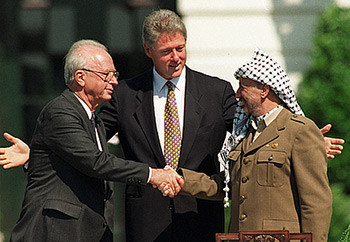
It is embarrassing to recall the elation and expectations that accompanied the signing of the Oslo accords in September 1993 when Israel's prime minister Yitzhak Rabin shook hands on the White House lawn with Yasir Arafat, the Palestinian leader. For some years afterward, "The Handshake" (as it was then capitalized) served as the symbol of brilliant diplomacy, whereby each side achieved what it most wanted: dignity and autonomy for the Palestinians, recognition and security for the Israelis.

President Bill Clinton hosted the ceremony and lauded the deal as a "great occasion of history." Secretary of State Warren Christopherconcluded that "the impossible is within our reach." Yasir Arafat called the signing an "historic event, inaugurating a new epoch." Israel's foreign minister Shimon Peres said one could see in it "the outline of peace in the Middle East."

The press displayed similar expectations. Anthony Lewis, a New York Times columnist, deemed the agreement "stunning" and "ingeniously built." Time magazine made Arafat and Rabin two of its "men of the year" for 1993. To cap it off, Arafat, Rabin, and Peres jointly won the Nobel Peace Prize for 1994.

As the accords led to a deterioration of conditions for Palestinians and Israelis, rather than the expected improvement, these heady anticipations quickly dissipated.

When Palestinians still lived under Israeli control, pre-Oslo accords, they had benefited from the rule of law and a growing economy, independent of international welfare. They enjoyed functioning schools and hospitals; they traveled without checkpoints and had free access to Israeli territory. They even founded several universities. Terrorism declined as acceptance of Israel increased. Oslo then brought Palestinians not peace and prosperity, but tyranny, failed institutions, poverty, corruption, a death cult, suicide factories, and Islamist radicalization. Yasir Arafat had promised to build his new dominion into a Middle Eastern Singapore, but the reality he ruled became a nightmare of dependence, inhumanity, and loathing, more akin to Liberia or the Congo.


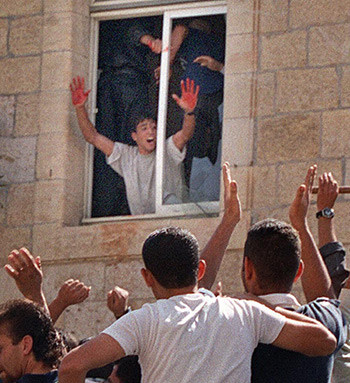
As for Israelis, they watched as Palestinian rage spiraled upward, inflicting unprecedented violence on them; theIsraeli Ministry of Foreign Affairs reports that more Israelis were killed by Palestinian terrorists in the five years after the Oslo accords than in the fifteen years preceding it. If the two hands in the Rabin-Arafat handshake symbolized Oslo's early hopes, the two bloody handsof a young Palestinian male who had just lynched Israeli reservists in Ramallah in October 2000 represented its dismal end. In addition, Oslo did great damage to Israel's standing internationally, resurrecting questions about the very existence of a sovereign Jewish state, especially on the Left, and spawning moral perversions such as the U.N. World Conference against Racism in Durban. From Israel's perspective, the seven years of Oslo diplomacy, 1993-2000, largely undid forty-five years of success in warfare.

Palestinians and Israelis agree on little, but with a near universality they concur that the Oslo accords failed. What is called the "peace process" should rather be called the "war process."

(Full Article)


Love of the Land: Peace Process or War Process?

Love of the Land: David Landau’s Criticism of Goldstone: Even the Self-Absorbed See a Problem

David Landau’s Criticism of Goldstone: Even the Self-Absorbed See a Problem


Richard Landes
Augean Stables
21 September 09

Even hyper-self-critic David Landau, whose astonishingly self-destructiive advice to Condaleeza Rice, I’ve discussed before, finds Goldstone unpalatable. And yet, he remains firmly inside his moral narcissism, obsessing over the four-dimensional Israeli soul, implicitly treating Gentiles as three-dimensional bit players, and the Palestinians as two dimensional cardboard figures whose moral angency does not even exist.Even for Goldstone, getting criticized by someone like Landau has to hurt. From fashlah to fadihah.

The Gaza Report’s Wasted Opportunity

By DAVID LANDAU
Published: September 19, 2009
JERUSALEM

ISRAEL intentionally went after civilians in Gaza — and wrapped its intention in lies.
That chilling — and misguided — accusation is the key conclusion of the United Nations investigation, led by Richard Goldstone, into the three-week war last winter. “While the Israeli government has sought to portray its operations as essentially a response to rocket attacks in the exercises of its right to self-defense,” the report said, “the mission considers the plan to have been directed, at least in part, at a different target: the people of Gaza as a whole.”

The report has produced a storm of outraged rejection in Israel. Politicians fulminate about double standards and anti-Semitism. Judge Goldstone, an eminent South African jurist and a Jew, is widely excoriated as an enemy of his people.

The report stunned even seasoned Israeli diplomats who expected no quarter from an inquiry set up by the United Nations Human Rights Council, which they believe to be deeply biased against Israel. They expected the military operation to be condemned as grossly disproportionate. They expected Israel to be lambasted for not taking sufficient care to avoid civilian casualties. But they never imagined that the report would accuse the Jewish state of intentionally aiming at civilians.

Israelis believe that their army did not deliberately kill the hundreds of Palestinian civilians, including children, who died during “Operation Cast Lead.” They believe, therefore, that Israel is not culpable, morally or criminally, for these civilian deaths, which were collateral to the true aim of the operation — killing Hamas gunmen.

It is, some would argue, a form of self-deception.

When does negligence become recklessness, and when does recklessness slip into wanton callousness, and then into deliberate disregard for innocent human life?

Note that we have yet to even reach the Palestinian starting point — target civilians deliberately… or, in short, terrorism. This simple observation, not on Landau’s radar screen because he doesn’t really think about Palestinians as human beings (i.e., moral agents), but only as victims (i.e., as innocent creatures), will become especially important in noting how the Goldstone Commission used the “T” wordonly to refer to Israel and never to refer to Hamas.

But that is the point — and it should have been the focus of the investigation. Judge Goldstone’s real mandate was, or should have been, to bring Israel to confront this fundamental question, a question inherent in the waging of war by all civilized societies against irregular armed groups.

“…that attack the civilized society’s civilians from within their own civilian population, making non-retaliation a recipe for further aggression and retaliation an excruciating moral dilemma.”

Are widespread civilian casualties inevitable when a modern army pounds terrorist targets in a heavily populated area with purportedly smart ordnance?

That, of course, depends on your definition of “widespread.” For the Sri Lankans, and their allies in the UNHRC, which commissioned Goldstone’s investigation, 20,000 civilians were a fair price to pay in order to wipe out the Tamil Tigers. Even by Palestinian figures — which are undoubtedly exaggerated — the Sri Lankan operation has “widespread” civilian casulties of an order of over 20 times the magnitude of Palestinian civilians.

Are they acceptable? Does the enemy’s deployment in the heart of the civilian area shift the line between right and wrong, in morality and in law?

Duh, yes. That’s the whole point; and according to the Geneva Convention, the civilian deaths are the fault of the military that hides among the civilians. The case for responsibility to the latter is further sharpened when the civilians among which the enemy army has hidden has voted in “democratic elections” for that army. But again, Landau poses the question as if it were answerable in the negative — “No, the enemy’s deployment does not shift the line [and allow attacks with civilian casualties].” For him, Hamas’ culpability does not even enter into the equation.

These were precisely the questions that Israeli politicians and generals wrestled with in Gaza, as others do today in Afghanistan.

Because the generals and politicians in Israel and the US live by principles that value human life even the lives of the enemy, and have free MSNM to keep them honest. They are, to a significant extent, self-policing, even when it harms them tactically (e.g., Abu Graibh).

It is possible, and certainly arguable, that the Israeli policymakers, or individual Israeli field commanders in isolated instances, pushed the line out too far.

But Judge Goldstone has thwarted any such honest debate — within Israel or concerning Israel. His fundamental premise, that the Israelis went after civilians, shut down the argument before it began.

This is regrettable, for the report could have stirred the conscience of the nation. Many Israelis were dismayed at the war’s casualty figures, at the disparity between the dozen deaths on the Israeli side and the thousand-plus deaths, many of them of noncombatants, in Gaza.

Many Israelis were profoundly troubled by this arithmetic even though they supported Israel’s resort to arms in the face of incessant violation of their sovereign border by Hamas’s rain of rockets.

Note three things:

  • 1) the “many” Israelis represent, by and large, the amazing shrinking Israeli left where Landau hangs out; many more Israelis felt it was an unfortunate but necessary move.
  • 2) they were profoundly troubled by the numbers, which are themselves, figments of PCHR operatives’ imaginationschanneled by NGOs and MSNM. Would they have been as troubled had the figures come — as they plausibly may — with a 3:1 combatant/civilian casualty rate, the best by far in the history of urban warfare?
  • because Israelis have such high standards, they are troubled by figures which still have them in the front ranks of armies fighting against terrorist armies hiding among civilians.

Landau can only gaze, obsessively, at his own navel, agonizing over every Palestinian casualty. He welcomes the UN commission’s harsh gaze, because it can “stir the conscience of the nation.” But he would be incapable of saying,

    Had the Commission investigated more carefully the behavior of Hamas, and they ways it deliberately sought to endanger its people, they might have stirred the conscience of the Gazans, who voted for them despite (or because of) their open claims to want war with Israel, and of Hamas, who would stand before the court of world opinion, shamed for their victimization of their own people and their hypocritical accusations against Israelis.


Love of the Land: David Landau’s Criticism of Goldstone: Even the Self-Absorbed See a Problem
Related Posts Plugin for WordPress, Blogger...