Showing posts with label Camp David. Show all posts

Monday, 8 March 2010

Love of the Land: The Green Prince Debunks a Big Media Myth

The Green Prince Debunks a Big Media Myth


Honest Reporting/Backspin
07 March '10

I'm very looking forward to reading Mosab Hassan Yousef's book, "Son of Hamas." Until I get my hands on a copy, I'm sufficing with interviews and reviews. The Wall St. Journal notes one important myth the "Green Prince" debunked.

Myth: The second intifada was a popular uprising sparked by Ariel Sharon's visit to the Temple Mount in September, 2000.

Fact: This WSJ snippet speaks for itself:


A few months before at Camp David, the late PLO chief Yasser Arafat had turned down the Israeli offer of statehood on 90% of the West Bank with East Jerusalem as the capital. According to Mr. Yousef, Arafat decided he needed another uprising to win back international attention. So he sought out Hamas's support through Sheikh Yousef, writes his son, who accompanied him to Arafat's compound. Those meetings took place before the Palestinian authorities found a pretext for the second Intifada. It came when future Prime Minister Ariel Sharon visited the Temple Mount in Jerusalem, site of the Al-Aqsa Mosque and the Dome of the Rock. Mr. Yousef's account helps to set straight the historical record that the uprising was premeditated by Arafat.


(Read full post plus video)


Love of the Land: The Green Prince Debunks a Big Media Myth

Saturday, 17 October 2009

Love of the Land: Peace vs. the 'peace process'

Peace vs. the 'peace process'

Jeff Jacoby
The Boston Globe
14 October 09

"WHOM THE GODS WOULD DESTROY," the late Irving Kristol once observed, "they first tempt to resolve the Arab-Israeli conflict." Maybe "destroy" was putting it a bit strongly, but there is no denying that American presidents seem irresistibly drawn to the belief that they can succeed where others have failed and conjure a lasting peace between Israel and its Arab enemies. This diplomacy has gone by various names -- Oslo, the Roadmap, Camp David, and so on -- but time and again it has led not to the end of the conflict but to its intensification.

In his memoirs, former President Bill Clinton describes Yasser Arafat's refusal to accept the extraordinarily generous terms for a permanent settlement offered by Israeli Prime Minister Ehud Barak at Camp David in 2000. That refusal led to a Palestinian terror war, the bloody Second Intifada, and when Arafat called Clinton in January 2001 to tell him what a great man he was, Clinton was bitter. "I am not a great man," he told Arafat. "I am a failure, and you have made me one."

Of course, if Clinton was a failure so were the two George Bushes. Each made it his goal to resolve the Arab-Israeli conflict, each convened a grand international conference for that purpose (Bush 41 in Madrid, Bush 43 in Annapolis), and each left the situation worse than he had found it.

In his first nine months as president, Barack Obama has shown every sign of succumbing to the same temptation. Two days after moving in to the White House, he named George Mitchell, the former Senate majority leader, his special envoy to the region. He pressured Israeli Prime Minister Benjamin Netanyahu intoendorsing a "two-state solution." He declared that "the moment is now for us to act" to achieve peace in the Middle East.

Unlike his recent predecessors, Obama has gone out of his way to signal a distinct coolness toward Israel and its interests. At a White House meeting with the leaders of American Jewish organizations in July, he suggested that because there had been "no daylight" between Israel and the United States when George W. Bush was president, there had been "no progress" toward peace.

In fact, there had often been "daylight" between Washington and Jerusalem during the Bush years. There had been plenty of movement too, from the adoption of the Roadmap to the Israeli "disengagement" from Gaza to the final-status negotiations that followed the Annapolis conference.

Still: Obama was right when he said there had been no progress toward Arab-Israeli peace under Bush. Nor had there been any under Clinton. Nor, as things stand now, will there be any under Obama.

Why? Because the "peace process" to which all of them, their sharp differences notwithstanding, have been so committed is not a formula for ending the decades-long war in the Holy Land, but for prolonging it.

Yitzhak Rabin and Yasser Arafat shake hands at the White House in September 1993, launching the Oslo "peace process." What resulted was not peace but an intensified war.

In an important article in the current Middle East Quarterly, Daniel Pipes reviews the terrible failure of the 1993 Oslo accords, and homes in on the root fallacy of the diplomatic approach it embodied: the belief that the Arab-Israeli war can "be concluded through goodwill, conciliation, mediation, flexibility, restraint, generosity, and compromise, topped off with signatures on official documents." For 16 years, Israeli governments, prodded by Washington, have sought to quench Palestinian hostility with concessions and gestures of goodwill. Yet peace today is more elusive than ever.

"Wars end not through goodwill but through victory," Pipes writes, defining victory as one side compelling the other to give up its war goals. Since 1948, the Arabs' goal has been the elimination of Israel; the Israelis', to win their neighbors' acceptance of a Jewish state in the Middle East. "If the conflict is to end, one side must lose and one side win," argues Pipes. "Either there will be no more Zionist state or it will be accepted by its neighbors."

Diplomacy cannot settle the Arab-Israeli conflict until the Palestinians abandon their anti-Israel rejectionism. US policy should be focused, therefore, on getting them to abandon it. The Palestinians must be put "on notice that benefits will flow to them only after they prove their acceptance of Israel. Until then -- no diplomacy, no discussion of final status, no recognition as a state, and certainly no financial aid or weapons."

So long as American and Israeli leaders remain committed to a fruitless Arab-Israeli "peace process," Arab-Israeli peace will remain unachievable. Let the newest Nobel peace laureate grasp and act upon that insight, and he may do more to genuinely hasten the conflict's end than any of his well-meaning predecessors.

(Jeff Jacoby is a columnist for The Boston Globe.


Love of the Land: Peace vs. the 'peace process'

Thursday, 8 October 2009

Love of the Land: Jerusalem: 'We win, you lose'

Jerusalem: 'We win, you lose'


Gerald Steinberg
JPost/Opinion
07 October 09

Since the deadly 1929 riots, the struggle over Jerusalem has been at the core of the Arab-Israeli conflict, and, as recent events show, nothing has changed. For the Palestinians and their supporters, any Jewish presence in Jerusalem that is not under Arab control is not only unacceptable, but seen as threatening. And every ancient text, archeological find or property claim that validates the 3,000-year Jewish historical and religious heritage in this most sacred of cities, is angrily rejected as "Judaization." These allegations are used to promote and justify violent attacks, from rock-throwing to mass terror.

In the language of game theory, Jerusalem - more than any other dimension of this extremely complex conflict - has been and remains a zero-sum situation. This means any concessions from one side are necessarily victories for the other, making compromise not only difficult but inconceivable. In a zero-sum world, there is no room for different voices and opinions, and compromise based on acceptance of different perspectives is impossible. Thus, for the Arabs, recognition of the history and legitimacy of Jewish claims is a threat to their own narrative and legitimacy, particularly for the Muslims. Trapped in this social rubric, shared control based on mutual acceptance and recognition, as imagined in many peace programs, is impossible.

THE LATEST round of Arab violence in Jerusalem, fanned by competition for the prestige gained by the most extreme voices highlights the lack of movement on this core identity issue. For most Palestinians, and indeed, much of the surrounding Arab and Islamic world, there is absolutely no readiness to acknowledge even the most basic historical facts that would require compromise on Jerusalem.

In July 2000 at the Camp David summit, Yasser Arafat shocked and angered president Bill Clinton by rejecting any discussion of joint control over Jerusalem. Clinton and his advisers, who had been shepherding the Oslo negotiations for many years, should not have been surprised. Arafat's position reflected and reinforced the dominant view of most Arabs and Muslims.

Similarly, the efforts by NGO officials who claim to promote mutual acceptance and compromise on Jerusalem, and are funded by European governments, have sharpened the zero-sum framework. For example, political NGOs like Ir Amim only criticize Israel. The film Jerusalem Moments was described in The Jerusalem Post as an "incendiary Palestinian propaganda onslaught" and "an exercise in the bludgeoning documentation of Palestinian victimhood and of allegedly mindless Israeli cruelty and aggression."

For Palestinians, support from these Israeli NGOs is used to reinforce the zero-sum position, and reject compromise. (Ir Amim and similar political NGOs also address foreigners, including journalists and diplomats, and take groups on highly distorted "educational" tours of Jerusalem and the security barrier in the effort to press their positions.) By their nature, zero-sum situations are not confined to one side of the conflict; when one participant rejects all compromise, the others are forced into the same strategy. Thus, the Palestinian and Arab position that erases all Jewish links to Jerusalem leads to escalation of Jewish defensive moves, designed to prevent a return to the 1948-1967 situation of total exclusion and desecration.

For Jews, the total failure to implement the terms of the 1949 armistice agreement guaranteeing, on paper, free access to sacred sites, remains a traumatic memory. Between 1948 and 1967, when the Old City was under Arab occupation, the Jewish Quarter, including synagogues and cemeteries, was systematically desecrated, and the "international community" did nothing to enforce the agreement. Since then, the periodic waves of Arab violence in Jerusalem revive the concerns that agreements based on shared sovereignty or "international control" would lead to the same unacceptable situation. With no sign of movement towards a realistic compromise, Jewish Israelis worry that unless their presence in the city is strengthened, they will eventually be pushed out, yet again.

In the zero-sum cycle, the Jewish responses to this history and ongoing threats are denounced by the Palestinians and their supporters as more "occupation" and "Judaization" of Jerusalem. This feeds the escalating violence and reinforces the sense that there is no sense in talking, as no one is listening or willing to compromise.

TO MOVE towards even minimal mutual understanding that can contain and prevent outbreaks of violence, the first goal must be to open Palestinian and Arab society to hearing the Jewish version. This would allow for the transition from the zero-sum black-and-white conflict framework to what is known as a "win-win" framework, which allows for coexistence and equality, despite basic differences in narrative and ideology.

This is where the various would-be peacemakers and NGO funders, particularly from European governments, should put their money and focus their activities. As long as the Arab and Muslim position slams the door to block Jewish history, Jerusalem will remain a battleground in which the Jewish nation will have no choice but to use force when necessary to defends these rights.

The writer heads NGO Monitor and is on the political science faculty of Bar-Ilan University.

Love of the Land: Jerusalem: 'We win, you lose'

Tuesday, 29 September 2009

Love of the Land: Camp David Syndrome

Camp David Syndrome


Ken Blackwell
The American Spectator
25 September 09

Readers who are familiar with the Stockholm Syndrome will recall that it refers to a hostage-taking 1973 incident in that Swedish capital city. Over time, the hostages began to look to their captors as friends and protectors rather than the murderous kidnapers that they truly were.

We are seeing something similar in what I call the Camp David Syndrome. President Obama has just announced the latest effort toward crafting a Middle East Peace Settlement. That grand-sounding title is Beltway-speak for "let's lean on Israel to gain some street cred with the Euros." He's chosen Hillary Clinton as his negotiator.
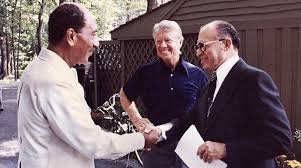
In 1978, Jimmy Carter brought Egypt's Anwar Sadat and Israel's Menachem Begin together to his mountain top presidential retreat in Maryland's beautiful Catoctin Mountains. There, over days of intense negotiation, Carter brokered what became known in diplomatic lore as the Camp David Accords. Under those agreements, Israel agreed to withdraw her forces from the Sinai Peninsula that she had seized in the lightning Six-Day War of 1967, and re-captured during the 1973 Yom Kippur War. That war had been launched by Egypt's Sadat -- showing the characteristic respect for other faiths that Muslims habitually show -- the Jewish High Holy Days of that year.

Carter hailed his achievement as something just shy of the Second Coming. It wasn't. Carter was led up to that mountain by growing problems on the plain below. Americans were becoming increasingly disenchanted with Jimmy's fecklessness on the domestic front. High interest rates made home ownership impossible for young couples, long gas lines frayed nerves, and rising unemployment made everyone edgy. But Carter felt that success on the international scene could bring him and his embattled party some goodwill from American voters.

It didn't. Barely six weeks after the media hullabaloo over the Camp David Accords, voters trooped to the polls and spanked Carter's party. Between 1978 and 1980, voters gave Republicans 46 seats in the House of Representatives, five more seats than the GOP had lost in the watershed post-Watergate election of 1974.

Still, the myth persists that a Middle East peace agreement will translate into electoral success at home. Carter proved to be a one-trick pony. He received a sharp kick from voters in 1980. They put the pony permanently out to pasture.

What Carter achieved at Camp David is not replicable today. That's because the Israelis in 1978 did not want to occupy Sinai. They agreed that it did not materially contribute to their security. (Israel's Prime Minister Golda Meir used to joke that the Almighty had led the Children of Abraham out of bondage in Egypt, called them to wander for forty years, and told them to settle on the only piece of real estate in the Middle East that has no oil!)

So Carter's fabled diplomacy was not really necessary to persuade the Israelis to disgorge territory that had never been Israeli and that they did not really want. And President Anwar Sadat had a firm grip over Egypt, which one Egyptian diplomat described as the only real nation in the Arab world. "The rest are just tribes with flags," that Arab diplomat memorably said. Besides, Sadat needed money. And the U.S. was ready to purchase a peace.

Despite the fact that Jimmy Carter got a shellacking at the polls in 1978 and 1980, Presidents persist in pursuing the brass ring, or an elusive Nobel Prize, for brokering a Mideast Peace Settlement.

Bill Clinton tried it in 2000. He was playing out an exhausted presidency, grasping for straws. He summoned Israeli Prime Minister Ehud Barak and the "reformed" terrorist leader, Yassir Arafat, to the U.S. He tried to arrange another Camp David breakthrough. Barak made extraordinary concessions, even dangerous ones. No dice. Arafat fomented a second "intifada" against Israel. Clinton's party lost the next Presidential Election.

Then, there was the 2007 Annapolis Conference on Mideast Peace. President George W. Bush chose that week after Thanksgiving to bring a wide range of Arab and Israeli negotiators to the U.S. Naval Academy's historic Yard. Some of the Arab delegates refused to enter the same doorway as the Israelis had entered. Some peace talks. The best we can say for this effort is that it could have been worse. It might have lasted two days instead of just one. And Bush's party lost the next Presidential Election.

What was considered historic about the Annapolis Conference is that for the first time all parties agreed to a "two-state solution." Did the Arab delegates who attended, the ones who refused to enter the same doorway as the Israelis, agree that Israel would be one of those two states? Don't ask.

What we have yet to hear is why the U.S. should want a Palestinian state to be formed in the Mideast. When the Israelis evacuated from Gaza and the local residents held elections, they promptly voted in Hamas, the terrorist organization. Hamas supporters stormed the residence of the late Yassir Arafat and stole his Nobel "Peace" Prize. Now, there's poetic justice.

On the West Bank, Arafat's loyal lieutenant, Abu Abbas, maintains a precarious perch. The U.S. is giving $900 million in aid to his so-called Authority for allegedly humanitarian purposes. This is where bombers use ambulances to run rockets to and from Palestinian hospitals and where children dance in mock explosive belts before PTA meetings in schools named for suicide bombers. This is what we want more of? For Peace's sake? For Pete's sake!

I was amazed to see President Obama come on TV so soon to call for a Mideast breakthrough. I didn't think he was in that much trouble on the domestic front already.
Ken Blackwell is a former U.S. ambassador to the United Nations Human Rights Commission and a senior fellow at the Family Research Council.

Love of the Land: Camp David Syndrome
Related Posts Plugin for WordPress, Blogger...