Showing posts with label Mahmoud Abbas. Show all posts

Wednesday, 18 May 2011

Love of the Land: Abbas demands something for nothing

Abbas demands something for nothing


Fresnozionism.org
17 May '11

http://fresnozionism.org/2011/05/abbas-demands-something-for-nothing/


As we get closer to September and a unilateral declaration of Palestinian statehood, Mahmoud Abbas has taken the opportunity to explain why he thinks justice requires yet another slice to be taken from the only Jewish state and given to his amalgamation of two vicious terrorist organizations. After Hamas has told us that even total Israeli withdrawal to 1949 lines won’t bring peace, Abbas explains here that this is his position as well.

The Abbas piece is remarkable for its distortions of the historical record, including the heart-wrenching account of how a little boy who would grow up to be Palestinian President was ‘expelled’ from Tzfat (see also here for a version of the article with lies replaced by truth).

One of the biggest lies Abbas tells is that the Palestinian Arabs should have had a state in 1947, but implementation of the UN partition agreement was derailed by the Zionists. He writes,


In November 1947, the General Assembly made its recommendation and answered in the affirmative. Shortly thereafter, Zionist forces expelled Palestinian Arabs to ensure a decisive Jewish majority in the future state of Israel, and Arab armies intervened. War and further expulsions ensued…


Minutes after the State of Israel was established on May 14, 1948, the United States granted it recognition. Our Palestinian state, however, remains a promise unfulfilled.


Abbas does not tell us that both the Palestinian Arab leadership and the rest of the Arab world rejected partition on the grounds that all of Palestine should be under Arab sovereignty. He does not tell us that the Palestinian Arabs have rejected offers of a state no less than six times between 1937 and 2008 (and once in 1919).

So why, if they did not want a state until now, will this time be different? Because this time they think they will be able to gain control over a large, strategic territory without having to commit to recognition of Israel, and without having to give up their claim on the rest of the land, in particular, the right to settle millions of Arab ‘refugees’ in Israel.

Israel would never agree to cede territory in return for a promise of belligerency, and — at least so far — the US has not tried to force it to do so. As a result, negotiations between Israel and the PLO have always failed. Abbas may say that “negotiations remain our first option,” but the PLO has only been prepared to negotiate surrender, not compromise. And no matter what concessions Israel has offered, they have not included giving up its right to exist.

Abbas believes that after the world makes Israel leave the territories, it can make Israel sit still and accept the return of the so-called ‘refugees’ (95% of whom are not refugees in any normal sense), and — probably after a bloody war — become another Arab state:


Palestine’s admission to the United Nations would pave the way for the internationalization of the conflict as a legal matter, not only a political one. It would also pave the way for us to pursue claims against Israel at the United Nations, human rights treaty bodies and the International Court of Justice …


… Once admitted to the United Nations, our state stands ready to negotiate all core issues of the conflict with Israel. A key focus of negotiations will be reaching a just solution for Palestinian refugees based on Resolution 194, which the General Assembly passed in 1948.


The Arab interpretation of resolution 194 is that every descendant of the 600,000 Arabs that fled Israel in 1948 (about 4.5 million claim this status) is entitled to ‘return’ to Israel and take possession of his property, or be compensated. This wasn’t the intent of the resolution, which referred only to actual refugees and required that they be prepared to ‘live in peace’ with Jewish Israelis. And it would also cover the approximately 850,000 Jewish refugees from Arab countries, who most likely wouldn’t want to return but would be happy for compensation!

Since 1967 the presumption of the West has been that land will be exchanged for peace, recognition and an end of all claims against Israel. The Abbas plan finally makes explicit what some of us have been saying all along, that the PLO never intended to give up its dream of replacing Israel with an Arab state of ‘Palestine’.

It’s time for the White House to recognize this and firmly oppose the attempt to give the PLO something for nothing.

If you enjoy "Love of the Land", please be a subscriber. Just put your email address in the "Subscribe" box on the upper right-hand corner of the page.

Love of the Land: Abbas demands something for nothing

Tuesday, 17 May 2011

Israel Matzav: The Long Overdue Palestinian State

The Long Overdue Palestinian State


Sixty three years ago, a 13-year-old Palestinian boy left his home in the Galilean city of Safed. His was a family of means. He studied in elementary school, and then came the naqba [calamity, namely, the founding of the State of Israel - ed.]. At night, his family left by foot from Tzfat, to the Jordan River, where they remained for a month. Then they went to Damascus, and then to their relatives in Jordan, and then they settled in Damascus. That child's story, like that of so many other Palestinians, is mine.

Continue reading here.

Note: This post is a rewrite of Abu Mazen's article in the New York Times (Hat Tip: Memeorandum).


Israel Matzav: The Long Overdue Palestinian State

Friday, 12 March 2010

Love of the Land: There is a reason Israel doesn't roll over when Mahmoud Abbas bats his eyelashes

There is a reason Israel doesn't roll over when Mahmoud Abbas bats his eyelashes


Stephanie Gutmann
Telegraph.co.uk
11 March '10

Like many of my friends in Israel I am still scratching my head over the announcement by Israeli Interior Minister Eli Yishai that he will grant construction permits in contested East Jerusalem — just as Vice President Biden swanned into town to play Big White Peace Broker between Israel and the Palestinian Authority.

The announcement seems to have temporarily sabotaged talks that Biden was eager to set up… now, chop-chop (Air Force Two is idling on the runway for goodness sake!) and he has reacted in his characteristic over-the-top way, by saying that the lack of an agreement over Palestine, is “endangering US troops in Iraq and Afghanistan.”

Oh please. Like what’s really irking the Taliban and Al-Qaeda is the placement of borders over in Palestine. If there was a “final status agreement” everybody would settle down and take up crocheting. The VP’s comment reveals some profound confusion about how the region works.

Almost everyone — Israeli and Palestinian alike — admits in private that with Hamas busy stock-piling Iranian weapons and tightening its law enforcement and Sharia noose on the citizens of the Gaza Strip, there was little chance either side’s leader, Mahmoud Abbas or Bibi Netanyahu, would commit to terms that change the status quo significantly. Both, in their own way, are quite preoccupied with very large existential threats. Whether a border is moved a few miles to the east or west seems quite trivial. A permanent status agreement is merely a trophy the Obama-ites would like to hang on their wall. Both leaders, to a certain extent, will help their friends in the US keep the office walls looking perky, even though those ever-waffling American friends are increasingly less useful to either side.

(Read full article)


Love of the Land: There is a reason Israel doesn't roll over when Mahmoud Abbas bats his eyelashes

Thursday, 11 March 2010

Love of the Land: A Lesson for the Future in Abbas’s Retreat on Refusing to Talk

A Lesson for the Future in Abbas’s Retreat on Refusing to Talk


Evelyn Gordon
Contentions/Commentary
10 March '10

That Israel and the Palestinians, after 16 years of direct talks, are now back to indirect talks is an undeniable retreat. But in a must-read analysis, the Jerusalem Post’s diplomatic correspondent, Herb Keinon, points out that this may nevertheless be one of the most hopeful moments of the entire peace process — because for the first time, “the Palestinians gave in on something.”

“Israelis, Palestinians and the world have become accustomed to Israel setting red lines, and then moving them,” Keinon wrote. “The Palestinians, on the other hand, have set a track record of saying what they mean.” For instance, they have never budged from their demand for “all of east Jerusalem, including the Old City,” or for “the right of Palestinian refugees to return to Israel proper.”

But after months of proclaiming that he would not resume talks with Israel without a complete freeze on Israeli construction in both the West Bank and East Jerusalem, Palestinian Authority President Mahmoud Abbas has backed down. And this offers a crucial lesson for the future.

“The reason Abbas was willing to move his red line was because he came under intense pressure from the US, certain elements inside the EU, and from Arab states such as Egypt and Jordan to start talks, even though all his conditions were not met,” Keinon noted. “The valuable lesson here: The Palestinians, too, and not only Israel, are susceptible to pressure.”

(Read full post)


Love of the Land: A Lesson for the Future in Abbas’s Retreat on Refusing to Talk

Tuesday, 2 March 2010

Love of the Land: Palestinian Authority: Direct the Heat Toward Israel

Palestinian Authority: Direct the Heat Toward Israel


Khaled Abu Toameh
Hudson New York
02 March '10

The Palestinian Authority is once again trying to divert attention from its problems at home, and the best way to do this is being escalating tensions with Israel - the Palestinian Authority’s policy since its inception after signing the Oslo Peace Accords in 1993.

To distract attention from charges of financial corruption and embarrassing sexual scandals, the Palestinian leadership in the West Bank has stepped up its anti-Israel rhetoric. Allegations of “ethnic cleansing,” “destruction and desecration of Islamic religious sites,” “apartheid,” “racism,” “land theft” and “conducting medical experiments on Palestinian prisoners” are directed every day toward Israel by Abbas and his top officials and spokesmen.

These charges are often backed up by threats to launch a “third intifada” or to resume suicide bombings against Israel.

Given Abbas’s growing predicament, the likelihood of a new wave of violence in the West Bank or the Gaza Strip seems to be more realistic than ever.

Yasser Arafat was the first to employ this policy to divert attention from the fact that his regime was stealing hundreds of millions of dollars of international aid to the Palestinians. Almost each time that the issue of financial corruption and bad government was raised, Arafat and his aides would step their rhetorical attacks on Israel under various pretexts. The incitement, which in the beginning led to periodic outbursts of violence against Israelis, finally saw the eruption of the second intifada. Now Mahmoud Abbas and his administration in the West Bank are employing the same policy.

In recent months, Abbas has been facing growing criticism from many Palestinians who, on the one hand accuse him of turning a blind eye to corruption in the Palestinian Authority and, on the other hand, denounce him as a “puppet” in the hands of Israel and the US.

(Read full article)


Love of the Land: Palestinian Authority: Direct the Heat Toward Israel

Wednesday, 24 February 2010

Love of the Land: BBC and New York Times Omit Coverage of Palestinian Corruption Story

BBC and New York Times Omit Coverage of Palestinian Corruption Story


Steve Stotsky
CAMERA Media Analysis
23 February '10

The Jerusalem Post has published a series of articles relaying accusations by the former head of the Palestinian Authority’s anti-corruption department, Fahmi Shabaneh, that close associates of Palestinian President Mahmoud Abbas engaged in embezzlement, land theft and fraud. According to Post correspondent Khalid Abu Toameh, Shabaneh possesses numerous documents exposing the theft of government money, much of which comes from foreign donations.

These revelations are only part of the story. An equally troubling aspect of this scandal is the accusation by Shabaneh that he offered his information to foreign journalists and they refused it for fear of offending the Palestinian government. According to the Jerusalem Post story on Feb. 11, 2010, Shabaneh claims he

decided to talk to the Post after Palestinian, Arab and foreign media organizations refused to interview him out of fear of being "punished" by the PA. Shabaneh explained further, "Al-Jazeera and other Arab media outlets told me that they are afraid to publish anything that angers the Palestinian Authority."


Unfortunately, the Arab media is not free to publish what they would like, but the same excuse does not apply to Western journalists. The Jerusalem Post report continues,

Shabaneh said that even some foreign journalists based in the country had refused to publish his statements, citing various pretexts, including fear of retribution by the PA.

"Some of the foreign journalists don’t want to hear negative things about Fatah and Abbas," he said. "That’s why they didn’t want to cooperate with me and why I decided to go to the Post."


Even after the story broke on Jan. 29, 2010, there was nearly total silence about Shabaneh’s accusations. A search of major publications indicates the National Post of Canada was the only western print media to cover the story for nearly two weeks after the Jerusalem Post published the revelations.

(Read full article)

Love of the Land: BBC and New York Times Omit Coverage of Palestinian Corruption Story

Saturday, 20 February 2010

Love of the Land: The Fatah fairy tale

The Fatah fairy tale

Israel's is the only government that can force the rest of the world to recognize that Abbas is not an ally.


Caroline Glick
Column One
20 February '10

Fahmi Shabaneh is an odd candidate for dissident status. Shabaneh is a Jerusalemite who joined the Palestinian Authority’s General Intelligence Service in 1994.

Working for PA head Mahmoud Abbas and GIS commander Tawfik Tirawi, Shabaneh was tasked with investigating Arab Jerusalemites suspected of selling land to Jews. Such sales are a capital offense in the PA. Since 1994 scores of Arabs have been the victims of extrajudicial executions after having been fingered by the likes of Shabaneh.

A few years ago, Abbas and Tirawi gave Shabaneh a new assignment. They put him in charge of a unit responsible for investigating corrupt activities carried out by PA officials. They probably assumed a team player like Shabaneh understood what he was supposed to do.

Just as Abbas’s predecessor, Yasser Arafat, reportedly had full dossiers on all of his underlings and used damning information to keep them loyal to him, so Abbas probably believed that Shabaneh’s information was his to use or ignore as he saw fit.

For a while, Abbas’s faith was well-placed. Shabaneh collected massive amounts of information on senior PA officials detailing their illegal activities. These activities included the theft of hundreds of millions of dollars in international aid; illegal seizure of land and homes; and monetary and sexual extortion of their fellow Palestinians.

Over time, Shabaneh became disillusioned with his boss. Abbas appointed him to his job around the time he was elected PA head in 2005. Abbas ran on an anti-corruption platform. Shabaneh’s information demonstrated that Abbas presided over a criminal syndicate posing as a government. And yet rather than arrest his corrupt, criminal associates, Abbas promoted them.

Abbas continued promoting his corrupt colleagues even after Hamas’s 2006 electoral victory. That win owed to a significant degree to the widespread public revulsion with Fatah’s rampant corruption.

(Read full article)


Love of the Land: The Fatah fairy tale

Love of the Land: Citizen Mahmoud Abbas

Citizen Mahmoud Abbas


Michael Freund
Opinion/JPost
17 February '10
Posted before Shabbat

This past Monday, Foreign Minister Avigdor Lieberman raised an interesting point about Mahmoud Abbas that has not received the attention it deserves.

Speaking at a session of the Knesset Foreign Affairs and Defense Committee, Lieberman intimated that the chairman of the Palestinian Authority, who is also known as Abu Mazen, may very well be little more than a has-been – not just politically, but constitutionally as well.

“Abu Mazen does not represent the residents of Gaza because Hamas rules there,” Lieberman said, adding, “Seeing as elections in the PA have been postponed three times, one needs to ask whom does Abu Mazen represent. It is not clear that he can supply the goods in negotiations.”

To be sure, those in favor of talks with the Palestinians will dismiss Lieberman’s remarks as little more than rhetoric, viewing them as an attempt to minimize Abbas’s importance in order to justify ignoring him. But whether the critics like it or not, the fact is that Lieberman is correct: under Palestinian law, Abbas is no longer the lawful and legitimate leader of the PA.

Indeed, ever since January 24, the Palestinian chairman can no longer be said to be legally occupying his post. It was on that date, after all, that a new round of Palestinian balloting was supposed to be held to fill the post of chairman as well as elect a new Palestinian Legislative Council.

But because of disagreements between Fatah and Hamas, the vote never took place, leaving the Palestinian areas in a constitutional vacuum of epic proportions.

If you don’t believe me, just listen to what the Palestinians themselves have to say.

(Read full article)


Love of the Land: Citizen Mahmoud Abbas

Wednesday, 17 February 2010

Love of the Land: Fatahgate Fallout: Where are the Media? "Editors Are Not Interested Unless It Has an Anti-Israeli Angle"

Fatahgate Fallout: Where are the Media? "Editors Are Not Interested Unless It Has an Anti-Israeli Angle"


Nina Rosenwald
Hudson New York
17 February '10

Jerusalem. The new corruption scandal, first exposed by Khaled Abu Toameh, has rocked the Palestinian Authority and left its leaders in a state of disarray -- But where are the media?

The revelations of Fahmi Shabaneh, the former senior intelligence officer of the Palestinian Authority's Anti-Corruption Department for the past four years, first appeared as a banner headline in the Jerusalem Post on January 29th ("Corruption will let Hamas take W. Bank"), five days before Israel’s Channel 10 TV picked up the story. The station, however, failed to note that its “exclusive scoop” had already been published by Abu Toameh (who also writes for Hudson New York.)

Shabaneh, who lives in East Jersualem, Israel, said he decided to break the story to Abu Toameh after most of the Arab and Western journalists, including those at Al Jazeera and Al Arabiya, refused to listen to him. Shabaneh said the journalists cited various reasons, including fear of retribution from the Palestinian Authority; a lack of desire to publish anything that would reflect negatively on the Palestinians; fear of "losing access," and, “Editors are not interested in a story unless it has an anti-Israeli angle.”

Shabaneh presented a written letter, which he had sent to the Al Jazeera bureau in Ramallah: it included an offer to expose cases of corruption among the high echelons of the Palestinian Authority.

(Read full article)


Love of the Land: Fatahgate Fallout: Where are the Media? "Editors Are Not Interested Unless It Has an Anti-Israeli Angle"

Love of the Land: "Fatahgate"

"Fatahgate"


Khaled Abu Toameh
Hudson New York
16 February '10

This is the kind of stuff that drives a young Palestinian man or woman to take a gun or a knife and kill the first Jew he or she meets on the street:

By telling Palestinians that the sex scandal is an Israeli “conspiracy” to weaken Palestinian President Mahmoud Abbas and force him to make political and territorial concessions, the Palestinian leaders are generating still more hatred among Palestinians against the Jewish state. Only a few dared to demand an inquiry into the sex scandal or cases of financial and administrative corruption revealed by former Palestinian intelligence official, Fahmi Shabaneh.

Blaming Israel and the Jews for everything that goes wrong has long been the accepted norm in the Arab and Islamic world. This is how Arab dictators divert attention from the real problems at home. If the economy in an Arab country is bad, then it’s because of Israel and the Jews. If there is no democracy and stability, then its Israel’s and the Jews’ fault, too.

Rafik Husseini was caught with his pants down in the bedroom of an Arab woman and, of course, it’s the Jews’ fault. Never mind that he was caught red-handed soliciting sex from the woman by members of his own security forces, who also filmed him while he was bad-mouthing Abbas and his predecessor, Yasser Arafat. Instead of responding to the charges made by Shabaneh, the Palestinian Authority rushed to accuse him of “collaboration” with Israel. The official Palestinian version is that the Israeli government had recruited the whistle-blower to incriminate Abbas because of his refusal to return to the negotiating table with Israel.

(Read full article)

Love of the Land: "Fatahgate"

Friday, 12 February 2010

Love of the Land: 'I'm Unconvinced By Every Term I Draw On In My Reporting'

'I'm Unconvinced By Every Term I Draw On In My Reporting'


Honest Reporting/Backspin
10 February '10

The problem: You and your Hamas colleagues are de facto rulers of Gaza after seizing the strip in a bloody coup more than two years ago.

But you feel delegitimized by news services which continue to describe Hamas as "the deposed government" because Mahmoud Abbas dismissed the national unity government and appointed Salam Fayyad to replace Ismail Haniyeh as Prime Minister.

The solution: Formally ban media references to the Hamas as Gaza's "deposed government."

Well, Hamas did just that, leaving Palestinian journalists stuck in the middle. Fares Akram of Xinhua describes the situation in a remarkably frank dispatch:

Fed up with the description, the deposed Hamas Information Ministry last month issued a statement aimed at "defining the accurate idioms and explaining the confusion in some of the terms in use."


(Read full post)


Love of the Land: 'I'm Unconvinced By Every Term I Draw On In My Reporting'

Thursday, 28 January 2010

Love of the Land: Mahmoud Abbas, Palestinian Authority President

Mahmoud Abbas, Palestinian Authority President


John Perazzo
Frontpagemag.com
27 January '10

Click here to view the full Mahmoud Abbas profile.

Excerpts from the Mahmoud Abbas profile:

In the mid-1950s Abbas became involved in underground Palestinian politics, and joined a number of exiled Palestinians in Qatar. While there, he recruited numerous people who would become key figures in the Palestine Liberation Organization (PLO), and was one of the founding members of Fatah in 1957.

Through the 1960s, 70s, and 80s, Abbas travelled with Yasser Arafat and the rest of the PA leadership-in-exile to Jordan, Lebanon, and Tunisia. Widely regarded as a pragmatist, Abbas is credited with initiating secretive contacts with leftist and pacifist Jewish organizations during the 1970s and 80s, and is considered by many to have been a major architect of the 1993 Oslo peace accords (evidenced in part by the fact that he traveled with Arafat to the White House to sign the accords).

Love of the Land: Mahmoud Abbas, Palestinian Authority President

Saturday, 23 January 2010

Love of the Land: Masters and donkeys

Masters and donkeys


Sarah Honig
Another Tack/JPost
22 January '10

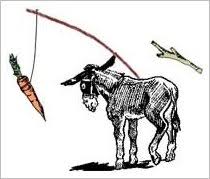
Consciously or otherwise, the carrot-or-stick motif conjures images of masters and the dumb donkeys they try to prod and move along. Those lucky enough to be in position to choose between inducing or punishing are obviously the power-wielding honchos.

Those to be tempted or whacked into submission are clearly the brutish troublesome beasts which must be disciplined - one way or another.

Therefore, when US President Barack Obama's special Mideast envoy fails to object to carrot-and-stick speak - and even bothers to specify one stick's characteristics - he implies that he's in charge, while we, threatened with a severe whack on the rump, are his asses.

So forget the nitty-gritty of George Mitchell's January 7 gibber-jabber in the PBS interview with Charlie Rose about withdrawing loan guarantees if we Israelis don't obey pronto. Plenty of ink has been spilled on whether this constituted a serious signal. The point has been honed that we don't desperately depend on said guarantees, that Israel repays all its debts dutifully and that it can get along just fine, thank you, without Washington's grudging favor.

That's almost the lesser issue.

(Read full article)


Love of the Land: Masters and donkeys

Sunday, 17 January 2010

Love of the Land: Who’d bother to kill Mahmoud Abbas?

Who’d bother to kill Mahmoud Abbas?


FresnoZionism.org
16 January '10

News item:

Fatah head Mahmoud Abbas, current chairman of the Palestinian Authority, claims that Israel is trying to assassinate him. Abbas told an Egyptian news agency this week that Israel had murdered his predecessor,Yasser Arafat – despite Arafat’s commitment to peace – and that he is afraid of suffering the same fate.


The man is beyond belief, and the US keeps paying him!

The implication is that he is for peace and a two-state solution, and Israel, which does not want peace, might kill him for his courageous stance, like his mentor Arafat.

In the real world the PA is doing its best to avoid negotiations with Israel, because it knows that its bottom lines — strict 1949 borders, return of ‘refugees’ to Israel, no recognition of Israel as the state of the Jewish people, etc. — are unacceptable to either Israel or the US.

This is because they do not represent a compromise; they represent the whole ball game. Even Barack Obama has ruled out a right of return, has called for recognition of Israel as a Jewish state, and has favored land swaps.

So Abbas insists that the fact that Israel will not extend its building freeze to East Jerusalem means that it is impossible to talk. Of course, extending the ill-considered freeze would prejudge the status of East Jerusalem, something which is theoretically part of the theoretical negotiations. It’s bad enough that a cloud has been cast over all the rest of Judea and Samaria.


Love of the Land: Who’d bother to kill Mahmoud Abbas?

Thursday, 12 November 2009

Love of the Land: Call Abbas’s Bluff

Call Abbas’s Bluff


Martin Krossel
FrumForum.com
11 November 09


At a Tel Aviv rally on Saturday night commemorating the assassination of Israeli Prime Minister Yitzchak Rabin, the country’s president Shimon Peres called on the head of the Palestinian Authority Mahmoud Abbas to reverse his decision to resign. Peres reminded Abbas, by name, that they together had signed the 1993 Oslo Accords,and he implored, “I turn to you, don’t let go.”

Peres was hardly alone among prominent politicians and statesmen who were calling on Abbas not to resign. While Prime Minister Benjamin Netanyahu refused to comment on the resignation publicly, the Israeli daily Haaretz reported that he told officials behind closed doors that it was in Israel’s interest to have a strong Abbas who could move negotiations forward. French Foreign Minister Bernard Kouchner publicly expressed regret over Abbas’s planned resignation, calling it “a threat to peace.” White House spokesman Robert Gibbs said that Abbas had been a “true partner” of the United States. Secretary of State Hillary Clinton accepted Abbas’s announced resignation at face value, but she expressed the hope that she would be able to work with Abbas “in any capacity.” She also told the press that when she had met with Abbas the previous weekend, “He reiterated his personal commitment to do whatever he can to achieve a two-state solution to the Israeli-Palestinian conflict, something that he’s actually been working on since 1972.”

Middle East observers of all political stripes agree on why Abbas is threatening to resign. In light of his popularity with American presidents and other world leaders, Abbas reasons that his threat will spur the Obama Administration and other governments to pressure Israel to freeze settlement growth. Presumably, once this happens, then somewhere further down the road, Abbas will re-issue his threat in order to get the international community to force Israel to dismantle the settlements and eventually to retreat entirely from the territories captured in the 1967 war. What is much less obvious is why Abbas is so popular internationally and consequently why such gambits have even a chance of working.

In the past few weeks, I have been struck by the difference in the way that the Obama Administration, other national leaders, and much of the press look at Afghanistan’s Hamid Karzai and Abbas. The Palestinian government under Yasser Arafat and Abbas has proven to be every bit as corrupt and ineffective as Afghanistan’s. But the Karzai government is at least clearly superior to its Taliban alternative. There is little such difference between Abbas and his political rivals. The Jerusalem Post’s Evelyn Gordon noted this weekend on Commentary magazine’s Contentions blog that:

in 2005, his one year in sole control over the PA before Hamas’s electoral victory, Palestinians killed 54 Israelis and wounded 484 while 1,059 rockets were fired at Israel from Gaza. Yet not only did Abbas never order his forces to combat this terror; he explicitly and repeatedly refusedto do so. He first cracked down on Hamas only in 2007, after its violent takeover of Gaza convinced him that Hamas threatened him, not just Israel.

But the problem with America’s and the rest of the world’s approach to the Arab-Israeli conflict goes far deeper than Abbas, and their never-ending delusional attempts to identify a Palestinian “peace partner” for Israel. International efforts to resolve the conflict have always focused on getting Israel to make concessions to Arabs, which would supposedly encourage Arabs to make peace. Yet the source of the trouble has always been found on the other side of the line: the refusal of Israel’s neighbors to accept a Jewish state in their midst.

Until that happens, all efforts to settle the Arab-Israeli conflict will be futile.


Love of the Land: Call Abbas’s Bluff

Wednesday, 11 November 2009

Love of the Land: On threats and opportunities

On threats and opportunities


FresnoZionism.org
08 November 09

Recently Israel has been warned of the ‘threat’ of a unilateral declaration of a Palestinian state if it doesn’t move to make ‘peace’ with the PA soon. Ha’aretz threatened,

Concerns are growing in Israel’s government over the possibility of a unilateral Palestinian declaration of independence within the 1967 borders, a move which could potentially be recognized by the United Nations Security Council.


Prime Minister Benjamin Netanyahu recently asked the administration of U.S. President Barack Obama to veto any such proposal, after reports reached Jerusalem of support for such a declaration from major European Union countries, and apparently also certain U.S. officials.


The reports indicated that Palestinian Prime Minister Salam Fayyad has reached a secret understanding with the Obama administration over U.S. recognition of an independent Palestinian state. Such recognition would likely transform any Israeli presence across the Green Line, even in Jerusalem, into an illegal incursion to which the Palestinians would be entitled to engage in measures of self-defense.


There is no doubt that some ‘major EU countries’ and “certain U.S. officials” would love to see the Israeli presence in Judea and Samaria declared illegal, not to mention East Jerusalem (in fact, these same countries and officials would probably say that Israel should be replaced by a Palestinian Arab state if they spoke honestly).


But a secret agreement? There’s still enough support for Israel in the US Congress and the public to make this a very dumb idea. At least today.


Here’s another threat, of a different kind, this one from Palestinian Authority (PA) President Mahmoud Abbas:


“I don’t know what the Israelis want,” he said. “They must start thinking about what needs to be done if they really want peace.”

Meanwhile, Hassan Khraisheh, deputy speaker of the Palestinian Legislative Council, called on Abbas to seriously consider dissolving the PA because of the failure of the peace process. “This authority was created so that it could prepare for the establishment of a Palestinian state,” Khraisheh said. “But after more than 15 years of thorough negotiations with Israel, this state still hasn’t been established.”


On Sunday, The Jerusalem Post, quoting senior PA officials, revealed that Abbas was already considering dismantling the PA, to protest Washington’s failure to force Israel to freeze settlement construction.


Leaving aside the fact that the dissolution of the PA would end the hundreds of millions of dollars that flow to Abbas and Co. from the US, as well as the arms and training for the PA’s new army, the implied danger here is that Hamas — or Israel — would take over control of PA territory and population.

(Continue reading...)


Love of the Land: On threats and opportunities

Friday, 16 October 2009

Love of the Land: Mahmoud Abbas as Peace Partner? Dictators vs. "The Street"

Mahmoud Abbas as Peace Partner? Dictators vs. "The Street"


Khaled Abu Toameh
Hudson New York
15 October 09

The US Administration has resumed its efforts to bring Israelis and Palestinians back to the negotiating table. US special Middle East envoy George Mitchell is back in the region in yet another bid to persuade the two parties to revive the peace process.

But the question that needs to be asked these days is: Is there really a strong, credible and reliable partner on the Palestinian side for any deal? Or, in simple terms, can Mahmoud Abbas and the Palestinian deliver?

The answer obviously is no.

Even if Israeli Prime Minister Binyamin Netanyahu and Abbas were to sign a peace agreement tomorrow morning, it is highly unlikely that the Palestinian president would be able to sell it to his people.

Abbas’s credibility has been severely damaged as a result of the manner in which he handled a resolution that was supposed to be brought before the UN Human Rights Council regarding the findings of the Richard Goldstone report into Operation Cast Lead.

Palestinians were hoping that the resolution, which accuses both Israel and Hamas of committing war crimes during the war, would be endorsed by the Council.

Abbas, however, shocked many Palestinians by ordering his representative at the UN, Ibrahim Khraishi, to set aside the resolution.

Abbas has since been facing an unprecedented wave of denunciations and allegations of high treason from many Palestinians and Arabs. Even some of his loyalists are now calling for his resignation on the pretext that he cannot be trusted to negotiate peace with Israel on behalf of the Palestinians.

The street protests that erupted in the Palestinian territories and Arab capitals following Abbas’s controversial decision serve as a reminder of the wide gap that has always existed between Arab dictators and their constituents.

The protests also serve as a reminder that the Arab masses are more interested in punishing Israel than making peace with the Jewish state.

Abbas is under attack because, in the eyes of many Palestinians and Arabs, he “helped Israel bury its war crimes” in the Gaza Strip. In mosques in different parts of the Arab world, he has been condemned for “exonerating the Jews” and “betraying the blood of the Palestinian martyrs” killed in the war.

Abbas has offered a number of explanations for his decision to set aside the Goldstone report - explanations which have only caused further damage to his credibility.

First his aides and he claimed that the decision was taken under US pressure and threats. Then they argued that the decision was taken at the request of a number of Arab and Islamic countries. When these two explanations did not calm the Palestinian and Arab streets, Abbas ordered the establishment of a three-man commission of inquiry to look into the circumstances that prompted him to set aside the resolution.

This last move - the formation of a commission of inquiry - has been received with laughter by Abbas’s critics. As a Palestinian minister put it, “In the beginning I thought it was a joke when I heard that the president had established a commission of inquiry to investigate himself. How can anyone take him seriously from now on?”

Well, it seems that there are still many who do take Abbas seriously, especially in Washington and some European capitals. Abbas’s more recent decision to revive the debate over the Goldstone report by bringing it back to the UN Human Rights Council is seen as a pathetic attempt to save what’s left of his credibility. So is his decision to send Palestinian policemen in civilian clothes to the streets of West Bank cities to demonstrate in favor of their embattled president.

Abbas cannot be a partner to any deal: his image and credibility have been severely tarnished. Any agreement he reaches with Israel will be received with suspicion by a majority of Palestinians and Arabs.

Hamas, on the other hand, is not a partner because the movement is not going to change its radical ideology, at least not in the foreseeable future.

All that one can do now is to wait until a new, third-way party emerges in the Palestinian territories. Sadly, that option also does not seem to be realistic at this stage -- especially not when both Abbas and Hamas have a common interest in suppressing the emergence of new leaders.

Khaled Abu Toameh, an Arab Muslim, is a veteran award-winning journalist who has been covering Palestinian affairs for nearly three decades. He studied at Hebrew University and began his career as a reporter by working for a PLO-affiliated newspaper in Jerusalem. Abu Toameh currently works for the international media, serving as the “eyes and ears” of foreign journalists in the West Bank and Gaza Strip.


Love of the Land: Mahmoud Abbas as Peace Partner? Dictators vs. "The Street"

Thursday, 24 September 2009

Love of the Land: The Netanyahu, Obama, Abu Mazen Summit

The Netanyahu, Obama, Abu Mazen Summit


By Moshe Feiglin
5 Tishrei 5770
23 September 09

What does Abu Mazen want?

Abu Mazen, (who holds a Soviet doctorate for his Holocaust denial thesis) wants to destroy Israel – just like every other Jew-hater in the world. Like every reasonable Moslem Arab who lives in Dar el Islam (a.k.a. the Middle East) that is polluted by the Zionist entity, Abu Mazen would also be pleased to carry on with the murders, rapes and mutilations that we all remember from the Arab riots of 1929, 1936, Israel's War of Independence - and from every opportunity that the Arabs in the Land of Israel have had to express their unique talents.

But in the meantime, Abu Mazen's immediate goal is to perpetuate the current situation. At the present, he needs Israel to prevent the Hamas from taking over Ramallah and throwing him off a local rooftop. He also has to prevent the establishment of a Palestinian state – at any price. Why? Because in addition to all the honor and authority that he enjoys even now as "head of state", he would actually have to take responsibility for the Arabs of Judea and Samaria. Abu Mazen is not a pushover. He knows that as soon as there is "peace" he will interest no one. What will he do then? Take care of the sewage problem in Bir Zait?

Sound confusing? Just wait for the rest. For now, just remember that Abu Mazen needs to talk peace and to present Israel as intransigent.

What does Obama want?

The places in which Obama grew up and was educated, the mentors and events that, as per his own testimony, shaped his personality and world view – do not leave room for sweet speculation. Obama is a dangerously radical leftist who willingly subjugates himself to the most radical Islam.

Obama wants to appease all the dictators of the world – first and foremost, of the Moslem world – at Israel's expense. Anti-Semitism has always been subtly present in American governments. But the common values shared by the US and Israel had always afforded the two countries a basis for cooperation. Obama is past all that. As opposed to the previous US presidents of this generation, Obama sees no justification for Israel's very existence.

In the meantime, what is important to Obama is to talk peace and to appease the Arabs by presenting Israel as intransigent.

What does Netanyahu want?

This is the hardest question. The analysts in Israel can't seem to decide if Netanyahu would like to retreat but cannot, or if he can retreat but does not want to. As we are not mind-readers, we will try to get to the root of the matter.

What Netanyahu wants is what the State of Israel has wanted since it was established and even before that. A state wants to be normal, a country like any other country, a nation like any other nation. To accomplish that, Netanyahu needs to keep up normal relations with the US and the western world. The paradox is that the more that Israel surrenders its strategic and tangible assets (its land, settlements, army checkpoints) as well as its principles (recognition of our very right to a Jewish state) the more that the nations distance themselves from her. The more that we surrender our unique identity and destiny, the more that we insist that we seek only peace - the more that we become an international pariah.

But Netanyahu has nowhere to run. The concepts of holiness, of Israel's uniqueness and of Jewish rectification of the world are completely foreign to him. All that he can do is to continue to play the peace game and to hedge his bets that Abu Mazen will back down first.

In summary:
Abu Mazen wants to perpetuate the current situation.
Obama wants to appease Islam.
Netanyahu wants the US and the West to stop pressuring Israel.

The only one of the three who will get exactly what he wants is, of course, Abu Mazen.


Love of the Land: The Netanyahu, Obama, Abu Mazen Summit
Related Posts Plugin for WordPress, Blogger...