Showing posts with label Movies. Show all posts

Wednesday, 11 May 2011

_It Don't Make Sense_: We'll Meet Again

Great, this movie is one of the 100 I 'd choose to bring with me to a desert island (joke). So when I saw this post I could'nt resist and reposted it.


My thanks to Nickie Goomba of the blog "It don't make sense"


We'll Meet Again


One of my favorite satirical movies is "Dr. Strangelove" starring Peter Sellers, George C. Scott and a host of other great actors. The movie ends with an all out nuclear war - fantastic atomic explosions, billowing mushroom clouds - and a haunting refrain.

"We'll Meet Again" played at the end of the movie was sung by Dame Vera Lynn who was accompanied by a few hundred men of the RAF. I ran across this video of the song. This lovely, sentimental tune is from a different age, almost a different world.


Sometimes I feel that I was born twenty years too late. I miss my father's generation, the innocence, the music, the trust...


_It Don't Make Sense_: We'll Meet Again

Sunday, 9 August 2009

THE PUNISHER - WARZONE


My thanks to my friend R...... for sending me the DVD .
Now vengeance really has a name. A fantastic Frank Castle/Punisher.

Thursday, 18 June 2009

DEFIANCE - PORTUGUESE DVD RELEASE


DEFIANCE, suffered here in Portugal the questionable fate of some movies : going directly into sale in DVD edition, without being seen in any movie theater.
Whil piles of junk are kept in exhibition simultaneously in more than one theater in the same city, th e film importers weren't able (or didn't want)to find a place to screen this movie.
They can't use the excuse that the director is unknown, (Edward Zwick is well known here as some of his movies as Blood Diamonds or The Last Samurai), or Daniel Craig (James Bond saga). So why this decision ?
Maybe, in their "wisdom", film importers saw no interest in what DEFIANCE tells.
Is it that the story of the Bialky's is something this guys can't stand ?
Is it that this decision, a camouflaged censorship, due to the obeyance of the "politically correctness" so dear to portuguese government and his EU patrons ?
One thing i'm certain: for these minds it's unbearable the idea of someone fighting back agression, especially when that agression is directed against ... Jews !

Friday, 22 May 2009

WATCH: Quentin Tarantino Nazi-hunting flick makes waves at Cannes - Haaretz - Israel News

WATCH: Quentin Tarantino Nazi-hunting flick makes waves at Cannes

By Reuters
Tags: Brad Pitt, Quentin Tarantino

Quentin Tarantino rolls a Western, gangster flick and wartime caper into one in "Inglourious Basterds," a new film starring Brad Pitt as the leader of a ruthless gang of Nazi-slayers. So fearsome is the band of Jewish-American "bastards" that Adolf Hitler himself comes to hear of them, and the violent and action-packed narrative weaves real life figures into a riotous and fanciful plot that re-writes history.

Most of the dialogue is in German and French and translated with subtitles, possibly limiting the film's box office potential in the United States.

But at the Cannes film festival, where Tarantino's picture is in the main competition, there was warm applause after a press screening on Wednesday.

Read All at :


WATCH: Quentin Tarantino Nazi-hunting flick makes waves at Cannes - Haaretz - Israel News

Tuesday, 16 December 2008

CASABLANCA BOX SET


"...Famed classic Casablanca will finally be getting the Blu-ray treatment it deserves this December 2nd when it arrives in Ultimate Collector's Edition form. The $64.99 package ($59.98 on DVD) is reportedly "elegantly boxed in an intricate laser-cut Moroccan design and will include such collectibles as replicas of actual props (Victor Laszlo's "Letter of Transit") as well as a number of Warner studio documents. ..."


Thursday, 11 December 2008

HAPPY BIRTHDAY MR. OLIVEIRA

Manoel Oliveira has completed today 100 years. He certainly is the oldest film director alive. And he's still working, still developing projects.


HAPPY BIRTHDAY !!!

Friday, 20 June 2008

FIDDLER ON THE ROOF - THE FILM

Fiddler on the Roof is the 1971 film version of the Broadway musical of the same name. It was directed by Norman Jewison. The film won three Academy Awards, including one for arranger-conductor John Williams. It was nominated for several more, including Best Picture, Best Actor for Chaim Topol as Tevye, and Best Supporting Actor for Leonard Frey, who played Motel the Tailor (both had originally acted in the musical; Topol as Tevye in the London production and Frey in a minor part as the rabbi's son). The decision to cast Topol as Tevye instead of Zero Mostel was a somewhat controversial one, as the role had originated with Mostel and he had made it famous.

Recording was done at Pinewood Studios in Buckinghamshire, England. Most of the exterior shots were done in Croatia: in Mala Gorica, Lekenik, and Zagreb.

The film follows the plot of the stage play very closely, although it omits the songs "Now I Have Everything" and "The Rumor". It takes place in the Jewish village of Anatevka in Tsarist Russia in 1905 and centers on the character of Tevye, a poor milkman, and his daughters' marriages. As Tevye says in the introductory narration, the Jews have relied upon their traditions to maintain the stability of their way of life for centuries; but as times change, that stability is threatened on the small scale by Tevye's daughters' wishes to marry men not chosen in the traditional way by the matchmaker, and on the large scale by pogroms and revolution in Russia.


Cast

Chaim Topol as Tevye
Norma Crane as Golde
Leonard Frey as Motel Kamzoil
Molly Picon as Yente
Paul Mann as Lazar Wolf
Rosalind Harris as Tzeitel
Michele Marsh as Hodel
Neva Small as Chava
Paul Michael Glaser as Perchik
Ray Lovelock as Fyedka
Elaine Edwards as Shprintze
Candy Bonstein as Bielke
Shimen Ruskin as Mordcha
Zvee Scooler as Rabbi
Louis Zorich as Constable
Tutte Lemkow as the Fiddler (His playing was overdubbed by Isaac Stern).

Synopsis

The film centers on the family of Tevye, a Jewish milkman in the village of Anatevka (probably in the Pale of Settlement) in Tsarist Russia. Tevye breaks the fourth wall by talking at times directly to the audience or to the heavens (to God) for the audience's benefit. Much of the story is also told in musical form.

Tevye is terribly poor despite working hard, as are most of the Jews in Anatevka. He and his wife, Golde, have five daughters, which is another burden for Tevye to shoulder (as he cannot afford a dowry to marry them off). Life in the shtetl of Anatevka is very hard and Tevye speaks not only of the difficulties of being poor but also of the Jewish community's constant fear of harassment from their non-Jewish neighbors.

The film begins with Tevye explaining to the audience that what keeps the Jews of Anatevka going is the balance they achieve through obedience to their ancient traditions. He also explains that the lot of the Jews in Russia is as precarious as a fiddler on a roof: trying to eke out a pleasant tune while not breaking their necks. The fiddler appears throughout the film as a metaphoric reminder of the Jews' ever-present fears and danger. While in town, Tevye meets Perchik, a student with modern religious and political ideas (he is clearly a Marxist). Tevye invites Perchik to live with him and his family in exchange for Perchick tutoring his daughters.

Through Yente the matchmaker, Tevye arranges for his oldest daughter, Tzeitel, to marry the only wealthy Jewish man in Anatevka, Lazar Wolf the butcher. However, Tzeitel is in love with her childhood sweetheart, Motel the tailor, and begs her father not to make her marry the much older butcher. Tevye reluctantly agrees and, despite the humiliation suffered by Lazar Wolf, Tzeitel and Motel arrange to be married. At the wedding, an argument breaks out between the guests over whether a girl should be able to choose her own husband. Perchik addresses the crowd and says that since they love each other it should be left for the couple to decide. He creates further controversy when he asks Tevye's daughter Hodel to dance with him, crossing the barrier between the men and women. Eventually, the crowd warms up to the idea and the wedding proceeds with great joy. Suddenly, a mob of local peasants arrive and begin a pogrom, attacking the Jews and their property.

Later, as Perchik prepares to leave Anatevka to work for the revolution, he tells Hodel that he loves her, and she agrees to marry him. When they tell Tevye, he is furious that they have decided to marry without his permission, and with Perchik leaving Anatevka, but he eventually relents because they love each other. Weeks later, when Perchik is arrested in Kiev and exiled to Siberia, Hodel decides to travel to join him there.

Meanwhile, Tevye's third daughter, Chava, has been flirting with a young Russian man, Fyedka, and eventually works up the courage to ask Tevye to allow her to marry him. In a soliloquy, Tevye concludes that while he could accept his older daughters' choosing their own husbands, he cannot countenance Chava marrying a non-Jew, in effect abandoning the Jewish faith, and forbids her to associate with him, but she elopes with him and marries in a Russian Orthodox Church.

Finally, the Jews of Anatevka are notified that the Russian government will force the Jews to leave the village; they have three days to pack up and leave. Tevye and his family and friends begin packing up to leave, heading variously for New York, Chicago, Palestine, and other places they know nothing about. Just before the credits, Tevye spots the fiddler and motions to him to come along. The film ends with a long, slow shot of the Jews walking out of their former village at sunset.

Awards

The film won the Golden Globe Award for Best Motion Picture (Musical or Comedy) in 1972. It also won the Academy Award for Best Original Score.

External links

STARDUST MEMORIES

Stardust Memories is a 1980 film written and directed by Woody Allen. Allen considers this to be one of his best films in addition to The Purple Rose of Cairo and Match Point.[1] Considered by some to be an homage to by Federico Fellini, the film is shot in black-and-white in the style of Fellini's surrealist films of the 1960s.

It examines the semi-autobiographical story of a famous filmmaker, played by Allen, who is plagued by fans who prefer his "earlier, funnier movies" to his more recent artistic efforts, while he tries to reconcile his conflicting attraction to two very different women, the earnest, intellectual Daisy (Jessica Harper), and the more maternal Isobel (Marie-Christine Barrault) while being haunted by memories of his ex-girlfriend, the mercurial Dorrie (Charlotte Rampling). The conflict between the maternal, nurturing woman and the earnest, usually younger one, is a recurring theme in Allen's films. It was nominated for a Writers Guild of America award for "Best Comedy written directly for screen".

Like many of Allen's films, Stardust Memories incorporates several jazz recordings and includes classic performances by such jazz notables as Louis Armstrong, Django Reinhardt, and Chick Webb.


Cast

Among the extended cast members were an ingenue named Sharon Stone, in her first film appearance; future political commentator Alan Colmes (Hannity & Colmes, the Fox News Channel), in his first role; a young Brent Spiner, later famous as Data on Star Trek: The Next Generation; Laraine Newman of Saturday Night Live fame; and Allen's ex-wife Louise Lasser.

Controversy

Allen denies that this film is biographical and regrets that audiences interpreted it as such.[2]

The film sharply divided both audiences and critics, and to this day it provokes strong reactions, with some Allen fans proclaiming it his best picture and perhaps just as many classing it among his worst.[3][4]


Box office

Stardust Memories opened in North America on September 26, 1980 to on onslaught of bad reviews. At 29 theatres, it grossed $326,779 ($11,268 per screen) in its opening weekend. The film failed to attract more than Woody Allen's loyal fanbase in the long run, and it grossed a modest $10,389,003 by the end of its run. The film's budget was $10 million, so it likely made a profit after foreign revenue was taken into account.[5]

References

Allen, Woody; Stig Björkman (1994). Woody Allen on Woody Allen: In Conversation with Stig Björkman. New York: Grove Press.

External links

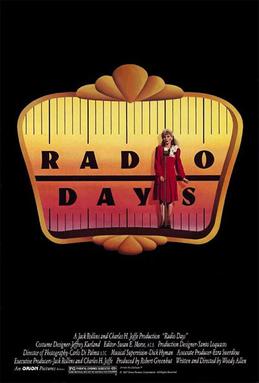
RADIO DAYS

Radio Days is a 1987 film directed by Woody Allen. The film looks back on American family life during the Golden Age of Radio.

Allen narrates the stories of his youth, although he is never seen by the audience. The young Allen is portrayed onscreen by Seth Green as "Joe".
Synopsis

The Narrator (Woody Allen) tells us how the radio influenced his childhood in the days before the TV. In the New York City of the late 1930s to the New Year of 1944, this coming-of-age tale mixes the Narrator's experiences with contemporary anecdotes and urban legends of the radio stars.

Even though the Narrator's Jewish-American family lives modestly in the Queens neighborhood of Rockaway Beach, each member finds in radio shows an escape from reality through the gossip of celebrities, sports legends of the day, crooners, etc. For the Narrator, the action adventurers on the radio (one of them based on The Shadow) inspire him, as he daydreams about his attractive replacement teacher, movie stars, and World War II. Meanwhile, the story of an aspiring radio star's (Mia Farrow) career is also told, along with the tale of the Narrator's aunt Bea (Dianne Wiest) and her search for love.

The musical score features classic songs from the 1930s and 40s, which play an important part in the plot. Even Orson Welles's famous radio broadcast of The War of the Worlds has an important role in Bea's life.

While having similarities to both Manhattan and Fellini's Amarcord, this film is Woody Allen's homage to his beloved New York City.


Awards and nominations

1988 Academy Awards (Oscars)
Nominated – Best Achievement in Art Direction: Art Direction: Speed Hopkins — Set Decoration: Carol Joffe, Leslie Bloom, George de Titta, Jr.
Nominated – Best Original Screenplay: Woody Allen

1988 BAFTA Film Awards
Won – Best Costume Design : Jeffery Kurland
Won – Best Production Design: Santo Loquasto
Nominated – Best Actress in a Supporting Role: Dianne Wiest
Nominated – Best Editing: Susan E. Morse
Nominated – Best Film: Robert Greenhut, Woody Allen
Nominated – Best Screenplay Original: Woody Allen
Nominated – Best Sound: Robert Hein, James Sabat, Lee Dichter

1988 Writers Guild of America Awards
Nominated – WGA Screen Award for Best Screenplay Written Directly for the Screen: Woody Allen

External links

Radio Days at the Internet Movie Database
[hide]
vdeFilms directed by Woody Allen
1960s
What's Up, Tiger Lily? (1966) · Take the Money and Run (1969)
1970s
Men of Crisis: The Harvey Wallinger Story (1971) · Bananas (1971) · Everything You Always Wanted to Know About Sex* (*But Were Afraid to Ask) (1972) · Sleeper (1973) · Love and Death (1975) · Annie Hall (1977) · Interiors (1978) · Manhattan (1979)
1980s
Stardust Memories (1980) · A Midsummer Night's Sex Comedy (1982) · Zelig (1983) · Broadway Danny Rose (1984) · The Purple Rose of Cairo (1985) · Hannah and Her Sisters (1986) · Radio Days (1987) · September (1987) · Another Woman (1988) · New York Stories (1989) · Crimes and Misdemeanors (1989)
1990s
Alice (1990) · Shadows and Fog (1992) · Husbands and Wives (1992) · Manhattan Murder Mystery (1993) · Bullets Over Broadway (1994) · Don't Drink the Water (1994) · Mighty Aphrodite (1995) · Everyone Says I Love You (1996) · Deconstructing Harry (1997) · Celebrity (1998) · Sweet and Lowdown (1999)
2000s
Small Time Crooks (2000) · The Curse of the Jade Scorpion (2001) · Hollywood Ending (2002) · Anything Else (2003) · Melinda and Melinda (2005) · Match Point (2005) · Scoop (2006) · Cassandra's Dream (2007) · Vicky Cristina Barcelona (2008)
Retrieved from "http://en.wikipedia.org/wiki/Radio_Days"

Saturday, 14 June 2008

THE FLIGHT OF THE PHOENIX

The Flight of the Phoenix is a 1964 novel by Elleston Trevor and a 1965 film adaptation. The plot involves the crash of a transport aircraft in the middle of a desert and the survivors' desperate attempt to save themselves.
The film was directed by Robert Aldrich, and stars James Stewart, Richard Attenborough, Peter Finch, Ernest Borgnine, Hardy Krüger, George Kennedy, Dan Duryea, Ronald Fraser and Ian Bannen.


Plot

Pilot Frank Towns (James Stewart) and navigator Lew Moran (Richard Attenborough) are ferrying a mixed bag of passengers out of the Sahara, among them oil workers, a couple of British soldiers and a German who was visiting his brother. An unexpected sandstorm forces the aircraft down, damaging it, killing two of the men, and severely injuring a third.

The survivors wait for rescue but begin to worry as the storm has blown them far off course, away from where searchers would look for them. After several days, Captain Harris (Peter Finch) marches towards a distant oasis together with another passenger. His aide Sergeant Watson (Ronald Fraser) feigns a leg injury and does not join Harris. Days later, Harris barely manages to return to the crash site.

As the water begins to run out, Heinrich Dorfmann (Hardy Krüger), a precise, arrogant German aeronautical engineer, proposes a radical solution. He claims they can rebuild a new aircraft from the wreckage, using the only working engine and adding skids to take off. They set to work.

At one point they spot a party of nomadic Arabs. Captain Harris decides to ask them for help, but Sergeant Watson refuses to accompany him. Instead, the doctor (Christian Marquand) - a person familiar with the local Arab dialect - goes with him. The next day, Towns finds their looted bodies, throats cut, and the nomads gone.

Later, Towns finds out that Dorfmann's job is designing model aircraft, not real, full-scale ones. Afraid of the effect on morale, he and Moran keep their discovery secret, though they now believe Dorfmann's plan is doomed. However, they turn out to be wrong. The aircraft is reborn, like the mythical Phoenix. It flies the passengers, lying on the wings, to an oasis and civilization.

Production

Locations

Principal photography started 26 April 1965 at the 20th Century-Fox Studios and 20th Century-Fox Ranch, California. Other filming locations, simulating the desert, were Buttercup Valley, Arizona and [[Pilot Knob Mesa, California. The flying sequences were all filmed at Pilot Knob Mesa near Winterhaven, located in Imperial Valley, California on the northern fringes of Yuma, Arizona.

Aircraft used

In 2005, Hollywood aviation historian Simon Beck identified the aircraft used in the film:
Fairchild C-82A Packet, N6887C - flying shots.
Fairchild C-82A Packet, N4833V - outdoor location wreck.
Fairchild C-82A Packet, N53228 - indoor studio wreck.
Fairchild R4Q-1 Flying Boxcar (the USMC C-119C variant), BuNo. 126580 - non-flying Phoenix prop.
Tallmantz Phoenix P-1, N93082 - flying Phoenix aircraft.
North American O-47A, N4725V - second flying Phoenix.

The C-82As were from Steward-Davies Inc. at Long Beach, CA, while the O-47A came from the Air Museum – Planes of Fame in California. The R4Q-1 was purchased from Allied Aircraft of Phoenix, AZ. The aerial camera platform was a B-25J Mitchell, N1042B, which was also used in the 1970 film Catch-22. The flying sequences were flown by Paul Mantz and Frank Tallman, co-owners of the Tallmantz Aviation.

A famous racing/stunt/movie pilot and collector of warplanes, Paul Mantz was flying the Tallmantz Phoenix P-1, the machine that was "made of the wreckage", in a low level pass in front of the cameras when he caught a skid on a hillock. The movie model crashed and broke apart, killing Mantz and seriously injuring stuntman Bobby Rose onboard.[1]

Although principal photography "wrapped" on 13 August 1965, in order to complete filming, a North American O-47A N4725V from the Planes of Fame Air Museum (Claremont, California) was modified and used as a flying Phoenix stand-in. With the canopy removed, a set of skids attached to the main landing gear as well as ventral fin added to the tail, made it a visual look-a-like. Filming using the O-47A was completed in October/November 1965. It appears in the last flying scenes, painted to look like the earlier Phoenix P-1.

The final production utilized a mix of footage that included the O-47A, the "cobbled-together" Phoenix and Phoenix P-1.

Reception

Critically acclaimed as a tense, character-driven study of men in adversity, The Flight of the Phoenix was nominated for two Academy Awards: Ian Bannen for Supporting Actor and Michael Luciano for Film Editing.

See also

Coffman engine starter, the starter system which uses an explosive cartridge to supply gas pressure. In the film, Towns and Dorfmann have a big argument on how to use their few remaining cartridges to try to start the engine of the rebuilt aircraft.

References

Notes

1^ Check-Six.com - The Final Flight of the Phoenix

Bibliography

Cox, Stephen. It's a Wonderful Life: A Memory Book. Nashville, Tennessee: Cumberland House, 2003. ISBN 1-58182-337-1.
Eliot, Mark. Jimmy Stewart: A Biography. New York: Random House, 2006. ISBN 1-4000-5221-1.
Hardwick, Jack and Schnepf, Ed. "A Viewer's Guide to Aviation Movies." The Making of the Great Aviation Films. General Aviation Series, Volume 2, 1989.
The Jimmy Stewart Museum Home Page. The Jimmy Stewart Museum Home Page. Retrieved: 18 February 2007.
Jones, Ken D., McClure, Arthur F. and Twomey, Alfred E. The Films of James Stewart. New York: Castle Books, 1970.
Munn, Michael. Jimmy Stewart: The Truth Behind The Legend. Fort Lee, New Jersey: Barricade Books Inc., 2006. ISBN 1-56980-310-2.
Pickard, Roy. Jimmy Stewart: A Life in Film. New York: St. Martin's Press, 1992. ISBN 0-312-08828-0.
Robbins, Jhan. Everybody's Man: A Biography of Jimmy Stewart. New York: G.P. Putnam's Sons, 1985. ISBN 0-399-12973-1.
Thomas, Tony. A Wonderful Life: The Films and Career of James Stewart. Secaucus, New Jersey: Citadel Press, 1988. ISBN 0-8065-1081-1.

External links
Related Posts Plugin for WordPress, Blogger...