Showing posts with label Directors. Show all posts

Thursday, 11 December 2008

HAPPY BIRTHDAY MR. OLIVEIRA

Manoel Oliveira has completed today 100 years. He certainly is the oldest film director alive. And he's still working, still developing projects.


HAPPY BIRTHDAY !!!

Friday, 20 June 2008

FIDDLER ON THE ROOF - THE FILM

Fiddler on the Roof is the 1971 film version of the Broadway musical of the same name. It was directed by Norman Jewison. The film won three Academy Awards, including one for arranger-conductor John Williams. It was nominated for several more, including Best Picture, Best Actor for Chaim Topol as Tevye, and Best Supporting Actor for Leonard Frey, who played Motel the Tailor (both had originally acted in the musical; Topol as Tevye in the London production and Frey in a minor part as the rabbi's son). The decision to cast Topol as Tevye instead of Zero Mostel was a somewhat controversial one, as the role had originated with Mostel and he had made it famous.

Recording was done at Pinewood Studios in Buckinghamshire, England. Most of the exterior shots were done in Croatia: in Mala Gorica, Lekenik, and Zagreb.

The film follows the plot of the stage play very closely, although it omits the songs "Now I Have Everything" and "The Rumor". It takes place in the Jewish village of Anatevka in Tsarist Russia in 1905 and centers on the character of Tevye, a poor milkman, and his daughters' marriages. As Tevye says in the introductory narration, the Jews have relied upon their traditions to maintain the stability of their way of life for centuries; but as times change, that stability is threatened on the small scale by Tevye's daughters' wishes to marry men not chosen in the traditional way by the matchmaker, and on the large scale by pogroms and revolution in Russia.


Cast

Chaim Topol as Tevye
Norma Crane as Golde
Leonard Frey as Motel Kamzoil
Molly Picon as Yente
Paul Mann as Lazar Wolf
Rosalind Harris as Tzeitel
Michele Marsh as Hodel
Neva Small as Chava
Paul Michael Glaser as Perchik
Ray Lovelock as Fyedka
Elaine Edwards as Shprintze
Candy Bonstein as Bielke
Shimen Ruskin as Mordcha
Zvee Scooler as Rabbi
Louis Zorich as Constable
Tutte Lemkow as the Fiddler (His playing was overdubbed by Isaac Stern).

Synopsis

The film centers on the family of Tevye, a Jewish milkman in the village of Anatevka (probably in the Pale of Settlement) in Tsarist Russia. Tevye breaks the fourth wall by talking at times directly to the audience or to the heavens (to God) for the audience's benefit. Much of the story is also told in musical form.

Tevye is terribly poor despite working hard, as are most of the Jews in Anatevka. He and his wife, Golde, have five daughters, which is another burden for Tevye to shoulder (as he cannot afford a dowry to marry them off). Life in the shtetl of Anatevka is very hard and Tevye speaks not only of the difficulties of being poor but also of the Jewish community's constant fear of harassment from their non-Jewish neighbors.

The film begins with Tevye explaining to the audience that what keeps the Jews of Anatevka going is the balance they achieve through obedience to their ancient traditions. He also explains that the lot of the Jews in Russia is as precarious as a fiddler on a roof: trying to eke out a pleasant tune while not breaking their necks. The fiddler appears throughout the film as a metaphoric reminder of the Jews' ever-present fears and danger. While in town, Tevye meets Perchik, a student with modern religious and political ideas (he is clearly a Marxist). Tevye invites Perchik to live with him and his family in exchange for Perchick tutoring his daughters.

Through Yente the matchmaker, Tevye arranges for his oldest daughter, Tzeitel, to marry the only wealthy Jewish man in Anatevka, Lazar Wolf the butcher. However, Tzeitel is in love with her childhood sweetheart, Motel the tailor, and begs her father not to make her marry the much older butcher. Tevye reluctantly agrees and, despite the humiliation suffered by Lazar Wolf, Tzeitel and Motel arrange to be married. At the wedding, an argument breaks out between the guests over whether a girl should be able to choose her own husband. Perchik addresses the crowd and says that since they love each other it should be left for the couple to decide. He creates further controversy when he asks Tevye's daughter Hodel to dance with him, crossing the barrier between the men and women. Eventually, the crowd warms up to the idea and the wedding proceeds with great joy. Suddenly, a mob of local peasants arrive and begin a pogrom, attacking the Jews and their property.

Later, as Perchik prepares to leave Anatevka to work for the revolution, he tells Hodel that he loves her, and she agrees to marry him. When they tell Tevye, he is furious that they have decided to marry without his permission, and with Perchik leaving Anatevka, but he eventually relents because they love each other. Weeks later, when Perchik is arrested in Kiev and exiled to Siberia, Hodel decides to travel to join him there.

Meanwhile, Tevye's third daughter, Chava, has been flirting with a young Russian man, Fyedka, and eventually works up the courage to ask Tevye to allow her to marry him. In a soliloquy, Tevye concludes that while he could accept his older daughters' choosing their own husbands, he cannot countenance Chava marrying a non-Jew, in effect abandoning the Jewish faith, and forbids her to associate with him, but she elopes with him and marries in a Russian Orthodox Church.

Finally, the Jews of Anatevka are notified that the Russian government will force the Jews to leave the village; they have three days to pack up and leave. Tevye and his family and friends begin packing up to leave, heading variously for New York, Chicago, Palestine, and other places they know nothing about. Just before the credits, Tevye spots the fiddler and motions to him to come along. The film ends with a long, slow shot of the Jews walking out of their former village at sunset.

Awards

The film won the Golden Globe Award for Best Motion Picture (Musical or Comedy) in 1972. It also won the Academy Award for Best Original Score.

External links

STARDUST MEMORIES

Stardust Memories is a 1980 film written and directed by Woody Allen. Allen considers this to be one of his best films in addition to The Purple Rose of Cairo and Match Point.[1] Considered by some to be an homage to by Federico Fellini, the film is shot in black-and-white in the style of Fellini's surrealist films of the 1960s.

It examines the semi-autobiographical story of a famous filmmaker, played by Allen, who is plagued by fans who prefer his "earlier, funnier movies" to his more recent artistic efforts, while he tries to reconcile his conflicting attraction to two very different women, the earnest, intellectual Daisy (Jessica Harper), and the more maternal Isobel (Marie-Christine Barrault) while being haunted by memories of his ex-girlfriend, the mercurial Dorrie (Charlotte Rampling). The conflict between the maternal, nurturing woman and the earnest, usually younger one, is a recurring theme in Allen's films. It was nominated for a Writers Guild of America award for "Best Comedy written directly for screen".

Like many of Allen's films, Stardust Memories incorporates several jazz recordings and includes classic performances by such jazz notables as Louis Armstrong, Django Reinhardt, and Chick Webb.


Cast

Among the extended cast members were an ingenue named Sharon Stone, in her first film appearance; future political commentator Alan Colmes (Hannity & Colmes, the Fox News Channel), in his first role; a young Brent Spiner, later famous as Data on Star Trek: The Next Generation; Laraine Newman of Saturday Night Live fame; and Allen's ex-wife Louise Lasser.

Controversy

Allen denies that this film is biographical and regrets that audiences interpreted it as such.[2]

The film sharply divided both audiences and critics, and to this day it provokes strong reactions, with some Allen fans proclaiming it his best picture and perhaps just as many classing it among his worst.[3][4]


Box office

Stardust Memories opened in North America on September 26, 1980 to on onslaught of bad reviews. At 29 theatres, it grossed $326,779 ($11,268 per screen) in its opening weekend. The film failed to attract more than Woody Allen's loyal fanbase in the long run, and it grossed a modest $10,389,003 by the end of its run. The film's budget was $10 million, so it likely made a profit after foreign revenue was taken into account.[5]

References

Allen, Woody; Stig Björkman (1994). Woody Allen on Woody Allen: In Conversation with Stig Björkman. New York: Grove Press.

External links

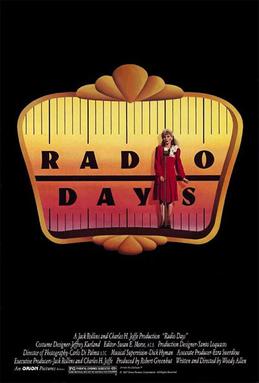
RADIO DAYS

Radio Days is a 1987 film directed by Woody Allen. The film looks back on American family life during the Golden Age of Radio.

Allen narrates the stories of his youth, although he is never seen by the audience. The young Allen is portrayed onscreen by Seth Green as "Joe".
Synopsis

The Narrator (Woody Allen) tells us how the radio influenced his childhood in the days before the TV. In the New York City of the late 1930s to the New Year of 1944, this coming-of-age tale mixes the Narrator's experiences with contemporary anecdotes and urban legends of the radio stars.

Even though the Narrator's Jewish-American family lives modestly in the Queens neighborhood of Rockaway Beach, each member finds in radio shows an escape from reality through the gossip of celebrities, sports legends of the day, crooners, etc. For the Narrator, the action adventurers on the radio (one of them based on The Shadow) inspire him, as he daydreams about his attractive replacement teacher, movie stars, and World War II. Meanwhile, the story of an aspiring radio star's (Mia Farrow) career is also told, along with the tale of the Narrator's aunt Bea (Dianne Wiest) and her search for love.

The musical score features classic songs from the 1930s and 40s, which play an important part in the plot. Even Orson Welles's famous radio broadcast of The War of the Worlds has an important role in Bea's life.

While having similarities to both Manhattan and Fellini's Amarcord, this film is Woody Allen's homage to his beloved New York City.


Awards and nominations

1988 Academy Awards (Oscars)
Nominated – Best Achievement in Art Direction: Art Direction: Speed Hopkins — Set Decoration: Carol Joffe, Leslie Bloom, George de Titta, Jr.
Nominated – Best Original Screenplay: Woody Allen

1988 BAFTA Film Awards
Won – Best Costume Design : Jeffery Kurland
Won – Best Production Design: Santo Loquasto
Nominated – Best Actress in a Supporting Role: Dianne Wiest
Nominated – Best Editing: Susan E. Morse
Nominated – Best Film: Robert Greenhut, Woody Allen
Nominated – Best Screenplay Original: Woody Allen
Nominated – Best Sound: Robert Hein, James Sabat, Lee Dichter

1988 Writers Guild of America Awards
Nominated – WGA Screen Award for Best Screenplay Written Directly for the Screen: Woody Allen

External links

Radio Days at the Internet Movie Database
[hide]
vdeFilms directed by Woody Allen
1960s
What's Up, Tiger Lily? (1966) · Take the Money and Run (1969)
1970s
Men of Crisis: The Harvey Wallinger Story (1971) · Bananas (1971) · Everything You Always Wanted to Know About Sex* (*But Were Afraid to Ask) (1972) · Sleeper (1973) · Love and Death (1975) · Annie Hall (1977) · Interiors (1978) · Manhattan (1979)
1980s
Stardust Memories (1980) · A Midsummer Night's Sex Comedy (1982) · Zelig (1983) · Broadway Danny Rose (1984) · The Purple Rose of Cairo (1985) · Hannah and Her Sisters (1986) · Radio Days (1987) · September (1987) · Another Woman (1988) · New York Stories (1989) · Crimes and Misdemeanors (1989)
1990s
Alice (1990) · Shadows and Fog (1992) · Husbands and Wives (1992) · Manhattan Murder Mystery (1993) · Bullets Over Broadway (1994) · Don't Drink the Water (1994) · Mighty Aphrodite (1995) · Everyone Says I Love You (1996) · Deconstructing Harry (1997) · Celebrity (1998) · Sweet and Lowdown (1999)
2000s
Small Time Crooks (2000) · The Curse of the Jade Scorpion (2001) · Hollywood Ending (2002) · Anything Else (2003) · Melinda and Melinda (2005) · Match Point (2005) · Scoop (2006) · Cassandra's Dream (2007) · Vicky Cristina Barcelona (2008)
Retrieved from "http://en.wikipedia.org/wiki/Radio_Days"

Saturday, 14 June 2008

THE FLIGHT OF THE PHOENIX

The Flight of the Phoenix is a 1964 novel by Elleston Trevor and a 1965 film adaptation. The plot involves the crash of a transport aircraft in the middle of a desert and the survivors' desperate attempt to save themselves.
The film was directed by Robert Aldrich, and stars James Stewart, Richard Attenborough, Peter Finch, Ernest Borgnine, Hardy Krüger, George Kennedy, Dan Duryea, Ronald Fraser and Ian Bannen.


Plot

Pilot Frank Towns (James Stewart) and navigator Lew Moran (Richard Attenborough) are ferrying a mixed bag of passengers out of the Sahara, among them oil workers, a couple of British soldiers and a German who was visiting his brother. An unexpected sandstorm forces the aircraft down, damaging it, killing two of the men, and severely injuring a third.

The survivors wait for rescue but begin to worry as the storm has blown them far off course, away from where searchers would look for them. After several days, Captain Harris (Peter Finch) marches towards a distant oasis together with another passenger. His aide Sergeant Watson (Ronald Fraser) feigns a leg injury and does not join Harris. Days later, Harris barely manages to return to the crash site.

As the water begins to run out, Heinrich Dorfmann (Hardy Krüger), a precise, arrogant German aeronautical engineer, proposes a radical solution. He claims they can rebuild a new aircraft from the wreckage, using the only working engine and adding skids to take off. They set to work.

At one point they spot a party of nomadic Arabs. Captain Harris decides to ask them for help, but Sergeant Watson refuses to accompany him. Instead, the doctor (Christian Marquand) - a person familiar with the local Arab dialect - goes with him. The next day, Towns finds their looted bodies, throats cut, and the nomads gone.

Later, Towns finds out that Dorfmann's job is designing model aircraft, not real, full-scale ones. Afraid of the effect on morale, he and Moran keep their discovery secret, though they now believe Dorfmann's plan is doomed. However, they turn out to be wrong. The aircraft is reborn, like the mythical Phoenix. It flies the passengers, lying on the wings, to an oasis and civilization.

Production

Locations

Principal photography started 26 April 1965 at the 20th Century-Fox Studios and 20th Century-Fox Ranch, California. Other filming locations, simulating the desert, were Buttercup Valley, Arizona and [[Pilot Knob Mesa, California. The flying sequences were all filmed at Pilot Knob Mesa near Winterhaven, located in Imperial Valley, California on the northern fringes of Yuma, Arizona.

Aircraft used

In 2005, Hollywood aviation historian Simon Beck identified the aircraft used in the film:
Fairchild C-82A Packet, N6887C - flying shots.
Fairchild C-82A Packet, N4833V - outdoor location wreck.
Fairchild C-82A Packet, N53228 - indoor studio wreck.
Fairchild R4Q-1 Flying Boxcar (the USMC C-119C variant), BuNo. 126580 - non-flying Phoenix prop.
Tallmantz Phoenix P-1, N93082 - flying Phoenix aircraft.
North American O-47A, N4725V - second flying Phoenix.

The C-82As were from Steward-Davies Inc. at Long Beach, CA, while the O-47A came from the Air Museum – Planes of Fame in California. The R4Q-1 was purchased from Allied Aircraft of Phoenix, AZ. The aerial camera platform was a B-25J Mitchell, N1042B, which was also used in the 1970 film Catch-22. The flying sequences were flown by Paul Mantz and Frank Tallman, co-owners of the Tallmantz Aviation.

A famous racing/stunt/movie pilot and collector of warplanes, Paul Mantz was flying the Tallmantz Phoenix P-1, the machine that was "made of the wreckage", in a low level pass in front of the cameras when he caught a skid on a hillock. The movie model crashed and broke apart, killing Mantz and seriously injuring stuntman Bobby Rose onboard.[1]

Although principal photography "wrapped" on 13 August 1965, in order to complete filming, a North American O-47A N4725V from the Planes of Fame Air Museum (Claremont, California) was modified and used as a flying Phoenix stand-in. With the canopy removed, a set of skids attached to the main landing gear as well as ventral fin added to the tail, made it a visual look-a-like. Filming using the O-47A was completed in October/November 1965. It appears in the last flying scenes, painted to look like the earlier Phoenix P-1.

The final production utilized a mix of footage that included the O-47A, the "cobbled-together" Phoenix and Phoenix P-1.

Reception

Critically acclaimed as a tense, character-driven study of men in adversity, The Flight of the Phoenix was nominated for two Academy Awards: Ian Bannen for Supporting Actor and Michael Luciano for Film Editing.

See also

Coffman engine starter, the starter system which uses an explosive cartridge to supply gas pressure. In the film, Towns and Dorfmann have a big argument on how to use their few remaining cartridges to try to start the engine of the rebuilt aircraft.

References

Notes

1^ Check-Six.com - The Final Flight of the Phoenix

Bibliography

Cox, Stephen. It's a Wonderful Life: A Memory Book. Nashville, Tennessee: Cumberland House, 2003. ISBN 1-58182-337-1.
Eliot, Mark. Jimmy Stewart: A Biography. New York: Random House, 2006. ISBN 1-4000-5221-1.
Hardwick, Jack and Schnepf, Ed. "A Viewer's Guide to Aviation Movies." The Making of the Great Aviation Films. General Aviation Series, Volume 2, 1989.
The Jimmy Stewart Museum Home Page. The Jimmy Stewart Museum Home Page. Retrieved: 18 February 2007.
Jones, Ken D., McClure, Arthur F. and Twomey, Alfred E. The Films of James Stewart. New York: Castle Books, 1970.
Munn, Michael. Jimmy Stewart: The Truth Behind The Legend. Fort Lee, New Jersey: Barricade Books Inc., 2006. ISBN 1-56980-310-2.
Pickard, Roy. Jimmy Stewart: A Life in Film. New York: St. Martin's Press, 1992. ISBN 0-312-08828-0.
Robbins, Jhan. Everybody's Man: A Biography of Jimmy Stewart. New York: G.P. Putnam's Sons, 1985. ISBN 0-399-12973-1.
Thomas, Tony. A Wonderful Life: The Films and Career of James Stewart. Secaucus, New Jersey: Citadel Press, 1988. ISBN 0-8065-1081-1.

External links

Tuesday, 10 June 2008

MARATHON MAN

Marathon Man is a 1974 paranoid thriller novel by William Goldman. In 1976 it was made into a film of the same name starring Dustin Hoffman, Laurence Olivier, and Roy Scheider and directed by John Schlesinger.

Plot introduction

The story is about a former Nazi SS dentist from Auschwitz, Dr. Christian Szell (inspired by Josef Mengele, the last doctor in charge of Auschwitz II), now residing in Paraguay (changed to Uruguay for the movie), trying to smuggle a large quantity of diamonds out of the U.S. after the death of his brother. This involves an ultra-secret intelligence agency called "The Division." The plot revolves around Thomas "Babe" Levy, a history graduate student at Columbia University and runner who is haunted by the suicide of his father, which was caused by the witchhunts of McCarthyism decades earlier. Thomas also has a brother, who unbeknownst to him works for this secret governmental body.

Both the novel and the film contain a graphic depiction in which Szell tortures Babe by drilling into his teeth, without anesthetic, and repeatedly asking the question, "Is it safe?" Babe does not know what the question means nor the identity of his inquisitor. The dentist offers him oil of cloves as positive inducement to cooperate. The quote "Is it safe?" was ranked #70 on the "100 Years...100 Movie Quotes" list. The quote was humorously parodied near the end of the ZAZ spoof, Hot Shots!.

Tuesday, 3 June 2008

MONSIEUR KLEIN

Monsieur Klein (Mr. Klein) is a French 1976 film directed by Joseph Losey, with Alain Delon starring in the title role.

Synopsis

It is 1942, the war is in full swing and France is occupied by the Nazis. To Robert Klein, however, these events are of little concern. As an art dealer, he makes a nice profit off the situation of the Jews, who are selling their possessions in a hurry to leave the country. He holds no political affinities and chooses to remain indifferent. All this changes when one day, a Jewish newspaper is accidentally delivered to his address, and Klein discovers there is another Robert Klein residing in Paris, a Jew sought by the police. When the other Klein cannot be found, authorities grow suspicious and the art dealer is forced to offer proof of his French heritage. Before long he's entangled in a quest to track down his elusive namesake and find out what happened.

Symbolism and allusions

Although Losey integrates historical elements (such as the Rafle du Vel'd'Hiv) into the film, it is more than a reconstruction of the life and status of the Jews under the Vichy regime.

The relationship of the film with the works of the writer Franz Kafka has often been noted: the link with The Metamorphosis, telling of the brutal and sudden transformation of a man into a cockroach, with The Castle, which describes a search for one's own identity by way of getting to know "the other", or with The Trial, which sees an accused man become an outlaw of society.

Awards

The film was nominated for the Palme d'Or at the 1976 Cannes Film Festival but lost to Taxi Driver. However, Monsieur Klein did win the César Award for Best Film while Losey won the César Award for Best Director. Alexandre Trauner won the César Award for Best Production Design, and in addition the film was nominated for Césars in four other categories.

Wednesday, 21 May 2008

EXODUS

Exodus is a 1960 epic war film made by Alpha and Carlyle Productions and distributed by United Artists. It was produced and directed by Otto Preminger from a screenplay by Dalton Trumbo from the novel, Exodus, by Leon Uris. The Super Panavision 70 cinematography was by Sam Leavitt. The music, including the frequently covered title theme, was written by Ernest Gold.


Summary

The film is based on the events that happened on the ship Exodus in 1947 and dealing with the founding of the state of Israel around 1948.

Nurse Katherine (Kitty) Fremont (Eva Marie Saint) is an American volunteer nurse at the Karaolos detention camp in Cyprus, where thousands of Jews - Holocaust survivors - are being held, as they have no homeland to return to. They sit in anticipation of the day they will be liberated. Ari Ben Canaan (Paul Newman), a Haganah rebel who previously was a Captain in the Jewish Brigade of the British Army in World War II, obtains a cargo ship and is able to smuggle 611 Jewish inmates out of the camp for an illegal voyage to Palestine before being found out by military authorities. When the British discover that the refugees are in a ship in the harbor of Famagusta, they blockade the harbor. The refugees stage a hunger strike, during which the camp's doctor dies; then the British relent and allow the Exodus safe passage.

Meanwhile, Kitty has grown very fond of Karen Hansen (Jill Haworth), a young Danish-Jewish girl searching for her father, from whom she was separated during the war. She has taken up the Zionist cause, much to the chagrin of Kitty, who had hoped to take young Karen to America so that she can begin a new life there.

Meanwhile, opposition to the partition of Palestine into Arab and Jewish states is heating up, and Karen's young beau Dov Landau (Sal Mineo) joins the Irgun, a radical Jewish underground network, led by Ari Ben Canaan's uncle Akiva (David Opatoshu). Because of his activities, Akiva has been disowned by Ari's father, Barak, who heads the mainstream Jewish Agency trying to create a Jewish state through political and diplomatic means. He fears that the Irgun will damage his efforts, especially since the British have put a price on Akiva's head. When the bombing of the King David Hotel in an act of terrorism leads to dozens of fatalities, Akiva is arrested and sentenced to hang. Meanwhile, Karen's father has been found, but he is suffering from clinical depression and does not recognize her. Karen has gone to live at Gan Dafna, the Jewish kibbutz near Mount Tabor at which Ari was raised.

Kitty and Ari have fallen in love, but Uncle Akiva's imprisonment is an obstacle, and Ari must devise a plan to free the prisoners.

Dov Landau, who had managed to elude the arresting soldiers, turns himself in so that he can use his knowledge of explosives to rig the Acre prison and plan an escape route. All goes according to plan; hundreds of prisoners, including Akiva, manage to escape. But Akiva is fatally shot by British soldiers while evading a roadblock set up to catch the escaped prisoners. Ari, who was driving, is badly wounded. He makes his way to Abu Yesha, an Arab village where his lifelong friend, Taha, is the mukhtar. Kitty is brought there and treats his wound.

An independent Israel is now in plain view, but Arab radicals commanded by the Grand Mufti of Jerusalem plot to attack Gan Dafna and kill its villagers. Ari receives prior warning of this attack from Taha, and he manages to get the chidren of the town out in a mass overnight escape. Karen, ecstatic over the prospect of a new nation, searches and finds Dov(who was patrolling outside the town) proclaims her love for him, and traveled back to Gan Dafna, only to be captured and killed by a wandering Arab radical.In the morning, Dov and a patrol group finds her lifeless body. That same day, the body of Taha is found hanging in his village killed by Arab extemists with a Star of David symbol carved on his body. Karen and Taha are buried together in one grave. At the Jewish burial ceremony, Ari swears on their bodies that someday, Jews and Arabs will live together and share the land in peace. The movie then ends with Ari and a Palmach contingent entering trucks and heading toward battle.

Cast

Paul Newman on Exodus DVD cover

Paul Newman - Ari Ben Canaan
Eva Marie Saint - Kitty Fremont
Ralph Richardson - Gen. Sutherland
Peter Lawford - Maj. Caldwell
Lee J. Cobb - Barak Ben Canaan
Sal Mineo - Dov Landau
John Derek - Taha
Hugh Griffith - Mandria
Gregory Ratoff - Lakavitch
Felix Aylmer - Dr. Lieberman
David Opatoshu - Akiva Ben-Canaan
Jill Haworth - Karen
Marius Goring - Von Storch
Michael Wager - David
Paul Stevens - Reuben
Victor Maddern - Sergeant
George Maharis - Yoav

Trivia

Director Otto Preminger helped to end the stigma of the Hollywood blacklist by hiring Dalton Trumbo to adapt the screenplay for the film
John Gielgud turned down the role of General Sutherland.

Awards and nominations

Academy Awards

The music score, written by Ernest Gold won the Academy Award for Best Original Score at the 1960 Oscars. The main theme from the film has been widely remixed and covered by many artists such as Ferrent and Teicher, whose version went all the way to number 2 on the Billboard Singles Chart, Other version were recorded by Mantovani, Peter Nero, Connie Francis, and the Duprees, who sang the theme with lyrics written by Pat Boone, Other artists (such as piano player Anthony Burger for the Homecoming titled "I Do Believe"), remixed by techno-crossover pianist Maksim, even being used as the sample for the T.I. song Bankhead, and the original version was used as theme song for professional wrestler "Mr. Perfect" Curt Hennig. Trey Spruance of the Secret Chiefs 3 rescored the theme for "surf band and orchestra" on the album 2004 Book of Horizons. Another professional wrestler, Bill Goldberg, used a version of the main theme as his entrance music while in WCW as a nod to his Jewish heritage. Furthermore, Howard Stern tends to use it for comedic effect when discussing aspects of Jewish life.

The film was also nominated for Best Supporting Actor (Sal Mineo) and for Best Cinematography (Sam Leavitt)

Sal Mineo won the Best Supporting Actor Award

Ernest Gold won Best Soundtrack Album and Song of the Year at the Grammy Awards of 1961 for the soundtrack and theme to Exodus respectively. It is the only instrumental song to ever receive that award to date. Oddly, the first notes of the great dramatic theme are identical to the opening theme of a somewhat obscure orchestral piece by Quincy Porter, New England Episodes, premiered in 1958 in Washington, DC.

Popular Culture

In "Talkin' John Birch Paranoid Blues," Bob Dylan sings: "To my knowledge there's just one man that's really and truly an American, that's George Lincoln Rockwell: I know for a fact he hates Commies 'cause he picketed the movie Exodus." Despite the fact that Dylan performed this song in the early 60s, it wasn't officially released until a live version appeared on 1991's Bob Dylan - The Bootleg Series 1-3.

See also

External links

Tuesday, 20 May 2008

THE BOYS FROM BRAZIL

The Boys from Brazil is a 1978 Academy Award-nominated thriller made by Lew Grade's ITC Entertainment and distributed by 20th Century Fox. It was directed by Franklin J. Schaffner and produced by Stanley O'Toole and Martin Richards with Robert Fryer as executive producer. The screenplay, by Heywood Gould, is loosely based on the novel The Boys from Brazil by Ira Levin. It bears no relation to another film Boys from Brazil from 1993 [1]. The music score was by Jerry Goldsmith and the cinematography by Henri Decae. As of August 2006, an updated remake of this film is in the works with New Line Cinema, featuring director Brett Ratner and screenwriters Richard Potter and Matthew Stravitz. Production is expected to start late in early 2008.[1]

The film was shot on location in Vienna, Austria; England; Portugal and Lancaster, Pennsylvania, USA.


Plot


The film follows the attempts of aging Nazi hunter Ezra Lieberman (Sir Laurence Olivier) to discover and thwart a diablolical plan by surviving Nazi death-camp doctor Josef Mengele (Gregory Peck) to clone Adolf Hitler.

When well-intenioned young Barry Kohler stumbles upon a secret sect of Third Reich war criminals holding clandestine meetings in South America, he alerts Ezra Lieberman by phone. Lieberman is well aware that Dr. Mengele is alive and in hiding, but is highly sceptical otherwise.
Kohler is discovered and killed. Lieberman begins following the trail of the Nazis, traveling throughout Europe and North America to investigate the suspicious deaths of a number of civil servants. He meets several widows and is amazed to find an uncanny resemblance in their adopted, black-haired, blue-eyed sons.

His investigations unnerve Mengele's superiors, who demand that he abort his scheme. But the mad doctor has spent nearly thirty years pursuing this, having acquired skin and blood samples from Hitler to use as DNA in a sinister, far-ahead-of-its-time plan to recreate the Fuhrer body and soul.

For him it is now or never. Mengele risks traveling to rural Pennsylvania, where one of the young Hitler clones lives on a farm. There he murders the boy's father and lies in wait for his hated nemesis Lieberman, who is on his way.

They fight savagely until Mengele gains the upper hand. At that point, young Bobby arrives home from school. It is Mengele's first look in person at one of his "boys." Bobby can tell from the carnage that something is amiss. Lieberman tells him that Mengele has killed his father and to notify the police. The cruel young boy has other ideas. He sets a pack of vicious Doberman dogs on Mengele, relishing his bloody death.

Lieberman is encouraged by fellow Nazi hunters to expose the scheme and turn over a list identifying the names and whereabouts of the other "boys from Brazil" from around the world, so that they can be systematically killed before growing up. But they are mere children, in Lieberman's opinion, so he destroys the list.

Principal cast

Gregory Peck : Dr. Josef Mengele
Sir Laurence Olivier : Ezra Lieberman
James Mason : Eduard Seibert
Lilli Palmer : Esther Lieberman
Uta Hagen : Frieda Maloney
Steve Guttenberg : Barry Kohler
Denholm Elliott : Sidney Beynon
Gunter Meisner : Farnbach
Jeremy Black : Jack Curry/Simon Harrington/Erich Doring/Bobby Wheelock

Award and nominations

Academy Awards Nominations
Academy Award for Best Actor - Sir Laurence Olivier
Academy Award for Film Editing - Robert Swink
Academy Award for Original Music Score - Jerry Goldsmith
Golden Globe Awards Nomination
Golden Globe Award for Best Motion Picture Actor - Drama - Gregory Peck
Academy of Science Fiction, Fantasy & Horror Films Saturn Award Nominations
Best Science Fiction Film
Best Actor - Sir Laurence Olivier
Best Director - Franklin J. Schaffner
Best Music - Jerry Goldsmith
Best Supporting Actress - Uta Hagen
Best Writing - Heywood Gould

Trivia

The character of Ezra Lieberman (Yakov Liebermann in the novel) is thought by many to be modeled on the famous real life Nazi hunter Simon Wiesenthal.

Olivier plays a Nazi hunter in this film whilst in Marathon Man (1976), he played Dr. Christian Szell, an evil Nazi doctor. Szell was known as 'The White Angel', whereas Mengele was known as the 'Angel of Death.'

Both of the lead actors, Gregory Peck and Laurence Olivier, played General Douglas MacArthur in films produced roughly the same time as The Boys From Brazil: Peck in MacArthur (1977) and Olivier in Inchon (1981). Coincidentally, Jerry Goldsmith was the composer for each of those films as well as for The Boys from Brazil.

Peck's performance as the evil Mengele contrasts with the heroic roles he was most famous for playing, notably Atticus Finch in To Kill a Mockingbird. The role was also a complete inversion of the actor's real-life beliefs, which were strongly devoted to tolerance, civil rights, and general liberal political activities.

Bruno Ganz, who plays Professor Bruckner, went on to play Adolf Hitler in Der Untergang (2004).

Jeremy Black plays four teenaged Adolf Hitler clones; two of which are American, one British, and the other German (in all, Black performs using three different accents).

External links

Monday, 19 May 2008

GANDHI - THE FILM

Gandhi (1982) is a biopic film about the life of Mohandas ("Mahatma") Gandhi, who was a leader of the nonviolent resistance movement against British colonial rule in India during the first half of the 20th century. The film was directed by Richard Attenborough and stars Ben Kingsley as Gandhi; both won Academy Awards for their work on the film. The film was also given the Academy Award for Best Picture.

It was an international co-production between production companies in India and the UK. The film premiered in New Delhi on November 30, 1982.


Synopsis

The film opens with a statement from the filmmakers explaining their approach to the problem of filming Gandhi's complex life story:
“No man's life can be encompassed in one telling... least of all Gandhi's, whose passage through life was so entwined with his nation's struggle for freedom. There is no way to give each event its allotted weight, to recount the deeds and sacrifices of all the great men and women to whom he and India owe such immense debts. What can be done is to be faithful in spirit to the record of his journey, and to try to find one's way to the heart of the man...”

The film begins with Gandhi's assassination and funeral on January 30, 1948. After an evening prayer, an elderly Gandhi is helped out for his evening walk to meet a large number of greeters and admirers. One of these visitors shoots him point blank in the chest. Gandhi exclaims, "Oh, God!" ("Hé Ram!" historically), and then falls dead. The film then cuts to a huge procession at his massive funeral, which is attended by dignitaries from around the world.

The early life of Gandhi is neither seen nor mentioned. Instead, the story flashes back to a life-changing event: in 1893, Gandhi is thrown off a South African train for being an Indian and traveling in a first class compartment with royal Britishers. Gandhi realizes that the laws are biased against Indians and decides to start a non-violent protest campaign for the rights of all Indians in South Africa. After numerous arrests and the unwanted attention of the world, the government finally relents by recognizing rights for Indians, though not for the native blacks of South Africa.

After this victory, Gandhi is invited back to India, where he is now considered something of a national hero. He is urged to take up the fight for India's independence from the British Empire. Gandhi agrees, and mounts a non-violent non-cooperation campaign of unprecedented scale, coordinating millions of Indians nationwide. There are some setbacks, such as violence against the protesters and Gandhi's occasional imprisonment.

Nevertheless, the campaign generates great attention, and Britain faces intense public pressure. Too weak from World War II to continue enforcing its will in India, Britain finally grants India's independence. Indians celebrate this victory, but their troubles are far from over. Religious tensions between Hindus and Muslims erupt into nation-wide violence. Gandhi declares a hunger strike, saying he will not eat until the fighting stops.

The fighting does stop eventually, but the country is divided. It is decided that the northwest area of India, and eastern part of India (current day Bangladesh), both places where Muslims are in the majority, will become a new country called Pakistan (West and East Pakistan respectively). It is hoped that by encouraging the Muslims to live in a separate country, violence will abate. Gandhi is opposed to the idea, and is even willing to allow Muhammad Ali Jinnah to become the first prime minister of India, but the Partition of India is carried out nevertheless.

Gandhi spends his last days trying to bring about peace between both nations. He thereby angers many dissidents on both sides, one of whom finally gets close enough to assassinate him in a scene at the end of the film that mirrors the opening.


Production

Shooting began on November 26, 1980 and ended on May 10, 1981. Approximately 300,000 extras were used in the funeral scene, the most for any film according to Guinness World Records.[1]


Cast

During pre-production, there was much speculation as to who would play the role of Gandhi. The choice was Ben Kingsley who is partly of Indian heritage (his birth name is Krishna Bhanji). Casting director for the film was Dolly Thakore, an Indian theatre actress who later went on to be casting director in several British Indian films.


Ratings

The film is rated PG in the UK for violence, language, and for thematic elements.


Awards


Precursors

This film had been Richard Attenborough's dream project, although two previous attempts at filming had been attempted and failed. In 1952, Gabriel Pascal secured an agreement with the Prime Minister of India (Pandit Nehru) to produce a film of Gandhi's life. However, Pascal died in 1954 before preparations were completed.[citation needed] Later David Lean and Sam Spiegel planned to make a film about Gandhi after completing The Bridge on the River Kwai (1957), reportedly with Alec Guinness as Gandhi. Ultimately, the project was abandoned in favour of Lawrence of Arabia (1962).[citation needed]

Popular culture references

The 1989 "Weird Al" Yankovic movie UHF features a parody movie trailer for Gandhi II, which portrays Gandhi as a character similar to John Shaft.

In The 40 Year-Old Virgin, two characters discuss smoking marijuana when viewing the film. They later regret watching it because the smoking will give them the munchies, whereas Gandhi is starving himself, so they feel guilty eating something.

In State and Main a character is heard asking someone over the phone if they've seen the grosses for Gandhi 2.

The Leftöver Crack song "So You Wanna Be A Cop" samples bits and pieces from the "Not My Obedience" speech in the movie.

Nas mentions the movie in his song "The World Is Yours" off of his critically acclaimed debut album Illmatic.

See also
References
Related Posts Plugin for WordPress, Blogger...