Showing posts with label Israel-Palestinian Conflict. Show all posts

Sunday, 22 May 2011

Love of the Land: Israel Will Never Have Peace

Israel Will Never Have Peace

Bret Stephens
Wall Street Journal
17 May '11
H/T The PostWest*


(While written 2 days prior to Pres. Obama's speech, and factually not conforming to the current White-House agenda, this is where the attention must be turned. YH)

http://online.wsj.com/article/SB10001424052748703421204576327094275297416.html

This weekend's border-crossing demonstrators believe, like Hamas, that the Jewish State has no right to any territory from the river to the sea.

No doubt it is true, as the Israeli newspaper Yedioth Ahronoth reported on Sunday, that among the Palestinian protesters seeking to force their way into Israel there were some with humbler aims than reclaiming “historic Palestine.” “We’ve crossed the border in order to stay with our families, away from all the killing in Syria,” the paper reported one of the infiltrators as saying. “We ask the powers that be in Israel to help us stay and not send us back.”

No doubt it is also true, as White House spokesman Jay Carney noted yesterday, that the attempted breach was an effort by Damascus “to distract attention from the legitimate expression of protest by the Syrian people.” The border between Israel and Syria has been quiet for 37 years; it’s no accident, comrades, that the embattled regime of Bashar Assad, perhaps advised by Iran, would choose this particular moment to shift violent energies toward a more opportune target.

But here’s something about which there should also be no doubt: People don’t scamper over barbed wire, walk through mine fields and march toward the barrels of enemy soldiers if they aren’t fearless. And if they aren’t profoundly convinced of the rightness of what they are doing.

For many years it has been the conventional wisdom of Arab-Israeli peace processors that the conflict was, at heart, territorial, and that it could be resolved if only Israel and its neighbors could agree on a proper border. For many years, too, it has been conventional wisdom that if only the conflict could be resolved, other distempers of the Muslim world—from dictatorship to terrorism—would find their own resolution.

If the Arab Spring has done nothing else, it has at least disposed of the latter proposition. From Tehran to Tunis to Tahrir Square, Muslims are rising against their rulers for reasons quite apart from anything happening in Gaza, the West Bank or the Golan Heights. This isn’t to say they’ve abandoned their emotional commitments to Palestinians, or their ideological ones against Israel. It’s simply to say that they have their own problems.

But just as the West has consistently misunderstood the Muslim problem, so too has it failed to grasp the Palestinian one. And what it has failed to grasp above all is the centrality of Palestinian refugees to the conflict.

The fiction that is typically offered about the refugees by devotees of the peace process is that Palestinian leaders see them as a bargaining chip in their negotiations with Israel, perhaps in exchange for the re-division of Jerusalem. But listen in on the internal dialogue of Palestinians and you will hear that the “right of return” is an inviolable, inalienable and individual right of every refugee. In other words, a right that can never (and never safely) be bargained away by Palestinian leaders for the sake of a settlement with Israel.

In this belief the Palestinians are sustained by many things. One is the mythology of 1948, which is long on tales of what Jews did to Arabs but short on what Arabs did to Jews—or to themselves. Another is the text of U.N. resolution 194, written in 1948, which plainly states that “refugees wishing to return to their homes and live at peace with their neighbors should be permitted to do so at the earliest practicable date.” A third is UNRWA, the U.N. agency that has perpetuated the Palestinian refugee problem for generations when most other refugees have been successfully repatriated. A fourth is their ill treatment at the hands of their Arab hosts, which has caused them to yearn for the fantasy of a homeland—orchards and all—that modern-day Israel succeeds in looking very much like. A fifth is the incessant drone of Palestinian propaganda whose idea of Palestinian statehood traces the map of Israel itself.

Other things could be mentioned. But the roots of the problem are beside the point. The real point is that a grievance that has been nursed for 63 years and that can move people to acts like those witnessed on Sunday is never going to allow a political accommodation with Israel and would never be satisfied by one anyway.

No wonder Ismail Haniyeh, Hamas’s prime minister, can say he would be prepared to accept the 1967 borders—but that establishing those borders will never mean an end to the conflict. The same goes for Palestinian President Mahmoud Abbas, who praised Sunday’s slain protesters as martyrs who “died for the Palestinian people’s rights and freedom.” This from the “moderate” who is supposed to acquaint his people with the reality and purpose of a two-state solution.

Israeli Prime Minister Benjamin Netanyahu is due in the U.S. soon to deliver what is being billed as a major policy address. What should he say? I would counsel the same wisdom that sailors of yore used to tattoo to their knuckles as a reminder of what not to forget on the yardarms of tall ships in stormy seas. Eight easy letters: H-O-L-D F-A-S-T.

If you enjoy "Love of the Land", please be a subscriber. Just put your email address in the "Subscribe" box on the upper right-hand corner of the page.


Love of the Land: Israel Will Never Have Peace

Wednesday, 5 May 2010

Love of the Land: The Myth of the 1967 Borders

The Myth of the 1967 Borders


Dore Gold
29 April '10

In rejecting, the proposal for a Palestinian state with temporary borders, that Haaretz reported last Friday, Abu Mazen insisted that the only basis for any future political arrangements with Israel is "the 1967 borders". He is not the only one today talking about the 1967 lines. President Carter's, national security adviser, Zbigniew Brzezinski, just wrote an article in the Washington Post on April 11, along with former congressman Steve Solarz calling for a territorial solution to the Israeli-Palestinian conflict "based on the 1967 borders." Brzezinski had recently been invited to discuss the Middle East with the President Barack Obama's National Security Adviser Jim Jones.

Even Secretary of State Hillary Clinton seemed to slip by using the same language during a visit to Bahrain on February 4, 2010: "we believe that the 1967 borders, with swaps, should be the focus of the negotiations over borders." That sentence contradicted the formal policy of the Obama administration, that she carefully crafted herself, which said that the U.S. believed that it was possible to reconcile the Palestinian position demanding the 1967 lines with the Israeli position calling for secure boundaries, which took into Israeli security requirements and realities on the ground. Clinton subsequently corrected herself.

In short, the 1967 lines are coming back as a common reference point when many officials and commentators talk about a solution to the Israeli-Palestinian conflict. It is increasingly assumed that there was a recognized international border between the West Bank and Israel in 1967 and what is necessary now is to restore it. Yet this entire discussion is based on a completely distorted understanding of the 1967 line, given the fact that in the West Bank it was not an international border at all.

(Read full article)


Love of the Land: The Myth of the 1967 Borders

Tuesday, 20 April 2010

Love of the Land: The View From Jerusalem

The View From Jerusalem

Why Israel is anxious about the Obama Administration.


Wall Street Journal
19 April '10

Imagine that you're an Israeli perusing the past week's headlines. Senior U.S. military officials have told Congress that Iran may be a year away from producing a bomb's worth of fissile material. Efforts to sanction Iran are again bogged down at the U.N., even as the sanctions are watered down to insignificance. And senior Israeli officials now say that Syria has supplied Hezbollah with Scud-D missiles that can hit every city in Israel with a one-ton warhead to an accuracy of 50 meters.

Oh, and now the Obama Administration seems increasingly of the view that Israel is the primary cause of instability in the Middle East. In a press conference last week, President Obama said the U.S. had a "vital national security interest" in resolving the Israeli-Palestinian conflict, on the theory that "when conflict breaks out . . . that ends up costing us significantly in terms of both blood and treasure."

The remark, which echoes previous comments by senior Administration and Pentagon officials, is being widely interpreted as presaging a concerted Administration effort to press even harder for an Israeli-Palestinian agreement over territory. After the recent flap over Jewish settlements north of Jerusalem, concern is growing that the U.S. wants Israel to return to its pre-1967 borders. At their narrowest, those borders give Israel a nine-mile margin between the West Bank and the Mediterranean Sea.

Israel could conceivably withdraw to something close to that border if it had credible assurances that a future Palestinian state would be peaceful, stable and well-governed. But the Palestinian reality today is that it is riven politically and geographically between two camps, one of which (Hamas) is armed by Iran and sworn to Israel's destruction.

As for Israel's other neighbors, Syria has further entrenched its alliance with Iran, despite repeated entreaties by the Administration and its allies in Congress; Egypt is entering a period of political transition; and Turkey has gone from being an Israeli ally to an adversary under its Islamist government. None of this can inspire much confidence among Israelis that the time is ripe to withdraw from the West Bank.

(Read full article)

Please be a subscriber. Just put your email address in the "Subscribe" box on the upper right-hand corner of the page.


Love of the Land: The View From Jerusalem

Love of the Land: The Jews of Silence

The Jews of Silence


Richard Baehr
American Thinker
18 April '10

The New York Times, in a front page article, described how President Obama appears to be reconsidering, if not turning away from, the historic strategic alliance between the U.S. and Israel. In remarks made at the end of the multinational nuclear security talks, Obama reinforced this message, saying the following:

It is a vital national security interest of the United States to reduce these conflicts because whether we like it or not, we remain a dominant military superpower[.] ... And when conflicts break out, one way or another, we get pulled into them. And that ends up costing us significantly in terms of both blood and treasure.


It is almost impossible to exaggerate the significance of these two lines as to the president's thinking. It is also impossible to read these and not realize that this president is the greatest threat to the strategic alliance of the U.S. and Israel since the founding of the modern Jewish state in 1948. The first sentence is in some ways the more incredible. No prior American president has been resentful or unhappy about leading the world's greatest superpower. This can mean only one of two things:

(Read full article)

Please be a subscriber. Just put your email address in the "Subscribe" box on the upper right-hand corner of the page.

Love of the Land: The Jews of Silence

Thursday, 11 February 2010

Love of the Land: Blinded by Hate

Blinded by Hate


P. David Hornik
Frontpagemag.com
10 February '10

For anyone wishing to understand the lack of progress in the Israeli-Palestinian “peace process,” as well as the persistence of extremist and anti-Semitic views in that part of the world, the latest Pew Research Center report on attitudes in the Arab and Muslim world makes for must-reading. (A summary of the report can be found here and the full report here.)

The report is based on a survey that the Pew Center’s Global Attitudes Project conducted from May 18 to June 16 last year. It begins by saying that “across predominantly Muslim nations, there is little enthusiasm for the extremist Islamic organizations Hamas and Hezbollah, although there are pockets of support for both groups, especially in the Middle East.” What the Pew Center calls “little enthusiasm,” however, is in most cases quite considerable enthusiasm.

True, in Turkey Hamas gets only a 5% “favorable” rating and Hezbollah only 3%. But the next-lowest ratings are in Lebanon, where 30% approve of Hamas and 35% of Hezbollah—substantial proportions considering that both are terrorist organizations. And regarding Hezbollah, Lebanese Shiites and Sunnis are, not surprisingly, sharply split, with 97% of Shiites seeing the Shiite terror group favorably and only 2% of Sunnis.

As for the Palestinians, when it comes to the most extreme organizations and leaders, only in the case of Hamas—paradoxically—do they trail behind some other nationalities. Some 44% of Palestinians view Hamas favorably; the group does better both in Jordan (56%) and Egypt (52%). That this has something to do with Palestinians’ direct experience of Hamas, the rulers of Gaza, is suggested by the fact that Hamas actually came in less popular in Gaza (37%) than in the West Bank (47%).

(Read full report)


Love of the Land: Blinded by Hate

Friday, 1 January 2010

Love of the Land: The Deadly Price of Pursuing Peace

The Deadly Price of Pursuing Peace


Evelyn Gordon
Commentary Magazine
January '10

When the Oslo process began in 1993, one benefit its adherents promised was a significant improvement in Israel’s international standing. And initially, it seemed as if that promise would be kept: 37 countries soon established or renewed diplomatic relations with Israel; a peace treaty was signed with Jordan; five other Arab states opened lower-level relations.

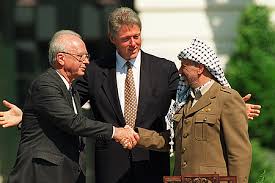
But 16 years later, it is clear that this initial boost was illusory. Not only is Israel’s standing no better than it was prior to the famous handshake between Yitzhak Rabin and Yasir Arafat on the White House Lawn in September 1993, it has fallen to an unprecedented low. Efforts to boycott and divest from Israel are gaining strength throughout the West, among groups as diverse as British academics, Canadian labor unions, the Norwegian government’s investment fund, and American churches. Israeli military operations routinely spark huge protests worldwide, often featuring anti-Semitic slogans.

References to Israel as an apartheid state have become so commonplace that even a former president of Israel’s closest ally, the United States, had no qualms about using the term in the title of his 2007 book on Israel. European polls repeatedly deem Israel the greatest threat to world peace, greater even than such beacons of tranquility and democracy as Iran and North Korea. Courts in several European countries, including Belgium, Britain, and Spain, have seriously considered indicting Israeli officials for war crimes (though none has actually yet done so). And in October, when the United Nations Human Rights Council overwhelmingly endorsed a report that advocated hauling Israel before the International Criminal Court on war-crimes charges, even many of Jerusalem’s supposed allies refused to vote against the measure. In academic and media circles, it has even become acceptable to question Israel’s very right to exist—something never asked about any other state in the world. None of these developments was imaginable back in the days when Israel refused to talk to the Palestine Liberation Organization, had yet to withdraw from an inch of “Palestinian” land, and had not evacuated a single settlement.

Yet even today, conventional wisdom, including in Israel, continues to assert that Israel’s international standing depends on its willingness to advance the “peace process.” That invites an obvious question: if so, why has Israel’s reputation fallen so low despite its numerous concessions for peace since 1993?

(Read full article)


Love of the Land: The Deadly Price of Pursuing Peace

Wednesday, 30 December 2009

Love of the Land: Jimmy Carter and the Politics of Apology

Jimmy Carter and the Politics of Apology


Jacob Laskin
FrontPageMag.com
29 December 09

When it comes to the Israeli-Palestinian conflict, Jimmy Carter is no stranger to apologies. The former president has spent years making excuses for Hamas, championing the Palestinian jihadists as the embattled victims of Israeli aggression – the group’s exterminationist founding charter and record of terrorism notwithstanding. Now it’s Israel’s turn to profit from Carter’s dubious public relations tactics.

After years of demonizing the Jewish state on the world stage, Carter at last has seen the error of his ways. Or so he says: Last week, Carter issued a statement to the Jewish community in which he apologized for his role in tarnishing Israel’s image and, invoking a traditional Jewish prayer, asked for forgiveness.

“I never intended or wanted to stigmatize the nation of Israel, even though I have disagreed with the settlement policy all the way back to the White House,” Carter reportedly said. He also urged that “[w]e must recognize Israel’s achievements under difficult circumstances,” and that “we must not permit criticisms for improvement to stigmatize Israel.”

(Read full article)


Love of the Land: Jimmy Carter and the Politics of Apology

Tuesday, 24 November 2009

Love of the Land: The Israeli-Palestinian Conflict: What’s It Really About and Why Does it Continue?

The Israeli-Palestinian Conflict: What’s It Really About and Why Does it Continue?


Barry Rubin
The Rubin Report
23 November 09

It is always the same theme: Palestinians are the victims of Israel. They want an end to the “occupation,” which in a real sense has not existed for 15 years, and are desperate for a state of their own. Help us! Help us! Help us!

But the funny thing is that it doesn’t turn out that the Palestinian political leaders behave as if they actually believe this stuff. Between 1948 and 1988, the Palestinian leadership explicitly rejected negotiations with Israel, rejected any two-state solution, and openly sought total victory. This was true for two decades after Israel captured the West Bank and Gaza Strip. Indeed, in 1979, for example, when local Palestinian notables indicated an interest in negotiating with Israel for a state (in the framework of the Egypt-Israel Camp David agreement), PLO leader Yasir Arafat told them they’d be traitors and die if they did any such thing.

In 1988, the PLO said it wanted a state of its own but did so with such double-talk language that it was all too clear this was intended only as a springboard for a second round in which Israel would be destroyed. Then the PLO opened a dialogue with the United States based on its agreement to stop terrorism. Though the United States bent over backwards to ignore terrorist attacks (it’s only a specific member group in the PLO attacking so it doesn’t count, said the State Department), Arafat so blatantly broke his promise that the dialogue was broken off.

Then Arafat supported Saddam Hussein of Iraq in his invasion of Kuwait and the Palestinian leader expressed the hope that Iraq would defeat the United States.

What followed at the PLO’s moment of weakness—Saddam defeated; the angry Kuwaitis and Saudis cut off his money—was an act of what they hoped would be enlightened generosity by Israel and America: now that the PLO was so defeated, they reasoned, it would see that victory was impossible and make peace. The result, the Oslo peace process, proved the Palestinian leadership didn’t want a stable peace with a two-state solution. Arafat repeatedly broke his commitments.

And when the moment of truth came, both at Camp David and in the Clinton plan during 2000, the Palestinian leadership (now the Palestinian Authority, PA) turned down offers of a state. Instead, Arafat launched an armed terrorist assault on Israel that went on for five years until the Palestinians were defeated.

(Continue reading...)


Love of the Land: The Israeli-Palestinian Conflict: What’s It Really About and Why Does it Continue?

Friday, 23 October 2009

Love of the Land: A Third Intifada?

A Third Intifada?


Eric Trager
EricTrager.org
20 October 09

On Monday, Jordanian King Abdullah II referred to the Israeli-Palestinian conflict as “the most serious threat to the stability of the region and the Mediterranean.” Middle East policy analysts should take his warning to heart. After all, in gauging the political trends of the Middle East, the Jordanian monarchy has been among the most reliable barometers historically.

This is partly due to Jordan’s uncomfortable geo-strategic position. Indeed, with the Israeli-Palestinian conflict to its west and Iraq to its east, Jordan is uniquely susceptible to the ideological currents and strategic shifts affecting the region’s hottest battle zones. Moreover, Jordan’s imbalanced demography – in particular, the fact that a Hashemite king presides over a Palestinian majority – makes its monarchy particularly wary of any destabilizing signals. These sensitivities create a strong bias in favor of non-ideological, interest-based policy-making, with Jordan shifting its priorities – and, at times, its loyalties – in rapid response to the regional changes that it perceives.

In this vein, Abdullah’s sudden insistence that the Israeli-Palestinian conflict is “the most serious threat to the stability of the region” represents a critical shift in judgment. Indeed, back in 2004, the Jordanian monarch warned that a looming “Shiite crescent” – a near-contiguous sphere of Iranian influence extending through Iraq, Syria, Lebanon, and the Palestinian territories – was the foremost threat to regional stability. Abdullah was prescient: Iran’s interference in Iraq undermined the U.S. war effort, while Tehran’s increased support for Hamas, Hezbollah, and Syria solidified an anti-western axis in the Middle East.

Of course, the challenges associated with Iranian ascendancy haven’t been resolved, and dealing with Iran’s ongoing pursuit of nuclear capabilities still tops the U.S.’s Middle East agenda. Still, Abdullah’s shift in priorities towards the Israeli-Palestinian sphere is worth noting, as it constitutes the best open-source indicator that recent Palestinian threats to resume suicide terrorism and launch a third Intifada are not idle chatter. Naturally, the prospect of renewed Israeli-Palestinian fighting – particularly within the West Bank – is far more threatening to Jordan than a nuclear Iran, and Abdullah’s diversion from his former fear of a “Shiite crescent” suggests that the next, bloody chapter of the Israeli-Palestinian conflict might be fast approaching.


Love of the Land: A Third Intifada?

Thursday, 24 September 2009

Love of the Land: Obama and the Middle East

Obama and the Middle East


Efraim Inbar
BESA Center For Strategic Studies
24 September 09

EXECUTIVE SUMMARY: US President Barack Obama has adopted an activist foreign policy, attempting to engage the Muslim world and signaling his expectation that an end the Israel-Palestinian conflict can be negotiated within two years. This ambitious agenda has so far produced meager results. Many regional players are primarily concerned about Iran’s quest for nuclear weapons, and are not easily amenable to American overtures.

US President Barack Obama's summit meeting with Benjamin Netanyahu and Mahmoud Abbas in New York this week was a good thing, but it amounted to little more than a photo opportunity. The impatient Obama demanded that the parties seriously discuss peace now. Obama appeared to be on the verge of enunciating his own peace plan in order to restart peace negotiations and to eventually end the protracted Israeli-Palestinian conflict – all within two years!

It is worth reminding the president that the many past US peace plans for the Middle East failed to bring the anticipated results. Moreover, the recent meeting in New York only reinforces the evaluation that after eight months in office, the record of Obama’s policy toward the Middle East is far from impressive.

Obama’s much heralded speech to the Muslim world in Cairo failed to make a dent in Middle Eastern realities and attitudes. His belief in the power of words to change people is naive when it comes to well-rooted attitudes or entrenched interests of nations. In instances where the US sided with Muslims when in conflict with non-Muslims, such as in Pakistan, Bosnia and Kosovo, there was little impact on Muslim dispositions. The anti-American rage among Muslims, primarily Arabs, is a result of a concatenation of factors: frustration originating from past grandeur, current poverty, backwardness, and a dark future; a cultural difficulty to accept responsibility; and a preference to blame others for failures to modernize and democratize. While words have great importance in Muslim culture, even the best of speeches cannot change the tide of history. Obama’s words are unlikely to have long-term positive effects for the US, which in final analysis is seen as foreign and domineering.

The “soft power” that this administration extols has its limitations, particular in a region where the use of force is part and parcel of the rules of the game and fear is a better political currency than empathy or love.

So far the “engagement” policy toward Iran, which is part of the new approach to the Muslim world, has produced no results. The nuclear program of Iran continues, and its new proposal to the West did not provide any opening for negotiations on the nuclear issue.

Similarly, the engagement of radical Syria hardly changed Syrian policies. Damascus still supports Hizballah in Lebanon and Hamas in Gaza; allows insurgents to infiltrate Iraq in order to destabilize the current regime; refuses to enter peace negotiations with Israel without preconditions; and above all continues its alliance with Iran. Why should Assad change Syrian foreign policy if he fears no American wrath? As a matter of fact, Iran, Syria, as well as the rest of the Middle East, see “engagement” primarily as an American weakness.

Obama’s Washington does not get anywhere even with its friends. The leaders in all Arab countries know that the American “engagement” of Iran is hopeless in stopping the nuclearization of Iran. During his August trip to Washington, Mubarak of Egypt tried to inject sense into the young American president. Moreover, Mubarak rejected Obama's offer for a nuclear umbrella. So did other pro-American Arab states. American promises to defend them are simply not credible if the US is reluctant to use military force to stop the Iranian nuclear threat.

The impending American withdrawal from Iraq and the difficulties in “fixing” Afghanistan contribute to the general sense of a decline in American influence in the Middle East. Indeed, as regional politics take their toll, a Pax Americana in the Middle East is no longer seen as a viable option for providing progress and prosperity. It is not only the Palestinians that have failed to develop a capacity to govern, with institutions that respond to the needs of the people. The political malaise of the Palestinians is not unique. We see several additional failed states in the Arab world: Somalia, Sudan, Yemen, and even Iraq. Pakistan, a Muslim state, is in danger of collapsing. Even American conquests, such as in Iraq and in Afghanistan, coupled with generous international aid, are not enough to transform these countries. Neither American speeches, nor American “soft power” are able to reform societies deep in crisis. Only a modernizing local leadership can do the trick. (Continue)


Love of the Land: Obama and the Middle East

Love of the Land: When Did Anti-Zionism Become An International Issue?

When Did Anti-Zionism Become An International Issue?


Alex Grobman
The American Thinker
24 September 09

For more than 20 years after the establishment of the State of Israel, anti-Zionism was a regional phenomenon - a conflict between Arab and Jewish national movements in the Middle East. In the Soviet Union and in Eastern Europe, the Soviets exploited antisemitism for political purposes, but it was seldom part of international debate until after the Six-Day War in 1967.

By the end of the 1960s, and since 1975, anti-Zionism became international in scope. It first appeared in the universities in the West where the New Left, in cooperation with Arab student associations, attacked Israeli policy. 1

When the United Nations General Assembly passed Resolution 3379 on November 10, 1975, and declared "Zionism is a form of racism and racial discrimination," it significantly expanded anti-Zionism into the sphere of international nongovernmental organizations (NGOs) and therefore into Third World countries. This was accomplished in collaboration between the Arabs and the Soviet Union that endowed anti-Zionism with legitimacy and official recognition.2

After the First World War, the Arabs expected Greater Syria - which included Palestine and Lebanon - to become a vast, united, and sovereign Arab empire. Instead, the French and the British divided the area into what the Arabs considered "irrationally carved out" entities that became the present-day states of Saudi Arabia, Syria, Trans-Jordan (later Jordan), Iraq, and Israel. The Arabs were outraged that a "non-Arab embryo state in Palestine" had been inserted into an area where it would never be accepted. They claimed that this shattered their dreams of unification and impeded their search for a common identity. 3

The fight against a Jewish homeland became an integral part of their struggle "for dignity and independence." Israel's existence, they claimed, "implied that not only a part of the Arab patrimony, but also parts of Islam, had been stolen. For a Moslem, there was no greater shame than for that to happen." The only way to eliminate this deeply felt affront - this "symbol of everything that had dominated them in the past" - was to rid the area of "imperialist domination." 4

Zionism has been branded as the official enemy of the Arab national movement, but Arab governments have long been accused of using the Arab-Israeli confrontation to divert attention from their own critical domestic social and economic problems. When confronted, they respond that if this were not a real concern, it would not resonate so strongly among the Arab masses. 5

Bernard Lewis, professor emeritus at Princeton University, the dean of Middle Eastern scholars in the West, says Arab fixation with Israel "is the licensed grievance. In countries where people are becoming increasingly angry and frustrated at all the difficulties under which they live - the poverty, unemployment, oppression - having a grievance which they can express freely is an enormous psychological advantage." 6

The Israeli-Arab conflict is the only local political grievance that can be openly discussed. If the population were permitted freedom of speech, Lewis believes that the obsession with Israel would become far less important. Like most people, Arabs are concerned about their own priorities. For the Palestinian Arabs, who view themselves as the permanent victims, the main issue is their struggle with Israel. If Arabs in other countries were permitted to focus on their own problems, they would do so. 7

For Arabs, the attempt to blame Western imperialism is nothing more than an excuse to attack Israel, as another Hebrew University professor Jacob Talmon asserted: "For decades the Arabs have been obsessed by memories of past glories and prophecies of future greatness, mocked by the injury and shame of having an alien and despised race injected into the nerve center of their promised pan-Arab empire, between its Asian and African halves, just at a time when the colonial powers had started their great retreat from their colonial possessions in Asia and Africa." 8

To lessen their feelings of shame for losing every war against Israel, the Arabs attributed the success of Jewish settlement in Palestine and the Israeli military triumphs of 1948 and 1956 to Western imperialism. As the representative of the Great Powers, Israel became the Arabs' scapegoat whenever they became frustrated in their attempt to transcend "centuries of social, economic, and cultural development, and catch up" with the West.
(Continue)


Love of the Land: When Did Anti-Zionism Become An International Issue?

Wednesday, 9 September 2009

Love of the Land: Myths?

Myths?


Jennifer Rubin
Contentions/Commentary
09 September 09

J Street has apparently gotten so much flack about its perpetual criticism of Israel and cheerleading for every Palestinian propaganda point that the J Street team has been forced to come up with a “Myths and Facts About J Street” crib sheet. Let me just say that if a Jewish organization has to put out a statement denying that it is anti-Israel, pro–Mary Robinson, is funded mostly by Arabs, and has defended a nuclear-armed Iran, then they might as well pack it in. Suffice it to say, you don’t see the ADL or AIPAC or any other genuinely pro-Israel group in such a defensive crouch.

Moreover, some of its “defenses” are rather, well, pathetic. Let’s take just two. On Mary Robinson, J Street says it never defended the choice of Mary Robinson for the Medal of Freedom Award. The “defense”? They were mute! Only their friends defended her. No, really:

J Street never issued a single statement related to Mary Robinson. Individuals associated with J Street’s public relations firm may have done some personal work on the issue — but that had nothing to do with J Street, just as the firm’s work for dozens of other clients is completely unrelated to J Street.

Wow, that sure settles that.

Then there is Iran. J Street denies it has defended Iran’s nuclear program. Well, they haven’t defended it. They just don’t think we should, you know, do anything about it:

As of the early fall of 2009, we are not of the opinion that the time has come for Congress to move ahead with further sanctions. We agree with those who are calling for ’strategic patience’ at this moment of unrest and uncertainty in Iranian domestic politics and continue to urge Congress to give the diplomatic and political processes currently underway more time to unfold.

I think the mullahs are the one’s calling for more and more and more time to “unfold.”

And so it goes: J Street doesn’t support U.S. negotiation with Hamas; it just thinks Hamas is too important to ignore:

Ultimately, a political resolution to the Israeli-Palestinian conflict will require Palestinian political reconciliation and we support efforts by third parties to achieve reconciliation and a unity government, whose officials will work within a diplomatic process to achieve an acceptable two-state solution. Further, we would not oppose a decision by the Israeli government, the United States, or other countries to find unofficial, indirect ways to engage Hamas in order to advance U.S. and Israeli interests.

Sort of easy to see how these “myths” take hold. It seems that crack team at J Street’s PR firm that defended Mary Robinson isn’t very good at its job. But then it has an impossible task—trying to convince the Jewish community that they really, deep down, support a strong and secure Jewish state.

Related: J Street Acquisitions And Mergers


Love of the Land: Myths?
Related Posts Plugin for WordPress, Blogger...