Wednesday, 6 January 2010

Love of the Land: What Marya Could Teach Goldstone

What Marya Could Teach Goldstone


Evelyn Gordon
Contentions/Commentary
04 December '10

Israel has spent the past year producing voluminous rebuttals of the Goldstone report, which accused it of deliberately targeting civilians during last year’s war in Gaza. But nothing better illustrates the inanity of this accusation than a single report in last week’s New York Times.

The report describes a friendship between two eight-year-olds who have spent long months together in Jerusalem’s Alyn Hospital for children with severe disabilities. Orel is an Israeli Jew severely wounded by a Hamas rocket. Marya is a Palestinian from Gaza severely wounded by an Israeli missile. Seemingly, complete symmetry — a point the report underscores with its concluding quote from Orel’s mother: “Do we need to suffer in order to learn that there is no difference between Jews and Arabs?”

But despite the Times’ efforts, the symmetry breaks down as Marya’s story proceeds. She was wounded three years ago, when a missile targeting a Hamas terrorist hit her family’s car instead. Her mother, grandmother, and older brother were killed; she was paralyzed from the neck down.

The Israeli government brought her to Israel for medical care that she couldn’t receive in Gaza. It also brought her father, Hamdi Aman, to be with her, and her younger brother, Momen, so he wouldn’t be separated from his surviving parent.

When Marya’s condition stabilized, the government proposed returning her to Gaza, or else the West Bank. Aman objected, fearing his daughter’s care would suffer. The Israeli media and “a bevy of volunteers” mobilized “to fight on his behalf,” and the government “backed off.”

(Read full post)

Love of the Land: What Marya Could Teach Goldstone

Love of the Land: Typical Human Rights Watch Dishonesty

Typical Human Rights Watch Dishonesty


David Bernstein
The Volokh Conspiracy
04 January '10

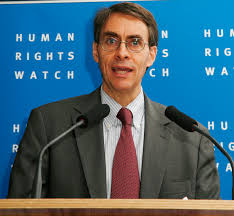
HRW’s website has published this piece on the Geneva Conventions and Israel by director Ken Roth. There are many things wrong with it, but I’ll focus on one piece of blatant dishonesty.

Here’s Roth:

Instead, there is strong evidence that Israel wanted Gazan civilians to pay the price for Hamas’s abuses, and that the decision to impose that cost was taken not by junior officers in the field but by senior government officials.... [A]s the foreign minister at the time, Tzipi Livni, said during a wartime debate in parliament: “On my way here I heard that Hamas declared the man killed by a rocket in Ashkelon ‘one of the Zionists’ despite being an Israeli Arab. They don’t make a distinction, and neither should we.” With culpability running to such senior levels of government, it is no surprise that Israel wants to rewrite the rules.

Roth helpfully provides a link to his source for Livni’s quote, a newspaper article from the Israeli news site Ynet. Put aside, for a moment, the fact that despite the seriousness of his accusation, Roth is quoting from a newspaper article that doesn’t give a transcript (and thus the full context) of Livni’s remarks. And put aside that he is relying on an English translation, not the original Hebrew.

(Read full article)

Love of the Land: Typical Human Rights Watch Dishonesty

Love of the Land: Andrew Roberts’ History Lesson

Andrew Roberts’ History Lesson


Rick Richman
Contentions/Commentary
04 January 09

Andrew Roberts, Britain’s distinguished historian, has an important front-page article in the Jewish Press, entitled “Israel’s Fair-Weather British Friends” – a survey of the history of British diplomatic betrayals and genteel anti-Semitism that should be read in its entirety.

Here’s a remarkable fact about the Queen’s travels, which are controlled by the British Foreign Office:

Though the queen has made over 250 official overseas visits to 129 different countries during her reign, neither she nor any other member of the British royal family has ever been to Israel on an official visit. …

But the Foreign Office has somehow managed to find the time over the years to send the queen on state visits to Libya, Iran, Sudan, Kuwait, Bahrain, Qatar, the United Arab Emirates, Oman, Saudi Arabia, Tunisia, Algeria, Morocco, Jordan and Turkey. So it can’t have been that she wasn’t in the area.

Perhaps Her Majesty hasn’t been on the throne long enough, at 57 years, for the Foreign Office to get around to allowing her to visit one of the only democracies in the Middle East.


Barack Obama has been in office for 56 fewer years than the Queen, but he did a remarkable amount of traveling last year – including three trips to Scandinavia alone (to make a pitch, receive a prize, and negotiate a non-binding agreement) — without visiting Israel. He went to Egypt to give a speech and to Saudi Arabia to make a bow, and to Turkey on another trip, so it couldn’t have been that he wasn’t in the area.

(Read full article)

Related: An Inconvenient Truth

Love of the Land: Andrew Roberts’ History Lesson

Elder of Ziyon: Former CIA analyst throws Israel to the dogs on C-SPAN

Elder of Ziyon: Former CIA analyst throws Israel to the dogs on C-SPAN

Elder of Ziyon: Abbas consolidates his power

Elder of Ziyon: Abbas consolidates his power

Elder of Ziyon: "Siege" news

Elder of Ziyon: "Siege" news

Elder of Ziyon: One and a half million human shields (video)

Elder of Ziyon: One and a half million human shields (video)

Elder of Ziyon: Egypt calls George Galloway a liar

Elder of Ziyon: Egypt calls George Galloway a liar

Why We supported Sharon Out of Gaza

Why We supported Sharon Out of Gaza

Jeffrey Goldberg has been musing about how Sharon made a great mistake leaving Gaza as he did in 2005. Matthew Yglesias thinks it wasn't a mistake, it was a calculated ploy to head off real negotiations; Goldberg agrees this may have been the case.

It may be a wee bit early to say if it was or wasn't a mistake, since the story isn't over yet. Back in 1994, for example, I (and many Israelis) felt Rabin's Oslo Process was wonderful; in 2004 most of us thought it had been a disaster; our perspective in 2014 hasn't happened yet. Bloggers and journalists have the disadvantage of reacting to things as they happen, with minimal data and no perspective in the best of cases.

I can't say what Sharon was thinking to himself: there isn't enough available evidence, only lots of speculation. I can say, however, that a large majority of Israelis supported his determination to leave Gaza. I was part of it, and can say about myself that our thought processes were not what Goldberg and Yglesias say Sharon's were.

I was convinced, and am convinced still, that the Palestinians have recognized that their single most powerful weapon against us is our control over them. This allows them to cast themselves as the oppressed and us as the oppressors, with myriad permutations of these two positions. Since they're our enemies, they are using this weapon to its full extent, as enemies are wont to do. They will not relinquish the weapon for anything less than all of the goals they've defined for themselves, and these include the migration of millions of descendants of the refugees of 1948 into Israel, acceptance by Israel of responsibility for the conflict, and rejection of any symbol of Jewish connection to Jerusalem. And that's the moderate Palestinians.

Given this dynamic, the Israeli imperative must be to end the occupation. Not as a way towards peace, which is not possible, but rather as the best way to manage the conflict. That's why I, and a firm majority of Israelis, supported Sharon in 2005 and voted for Olmert in 2006, when he openly campaigned on a program of ending the occupation in the West Bank even without Palestinian agreement. There will be excruciating complications in the application of the policy, but I'm still for it. Or rather, I'd prefer peace with the Palestinians, but since they're not willing to have peace on terms we can remotely live with, ending the occupation without the Palestinian's permission is the best option.
Originally posted by Yaacov Lozowick's Ruminations

The Mind of the Antisemites

The Mind of the Antisemites

Zionist Juice yesterday called my attention to this line in Michael Ratner's questionable reportage from Maale Edumim:

We saw field after field of olive tree stumps, 100 year old trees that once belonged to the Bedouins that had been cut down by the Israelis—insuring that Bedouins could not stay in or near East Jerusalem.

Set aside the minor complication that the Bedouins in the Judean Desert don't plant olive trees, and certainly didn't a century ago. I know the field (not plural) he's talking about. Or put it like this: there are no such fields on the road from Jerusalem to Maale Edumim. A few miles further on down the same road, however, where Ratner may well also have been, there is one field that theoretically could be what he saw. I wrote about it late in 2007, here; at the time a Guardian reporter had written about the blackened olive trees, and it just so happened I had just taken the same road:

Most significantly, however, in both directions I looked at the two only fields that could possibly fit Borger's description of blackened olive trees. I stared at them, because they are indeed rather puzzling. Back in the 1970s, so far as I can remember, they weren't there at all: merely a parched and dusty hillside. Then in the 80s, as Jewish settlements were built nearby, someone planted them with some kind of desert crop - acacia, perhaps? I sort of thought it must have been the initiative of the new settlers, but maybe I was wrong. I didn't give it much thought - two fields out in the desert, nothing all that noteworthy. And then yesterday, I was struck by the fact that all the stumps look dead.

There was never an olive tree there, the stumps aren't blackened stumps of them, and anyway, what's the connection between Maaleh Edumim, some miles up the road, and those two fields? Maybe the acacia's all died of something? Maybe the owner, whoever he or she might be, stopped watering them and they died? Indeed, I don't know - but I do know that Borger's version is hogwash.

Since writing that post I've learned more about how these peoples' minds work.

More than 99.8% of the settlers have never had anything to do with Palestinian olive trees, nor committed any kind of violence against their Palestinian neighbors. Along the fringe, however, there are cases of destroying olive trees (and worse). The two communities living alongside one another, however, are never reported in the media, just as there aren't many media reports of people elsewhere living near other people. What gets reported are the unusual cases; in the case of the settlers, reports that fit the template of cruel-settlers-ruining-the-lives- of-neighboring-Palestinians will always be given attention.

Eventually this consistent distortion of reality takes on a life of its own: Settlers have a policy of destroying Palestinian olive groves. So people who come to the West Bank to observe the things they've heard of so often are eager to see for themselves, perhaps as a way of inserting themselves in the story and inflating their own importance: I'm part of history! Alas, there are many Palesti
nian olive groves on the West Bank, but most of them are simple groves of olive trees. Not destroyed at all. If you didn't know exactly where to look, you could criss-cross the West Bank and never see a destroyed grove. Yet the purpose of the trip is to see - so the travelers invent.

Michael Ratner certainly did. He saw some Bedouins and told they're about to be evicted. He saw a road which has been constructed by the Israelis to assist Palestinian travel from Rammalah to Bethlehem and cast it as Apartheid. He saw some rotten stumps and knew they were century-old Palestinian olive trees destroyed by the Israelis.

Humbug.
Originally posted by Yaacov Lozowick's Ruminations

Freedom of Speech, Within Limits

Freedom of Speech, Within Limits

The Guardian has an interesting item about free speech and the right to be boorish. No, they're not defending the crude norm of their discussions of Israel. This time the shoe is on the other foot. A British Islamist with an impeccable accent by the name of Anjem Choudry has cooked up the idea of protesting the UK's participation in the war in Afghanistan and particularly the high number of civilian casualties there by having a procession with mock coffins in Wootton Basset, the town through which the biers of many fallen soldiers are marched. So the demonstration is sort of like pissing on their funerals.

Predictably, everyone is furious, from the prime minister through the Home Secretary Alan Johnson who apparently has the legal tools to block the demonstration, through 120,000 Facebookers who have banded to express their anger, all the way to the more mainstream Muslim Council of Britain, many of whose members probably agree with Choudry's politics but whose officials fear the tactic is all wrong.

You really ought to watch the short interview with Choudry. He's clearly a charismatic chap.

I've been saying for months that the societies whose soldiers are fighting the just war against the Islamists need to be taking a closer look at how they're waging it and how many civilians they're killing. So I'm warily on Choudry's side that someone's got to raise the issue. (I doubt there's much else we can agree on).

Banning freedom of speech is necessary sometimes. There's the principle of shouting Fire in a crowded theater, of course, but there are also operational matters at time of war which clearly don't need to be public - and even at time of non-active war, come to think of it. There's direct incitement to violence: there have to be limits on that, though they need to be monitored carefully.

Is being rude justification for being silenced? I think not. Even when it's extreme rudeness, beyond any plausible lines of discussion. It looks like the British consensus sees it differently than I. In the UK, being rude can get you silenced, if your rudeness is directed at the right (wrong) target. You can't offend Muslims too much, and you can't offend fallen soldiers. Israelis, Americans, Russians, MPs, fox hunters and zoo visitors, however, are all free season. It's a democracy, after all.
Originally posted by Yaacov Lozowick's Ruminations

DoubleTapper: M4 M16 Rifle accessories FGG-S

M4 M16 Rifle accessories FGG-S

تنسيق-الكليات-لعام سكس نيك كس

I've been on our Community Counter Terror Team for a long time. The team is under the auspices of the IDF with local municipal cooperation. Since the IDF can't be everywhere, we act as the first line of defense if there is a terror threat to our community.

We are issued IDF M16 or M4 rifles, and are tasked with carrying them around the neighborhood and take care of business in the event of a terror attack. In addition, we carry our personal handguns. Mine is a Glock, which is the most popular of the brands on our team.

We train in Hostage Rescue, Urban Warfare, Krav Maga and many other techniques and tactics.

Other then our rifles, our gear consists of whatever we can get our hands on (there is no budget). Over the years, we managed to scrape together enough funds to purchase the highest quality ceramic vests, Kevlar helmets, etc.


Rifle accessories are expensive so we tend to scrounge them from various sources including newly released IDF Servicemen. There are lots of different accessories in use by our team from lots of different sources. I've tried out just about everything and found some accessories to be high quality and others to be junk.

I've recently taken on the responsibility of evaluating new equipment for our team.


The newest accessory I've added is the FAB Defense FGGS Black Tactical Folding Grip that I got from Zahal.org


I've used fore grips in the past, some that even fold. Usually they are wobbly, not ergonomic and a pain to fold and unfold.

The FAB Defense FGGS Tactical Folding Grip is amazing. It mounts tightly to the Picatinny rail, it's ergonomic and feels natural when folded and unfolded and is knurled (so sweaty fingers can still grip it without slipping). It locks tightly when open (the others I've tried don't).


Here's what I use it for:


Open- Short range it adds stability to the rifle which is a must when shooting rapidly at moving targets.


Closed- Long range it provides a comfortable place to support the rifle when taking careful aim while not gripping the rifle tightly, think sharpshooter.


From the website:
  • Quickly transforms from a horizontal grip to a vertical grip
  • Durable & hardwearing construction
  • State-of-the-art ergonomic design
  • Quick attachment/removal mechanism
  • The FGG-S Grip Carries FAB Lifetime Replacement Guarantee!
  • Fits all standard Picatinny rails
  • Fits most handguns with a front Picatinny type accessory rails
  • Will not disturb operation when set to the horizontal position
  • Quick Folds/Unfolds and Release buttons
It also mounts to the rails on most handguns and is perfect fit for the Glock.


If you own a rifle, do yourself a favor and get the Fab Defense FGGS Tactical Folding Grip!

DoubleTapper: M4 M16 Rifle accessories FGG-S

A Soldier's Mother: A War Ago and a New Reality

A Soldier's Mother: A War Ago and a New Reality

"And he will rule over you" (Ber. 3:16) - Part 1

"And he will rule over you" (Ber. 3:16) - Part 1


04
ינו
2010

Question: Why isn't there equality in a family according to the Torah? Why should my husband rule over me?
Answer: This is a curse, not the ideal situation. This curse appears after Adam and Chavah sinned, on the advice of the snake, which is the evil inclination. Before this point, the Torah does not say that Adam ruled over his wife, rather he called her: "The bone of my bones" and "the flesh of my flesh" (Bereshit 2:23). This means that a couple is one soul with two bodies. There is therefore nothing inherent about ruling or being ruled over. But the sin mixed up this state. Adam and Chavah followed after the evil inclination and as a result their inner unity was destroyed. The man, the stronger of the two, is thus able to rule over his wife. But this is certainly not Hashem’s intention or will. This is a curse, but there is no curse which is beyond remedy. This is the challenge.
Originally posted by Torat HaRav Aviner

RubinReports: Boring Press Conference? No, Gold Mine for Understanding U.S. Middle East Policy

Boring Press Conference? No, Gold Mine for Understanding U.S. Middle East Policy

By Barry Rubin

What could be more boring, you might ask, then a press conference following the meeting between Secretary of State Hillary Clinton and Qatar Prime Minister Sheikh Hamad Bin Jassim Bin Jabr al-Thani? Well, a little document like this is a gold mine of interesting stuff that either won’t be covered or won’t be understood in the mass media.

Qatar, though tiny, is a very interesting country. On one hand, it hosts al-Udayd air base which is vital for the U.S. presence in the Gulf. On the other hand, it hosts and owns al-Jazira television which incites anti-Americanism. To make matters worse, Qatar has been the Gulf Arab state closest to Iran, which hosted the anti-American and radical summit led by the Iran-Syria bloc.

So Qatar is hedging its bets rather well. In public, Hillary isn’t going to complain about this stuff. Did she do so in the private meeting? Perhaps, though the jollity of al-Thani, a member of the ruling family, seems to belie any tough words from the secretary of state. But this is going too far:

“Qatar is a friend and an ally of the United States, and the partnership between our two countries is a model of the new beginning based on mutual respect and mutual interest that President Obama called for in Cairo.”

A model? Well, is that signaling countries like Egypt, Jordan, and Saudi Arabia that they can be praised as a model partner if they were to bash the United States more and cozy up to Tehran?

One matter the two leaders discussed was Yemen, which has become a headquarters for anti-American jihad, notably the recent plane bombing attempt. Hillary said the United States is working with Qatar, also thanking Qatar or its “efforts to facilitate an end to the crisis in Darfur and to promote security and stability in the broader Middle East as well as Africa.” As Egyptian and other Arab leaders will tell you, they consider Qatar a major contributor to regional instability.

Hillary also praised Qatar for its help in Israel-Palestinian peace (more on this in a moment), Iraq, and Iran. And finally—it’s impressive Clinton could say this with a straight face:

“Let me express our appreciation to His Excellency and to His Majesty the Emir and his country for their actions in combating hunger and poverty and disease across the region and the world.” No I don’t think Qatar, given its massive wealth, has been one o the main philanthropists.

One other thing Clinton said is rather disturbing. It is now in the Obama Administration talking points to say that the Palestinians "deserve" a state. This is quite a stupid formulation for it implies that it is theirs no matter what they do and nothing more is required of them.

In this approach, having a state isn't something to be earned by showing you are moderate, ending terrorism and incitement, truly accepting Israel's existence, providing strong security guarantees, and resettling your refugees in your own country. According ot the U.S. government, Palestinian statehood is an entitlement. So why shouldn't the Palestinians demand that they get all the compromises and concessions and give nothing themselves? The world owes them a state. By such policies the Obama Administration undermines its own leverage on the issue. One more nail in the already studded coffin of the peace process.

Now, what did Thani say in response to all of this. Yemen? Sure, what’s required there is a peaceful solution, not defeating the terrorists and the Iran-backed rebels. Remember, Qatar is more on Iran’s side than any other Arab states except for Syria. Palestinians? Here’s his suggestion:

“But the most important things is how we can do a unity governments [sic] between the Palestinians so they can concentrate how to deal in the peace process….”

What’s this mean? Why that the Palestinian Authority should go into a coalition with Hamas, a step that would ensure no progress could possibly be made since the latter is dedicated to Israel’s destruction and the creation of a radical Islamist state allied to Iran.

This doesn’t mean Qatar simply took a hard line on the issue. It advocated negotiations and while bashing Israel a bit Thani also said something very important: “and it’s an opportunity with this Administration to bring us together to a long-lasting peace between us and Israel.” By Arab standards that’s a significantly dovish thing to say (I wonder I that phrase will be quoted on al-Jazira, which is not allowed to criticize the Qatari government. Somehow I doubt it.)

Finally, an intriguing hint from Thani about Arab countries having given Clinton some kind of “letter o guarantees” relating to the peace process back around October and waiting or a U.S. response. What’s that about?
What does Thani say about Iran? The solution to the nuclear weapons’ drive must come through dialogue. Nothing he said would bother Tehran.

As for Clinton, her remark that the United States was “disappointed” by Tehran’s rejection of the U.S. proposal and “deeply disturbed” by repression makes it sound like the United States is still more involved in engagement than with pressure.

She, too, said something astonishing, regarding Iran:

“Now, we’ve avoided using the term `deadline’ ourselves. That’s not a term that we have used because we want to keep the door to dialogue open.”
What? The Obama Administration has repeatedly stated that it was setting a deadline by the end of 2009 in which sanctions would be raised unless Iran changed its approach. This statement can only be read in Tehran as a backing down by Washington.

Her saying, “We have already begun discussions with our partners and with likeminded nations about pressure and sanctions,” doesn’t sound like this is a high-priority activity. We’re in no hurry and we’ve just started talking. We’ll get back to you some time.

I wrote this predicting that the Iranian regime would pick up on this remark and sure enough in less than a day it came back in pleased triumph. Ramin Mehmanparast, an Iranian Foreign Ministry spokesman responded:

"We share the same idea with her. Deadlines are meaningless. We hope other countries return to their natural path, too."

In other words, we're glad the United States is giving us all the time in the world to develop nuclear weapons.

Clinton also confirmed my worst fears about the kind of limited sanctions the administration envisions: “Our goal is to pressure the Iranian Government, particularly the Revolutionary Guard elements, without contributing to the suffering of the ordinary Iraqis[1] who deserve better than what they currently are receiving.”

In other words, Clinton is saying, we’re going to make sure the sanctions don’t really damage the Iranian economy and limit the income by a tiny percentage of those getting rich within Iran itself.

I'm going to predict--and I've analyzed this in more detail here--that any sanctions on Iran from the Obama administration are going to be slow in coming and incredibly ineffective, even in comparison to what was expected a few months ago. For more on this issue, see:
http://rubinreports.blogspot.com/2009/12/obamas-2010-policy-and-iran.html

Barry Rubin is director of the Global Research in International Affairs (GLORIA) Center and editor of the Middle East Review of International Affairs (MERIA) Journal. His latest books are The Israel-Arab Reader (seventh edition), The Long War for Freedom: The Arab Struggle for Democracy in the Middle East (Wiley), and The Truth About Syria (Palgrave-Macmillan). To read and subscribe to MERIA, GLORIA articles, or to order books. To see or subscribe to his blog, Rubin Reports.

RubinReports: Boring Press Conference? No, Gold Mine for Understanding U.S. Middle East Policy

Tuesday, 5 January 2010

RubinReports: The Suicidal Rules of Arab Political Debate: How Relatively Moderate Regimes are Robbed of Self-Defense

The Suicidal Rules of Arab Political Debate: How Relatively Moderate Regimes are Robbed of Self-Defense

By Barry Rubin

It’s always interesting to analyze those little stories that show so clearly the rules of Arab politics and debate, themes which never quite find their way into the Western media, which only see these issues in a Western political and intellectual framework. Yet if you want to understand Middle East politics it is imperative to comprehend such realities.

The example here is a statement by Egyptian Minister of Legal Affairs Mofid Shehab attacking al-Jazira television for, in his words, “instigating civil war” in Egypt. Al-Jazira has been complaining that Egypt is building a steel barrier along its border with the Gaza Strip to block Hamas from smuggling in weapons and other things.

Shehab complains:.

"A number of Arab satellite stations, and [al-Jazira] especially, have placed themselves as responsible for the sovereignty of our country, and as usual have poisoned the public against the state."

Here are some of the rules. The more militant a group is in fighting Israel or the West, the better. All Arab regimes are supposed to help these groups without reservation, even if it damages their infrastructure and drags it into an unwanted war (Lebanon in 2006; Jordan in the 1960s).

Egypt is building the barrier because it views Hamas as an enemy of the Egyptian regime and national interest in two respects. First, Cairo sees Hamas as an instrument of Iran and its bloc, a grab for regional power of Persian, Shias, and Islamists to the determinant of Arabs, Sunnis, and Arab nationalists.

Second, because Hamas is aligned with the Egyptian Muslim Brotherhood which wants to overthrow the regime. If Hamas succeeds in entrenching itself in the Gaza Strip, that will be an inspiration to the regime’s enemies at home, while the arms’ smuggling will also eventually provide more guns for terrorists within Egypt.

Consequently, the Egyptian government would like to see Hamas fall from power in the Gaza Strip and be replaced by a Fatah-dominated Palestinian Authority regime. But given the constraints of Arab politics, it will not do too much to bring about that outcome. Similarly, the Egyptian government would be happy in theory if the Palestinians made peace with Israel, ended the conflict, and obtained a state. Again, though it won't do much toward that goal other than insisting the United States has to make it happen.

The above is basic and normal national interests’ stuff. Yet not one word of this—or at least very little--can be expressed by Egypt. After all, Hamas is fighting Israel and Western influence, so that has to be good. It is “Islamist,” piously Muslim, so that has to be good, too. Iran and Syria can speak and act freely; Egypt, Saudi Arabia, and Jordan cannot.

Shehab expresses his views in an interview with al-Ahram, a regime-controlled newspaper. Clearly, Hamas’s use of statist repression isn’t something repugnant in principle to the Egyptian government. And so Shehab switches the target from Hamas itself to foreign news media which is assumed to be the instrument of another state rather than merely reporting facts.

The goal of these television networks, explains Shehab, is, “To engender a civil war and inflame the Egyptian and Arab streets, and cause a clash of official authorities."

That is, calling attention to the wall is intended to stir up Egyptians against their own government. How come they’re restricting rather than helping Hamas in its battles? Since Shehab’s government cannot answer that question within the bounds of permitted discourse, it has to focus on the mere raising of the issue as the problem.

Shehab then raises another issue in his arsenal: al-Jazira and other Arab media attacked Israel during the Cast Lead operation in the Gaza Strip in early 2009. They now criticize Egypt. Therefore, according to this logic, they are comparing Egypt to Israel, which is unacceptable: "They have launched a war against the Egyptians just as they did during the barbaric attack on Gaza a year ago."

The mythology must be maintained that all Arabs are always on the same side and that all Muslims are always on the same side. The good guys are good guys who cannot be criticized; the bad guys are always bad guys who must always be criticized. Indeed, Shehab then turns to the ultimate weapon, the atomic bomb of propaganda: attacking Israel and America:

"Why didn't Al-Jazeera have a single word of condemnation to say about the weapons, missiles, and smart bombs that were sent from Al Udeid Base [in Qatar]to Israel in order to bomb the residents of Gaza?"

This is quite a startling lie for a cabinet minister of a “moderate” government “aligned” with the United States and receiving massive amounts of American aid. Shehab, obviously with permission from the highest levels of the Egyptian government is trying to “inflame the Egyptian and Arab streets, and cause a clash" of the Arab masses with the United States.

And of course it is untrue, a lie that could lead to terrorist murders of Americans. There was no U.S. equipment shipped to Israel especially in order to be dropped on the Gaza Strip, especially not from Qatar (which is singled out here because it is the master of al-Jazira). In other words, the proper response for any criticism by Arabs or Muslims is: Oh yeah! Well, you’re a murdering Zionist agent and a lackey of American imperialism!

This is, one must remind oneself, the end of the twenty-first century’s first decade while in the Middle East it is just like being in the 1960s. And the early 1960s at that.

Indeed, Shehab continues, this specific report is a Zionist operation to discredit Egypt:

"This civil war network is first and foremost an Israeli tool. It transferred reports on the Egyptian construction on the border from the news agencies in Israel and has begun to weave its usual plot."

Of course, Israel is happy that Egypt is building this wall. Precisely at the moment when Egyptian and Israeli interests align, the Egyptian government has to step up its verbal attacks on Israel.

The minister does note indirectly that the barrier is being built to avoid a repeat of the time in January 2008 when many Gazans broke through the border defenses as Hamas gunmen shot at Egyptian soldiers. "I ask all Egyptians, and all those who support their homeland, are you willing to accept the violation of your country's sovereignty?"

Shehab thus indulges in a bit of Egyptian patriotism, which is permissible though usually only as a secondary factor which doesn’t enjoy the same level of legitimacy of the other arguments. In short, a more moderate state, at least, is not quite able to pursue its own interests.

They can go against the current when necessary but always at a cost. Egypt made peace with Israel, for example, but faced years of boycott, President Anwar al-Sadat was assassinated, and the peace cannot be a warm one. Saudi Arabia can seek Western help in the fact of Iraq’s seizure of Kuwait but the cost is the rise of Usama bin Ladin and years of terrorism.

Already criticisms and demonstrations are starting against the Egyptian wall in various countries. The claim is that the structure is unacceptable because it “helps” Israel. The fact that it also helps Egypt as much or more is not considered to be relevant.

Thus, one sees in this little item, as in hundreds more, how crippled the Arabic-speaking world is by its own form of Political Correctness. Such a doctrine is incompatible with democracy at home, full peace with Israel or a real alliance with the West. The question for the future is whether it is compatible with the survival of the Arab regimes themselves in the face of a challenge from Iran and revolutionary Islamists.

RubinReports: The Suicidal Rules of Arab Political Debate: How Relatively Moderate Regimes are Robbed of Self-Defense

Hareidi Participation in Army On the Rise - Defense/Middle East - Israel News - Israel National News

Hareidi Participation in Army On the Rise - Defense/Middle East - Israel News - Israel National News

Eastern Jerusalem Yeshiva to Become Neighborhood - Inside Israel - Israel News - Israel National News

Eastern Jerusalem Yeshiva to Become Neighborhood - Inside Israel - Israel News - Israel National News

Jordanian Lawyers Seek Arrest of Two Knesset Legislators - Politics & Gov't - Israel News - Israel National News

Jordanian Lawyers Seek Arrest of Two Knesset Legislators - Politics & Gov't - Israel News - Israel National News

Tel Aviv Principal Preaches against %u2018IDF as Occupation Army%u2019 - Education - Israel News - Israel National News

Tel Aviv Principal Preaches against %u2018IDF as Occupation Army%u2019 - Education - Israel News - Israel National News

Arab Fired for Spreading Anti-Israel Disinformation At Work - Inside Israel - Israel News - Israel National News

Arab Fired for Spreading Anti-Israel Disinformation At Work - Inside Israel - Israel News - Israel National News

MK Rotem: If Settlements are Cancer I Hope it Grows and PA Dies - Politics & Gov't - Israel News - Israel National News

MK Rotem: If Settlements are Cancer I Hope it Grows and PA Dies - Politics & Gov't - Israel News - Israel National News

Police Foil Terrorist Attack in Jerusalem%u2019s Old City - Defense/Middle East - Israel News - Israel National News

Police Foil Terrorist Attack in Jerusalem%u2019s Old City - Defense/Middle East - Israel News - Israel National News

Love of the Land: Road to nowhere

Road to nowhere


Nitsana Darshan-Leitner
Opinion/JPost
04 January '10

Last week's High Court ruling opening part of Route 443 to Palestinian traffic has set off a firestorm of criticism in Israeli political circles. In a 38-page decision, the court ruled that by keeping Palestinians off the road, which winds through post-1967 lands on the northwest approach to Jerusalem, the army unfairly discriminated against local Palestinians who should be allowed to use it, fostering among them a "sense of inequality and even associations of improper motives."

The court ordered the army to find "another solution" that would avoid the "sense of discrimination" that the closure entails. While the ruling may at first sound both reasonable and fair, it is in practicality neither and will result in the deaths of additional Israelis.

FIRST, THE history. The IDF's security concerns are far from theoretical. Beginning with the second intifada in 2000, Palestinian terrorists found in 443 an easy target for shootings and other deadly attacks. In just eight months, from December 2000 to August 2001, six Israelis were murdered, and many more wounded, on that very road. The villagers who would use the road today are those who knowingly harbored these terrorists and provided them with an easy escape route. This is why the road was closed to Palestinian traffic in the first place.

Although the Palestinians have failed to mount deadly attacks on 443 since the road was closed to them in 2002, it is not for lack of trying. In the last few years, the IDF has recorded hundreds of violent attacks, from throwing rocks and Molotov cocktails to shootings, along Route 443. Just last month, the army defused a massive roadside bomb along the road. Even with the closure, 443 remains one of the most vulnerable highways to terror.

Second, the road itself. Route 443 is no side street. It is one of the two major arteries connecting Jerusalem with the rest of the country. For many of the more than 100,000 residents living along the stretch from Modi'in to the northern neighborhoods of Jerusalem, it is the only way to get to and from work each day. Although a small part of the road goes through post-1967 territory, the people who use the road are not "settlers," but ordinary Israelis, Arabs and Jews, living their lives.

(Read full article)

The writer is the director of Shurat Hadin - Israel Law Center.


Love of the Land: Road to nowhere

Israel Matzav: US forces EU parliamentarians to cancel Iran trip

US forces EU parliamentarians to cancel Iran trip

A group of EU parliamentarians that was planning to visit Iran has confirmed that it has canceled its trip under pressure from the United States.

A delegation of EU legislators canceled a planned trip to Iran after US congressmen sent a letter of protest to Jerzy Buzek, president of the European Parliament, EU Parliament spokesman Thomas Dudrap confirmed to The Jerusalem Post on Monday.

The EU delegation still wanted to travel this week to Teheran, but the meeting has been called off for now.

In the letter the congressmen wrote, "We believe that such a visit, especially at this critical juncture, is counterproductive and potentially damaging to the international community's efforts to stop Iran's pursuit of nuclear weapons.

"As you know, Iran's leaders have been relentlessly pursuing nuclear capabilities for several years, in violation of their obligations under the Nuclear Non-Proliferation Treaty (NPT). They have threatened their neighbors as well as the United States and the European Union.

"As prime funders of Hamas and Hizbullah, they have threatened Western targets, sought to destabilize a critical region in the world, and dedicated themselves to the destruction of the State of Israel."

The letter was signed by 15 members of Congress. Asked if it prompted the EU delegation to cancel its January 8 visit, Dudrap said he "does not know."

Can someone please explain to me why these unnamed members of Congress were apparently okay with John Kerry going to Iran until the Iranians said no, but objected to the Europeans going? Don't get me wrong - I don't think anyone should be visiting Iran right now because it will only encourage the current regime to believe that they can retain power. But the contrast between Kerry and Euroweenies does seem to be a double standard (which I made more blatant with the picture I chose. Heh). Then again, I wouldn't expect any better from this Democrat-controlled Congress.

Israel Matzav: US forces EU parliamentarians to cancel Iran trip

Israel Matzav: Pushing back against disarming America

Pushing back against disarming America

President Obama has a euphoric vision in which we will live in a nuclear-free world. That vision is totally unrealistic. If the United States gives up its nuclear weapons, in no time at all, the world will be dominated by terrorist states or by Russia and China. So the Pentagon has started to push back against Obama's nuclear free world.

Officials in the Pentagon and elsewhere have pushed back against Obama administration proposals to cut the number of weapons and narrow their mission, according to U.S. officials and outsiders who have been briefed on the process.

...

In turn, White House officials, unhappy with early Pentagon-led drafts of the blueprint known as the Nuclear Posture Review, have stepped up their involvement in the deliberations and ordered that the document reflect Obama's preference for sweeping change, according to the U.S. officials and others, who described discussions on condition of anonymity because of their sensitivity and secrecy.

The Pentagon has stressed the importance of continued U.S. deterrence, an objective Obama has said he agrees with. But a senior Defense official acknowledged in an interview that some officials are concerned that the administration may be going too far. He described the debate as "spirited. . . . I think we have every possible point of view in the world represented."

The debate represents another collision between Obama's administration and key parts of the national security establishment, after scrapes over troop levels in Afghanistan and missile defenses in Eastern Europe.

But more than those issues, the future of U.S. nuclear weapons policy is directly tied to a series of initiatives Obama has advanced as a prime goal of his presidency.

"This is the first test of Obama's nuclear commitments," said former U.S. Ambassador Nancy E. Soderberg, who held senior foreign policy positions in the Clinton administration. "They can't afford to fall short at the outset."

Read the whole thing. It's not realistic for the US to totally give up its nuclear arsenal. It may not be realistic to give up a significant portion of it either. If the West gives up its nuclear weapons, only terrorists would have them, which would be far worse than the current situation.


Israel Matzav: Pushing back against disarming America

Israel Matzav: Overnight music video

Overnight music video

Yeedle Werdyger sings "Every Jew has a share in the World to Come."

Let's go to the videotape.


Israel Matzav: Overnight music video

Israel Matzav: Who needs peace?

Who needs peace?

This is the flip side of the story about how much it costs us to try to make peace. Dan Ephron reports in Newsweek that most Israelis aren't very interested in peace anymore.

Only about 40 percent of Israelis now long for a rejuvenated peace process with the Palestinians. An even smaller number, about 20 percent, believe such talks would amount to anything. That doesn't mean Israelis are warmongers, although right-wing Prime Minister Benjamin Netanyahu often complains his government is portrayed that way. Palestinian negotiators were outraged last week when the Israelis approved construction of another roughly 700 housing units in East Jerusalem despite a freeze on new building in West Bank settlements; they claim Netanyahu's professed desire to sit down and talk is disingenuous. Yet in the long years since the Oslo process began, each side has had its turn—several turns—as the spoiler. And in fact, more Israelis than ever (including Netanyahu, though with major provisions) now say they're willing to live alongside an independent Palestinian state.

What's changed is that more Israelis than ever also seem to feel little urgency about reaching that goal. This, as much as any reluctance on Netanyahu's part, may pose the greatest obstacle to the Obama administration's efforts to reach a peace agreement before 2012. A combination of factors in recent years—an improved security situation, a feeling that acceptance by Arabs no longer matters much, and a growing disaffection from politics generally—have for many Israelis called into question the basic calculus that has driven the peace process. Instead of pining for peace, they're now asking: who needs it?

...

In short, Israelis are enjoying a peace dividend without a peace agreement. Clearly, that can't last. Without a resolution to its conflict, Israel will always face the prospect of international isolation and challenges to its very legitimacy. But the tendency toward short-term thinking is reinforced by another somewhat skewed cost-benefit analysis that Israelis are inclined to embrace: while the absence of peace is exacting a very low price, Israeli attempts to forge a peace deal have exacted a very high one.

Most Israelis, in this analysis, associate the Oslo accords not just with the historic handshake on the White House lawn but with the first suicide attacks by Palestinians. Ask Israelis what they got in return for their offer at Camp David nearly a decade ago to hand over most of the West Bank and they'll point to the second intifada. In Israeli minds, Palestinians should have been grateful for the 2005 withdrawal from Gaza—instead they fired rockets at Israel.

Read the whole thing.

I don't agree with everything he says, but it would be fair to say that most Israelis feel no urgency to reach an agreement with the 'Palestinians' and many of us are convinced that the current situation could last for quite some time - barring an Iranian nuclear weapon coming into play. In the long run, the fact that most Israelis don't feel that we have to make peace may be what brings the 'Palestinians' to the table without an unreasonable set of demands.

Israel Matzav: Who needs peace?

Israel Matzav: Too good to check: Ahmadinejad's web site has been hacked

Too good to check: Ahmadinejad's web site has been hacked

This is too good to check: Ahmadinejad's web site has been hacked (Hat Tip: Only Mehdi).

UPDATE 2:24 AM

Welcome Gateway Pundit readers.

Israel Matzav: Complying with Goldstone's demands would lower Israel's standards

Complying with Goldstone's demands would lower Israel's standards

Justice Richard Goldstone has demanded that Israel establish a special review committee to examine the IDF's conduct during Operation Cast Lead. But, argues David Benjamin, establishing such a committee would actually lower the standards to which the IDF is already subject.

LET'S TAKE a look at the investigation process as stipulated by Israeli law: Firstly, the IDF is required to investigate every complaint into misconduct by its troops, from the severe to the trivial. The IDF will also launch investigations even when no complaint has been filed, such as when alleged misconduct is brought to light in the media. Generally, the initial investigation may take one of two forms: either a criminal investigation by the Military Police or an operational enquiry by senior officers.

The former is appropriate when the criminality of the alleged misconduct is clear, e.g. looting, assault of detainees. The latter is employed where the circumstances do not necessarily point to a criminal act, e.g. civilian casualties as a result of a bombing raid. There is nothing to preclude the military advocate general (MAG) from ordering a criminal investigation at the outset in any case, including in cases concerning operational activity (note that Goldstone erroneously claims that this is not so) and the MAG has in fact done so on a number of occasions.

The MAG is authorized to review the findings of all operational enquiries for the purpose of deciding whether or not to order a criminal investigation. Moreover, the civilian attorney-general is authorized to review and overturn the decisions of the MAG in this regard. Most significantly, the Supreme Court can review and overturn any such decision.

Also, the MAG's decision whether to press charges - and if so, what charges - is also reviewable and can be overturned both by the attorney-general and by the Supreme Court.

The point is that all decisions by the military and civil authorities in relation to investigations and prosecutions, including questions of "pusillanimity," are ultimately reviewable by the highest court in the land.

THE LIKELIHOOD of such review taking place is far from hypothetical. Anyone with a legitimate interest can petition the High Court to review any decision by any Israeli authority, civilian or military. It has been long established that Palestinian residents of Gaza and the West Bank as well as Israeli human rights organizations have the right of standing in the High Court.

The thousands of petitions brought annually against the IDF are testimony to the routine nature of such proceedings. It is important to note that unlike the US Supreme Court, which can select the cases it wishes to adjudicate, the High Court has no such luxury and is obliged to give its attention to every petition. The bottom line is that anybody who is unhappy with the Cast Lead investigation process in general, or with any individual investigation in particular, has a clear path to the High Court once they have exhausted other remedies.

Benjamin, a former legal adviser to the IDF, wonders whether Goldstone ignored the IDF investigatory process, or whether he was simply unaware of it. As you may recall, at the Jerusalem Center for Public Affairs' session for bloggers two weeks ago, I asked Dore Gold how much Goldstone had previously seen of the material that Dore presented during his debate with Goldstone in November. Dore said that it had all been sent to Goldstone last summer, but Goldstone had obviously not seen it. Dore speculated that Goldstone's staff may have kept the material away from him.

This is also likely the case with respect to the IDF's investigatory process. It's doubtful that Goldstone's staff knew or bothered to ask what the IDF's investigatory process is. Goldstone was likely too lazy or apathetic to care. After all, he knew what his conclusions had to be in order to advance his career, and was likely not interested in any evidence that would conflict with those conclusions.

Israel Matzav: Complying with Goldstone's demands would lower Israel's standards

Israel Matzav: Pursuing peace brings out the sharks

Pursuing peace brings out the sharks

Let's get you into the mood first. Let's go to the videotape.


Sixteen years ago, Israel signed the Oslo Accords and began what looks like a panicked pursuit of peace. Not only have we not gotten peace, argues Evelyn Gordon in the latest issue of Commentary, but the more we pursue peace, the worse our standing in the 'international community' becomes. Gordon argues that there are four reasons behind this:

First, Oslo led Israel to sideline its own claim to the West Bank and Gaza, which all Israeli governments (and international Jewish leaders) had stressed to some extent before 1993. Though there had long been a lively debate as to whether Israel ought to hold on to these territories in practice, until 1993 all sides were ready to assert that it had a valid claim to them in principle.

...

Granted, much of the world was disposed to accept the Palestinian claim even before Oslo. But as the sage Hillel famously said 2,000 years ago, “If I am not for myself, who will be for me?” Oslo marked the moment when Israel stopped defending its own claim to the West Bank and Gaza and instead increasingly endorsed the Palestinian claim. And with no competing narrative to challenge it any longer, the view of Israel as a thief, with all its attendant consequences, has gained unprecedented traction.

...

[T]he problem has been compounded by another unanticipated consequence of Oslo: the territorial withdrawals it entailed have resulted not only in more dead Israelis but also in more dead Palestinians. Nothing undermines a country’s image more quickly than pictures of bleeding victims recycled endlessly on television and computer screens. That is precisely why worldwide protests against both the Second Lebanon War in 2006 and Operation Cast Lead in Gaza last January—operations aimed at halting terror launched from territory Israel had evacuated to the last inch—drew far larger crowds than protests against Israel’s ongoing occupation of the West Bank. Death causes more outrage than occupation.

...

Israeli withdrawals have also had another unintended consequence: they have energized anti-Israel radicals who, despite their small numbers, have contributed greatly to the anti-Israel climate by propelling the boycott and divestment movement. Because groups such as labor unions and churches are generally viewed positively, when a wide variety of such groups throughout the West all start targeting one particular country for boycott and divestment, people without any prior knowledge of the facts might naturally assume that the accused country must indeed be guilty to merit such treatment. What those people fail to realize is that boycotts and divestments are usually approved not by an organization’s full membership but by a handful of activists, which enables a few radicals to hijack the debate.

...

Yet this desperate quest for peace also failed to win Israel points among the general public, because each new initiative raised new hopes of a peace that was in fact never achievable. And it is human nature to be angrier over disappointed hope than over having never hoped at all. What is worse is the very fact that whenever negotiations broke down, it was Israel, rather than the Palestinian side, that came back with a better offer, created the impression that both sides thought peace would be achievable if Israel just gave enough. Thus the lack of peace must be Israel’s fault.

Gordon believes that the damage is reversible. I'm not sure it is. We need to add a fifth factor: Many Israelis - maybe even majority - don't believe in our right to be here anymore. Many Israelis would gladly emigrate elsewhere and melt into the non-Jewish communities in the diaspora if they were able to do so. Those of us who are religious and believe that this country is where we belong do not realize how many secular Israelis would like to leave. For them, Oslo's failure was the last straw. They want to live 'normally' and don't believe they can do so here. The sharks smell blood and are ready to eat us alive.

Read the whole thing.

Israel Matzav: Pursuing peace brings out the sharks

Israel Matzav: Video: Israel introduces new drone

Video: Israel introduces new drone

The Israel Air Force has unveiled the new Shoval UAV (unmanned aerial vehicle) system, which represents a huge leap in Israel military operational capabilities. Infolive.TV covered the unveiling of the advanced drone.

Let's go to the videotape.


Still waiting for the first 'Palestinian' drone.

Heh.


Israel Matzav: Video: Israel introduces new drone

Israel Matzav: China evading UN sanctions on Iran

China evading UN sanctions on Iran

Before President Obama seeks new sanctions on Iran, perhaps he ought to do something about enforcing the existing ones (yes, they do exist). The Wall Street Journal reports that - surprise - China has been evading the existing sanctions by continuing to trade missile technology with Iran while continuing to trade with the United States at the same time.

A unit of state-owned China Precision Machinery Import-Export Corp., for example, has made nearly 300 illegal shipments to U.S. firms since a ban was imposed on CPMIEC and its affiliates in mid-2006, according to an analysis of shipping records by the Wisconsin Project on Nuclear Arms Control, a nonprofit proliferation watchdog.

A Wall Street Journal review of the records and interviews with officials at some of the American companies indicate that the U.S. firms likely were unaware they were doing business with banned entities, and in many cases were tripped up by altered company names.

The CPMIEC shipments, worth millions of dollars, include everything from anchors and drilling equipment to automobile parts and toys. In many cases, CPMIEC acted as a shipping intermediary -- activity also banned under a 2006 presidential order.

The ability of CPMIEC and other foreign companies to continue doing business in the U.S. despite the sanctions comes as the Obama administration considers fresh economic sanctions against Iran. The illegal shipments suggest that U.S. sanctions have become so numerous and complex that they have become difficult to enforce.

Or that there isn't enough enforcement and that the penalties for being caught are too low to serve as a deterrent for those who might consider trying. If you had to pay a civil fine equal to two to three times any transaction you're caught doing with a company under sanctions, I suspect these companies would find ways to figure out whether they're doing business with CPMIEC and the like.

This is something that needs to be resolved. The sooner, the better.


Israel Matzav: China evading UN sanctions on Iran

Israel Matzav: Cartoon: The evolution of the modern airport passenger

Israel Matzav: Cartoon: The evolution of the modern airport passenger

Israel Matzav: Arabs protest against Egyptian apartheid wall

Arabs protest against Egyptian apartheid wall

In front of Egyptian embassies throughout the Arab world, there are protests going on against the apartheid wall being built between Egypt and the Gaza Strip.

Some 150 people gathered outside the Egyptian embassy in Amman, Jordan on Sunday and burned photos of President Hosni Mubarak. The photos depict Mubarak with a Star of David stamped on his forehead.

The rally was organized by Jordanian labor unions and supporters of the opposition.

In Lebanon, members of the Jamaa al-Islamiya movement demonstrated outside the Egyptian embassy. A number of clerics who took part in the rally said the wall being constructed by Egypt violates Islamic law.

Meanwhile, the London-based Arabic-language newspaper al-Quds al-Arabi reported that a number of prominent and radical Muslim clerics have issued edicts against the wall. According to the newspaper, Abdul Majeed al-Zindani, head of the Iman University in Yemen, and Egyptian scholar and Islamist preacher Sheikh Yusuf Qaradawi, who is affiliated with the Muslim Brotherhood in Egypt, have also voiced their objection to the wall, as have other Egyptian and Saudi religious leaders.

However, Cairo's Al-Azhar University, a major center of Arabic literature and Sunni Islamic learning, has officially backed the government's decision to build a wall along the border with Gaza. On Thursday 25 of the institute's senior administrators issued a statement backing the "state's right to build along its walls facilities and obstacles that will enhance is security."

The wall will take 'months' to complete even if the Egyptians work at it 24/7, and although it will be an improvement over the current situation, it will not hermetically seal the Gaza Strip.

Israel has far more effective methods to deal with 'Palestinian' smuggling: Out of 3,000 tunnels that were active before Operation Cast Lead, only 150 now remain. Too bad Olmert didn't finish the job when he had the chance.

Israel Matzav: Arabs protest against Egyptian apartheid wall

Israel Matzav: Lockdown at Newark Airport

Lockdown at Newark Airport

Rabbi Shmuely Boteach was sitting in Newark International Airport during Sunday night's lockdown, waiting for his wife and nine children to come off a flight from Chicago. While he was there, he scribbled a few words about airport security that got published at Huffington Post.

Let's state the obvious. They can install the most sophisticated machinery in every American airport. They can X-Ray our boxers, they can check for explosives in every bodily orifice. We're still not going to be safe. It's not only people's bodies you're supposed to check but their backgrounds, their nationalities, and especially their eyes. Israel has the most secure airport in the world. I cannot imagine for a moment that a man with nitroglycerine in his undies would ever have made it on a plane. And why? Because they would have asked him some simple and direct questions with the purpose of studying his reaction as he responded. You're from Nigeria. You're going to the US. Why? How long are you staying? What is your purpose? And where is your return ticket? All along they would be scrutinizing not his bodily bulges but his twitches. What Israel excels at is not even ethnic profiling so much as psychological profiling.

But how can we ever hope to study people's suspicious behavior when the TSA agents are wasting their precious time on the most innocent of passengers who don't fit any kind of terrorist profile whatsoever. On the way to Chicago last week my eleven-year-old daughter's backpack somehow merited secondary screening. For ten minutes a TSA agent performed about seven explosive swab tests on every knickknack a young girl might carry on a plane. Her reading books seemed to be of particular interest. I could only roll my eyes and pray for patience. While this went on approximately fifty adults passed through without any secondary screening because my eleven year old occupied the rapt attention of the TSA. Could this have gotten any more ridiculous?

The answer, unfortunately, is yes. I travel often. The degree of silliness I have witnessed is staggering. I have seen seventy-year-old grandmas with hip replacements being combed by two TSA agents (who knows what those surgeons implanted there!) I once saw an octogenarian man with a cane forced to remove his neck brace as it was repeatedly swabbed for explosives.

Good you say. Terrorists come in many forms. And if we principally look out for young men from known terrorist countries to carry explosives on planes, the terrorists will quickly adapt and activate their sleeper-agent Edith from Valley View Retirement Home to detonate the nitroglycerine hidden in her dentures. I concede that indeed there have been unsuspecting young women who have been given bombs by their terrorists boyfriends to bring on planes, which is why we have to absolutely check everyone. But airport security is never going to be omniscient. And you need to focus your energy on those who pose the greatest threat. Nationality is not any real predictor of terrorists. Richard Reid was a Briton who was half-Jamaican. Umar Farouk Abdulmutallab is not from the Middle East but Nigeria. Timothy McVeigh was an American. But these and nearly every other terrorist bomber was a male of a certain age group. None were eleven-year-olds with schoolwork stuffed in their backpacks who happened to be travelling with eight other siblings. Would it not therefore make sense to concentrate on those who most fit the terrorist profile while letting up on the three-year-olds with their toy tractors?

Here is where Israel has a unique opening. A country that routinely gets terrible press because of how effectively its enemies portray it as repressive can come to the West's rescue with sound advice on how to secure airport and air travel. In the process the West will gain a greater understanding of the level of threat Israel is up against. I'm surprised that Prime Minister Netanyahu has not already given a major address sympathizing with the American people for the intended attack on Christmas Day and offering Israel's assistance in securing American air travel. Israel, after all, often dispatches humanitarian rescue teams to various parts of the world after an earthquake or a tsunami. Why not immediately dispatch a high-level security team to Washington, DC, to advise an increasingly hapless Homeland Security Administration about the right way to deploy limited resources in securing a vast air network? I realize that Israel is a tiny country and has to secure only one major international airport. But then again, unlike the United States it lives surrounded by terrorists yet has an exemplary record in protecting air travel.

This makes a lot of sense. But come on Rabbi, you can't really believe that the Obama administration would take advice from little Israel, could you?

Read the whole thing.

Israel Matzav: Lockdown at Newark Airport

Israel Matzav: Netanyahu thinks it's time for talks

Netanyahu thinks it's time for talks

Prime Minister Netanyahu told his Likud party on Monday that he believes that it is time for Israel to sit and talk to the 'Palestinians' without preconditions.

The prime minister went on to say, "I wish for the resumption of talks without preconditions… in which both sides can express their views… and I will insist on maintaining our national interests."

But Netanyahu, Deputy Prime Minister Moshe (Boogie) Yaalon and Foreign Minister Avigdor Lieberman all rejected the notion that an agreement with the 'Palestinians' could be reached within two years.

The prime minister also addressed earlier reports of a US peace initiative that could result in a Palestinian state in two years' time. "I see in the media certain viewpoints, plans and border lines that have been attributed to me. There is no truth in this. I want to clarify that my views have not changed," he said.

Also responding to the US plan, Foreign Minister Avigdor Lieberman asserted Monday that a final status arrangement with the Palestinians could not be reached in the near future.

Speaking during a meeting with Quartet Middle East envoy Tony Blair, Lieberman said, "It will not be possible to reach an arrangement on final borders within nine months, nor a complete final status arrangement within two years… This is an unrealistic date."

He suggested that the two sides "begin direct talks without committing to any target date."

Vice Premier Moshe Ya'alon also responded to reports concerning the Washington peace plan, saying that they were "not even close to being accurate."

The leaders' comments followed an Egyptian confirmation that the US peace plan includes Israeli guarantees for the establishment of an independent Palestinian state within two years.

A spokesperson for the Egyptian Foreign Ministry told the country's Al Ahram newspaper on Monday that according to the plan, both sides were to exchange formal letters dealing with mutual guarantees.

The principles behind the White House initiative reportedly include an immediate resumption of talks between the Palestinians and the Israelis with the defined goal of reaching a final status arrangement within two years.

The first issue to be addressed would be that of permanent borders, according to the report. It also said that the target date established by US President Barack Obama to reach a compromise on the border issue was nine months, before the end of the settlement construction moratorium in Judea and Samaria.

According to the plan, immediately following the demarcation of defined borders, negotiations would shift to more complex issues ranging from the future of Jerusalem to the status of Palestinian refugees.

Obama reportedly expects a formal exchange of guarantees between the Israelis and Palestinians. In conjunction, it is believed by the White House that members of the Arab League will come out in support of this phase of the proceedings in order to help the Palestinian Authority leader raise his stature among the Palestinian public.

On top of that, the despicable Shlomo Ben Ami has emerged from his cave.

In an interview with Army Radio on Monday morning, former foreign minister Shlomo Ben-Ami stressed that "Hamas must be included in the process" even if it means losing momentum for jump-starting peace talks with the Palestinians. Ben-Ami went on to say that "the moderate elements will not accept a decision that the extremists will define as treason."

What could go wrong?

Israel Matzav: Netanyahu thinks it's time for talks

Israel Matzav: 'Moderate,' Western-looking 'Palestinian' calls for ethnic cleansing of Jews

'Moderate,' Western-looking 'Palestinian' calls for ethnic cleansing of Jews

The West is enamored with 'moderate' 'Palestinian Prime Minister' Salam Fayyad, because he dresses Western. No kafiyah, no scraggly Islamic beard, no long robes. Suit and tie.

Well, the West is enamored with the outside. The inside is pure 'Palestinian.' And unless the West is still into ethnic cleansing, if they'd chip just a little beneath the Western facade, they might not like what they find.

On Sunday night, Fayyad called for ethnic cleansing of Jews from Judea and Samaria.

At a demonstration near Ramallah Sunday night, Palestinian Authority Prime Minister Salam Fayyad told a crowd that a future Arab state in Judea and Samaria must be free of all Jews. Fayyad, who was never elected to his office democratically, was an economist for the International Monetary Fund until being handpicked by former United States President George W. Bush to lead the PA.

Maybe President Obumbler's attorney general can explain why that kind of statement and the ethnic cleansing that underlies it, which would not be tolerated in the United States, are okay for our region. I'm sure Eric Holder would tell you that it's fine but there is no logical way to explain why.


Israel Matzav: 'Moderate,' Western-looking 'Palestinian' calls for ethnic cleansing of Jews
Related Posts Plugin for WordPress, Blogger...