Friday, 20 June 2008

SHELACH: AGENTS OF THE EXILE


by Rabbi Baruch Binyamin Hakohen Melman
Exile can be a state of mind. But it can also be very real. The Nation of Israel was on track to be united with the Land of Israel, when the sin of the spies caused a deep rupture, thus delaying the reunion until the passing of the generation that was accustomed to a negative slave mindset. Thus the exile of the mind led to an exile of the body. Our thoughts determine who we are to become, what our destiny will be.
The Torah identifies two agents of the exile. One agent leading us to sin was the organ of vision, viz. the eyes. Whereas in Eden man saw himself as larger than G*d, and thus his eyes caused him to disobey, leading to the first exile, the exile from Eden, this new exile similarly was caused by the eyes. This time the sin was that man saw himself as being too small, just the opposite of Eden.
"..We were IN OUR EYES like tiny grasshoppers, that's all that we were IN THEIR EYES(vanhi v'eyneynu kachagavim v'chen hayinu b'eyneyhem - NUM 13:33).
The use of eyes attributed to both the Canaanites and Israel is possibly indicative that this smallness of vision was a universal pathology. The fixing or corrective for the sin of Eden was not that man should think of himself as being small, G*d forbid, but rather that he should see his own greatness and become a partner with G*d to fix the world. Obeying G*d is essentially forming a partnership with the Divine.
The corrective for the sin of the eyes are the phylacteries which are worn during morning prayers. As they are placed as "frontlets between the eyes," they have the power to lift us up to a higher vision of ourselves.
The other agent of the exile is the organ of action, the arm. Moses in his anger and rage disobeyed G*d and struck the rock to bring forth water. Now he himself, the leader of Israel, would in turn be denied entrance to the Land of Israel. His anger and rage, made manifest in his actions, led to his personal exile. We can apply this to our own lives. How often does anger exile us from our friends and loved ones?
The corrective for the sin of anger and angry action are the phylacteries which are worn during morning prayers. As they are tied as a sign upon the hand, they have the power to lift us up so that we engage in behaviors which sanctify the world and which bring humanity closer to its Divine Source.
At the end of our parsha, Shelach (NUM 13:38), we have the mitzvah of wearing fringes on our garments:
...veasu lahem tzitzit al kanfei bigdeyhem ledorotam...have them make tassels on the corners of their garments for all their generations.
"This is already a sign of our healing. The reference to future generations speaks to israel's eternal mission. Tzitz, the singular, is the diadem of gold that the High Priest wore on his forehead (LEV 8:9). Tzitzit is the plural, and yet, it lacks the letter yud which indicates the plural form. It is spelled Tzadi, Yud, Tzadi, Tav. The missing letter Yud (numerical value of 10) reminds us of the ten spies who caused Israel to sin. More importantly, it reminds us that just as the kohen gadol, the high priest, had the words Kodesh laShem, Holy to G*d, engraved on his Tzitz, his golden diadem, so too is *all* of Israel, as represented by the Yud, the community of ten, enjoined to strive to be Holy before G*d, for all their generations.
Phylacteries are essentially that, a spiritual prophylactic to prevent and ward off the potential for spiritual exile which inheres within each of us, both as individuals and as a nation. The Tefillin Shel Rosh, the head tefillin which rest above and between the eyes, serves as the symbolic spiritual prophylactic for the nation, while the Tefillin Shel Yad, the arm tefillin, serve as a spiritual prophylactic for its governmental leadership.
The Tzitzit, the fringed garment, points to a unity between the people and its spiritual leadership, in that one day all of Israel will come to take on its destined priestly role to serve G*d and to serve the nations, bringing them closer to recognizing the One G*d. The Tzitzit are a fixing for the sin of the spies.
"Ve lo taturu acharei levavchem ve'acharei eyneychem..." -
"and so that you not go on a tourist vacation without responsibility following after your heart and your eyes..."
Being that this passage follows the narrative of the spies and actually uses the same word root (laTuR), it is clear that the tallit is therefore a fixing for the sin of our forefathers when their eyes and their hearts led them astray. Levavchem (your hearts) is in the plural. Just as we have two eyes we also have two hearts. We have the potential for either an ayin tova ( a good, generous eye/disposition) or an ayin ra'ah ( a bad, stingy eye/disposition). Likewise we can have a lev tov ( a good heart - i.e., judging others favorably, or a lev ra (a bad heart - i.e., judging others poorly, without giving them the benefit of the doubt). The tallit envelops us, ensconces us, serving as a reminder of G*d's own generous eye and expansive heart.
Our morning prayers, when we don all the three- the Tallit and the two Batei Tefillin, the two phylacteries, are to bring us closer to the realization of the dream- to end our collective soul exile and restore Eden's vision of harmony in our lives.
Shabbat Shalom
Good Shabbos!
© 2000 - 2008 by Rabbi Baruch Binyamin Hakohen Melman

Roadside Rambles: The Feminist Engine Sputters of Exhaustion

Roadside Rambles: The Feminist Engine Sputters of Exhaustion

THE ILLUSION OF PEACE AT ANY COST

My father used to say that there is only two ways to approach a promlem: the good way and the bad way. If the good approach is chosen then the problem is solved. But, instead, if your choice is poor things will remain bad. He also used to say that some people, when facing a crisis, believe that if they try to reason with their foe, making concessions, perhaps they will overcome the threat.
"Never try to get peace at any price", said him,"you are only buying time to become weaker, and, on the other hand, giving strenght to your enemy. Soon you will have nothing more to give, the he will anihilate you."
I could never understand how people can be deceived by the good intentions of an opponent when he says: "let's talk about peace", when the only peace he knows is the one given by the graves of his enemies.
How can anyone in his perfect mind believe that can be any "peace talk" with his sworn enemy, whose intentions are the complete anihilation of a people ?
The enemy wants, of course, "mesmerize" public opinion worldwide. In the first place by presenting himself as a "victim"; if he is a victim it can only be of his own acts of agression and terror. Then, the next step, will be to convince everybody that he only wants peace, and so on.
This trick works when covered by televisions, newspapers, etc. Soon opinion-makers, politicians, "anti"-war organisations, assorted "human"-rights groups are crying for the fate of those "poor souls", who until now are living under occupation.
Really, this world didn't learn anything with the last century's lessons. In the "thirties" of the 20th century, democratic nations surrendered time after time to the demands of a maniac. They gave and gave until there was nothing more to be given. In the name of peace, populations were left in the hands of barbarism. Did it work ? No. The rope was streched until its limits and broke; then war came.
Europe burned in the fires that cowardice helped to light.
Even then, although sounds of alarm were echoing in the cabinets of free nations, they choosed to remain silent and looked the other way. Only at the end of the war recognized the slaughter that had been committed. By their ommissions they helped in the murder of 6 millions.
If not for that "death wish" of peace at any price, nazism would be stopped as soon he started gambling with the desire to avoid confrontation (read cowardice) of the democratic nations.
But in present times the mistake is being done once more. Leaders of nations are "breaking" under the pressure of terrorism. They preffer not to rise problems, and let those perpetretors of hate and violence impose their points of view, than to react and stop the blackmail.
Once more they think in terms of peace at any price. Does Oil have anything to do with that ?
So in order to put away problems from their homes, they are gambling with the lives of millions.
They are only postponing a problem that sooner or later they must have to deal with.
And when at last, inevitably, war comes, then, maybe, it will be too late, once more.
Rome had a saying : "Se vis pace, para bellum" and I believe this is true.

TEVYE'S QUERY - by: YAAKOV BRAER


Tevye's Query

Lord who made the lion and the lamb You decreed I should be what I am Would it spoil some vast eternal plan If I were a Wealthy Man?

Philosophical profundity crops in up in funny places. Fiddler on the Roof is a sentimental, feel-good, dollop of schmaltz that has warmed Jewish hearts for decades. Its enormous popularity has nothing to do with metaphysical content. The video cassettes are not rented by scholars in quest of ontologic truths. Nonetheless, there it is, put into the mouth of Tevye the milkman by an unwitting lyricist, garnished with "yubba buhs" and accompanied by an antic little jig: "Would it spoil some vast eternal plan/ if I were a wealthy man?"

Tevye is no theologian. He is obviously not interested in discerning the Almighty's ways. The question is rhetorical, intended merely as a little dig at G-d for His apparent indifference to Tevye's poverty. The proposition that the foundation of the cosmos would be shaken in some way if Tevye should come into a few rubles is clearly absurd, or so it would seem. In fact, Tevye has raised one of the most enigmatic and recondite issues in religious thought: What, if anything, is the meaning of finite physical existence? The impecunious milkman would undoubtedly be shocked to learn that the answer to his question is yes, it would spoil some vast eternal plan if he were a wealthy man.

Tevye's query is really the following: I inhabit a minuscule particle situated somewhere in an endless universe teeming with countless stars, galaxies, and planets of mind-boggling proportions. I share this tiny speck with six billion fellow humans. I will live for no more than 80 or 90 years, which in cosmic terms is less then a blink of an eye. I am utterly dwarfed by the endlessness of time and the boundlessness of space. How is it conceivable that what I do or what happens to me is of any consequence whatsoever?

In order to address this question, we must first deal with a misconception that is deeply ingrained in the human psyche -- the size fallacy. Briefly put, size matters. A child stubs his toe getting out of bed in the morning and cries in pain. On the same day a bomb scare at Kennedy International Airport delays flights and inconveniences thousands of travelers. Which of these two stories is likely to make the front page of the New York Times? Since, in either case, nothing of any lasting consequence occurred, why is the airport closure news and the toe stubbing beneath notice? Why does the conquest of mount Everest still excite the imagination, whereas the scaling of half a dozen more challenging peaks attracts no attention at all? Why are the Eiffel Tower, the Rock of Gibraltar, and the World Trade Center in New York major tourist attractions? Why should anyone spend time and money in order to see a stack of girders, a stone, or an office building? The answer is that all of the above are big, and people instinctively (and mindlessly) equate size with significance.

If bigger is better, infinite is best. In the presence of the infinite, anything limited by dimensions, regardless of magnitude, is of no account. A galaxy and a speck of dust are indistinguishable before the endless expanse of the universe. Since Tevye is finite, neither he nor his circumstances make a dent. Whether or not he were rich could no more botch up G-d's vast eternal plan than would the removal of a drop of water from the Pacific ocean.

Tevye's first mistake is shackling G-d with the limitation of infinitude. The term "infinite" defines a property, and it is, therefore, no less restrictive that its antonym, "finite". The concept of properties or characteristics is inapplicable to G-d . He is not infinite nor finite nor anything else. There is nothing within the realm of created being that applies to G-d and no term can describe Him. The names that we ascribe to G-d do not denote His essence, but rather attributes through which he reveals Himself and with which He interacts with creation. Terms such as HaKadosh Baruch Hu ("the holy one blessed by he"), Hamelech hamromam, (exalted king) define transcendent (infinite) manifestations of G-dliness whereas Shechinah (the divine presence), and Av Harachamim (merciful father) define immanent (finite) modes of expression.

Since Divine powers of transcendence and infinitude delineate G-d's essence no better than those of immanence, our erroneous tendency to identify G-dliness with infinitude simply reflects a natural human bias. Significance, therefore, is determined not by size nor by any other property, but rather exclusively by the will of the Almighty. That is, an entity is significant if the Almighty so chooses. There is, accordingly, no basis for Tevye to assume that he plays a negligible role in G-d's vast eternal plan simply because he is small. On the contrary, the fact that the Almighty has chosen to create, sustain, and relate to a puny, frail, mortal creature such as Tevye, indicates that he is of great importance to G-d, if to no one else.

Tevye's second error is his assumption that the "vast eternal plan" is modular, consisting of interchangeable, disposable parts. This misconception follows naturally from the observation that when a prime minister dies or a multinational corporation collapses, celestial orbits continue unperturbed, the laws of nature remain in force and the world goes on pretty much as before. The totality of being is unaffected by individual occurrences, regardless of their local importance. To put it another way, the world appears to comprise a multiplicity of autonomous, self-sustaining components engaged in an endless variety of unrelated events. Thus, replacing Tevye the pauper with Tevye the magnate would have no impact outside of Anatevka and should easily be accommodated by the vast eternal plan.

What Tevye does not understand is that creation is a form of language. The symbols of language, the letters and words, are chosen and arranged in such a way as to capture and reveal a thought or a feeling. Every word in a sentence, as well as its relative position, contributes to the intent and to the clarity of expression.

Consider the verse Shma Yisroel Hashem Elokeinu Hashem Echad. It is well known that this ultimate statement of Jewish faith expresses the unity of G-d, that He is the only true existence and that all other apparent existence is merely a reflection of His true being. Suppose a scribe made a small error and substituted the letter aleph for the letter ayin at the end of the word Shma. Since the other 24 of the 25 letters (in the Hebrew version) are written correctly, 96% of the verse is just fine and the inadvertent substitution should have a minimal effect. In fact, this little alteration not only changes the meaning of the verse, it perverts it entirely. The word Shma with an aleph means "perhaps", so instead of "Hear O Israel, the Lord is our G-d, the Lord is one" the verse now translates into "Perhaps O Israel the Lord is our G-d, the Lord is one." Thus this little isolated change has transformed the great statement of faith into a great statement of doubt. Although substitution of other letters of the Shma may not result in such a dramatic distortion in meaning, transposition, substitution, elimination, or deformation of any individual letter is sufficient to render Tefillin, a Mezzuzah, or an entire Torah scroll invalid.

Just as every letter of Torah captures an essential aspect of Divine will and Wisdom, so is each detail of creation a vehicle or a "letter" through which a facet G-d's will and wisdom, as expressed in Torah, is embodied, objectified and introduced into our physical world. In the words of the holy Zohar, "He looked into the Torah and Created the world". This explains why the Halachah (Torah Law), governs every minute detail of life in this world, and why no object, act, or event is beneath consideration by the vast corpus of oral Torah known as the Talmud. Inasmuch as each particular of creation is mandatory for the realization of G-d's "vast eternal plan" Tevye has no case. He and the details of his life are critical to the purpose of creation. He is not only important, but in a very real sense, the very fabric of the cosmos depends upon him.

It is hard to imagine that such a complex and abstruse concept as man's place in creation emerged fortuitously from a Broadway Musical. In fact, Tevye's query did not originate with Tevye. As is the case with any matter of substance, the source is the Torah. The Talmud (tractate Taanit) relates that Rabbi Elazar ben Pdat, who was exceedingly poor, once fell ill and required bleeding, a common medical treatment in ancient times. Following the procedure, he wished to strengthen himself by taking nourishment, but he was so poor that all he had was a garlic peel. He ate he garlic peel and fell into a faint during which he had a vision of the Divine Presence (Shechinah). He inquired of the Divine Presence how long he was to be subjected to such grinding poverty. The Divine Presence answered "Elazar my son, do you wish that I destroy the universe and reconstruct it so that you can perhaps be created in a time favorable to prosperity?"

The implication is obvious. Rabbi Elazer's penury is essential to the vast eternal plan. Since Rabbi Elazer plays an integral role in the Divine scheme, were his situation to change, the macrocosm would have to be redesigned so as to conform to his new standing. In other words, the "story" of creation would have to be rewritten so as to square with Rabbi Elazar's altered situation. Similarly the writer of Fiddler on the Roof could very well have recreated Tevye a wealthy man, but then he would no longer have a play, and a new story would have to be devised in which Tevye's affluence is meaningful.

Where then, does all of this leave Tevye, and for that matter, the rest of us? Must we live lives of rigid predestination, locked into roles demanded of us by the vast eternal plan, prisoners of our own indispensability? We can not, after all, expect the Almighty to restructure creation in order in order to adjust to our individual desires, or can we?

Consider prayer. If a friend (G-d forbid) lacks a livelihood, we pray that he be helped. In view of the implications of Tevye's query, prayer is really nothing less then a request to the Almighty to reconstruct the universe. What we are saying to G-d is that we are dissatisfied with a cosmic order in which our friend is destitute, so would the Almighty be so kind as to scrap it and invent a new one in which his circumstances include a reasonable income.

Although this outlandish request seems like the ultimate in chutzpah, we are not only entitled, but obligated to submit it. Praying for those in need is not optional, it is a Mitzvah, which is to say that G-d commands us to do it. Moreover the Torah assures us that prayer does not go unanswered, although the results may not be readily apparent. It would appear, then, that we are not only characters in the Divine Drama, we are co-authors.

Although, as presupposed by Tevye's query, we are puny, feeble, vulnerable, fallible mortals, there are universal consequences to everything that we do. Every prayer, every mitzvah, every act of kindness, every attempt at self-improvement, redefines an individual's role in life, and necessitates a corresponding refinement in the cosmos consistent with his or her new status. The Divine plan is thus constantly being amended to adjust to the improvements introduced by ourselves, and we are, therefore, truly partners with the Almighty in the progressive ongoing process of creating a perfect world. With each positive act and subsequent revision of the Divine script, we advance ever closer to the final draft.

Several years ago I asked a noted Kabbalist why Torah assigns the term "nature" to the workings of the physical world whereas the higher spiritual realms, antecedent to the physical universe, are considered above the natural order. Are not these "worlds" also orderly, consistent, and governed by immutable laws of cause and effect, and do they not, therefore, run according to a type of nature? He smiled and answered that every time someone puts a coin in charity box, or dons tefillin, or lifts someone's spirits with a kind word or a smile, angelic vehicles of Divine grace are created and new channels of G-dly effulgence are opened in these worlds. Since every mitzvah produces radical innovations, higher worlds are in a constant state of reorganization and they have no stable nature. On the other hand, in this "natural" world the revolutionary changes brought about by performance of Torah, mitzvot and prayer are concealed by the coarseness of material existence and, although very real, they are not apparent, at least not yet.

It is, therefore, clear that not only do our actions effect changes in the vast eternal plan, we have been placed here specifically for that purpose.

FIDDLER ON THE ROOF - THE FILM

Fiddler on the Roof is the 1971 film version of the Broadway musical of the same name. It was directed by Norman Jewison. The film won three Academy Awards, including one for arranger-conductor John Williams. It was nominated for several more, including Best Picture, Best Actor for Chaim Topol as Tevye, and Best Supporting Actor for Leonard Frey, who played Motel the Tailor (both had originally acted in the musical; Topol as Tevye in the London production and Frey in a minor part as the rabbi's son). The decision to cast Topol as Tevye instead of Zero Mostel was a somewhat controversial one, as the role had originated with Mostel and he had made it famous.

Recording was done at Pinewood Studios in Buckinghamshire, England. Most of the exterior shots were done in Croatia: in Mala Gorica, Lekenik, and Zagreb.

The film follows the plot of the stage play very closely, although it omits the songs "Now I Have Everything" and "The Rumor". It takes place in the Jewish village of Anatevka in Tsarist Russia in 1905 and centers on the character of Tevye, a poor milkman, and his daughters' marriages. As Tevye says in the introductory narration, the Jews have relied upon their traditions to maintain the stability of their way of life for centuries; but as times change, that stability is threatened on the small scale by Tevye's daughters' wishes to marry men not chosen in the traditional way by the matchmaker, and on the large scale by pogroms and revolution in Russia.


Cast

Chaim Topol as Tevye
Norma Crane as Golde
Leonard Frey as Motel Kamzoil
Molly Picon as Yente
Paul Mann as Lazar Wolf
Rosalind Harris as Tzeitel
Michele Marsh as Hodel
Neva Small as Chava
Paul Michael Glaser as Perchik
Ray Lovelock as Fyedka
Elaine Edwards as Shprintze
Candy Bonstein as Bielke
Shimen Ruskin as Mordcha
Zvee Scooler as Rabbi
Louis Zorich as Constable
Tutte Lemkow as the Fiddler (His playing was overdubbed by Isaac Stern).

Synopsis

The film centers on the family of Tevye, a Jewish milkman in the village of Anatevka (probably in the Pale of Settlement) in Tsarist Russia. Tevye breaks the fourth wall by talking at times directly to the audience or to the heavens (to God) for the audience's benefit. Much of the story is also told in musical form.

Tevye is terribly poor despite working hard, as are most of the Jews in Anatevka. He and his wife, Golde, have five daughters, which is another burden for Tevye to shoulder (as he cannot afford a dowry to marry them off). Life in the shtetl of Anatevka is very hard and Tevye speaks not only of the difficulties of being poor but also of the Jewish community's constant fear of harassment from their non-Jewish neighbors.

The film begins with Tevye explaining to the audience that what keeps the Jews of Anatevka going is the balance they achieve through obedience to their ancient traditions. He also explains that the lot of the Jews in Russia is as precarious as a fiddler on a roof: trying to eke out a pleasant tune while not breaking their necks. The fiddler appears throughout the film as a metaphoric reminder of the Jews' ever-present fears and danger. While in town, Tevye meets Perchik, a student with modern religious and political ideas (he is clearly a Marxist). Tevye invites Perchik to live with him and his family in exchange for Perchick tutoring his daughters.

Through Yente the matchmaker, Tevye arranges for his oldest daughter, Tzeitel, to marry the only wealthy Jewish man in Anatevka, Lazar Wolf the butcher. However, Tzeitel is in love with her childhood sweetheart, Motel the tailor, and begs her father not to make her marry the much older butcher. Tevye reluctantly agrees and, despite the humiliation suffered by Lazar Wolf, Tzeitel and Motel arrange to be married. At the wedding, an argument breaks out between the guests over whether a girl should be able to choose her own husband. Perchik addresses the crowd and says that since they love each other it should be left for the couple to decide. He creates further controversy when he asks Tevye's daughter Hodel to dance with him, crossing the barrier between the men and women. Eventually, the crowd warms up to the idea and the wedding proceeds with great joy. Suddenly, a mob of local peasants arrive and begin a pogrom, attacking the Jews and their property.

Later, as Perchik prepares to leave Anatevka to work for the revolution, he tells Hodel that he loves her, and she agrees to marry him. When they tell Tevye, he is furious that they have decided to marry without his permission, and with Perchik leaving Anatevka, but he eventually relents because they love each other. Weeks later, when Perchik is arrested in Kiev and exiled to Siberia, Hodel decides to travel to join him there.

Meanwhile, Tevye's third daughter, Chava, has been flirting with a young Russian man, Fyedka, and eventually works up the courage to ask Tevye to allow her to marry him. In a soliloquy, Tevye concludes that while he could accept his older daughters' choosing their own husbands, he cannot countenance Chava marrying a non-Jew, in effect abandoning the Jewish faith, and forbids her to associate with him, but she elopes with him and marries in a Russian Orthodox Church.

Finally, the Jews of Anatevka are notified that the Russian government will force the Jews to leave the village; they have three days to pack up and leave. Tevye and his family and friends begin packing up to leave, heading variously for New York, Chicago, Palestine, and other places they know nothing about. Just before the credits, Tevye spots the fiddler and motions to him to come along. The film ends with a long, slow shot of the Jews walking out of their former village at sunset.

Awards

The film won the Golden Globe Award for Best Motion Picture (Musical or Comedy) in 1972. It also won the Academy Award for Best Original Score.

External links

STARDUST MEMORIES

Stardust Memories is a 1980 film written and directed by Woody Allen. Allen considers this to be one of his best films in addition to The Purple Rose of Cairo and Match Point.[1] Considered by some to be an homage to by Federico Fellini, the film is shot in black-and-white in the style of Fellini's surrealist films of the 1960s.

It examines the semi-autobiographical story of a famous filmmaker, played by Allen, who is plagued by fans who prefer his "earlier, funnier movies" to his more recent artistic efforts, while he tries to reconcile his conflicting attraction to two very different women, the earnest, intellectual Daisy (Jessica Harper), and the more maternal Isobel (Marie-Christine Barrault) while being haunted by memories of his ex-girlfriend, the mercurial Dorrie (Charlotte Rampling). The conflict between the maternal, nurturing woman and the earnest, usually younger one, is a recurring theme in Allen's films. It was nominated for a Writers Guild of America award for "Best Comedy written directly for screen".

Like many of Allen's films, Stardust Memories incorporates several jazz recordings and includes classic performances by such jazz notables as Louis Armstrong, Django Reinhardt, and Chick Webb.


Cast

Among the extended cast members were an ingenue named Sharon Stone, in her first film appearance; future political commentator Alan Colmes (Hannity & Colmes, the Fox News Channel), in his first role; a young Brent Spiner, later famous as Data on Star Trek: The Next Generation; Laraine Newman of Saturday Night Live fame; and Allen's ex-wife Louise Lasser.

Controversy

Allen denies that this film is biographical and regrets that audiences interpreted it as such.[2]

The film sharply divided both audiences and critics, and to this day it provokes strong reactions, with some Allen fans proclaiming it his best picture and perhaps just as many classing it among his worst.[3][4]


Box office

Stardust Memories opened in North America on September 26, 1980 to on onslaught of bad reviews. At 29 theatres, it grossed $326,779 ($11,268 per screen) in its opening weekend. The film failed to attract more than Woody Allen's loyal fanbase in the long run, and it grossed a modest $10,389,003 by the end of its run. The film's budget was $10 million, so it likely made a profit after foreign revenue was taken into account.[5]

References

Allen, Woody; Stig Björkman (1994). Woody Allen on Woody Allen: In Conversation with Stig Björkman. New York: Grove Press.

External links

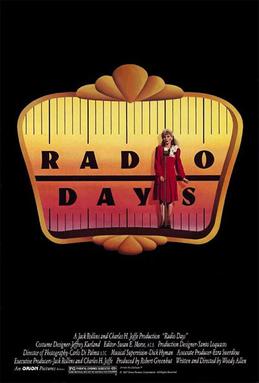
RADIO DAYS

Radio Days is a 1987 film directed by Woody Allen. The film looks back on American family life during the Golden Age of Radio.

Allen narrates the stories of his youth, although he is never seen by the audience. The young Allen is portrayed onscreen by Seth Green as "Joe".
Synopsis

The Narrator (Woody Allen) tells us how the radio influenced his childhood in the days before the TV. In the New York City of the late 1930s to the New Year of 1944, this coming-of-age tale mixes the Narrator's experiences with contemporary anecdotes and urban legends of the radio stars.

Even though the Narrator's Jewish-American family lives modestly in the Queens neighborhood of Rockaway Beach, each member finds in radio shows an escape from reality through the gossip of celebrities, sports legends of the day, crooners, etc. For the Narrator, the action adventurers on the radio (one of them based on The Shadow) inspire him, as he daydreams about his attractive replacement teacher, movie stars, and World War II. Meanwhile, the story of an aspiring radio star's (Mia Farrow) career is also told, along with the tale of the Narrator's aunt Bea (Dianne Wiest) and her search for love.

The musical score features classic songs from the 1930s and 40s, which play an important part in the plot. Even Orson Welles's famous radio broadcast of The War of the Worlds has an important role in Bea's life.

While having similarities to both Manhattan and Fellini's Amarcord, this film is Woody Allen's homage to his beloved New York City.


Awards and nominations

1988 Academy Awards (Oscars)
Nominated – Best Achievement in Art Direction: Art Direction: Speed Hopkins — Set Decoration: Carol Joffe, Leslie Bloom, George de Titta, Jr.
Nominated – Best Original Screenplay: Woody Allen

1988 BAFTA Film Awards
Won – Best Costume Design : Jeffery Kurland
Won – Best Production Design: Santo Loquasto
Nominated – Best Actress in a Supporting Role: Dianne Wiest
Nominated – Best Editing: Susan E. Morse
Nominated – Best Film: Robert Greenhut, Woody Allen
Nominated – Best Screenplay Original: Woody Allen
Nominated – Best Sound: Robert Hein, James Sabat, Lee Dichter

1988 Writers Guild of America Awards
Nominated – WGA Screen Award for Best Screenplay Written Directly for the Screen: Woody Allen

External links

Radio Days at the Internet Movie Database
[hide]
vdeFilms directed by Woody Allen
1960s
What's Up, Tiger Lily? (1966) · Take the Money and Run (1969)
1970s
Men of Crisis: The Harvey Wallinger Story (1971) · Bananas (1971) · Everything You Always Wanted to Know About Sex* (*But Were Afraid to Ask) (1972) · Sleeper (1973) · Love and Death (1975) · Annie Hall (1977) · Interiors (1978) · Manhattan (1979)
1980s
Stardust Memories (1980) · A Midsummer Night's Sex Comedy (1982) · Zelig (1983) · Broadway Danny Rose (1984) · The Purple Rose of Cairo (1985) · Hannah and Her Sisters (1986) · Radio Days (1987) · September (1987) · Another Woman (1988) · New York Stories (1989) · Crimes and Misdemeanors (1989)
1990s
Alice (1990) · Shadows and Fog (1992) · Husbands and Wives (1992) · Manhattan Murder Mystery (1993) · Bullets Over Broadway (1994) · Don't Drink the Water (1994) · Mighty Aphrodite (1995) · Everyone Says I Love You (1996) · Deconstructing Harry (1997) · Celebrity (1998) · Sweet and Lowdown (1999)
2000s
Small Time Crooks (2000) · The Curse of the Jade Scorpion (2001) · Hollywood Ending (2002) · Anything Else (2003) · Melinda and Melinda (2005) · Match Point (2005) · Scoop (2006) · Cassandra's Dream (2007) · Vicky Cristina Barcelona (2008)
Retrieved from "http://en.wikipedia.org/wiki/Radio_Days"

Thursday, 19 June 2008

Barak Obama - 50 Lies and Counting:
Posted on Political forum.com <http://forum.com/> - Elections and Campaigns...
1.) 'Selma Got Me Born' - LIAR, your parents felt safe enough to have you in 1961 - Selma had no effect on your birth, as Selma didn't occur until 1965.
2.) 'Father Was A Goat Herder' - LIAR, he was a privileged, well educated youth, who went on to work with the socialistic Kenyan Government.
3.) 'Father Was A Proud Freedom Fighter' - LIAR, he was part of one of the most corrupt and violent governments Kenya has ever had.
4.) 'My Family Has Strong Ties To African Freedom' - LIAR, your cousin Raila Odinga has created mass violence in attempting to overturn a legitimate election in 2007, in Kenya. It is the first widespread violence in decades.
5.) 'My Grandmother Has Always Been A Christian' - LIAR, she does her daily Salat prayers at 5 am according to her own interviews. Not to mention, Christianity wouldn't allow her to have been one of 14 wives to 1 man.
6.) 'My Name is African Swahili' - LIAR, your name is Arabic and Baraka (from which Barack came) means blessed in that language. Hussein is also Arabic and so is Obama.
7.) 'I Never Practiced Islam' - LIAR, you practiced it daily at school, where you were registered as a Muslim and kept that faith for 31 years, until your wife made you change, so you could run for office.
8.) 'My School In Indonesia was Christian' - LIAR, you were registered as Muslim there and got in trouble in Koranic Studies for making silly faces. (check your own book)
9.) 'I Was Fluent In Indonesian'- LIAR, not one teacher says you could speak the language.
10.) 'Because I Lived In Indo nesia, I Have More Foreign Experience' - LIAR, you were there from the ages of 6 to 10, and couldn't even speak the language. What did you learn, how to study the Koran and watch cartoons?
11.) 'I Am Stronger On Foreign Affairs' - LIAR, except for Africa (surprise) and the Middle East (bigger surprise), you have never been anywhere else on the planet and thus have NO experience with our closest allies.
12.) 'I Blame My Early Drug Use On Ethnic Confusion' - LIAR, you were quite content in high school to be Barry Obama, no mention of Kenya and no mention of struggle to identify - your classmates said you were just fine...you merely chose to do drugs.
13.) 'An Ebony Article Moved Me To Run For Office' - LIAR, Ebony has yet to find the article you mention in your book. It doesn't, and never did exist.
14.) 'A Life Magazine Article Changed My Outlook On Life' - LIAR, Life has yet to find the article you mention in your book. It doesn't, and never did, ex ist.
15.) 'I Won't Run On A National Ticket in '08' - LIAR, here you are, despite saying, live on TV, that you would not have enough experience by then, and you are all about having experience first.
16.) 'Voting Present rather than Yes or No is Common In Illinois' - LIAR, That is common for YOU, but not many others have 130 'Present' votes which means you wouldn't commit yourself because you didn't want the voters to know the real you and where you stood on the issues!
17.) 'Oops, I Misvoted' - LIAR, only when caught by church groups and democrats, did you beg to change your so-called 'misvote'.
18.) 'I Was A Professor Of Law' - LIAR, you were only a senior lecturer ON LEAVE.
19.) 'I Was A Constitutional Lawyer' - LIAR, you were only a senior lecturer ON LEAVE.
20.) 'Without Me, There Would Be No Ethics Bill' - LIAR, you didn't write it, introduce it, change it, or create it.
21.) 'The Ethics Bill Was Hard To Pass' - LIAR, it took just 14 days from start to finish.
22.) 'I Wrote A Tough Nuclear Bill' - LIAR, your bill was rejected by your own party for its pandering and lack of all regulation - mainly because of the money you took from your Nuclear Donor, Exelon, from which David Axelrod came.
23.) 'I Have Released My State Records' - LIAR, as of March, 2008, state bills you sponsored or voted for have yet to be released, exposing all the special interests pork hidden within.
24.) 'I Took On The Asbestos Altgeld Gardens Mess' - LIAR, you were part of a large group of people who remedied Altgeld Gardens. You failed to mention anyone else but yourself, in your books.
25.) 'My Economics Bill Will Help America' - LIAR, your 111 economic policies were just combined into a proposal which lost 99-0, and even YOU voted against your own bill.
26.) 'I Have Been A Bold Leader In Illinois' - LIAR, even your own supporters claim to have never seen any BOLD action on your par t.
27.) 'I Passed 26 Of My Own Bills In One Year' - LIAR, they were not YOUR bills, but rather handed to you, after their creation by a fellow Senator, to assist you in a future bid for higher office.
28.) 'No One Contacted Canada About NAFTA' - LIAR, the Canadian Government issued the names and a memo of the conversation your campaign had with them.
29.) 'I Am Tough On Terrorism' - LIAR, you missed the Iran Resolution vote on terrorism and your good friend Ali Abunimah supports the destruction of Israel and another friend el Hadi(sp?) was stopped by the Federal Government from collecting and sending donations to the terrorist group Hamas...now he is raising money for you and lists your wife Michelle as a supporter of his and she lists him as one of her friends. Also you and your wife are known co-horts of the man and wife 'Weather-Underground' hippie pair who admitted killing people and bombing several federal buildings back in the late sixties or early seventies. The man has written a book saying he and his wife only wish they had done more killings and bombings!
30.) 'I Am Not Acting As President Yet' - LIAR, after the NAFTA Memo, a dead terrorist in the FARC, in Colombia, was found with a letter stating how you and he were working together on getting FARC recognized officially.
31.) 'I Didn't Run Ads In Florida' - LIAR, you allowed national ads to run 8-12 times per day for two weeks - and you still lost.
32.) 'I Won Michigan' - LIAR, no you didn't.
33.) 'I won Nevada' - LIAR, no you did not.
34.) 'I Want All Votes To Count' - LIAR, you said let the delegates decide.
35.) 'I Want Americans To Decide' - LIAR, you prefer caucuses that limit the vote, confuse the voters, force a public vote, and only operate during small windows of time.
36.) 'I passed 900 Bills in the State Senate' - LIAR, you only passed 26, most of which you didn't write yourself.
37.) 'My Campaign Was Extorted By A Friend' - LIAR, that friend is threatening to sue if you do not stop saying this. Obama has stopped saying this.
38.) 'I Believe In Fairness, Not Tactics' - LIAR, you used tactics to eliminate Alice Palmer from running against you.
39.) 'I Don't Take PAC Money' - LIAR, you have taken loads of it.
40.) 'I don't Have Lobbyists' - LIAR, you have over 47 lobbyists, and counting.
41.) 'My Campaign Had Nothing To Do With The 1984 Ad' - LIAR, your own campaign worker made the ad on his Apple in one afternoon.
42.) 'My Campaign Never Took Over My Space' - LIAR, Tom, who started My Space issued a warning about this advertising to My Space clients.
43.) 'I Inspire People With My Words' - LIAR, you inspire people with other people's words.
44.) 'I Have Passed Bills In The U.S. Senate' - LIAR, you have passed A BILL in the U.S. Senate - for Africa, which shows YOUR priorities.
45.) 'I Have Always B een Against Iraq' - LIAR, you weren't in office to vote against it AND you have voted to fund it every single time, unlike Kucinich, who seems to be gutting you, Obama. 46.) 'I Have Always Supported Universal Health Care' - LIAR, your plan leaves all of us working taxpayers to pay for the 15,000,000 who don't have to buy it.
47.) 'I Only Found Out About My Investment Conflicts Via Mail' - LIAR, both companies you cite as having sent you letters about this conflict have no record of any such letter ever being created or sent.
48.) 'I Am As Patriotic As Anyone' - LIAR, you won't wear a flag pin and you don't put your hand over your heart during the Anthem... because you have said 'you didn't want to offend muslims and others who don't like America'!
49.) 'My Wife Didn't Mean What She Said About Pride In Country' - LIAR, your wife's words follow lock-step in the vein of Wright and Farrahkan, in relation to their contempt and hatred of America.
50.) 'Wal-Mart Is A Company I Would't Support' - LIAR, your wife has received nearly a quarter of a million dollars through Treehouse, which is connected to Wal-Mart. PASS IT ON PLEASE..and counting: Posted on Political forum.

Wednesday, 18 June 2008

A LOOK AT THE "PROTOCOLS"


Michael Fox has had a peek at the Protocols and comes back to tell that they're visibly rubbish on all levels.He's right, of course, but it makes no difference. Back when I was at the university I remember learning that the Protocols were the third most popular book in the history of mankind, with only the Bible and Mao's Little Red Book topping it. This was before Harry Potter, and Mao has proven less than durable, so perhaps the top of the list looks a bit different these days, but not much. The moral of the story, of course, being that not only is there no connection between facts and antisemitism; there doesn't even need to be any connection between common sense, or even simply good writing. Along with all their other problems, The Protocols are simply extraordinarily BORING, yet even that never dents their (ongoing) sales figures.
taken from:http://yaacovlozowick.blogspot.com/Yaacov Lozowick Ruminations

To Save One Life is to Save a World

To Save One Life is to Save a World

A TREE GROWS IN ISRAEL


Posted: Tue, 17 Jun 2008

Despite rocket attacks and suicide bombers, there's some good news for Israel: EU nations today agreed to strengthen relations with Israel. No one should doubt that if it were not for Arab oil, Europe would have strong economic ties with Israel. Hopefully someday the non-Muslim world will find a way to get off Muslim oil or render Islam powerless to wreak havoc in the civilized world.
Despite rocket attacks and suicide bombers, tourists are still flocking to Israel:
Business Week, 21 May 2008, Despite Turmoil, Tourists Flock to Israel

Perpetual conflict and the looming threat of terrorism might keep less adventuresome travelers away, but when it comes to Israel, the number of sightseers is rising fast. Nearly 1 million tourists arrived in the Holy Land during the first four months of 2008, an increase of 43% year-on-year, according to the Israel Tourism Ministry. The country hopes to attract 2.8 million visitors this year for its 60th anniversary; about the same number came in 2000 before the Palestinian intifada that began in late September of that year.
The fighting, which lasted until 2004, suppressed tourism, as did the war with Lebanon in the summer of 2006. But even during times of hardship, committed supporters—especially Christian pilgrims and Jews from the U.S. and Europe—have continued to flock to Israel. About 1 million visitors went there in 2002, during the peak of the most recent intifada.
Can you imagine the prosperity and wealth the Palestinians could enjoy if they were just peaceful in their own country? Sadly they turned down Nationhood in 2000. As an Israeli child's poem reads: "Ahmed and his friends could be wealthy and sunny, if only they wouldn't buy rockets with all their money." [Stop Raping Israel]
Many Muslim apologists like to ignore the fact that Palestinians receive over a billion dollars in aid each year [New York Times] and in return for which the world receives zip. Israel, meanwhile, Creates more in One Month than Islam in a Century helping the world fight disease, hunger, and poverty.
Despite rocket attacks and suicide bombers, the Israeli Shekel is strong:

Even the powerful euro has had a hard time competing with what has become probably the strongest currency in the world since the beginning of 2008: the Israeli shekel.
Since the beginning of 2008 the shekel has made some serious gains against nearly all the major world currencies. The shekel has gained 15% against the dollar, slightly more against the British pound and the Canadian dollar, as well as 8% versus the Swedish kroner and 24% against the South African rand.
Despite rocket attacks and suicide bombers, Israel grows trees where no trees can grow. In the days of the patriarchs Israel was a land flowing with milk and honey. When Jews lost control of Israel it turned into a barren wilderness until Israel once again became a nation.
More on tree planting: We happen to be in the middle of the Hebrew year 5768 which is a sabbatical year during which the land has to rest and nothing may be sown or planted in the Land of Israel until Rosh HaShana 5769 (30th September 2008). Judaism is a religion so compassionate that it considers even land worthy of a year of rest.
The Keren Kayemeth LeIsrael-Jewish National Fund runs the Click to Plant website which will enable you to donate a tree now but will actually be planted by KKL-JNF foresters the following year, 5769. To date, KKL-JNF has planted more than 230 million trees throughout Israel. While Jews send money to make the Earth more green, Islamic charities fund death and destruction. You will never see an ad in Saudi Arabia asking for Dinars for D'Trees.
taken from: Stop Raping Israel - http://stoprapingisrael.blogspot.com/

Sefer Chabibi Deepest Torah: BEHA'ALOTECHA: Humbly Yours

Sefer Chabibi Deepest Torah: BEHA'ALOTECHA: Humbly Yours

Tuesday, 17 June 2008

HAPPY BIRTHDAY, DAD !!!

If you were with us today it meant that you would be celebrating your 85 th. birthday.
But for me you are still amongst us, the living.
I know that He has a better place for you.
Meanwhile, until we meet again, I want you to know how much I miss you, also, how much I am proud of having a father like you.
Your grand-daughters, and your great-grandchildren (yes, I am a grandpa now) send their love.

I LOVE YOU DAD !!!

Phantom of the Opera- Sarah Brightman and Steve Harley

PHANTOM OF THE OPERA

Christine:
In sleep he sang to me
In dreams he came
That voice which calls to me
And speaks my name
And do I dream again?
For now I find
The phantom of the opera is there,
Inside my mind

Phantom:
Sing once again with me
Our strange duet
My power over you
Grows stronger yet
And though you turn from me
to glance behind
The phantom of the opera is there
Inside your mind

Christine:
Those who have seen your face
Draw back in fear
I am the mask you wear

Phantom:
It's me they hear

Both:
My/Your spirit and my/your voice
In one combined
The phantom of the opera is there
inside my/your mind

Chorus:
Is that the phantom of the opera?
Beware the phantom of the opera

Phantom:
In all your fantasies you always knew
That man and mystery

Christine:
Were both in you

Both:
And in this labrinth
Where night is blind
The Phantom of the opera is here/there

Christine:
Inside my mind

Phantom:
Sing, my Angel of Music!

CHRISTINE
He's there,
the Phantom of the Opera . .

Monday, 16 June 2008

Time To Say Goodbye

TIME TO SAY GOODBYE

When I'm alone I dream of the horizon and words fail me.
There is no light in a room where there is no sun
and there is no sun if you're not here with me, with me.
From every window unfurls my heart the heart that you have won.
Into me you've poured the light,
the light that you found by the side of the road.

Time to say goodbye.
Places that I've never seen or experienced with you.
Now I shall, I'll sail with you upon ships across the seas,
seas that exist no more,
it's time to say goodbye.

Andrea Bocelli
When you're far away I dream of the horizon and words fail me.
And of course I know that you're with me, with me.
You, my moon, you are with me.
My sun, you're here with me with me, with me, with me.

Time to say goodbye.
Places that I've never seen or experienced with you.
Now I shall, I'll sail with you upon ships across the seas,
seas that exist no more,

Both
I'll revive them with you.
I'll go with you upon ships across the seas,
seas that exist no more,
I'll revive them with you.
I'll go with you.

You and me.

Queen + Luciano Pavarotti - Too Much Love Will Kill You

Andrea Bocelli and Luciano Pavarotti Medley

The3 Tenors-Carreras-Domingo-Pavarotti--Nessun Dorma

NESSUN DORMA

ITALIAN;
Nessun dorma! Nessun dorma!
Tu pure, o, Principessa,
nella tua fredda stanza,
guardi le stelle
che fremono d'amore
e di speranza.

Ma il mio mistero e chiuso in me,
il nome mio nessun sapra!
No, no, sulla tua bocca lo diro
quando la luce splendera!

Ed il mio bacio sciogliera il silenzio
che ti fa mia!

(Il nome suo nessun sapra!...
e noi dovrem, ahime, morir!)

Dilegua, o notte!
Tramontate, stelle!
Tramontate, stelle!
All'alba vincero!
vincero, vincero!


ENGLISH
None must sleep! None must sleep!
And you, too, Princess,
in your cold room,
gaze at the stars
which tremble with love
and hope!

But my mystery is locked within me,
no-one shall know my name!
No, no, I shall say it as my mouth
meets yours when the dawn is breaking!

And my kiss will break the silence
which makes you mine!

(No-one shall know his name,
and we, alas, shall die!)

Vanish, o night!
Fade, stars!
At dawn I shall win

Jean-michel Jarre-Rendezvous IV (R'Houston pt4)

Supertramp

SCHOOL

I can see you in the morning when you go to school
Dont forget your books, you know youve got to learn the golden rule,
Teacher tells you stop your play and get on with your work
And be like johnnie - too-good, well dont you know he never shirks
- hes coming along!

After school is over youre playing in the park
Dont be out too late, dont let it get too dark
They tell you not to hang around and learn what lifes about
And grow up just like them - wont you let it work it out
- and youre full of doubt

Dont do this and dont do that
What are they trying to do?
- make a good boy of you
Do they know where its at?
Dont criticise, theyre old and wise
Do as they tell you to
Dont want the devil to
Come out and put your eyes

Maybe Im mistaken expecting you to fight
Or maybe Im just crazy, I dont know wrong from right
But while I am still living, Ive just got this to say
Its always up to you if you want to be that
Want to see that
Want to see that way
- youre coming along!

Your Latest Trick - Dire Straits

YOUR LATEST TRICK

All the late night bargains have been struck
Between the satin beaus and their belles
And prehistoric garbage trucks
Have the city to themselves
Echoes roars dinosaurs
They're all doing the monster mash
And most of the taxis and the whores
Are only taking calls for cash

I don't know how it happened
It all took place so quick
But all I can do is hand it to you
And your latest trick

My door was standing open
Security was laid back and lax
But it was only my heart got broken
You must have had a pass key made out of wax
You played robbery with insolence
And I played the blues in twelve bars down Lover's Lane
And you never did have the inteligence to use
The twelve keys hanging off my chain

I don't know how it happened
It all took place so quick
But all I can do is hand it to you
And your latest trick

Now it's past last call for alcohol
Past recall has been here and gone
The landlord finally paid us all
The satin jazzmen have put away their horns
And we're standing outside of this wonderland
Looking so bereaved and so bereft
Like a Bowery bum when he finally understands
The bottle's empty and there's nothing left

I don't know how it happened
It was faster than the eye could flick
But not all I can do is hand it to you
And your latest trick

Dire Straits - Romeo and Juliet Live

ROMEO AND JULIET

A lovestruck romeo sings a streetsus serenade
Laying everybody low with me a lovesong that he made
Finds a convenient streetlight steps out of the shade
Says something like you and me babe how about it ?

Juliet says hey its romeo you nearly gimme a heart attack
Hes underneath the window shes singing hey la my boyfriends back
You shouldnt come around here singing up at people like that
Anyway what you gonna do about it ?

Juliet the dice were loaded from the start
And I bet and you exploded in my heart
And I forget the movie song
When you wanna realise it was just that the time was wrong juliet ?

Come up on differents streets they both were streets of shame
Both dirty both mean yes and the dream was just the same
And I dreamed your dream for you and your dream is real
How can you look at me as if I was just another one of your deals ?

Where you can fall for chains of silver you can fall for chains of gold
You can fall for pretty strangers and the promises they hold
You promised me everything you promised me think and thin
Now you just says oh romeo yeah you know I used to have a scene with him

Juliet when we made love you used to cry
You said I love you like the stars above Ill love you till I die
Theres a place for us you know the movie song
When you gonna realise it was just that the time was wrong juliet ?

I cant do the talk like they talk on tv
And I cant do a love song like the way its meant to be
I cant do everything but Id do anything for you
I cant do anything except be in love with you

And all I do is miss you and the way we used to be
All do is keep the beat and bad company
All I do is kiss you through the bars of a rhyme
Julie Id do the stars with you any time

Juliet when we made love you used to cry
You said I love you like the stars above Ill love you till I die
Theres a place for us you know the movie song
When you gonna realise it was just that the time was wrong juliet ?

A lovestruck romeo sings a streetsus serenade
Laying everybody low with me a lovesong that he made
Finds a convenient streetlight steps out of the shade
Says something like you and me babe how about it ?

Eagles - New Kid In Town

NEW KID IN TOWN

There's talk on the street; it sounds so familiar
Great expectations, everybody's watching you
People you meet, they all seem to know you
Even your old friends treat you like you're something new

Johnny come lately, the new kid in town
Everybody loves you, so don't let them down

You look in her eyes; the music begins to play
Hopeless romantics, here we go again
But after awhile, you're lookin' the other way
It's those restless hearts that never mend

Johnny come lately, the new kid in town
Will she still love you when you're not around?
There's so many things you should have told her,
but night after night you're willing to hold her,
Just hold her, tears on your shoulder

There's talk on the street, it's there to
Remind you, that it doesn't really matter
which side you're on.
You're walking away and they're talking behind you
They will never forget you 'til somebody new comes along
Where you been lately? There's a new kid in town
Everybody loves him, don't they?
Now he's holding her, and you're still around
Oh, my, my
There's a new kid in town
just another new kid in town
Ooh, hoo
Everybody's talking 'bout the new kid in town,
Ooh, hoo
Everybody's walking' like the new kid in town
There's a new kid in town
I don't want to hear it
There's a new kid in town
I don't want to hear it
There's a new kid in town

The Eagles - Hotel California

HOTEL CALIFORNIA

On a dark desert highway, cool wind in my hair
Warm smell of colitas, rising up through the air
Up ahead in the distance, I saw a shimmering light
My head grew heavy and my sight grew dim
I had to stop for the night
There she stood in the doorway;
I heard the mission bell
And I was thinking to myself,
’this could be heaven or this could be hell’
Then she lit up a candle and she showed me the way
There were voices down the corridor,
I thought I heard them say...

Welcome to the hotel california
Such a lovely place
Such a lovely face
Plenty of room at the hotel california
Any time of year, you can find it here

Her mind is tiffany-twisted, she got the mercedes bends
She got a lot of pretty, pretty boys, that she calls friends
How they dance in the courtyard, sweet summer sweat.
Some dance to remember, some dance to forget

So I called up the captain,
’please bring me my wine’
He said, ’we haven’t had that spirit here since nineteen sixty nine’
And still those voices are calling from far away,
Wake you up in the middle of the night
Just to hear them say...

Welcome to the hotel california
Such a lovely place
Such a lovely face
They livin’ it up at the hotel california
What a nice surprise, bring your alibis

Mirrors on the ceiling,
The pink champagne on ice
And she said ’we are all just prisoners here, of our own device’
And in the master’s chambers,
They gathered for the feast
The stab it with their steely knives,
But they just can’t kill the beast

Last thing I remember, I was
Running for the door
I had to find the passage back
To the place I was before
’relax,’ said the night man,
We are programmed to receive.
You can checkout any time you like,
But you can never leave!

Guns N Roses - Knocking On Heaven's Door

KNOCKING ON HEAVEN'S DOOR

Mama take this badge from me
I can't use it anymore
It's getting dark too dark to see
Feels like I'm knockin' on heaven's door

Knock-knock-knockin' on heaven's door

Mama put my guns in the ground
I can't shoot them anymore
That cold black cloud is comin' down
Feels like I'm knockin' on heaven's door

Knock-knock-knockin' on heaven's door

"You just better start sniffin' your own
rank subjugation jack 'cause it's just you
against your tattered libido, the bank and
the mortician, forever man and it wouldn't
be luck if you could get out of life alive"*
Knock-knock-knockin' on heaven's door

Bob Dylan - Like a Rolling Stone

THIS ONE'S DEDICATED TO EVERYONE WHO LIKE DYLAN - ESPECIALLY TO MY GOOD FRIEND RACHEL WHO SAYS HE'S A "MASTER"

LIKE A ROLLING STONE

Once upon a time you dressed so fine
You threw the bums a dime in your prime, didn't you?
People'd call, say, "Beware doll, you're bound to fall"
You thought they were all kiddin' you
You used to laugh about
Everybody that was hangin' out
Now you don't talk so loud
Now you don't seem so proud
About having to be scrounging for your next meal.

How does it feel
How does it feel
To be without a home
Like a complete unknown
Like a rolling stone?

You've gone to the finest school all right, Miss Lonely
But you know you only used to get juiced in it
And nobody has ever taught you how to live on the street
And now you find out you're gonna have to get used to it
You said you'd never compromise
With the mystery tramp, but now you realize
He's not selling any alibis
As you stare into the vacuum of his eyes
And ask him do you want to make a deal?

How does it feel
How does it feel
To be on your own
With no direction home
Like a complete unknown
Like a rolling stone?

You never turned around to see the frowns on the jugglers and the clowns
When they all come down and did tricks for you
You never understood that it ain't no good
You shouldn't let other people get your kicks for you
You used to ride on the chrome horse with your diplomat
Who carried on his shoulder a Siamese cat
Ain't it hard when you discover that
He really wasn't where it's at
After he took from you everything he could steal.

How does it feel
How does it feel
To be on your own
With no direction home
Like a complete unknown
Like a rolling stone?

Princess on the steeple and all the pretty people
They're drinkin', thinkin' that they got it made
Exchanging all kinds of precious gifts and things
But you'd better lift your diamond ring, you'd better pawn it babe
You used to be so amused
At Napoleon in rags and the language that he used
Go to him now, he calls you, you can't refuse
When you got nothing, you got nothing to lose
You're invisible now, you got no secrets to conceal.

How does it feel
How does it feel
To be on your own
With no direction home
Like a complete unknown
Like a rolling stone?

Related Posts Plugin for WordPress, Blogger...