Showing posts with label Mufti. Show all posts

Monday, 28 September 2009

Love of the Land: Multi-culturalists distort Nazi past to placate Muslims in Germany

Multi-culturalists distort Nazi past to placate Muslims in Germany

Robin Shepherd
Think Tank Blog
27 September 09

What happens when multi-culturalist, anti-Israeli pieties clash with a full and rounded rendition of the Nazi past? If recent events in Berlin (of all places) are anything to go by the answer may be as follows: important truths will be denied so that those multi-culturalist, anti-Israeli pieties may be preserved.

In the most important commentary on the subject for quite some time, Daniel Schwammenthal of the Wall Street Journal Europe relates a story about such events which everyone should read and internalise. It is not only shocking in itself, it holds up an image of one of Europe’s possible futures.

Schwammenthal’s piece pegs off an attempt by a German journalist, Karl Rössel, to stage an exhibition at a state funded multi-cultural centre in an Arab and Turkish dominated area of Berlin. The exhibition was entitled “The Third World in the Second World War” and included a small section on the Grand Mufti of Jerusalem, Haj Amin al Husseini — the Palestinian leader and national hero who was an admirer of Hitler, a prolific propagandist for the Nazi cause and an active recruiter for the SS in wartime Yugoslavia where he participated in genocide.

Such facts, unfortunately, do not fit with the multi-culturalist narrative in which the people of the third world can only be counted as victims. Nor do they fit with important elements of the anti-Israeli narrative in which, as Schwammenthal notes, the notion that the Palestinians are “paying the price for Germany’s sins” as “the second victims” of the Holocaust is deeply rooted. The event was, therefore, cancelled. The Berlin authorities initially supported the decision but then belatedly and reluctantly backed down following accusations they were pandering to historical revisionism.

In Schwammenthal’s words:

“Mr. Rössel [the author of the exhibition] says this episode is typical of how German historians, Arabists and Islam scholars deny or downplay Arab-Nazi collaboration. What Mr. Rössel says about Germany applies to most of the Western world,where it is often claimed that the mufti’s Hitler alliance later discredited him in the region. Nothing could be further from the truth. In the Mideast, Nazis were not only popular during but also after the war—scores of them found refuge in the Arab world, including Eichman’s deputy, Alois Brunner, who escaped to Damascus. The German war criminals became trusted military and security advisers in the region, particularly of Nazi sympathizer Gamal Nasser, then Egypt’s president. The mufti himself escaped to Egypt in 1946. Far from being shunned for his Nazi past, he was elected president of the National Palestinian Council. The mufti was at the forefront of pushing the Arabs to reject the 1948 United Nations partition plan and to wage a “war of destruction” against the fledgling Jewish state. His great admirer, Yasser Arafat, would later succeed him as Palestinian leader.

“The other line of defense is that Arab collaboration with the Nazis supposedly wasn’t ideological but pragmatic, following the old dictum that “the enemy of my enemy is my friend.” This “excuse” not only fails to consider what would have happened to the Jews and British in the Mideast had the Arabs’ German friends won. It also overlooks the mufti’s and his followers’ virulent anti-Semitism, which continues to poison the minds of many Muslims even today.”

But not, it seems, if you listen to the BBC or read the Guardian or most other bien pensant organs of the media in western Europe. The inconvenient truths about Arab and Muslim anti-Semitism must be denied even if this means providing a distorted picture of the Holocaust and its participants and collaborators.

The other significant part of this story, of course, is that the furore arose in large part because of the location of the planned exhibition in an area dominated by Muslims. But since any discussion of potential problems arising from Europe’s soaring Muslim populations has been a prioridesignated as “racist” by multi-culturalist ideologues, that issue cannot be properly discussed either.

I’m afraid that this is the way things are going in modern Europe. And, be warned, this is just the start of it.

To read Schwammenthal’s excellent piece, click here:

http://calevbenyefuneh.blogspot.com/2009/09/mufti-of-berlin.html#links

For a broader discussion of such issues as they relate to Israel, click here to purchase my recently published book, A State Beyond the Pale: Europe’s Problem with Israel:

http://www.amazon.co.uk/State-Beyond-Pale-Europes-Problem/dp/0297856642/ref=sr_1_1?ie=UTF8&s=books&qid=1254042089&sr=8-1


Love of the Land: Multi-culturalists distort Nazi past to placate Muslims in Germany

Saturday, 26 September 2009

Love of the Land: The Mufti of Berlin

The Mufti of Berlin


Arab-Nazi collaboration is a taboo topic in the West.


Daniel Schwamenthal
Wall St. Journal
25 September 09

Berlin

One widespread myth about the Mideast conflict is that the Arabs are paying the price for Germany's sins. The notion that the Palestinians are the "second victims" of the Holocaust contains two falsehoods: It suggests that without Auschwitz, there would be no justification for Israel, ignoring 3,000 years of Jewish history in the land. It also suggests Arab innocence in German crimes, ignoring especially the fascist past of Palestinian leader Haj Amin al Husseini, who was not only Grand Mufti of Jerusalem but also Waffen SS recruiter and Nazi propagandist in Berlin. When a German journalist recently tried to shed some light on this history, he encountered the wrath of the Arab collaborators' German apologists.

Karl Rössel's exhibition "The Third World in the Second World War" was supposed to premier on Sept. 1 in the "Werkstatt der Kulturen," a publicly funded multicultural center in Berlin's heavily Turkish and Arab neighborhood of Neukölln. Outraged by the exhibition's small section on Arab complicity in Nazi crimes, Philippa Ebéné, who runs the center, cancelled the event. Among the facts Ms. Ebéné didn't want the visitors of her center to learn is that the Palestinian wartime leader "was one of the worst and fanatical fascists and anti-Semites," as Mr. Rössel put it to me.

The mufti orchestrated the 1920/1921 anti-Jewish riots in Palestine and the 1929 Arab pogroms that destroyed the ancient Jewish community of Hebron. An early admirer of Hitler, Husseini received Nazi funding—as did Egypt's Muslim Brotherhood—for his 1936-1939 Palestinian revolt, during which his thugs killed hundreds of British soldiers, Jews and also Arabs who rejected his Islamo-Nazi agenda. After participating in a failed fascist coup in Iraq, he fled to Berlin in 1941 as Hitler's personal guest. In the service of the Third Reich, the mufti recruited thousands of Muslims to the Waffen SS. He intervened with the Nazis to prevent the escape to Palestine of thousands of European Jews, who were sent instead to the death camps. He also conspired with the Nazis to bring the Holocaust to Palestine. Rommel's defeat in El Alamein spoiled these plans.

Associated Press

Hezbollah terrorists practicing a familiar salute in 2008.

After canceling the exhibition, Ms. Ebéné clumsily tried to counter the impression that she had pre-emptively caved to Arab pressure. As a "non-white" person (her father is Cameroonian), she said, she didn't have to fear Arabs, an explanation that indirectly suggested that ordinary, "white," Germans might have reason to feel less safe speaking truth to Arabs.

Berlin's integration commissioner, Günter Piening, initially seemed to defend her. "We need, in a community like Neukölln, a differentiated presentation of the involvement of the Arabic world in the Second World War," Der Tagesspiegel quoted him as saying. He later said he was misquoted and following media criticism allowed a smaller version of the exhibit to be shown.

Corbis

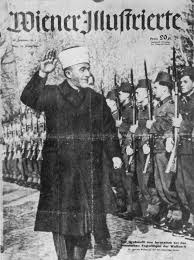
Palestinian leader Haj Amin al Husseini inspecting a Muslim SS parade in 1944.

Mr. Rössel says this episode is typical of how German historians, Arabists and Islam scholars deny or downplay Arab-Nazi collaboration. What Mr. Rössel says about Germany applies to most of the Western world, where it is often claimed that the mufti's Hitler alliance later discredited him in the region. Nothing could be further from the truth. In the Mideast, Nazis were not only popular during but also after the war—scores of them found refuge in the Arab world, including Eichman's deputy, Alois Brunner, who escaped to Damascus. The German war criminals became trusted military and security advisers in the region, particularly of Nazi sympathizer Gamal Nasser, then Egypt's president. The mufti himself escaped to Egypt in 1946. Far from being shunned for his Nazi past, he was elected president of the National Palestinian Council. The mufti was at the forefront of pushing the Arabs to reject the 1948 United Nations partition plan and to wage a "war of destruction" against the fledgling Jewish state. His great admirer, Yasser Arafat, would later succeed him as Palestinian leader.

The other line of defense is that Arab collaboration with the Nazis supposedly wasn't ideological but pragmatic, following the old dictum that "the enemy of my enemy is my friend." This "excuse" not only fails to consider what would have happened to the Jews and British in the Mideast had the Arabs' German friends won. It also overlooks the mufti's and his followers' virulent anti-Semitism, which continues to poison the minds of many Muslims even today.

The mufti "invented a new form of Jew-hatred by recasting it in an Islamic mold," according to German scholar Matthias Küntzel. The mufti's fusion of European anti-Semtism—particularly the genocidal variety—with Koranic views of Jewish wickedness has become the hallmark of Islamists world-wide, from al Qaeda to Hamas and Hezbollah. During his time in Berlin, the mufti ran the Nazis' Arab-language propaganda radio program, which incited Muslims in the Mideast to "kill the Jews wherever you find them. This pleases God, history and religion." Among the many listeners was also the man later known as Ayatollah Khomeini, who used to tune in to Radio Berlin every evening, according to Amir Taheri's biography of the Iranian leader. Khomeini's disciple Mahmoud Ahmadinejad still spews the same venom pioneered by the mufti as do Islamic hate preachers around the world.

Muslim Judeophobia is not—as is commonly claimed—a reaction to the Mideast conflict but one of its main "root causes." It has been fueling Arab rejection of a Jewish state long before Israel's creation.

"I am not a Mideast expert," Mr. Rössel told me, but "I wonder why the people who so one-sidedly regard Israel as the region's main problem never consider how the Mideast conflict would have developed had it not been influenced by fascists, anti-Semites and people who had just returned from their Nazi exile."

Mr. Rössel may not be a "Mideast expert" but he raises much more pertinent questions about the conflict than many of those who claim that title.

Mr. Schwammenthal is an editorial writer for The Wall Street Journal Europe.


Love of the Land: The Mufti of Berlin

Sunday, 13 September 2009

Love of the Land: Israel Can And Must Act In Her Own Best Interests.


Carpe diem quam minimum credula postero – “Seize the day, trusting as little as possible in the future.” Horace.

Ted Belman
Israpundit
12 September 09

As I read Ettinger’s excellent piece, I was reminded of other historical facts having to do with limiting Jewish settlement, emigration or immigration. Even before the British Mandate, Britain was actively limiting Jewish immigration to Palestine. Stalin also prevented Jewish emigration. The Mandate didn’t change much. Britain continued to limit immigration and so so did Russia/USSR right up to its downfall. Remember the “Let my people go” campaign in the seventies.

Haj Amin el Husseini, the grand Mufti of Jerusalem and confidant of Hitler, led a full scale Arab revolt against the Jews between 1936 and 1939 causing much Jewish bloodshed. In response the Peel Commission was set up and recommended limiting Jewish immigration to Palestine. Just what the Arabs wanted. In fact, the Peel Commission even recommended the abolition of the Mandate and recommended two states. Ben Gurion fought hard to maintain Jewish immigration and even supported partition while most of the Zionist movement did not. To his chagrin, friends of Zionism in England including Churchill, Lloyd George persuaded the British Parliament to vote against partition.

In 1938, Ben Gurion commented on Chamberlain’s “Peace in our time” and said “They handed Czechoslovakia over. Why shouldn’t they do the same with us?”

Shortly thereafter Ben Gurion made his case to Malcolm MacDonald, the Colonial Secretary, who suggested, that the Arab and Muslim world could rise up and threaten the British Empire and therefore to prevent this, Britain had to make sure that the Jews in Palestine remained a minority. In other words Britain was against the creation of a Jewish state.

During the war, the world conspired to prevent Jews from escaping Europe to Palestine. Britain, even after the war, actively attempted to limit Jewish immigration to Palestine. Remember the DP Camps in Cypress and Exodus.

It was due to Jewish resistance after the war that the British turned the matter over to the UN which ultimately voted for the partition that the British Parliament had turned down.. Ben Gurion preferred half a loaf to no loaf and so declared the State of Israel.

The Law of Return was quickly passed welcoming all “Jews” to come to Israel. All you needed to be eligible was one Jewish grandparent.

After the Six Day War in ‘67 the World attempted to prevent Jewish settlement of Judea and Samaria even though Jews had the legal right to do so stemming from the British Mandate. Neither Res 242 nor the Oslo Accords made mention of restricting such settlement, so the international community tried to brand the settlements as illegal pursuant to the Geneva Convention. Many legal scholars beg to differ with this and argue convincingly that the Convention doesn’t make settlements illegal.

Prior to the Roadmap, in response to atrocities the Arabs committed with their suicide bombers, Senator Mitchell rewarded them by recommending a settlement freeze just like the Peel Commission did. This freeze was incorporated into the Roadmap which came into existence in 2003.

Another refrain that developed particularly after the Roadmap, was that no one, meaning Israel, should do anything, meaning settle the land, to prejudge the outcome. Of course the Arabs could do anything they wanted to prejudge the outcome and the US cooperated with them. A case in point is opening her Consulate in Jerusalem to serve the Arabs while at the same time refusing to open her Embassy in Jerusalem to serve the Israelis. The US also supports illegal Arab construction and condemns Jewish construction, legal or otherwise.

The demand in the Roadmap that Palestine be “viable” and “contiguous” also prejudges the outcome as does the demand that Jerusalem be divided.

And now Obama is demanding a settlement freeze. Fortunately he doesn’t have the support in the US or in Israel to bring it about.

As Ettinger points out, Israel can and must resist the pressure and act in her own best interests.


Love of the Land: Israel Can And Must Act In Her Own Best Interests.
Related Posts Plugin for WordPress, Blogger...