

Our day of mourning... and hatred
Yitzhak Klein
JPost
1 November 09
Before the Hate had proceeded for thirty seconds, uncontrollable exclamations of rage were breaking out from half the people in the room... The horrible thing about the Two Minutes Hate was not that one was obliged to act a part, but that it was impossible to avoid joining in. Within thirty seconds any pretense was always unnecessary. A hideous ecstasy of fear and vindictiveness, a desire to kill, to torture, to smash faces with a sledge hammer, seemed to flow through the whole group of people like an electric current, turning one even against one's will into a grimacing, screaming lunatic.
- George Orwell, 1984
In George Orwell's dystopia, formal public ceremonies are devoted to the inculcation of hatred. The object of this hatred is the classic "enemy" that is a feature of every totalitarian society, legions of faceless and anonymous traitors who threaten society on all sides and whom it is an obligation to hate.
In totalitarian societies, the cultivation of hatred serves important political objectives. Totalitarian society requires subjects who subordinate their lives to the demands of the regime, who submerge their personalities within its logic. This is achieved by deliberately inflaming their basest passions.
The tragedy of totalitarian culture however is not that it finds the cultivation of hatred useful, but that hatred genuinely reflects the spiritual life of rulers and ruled alike. The true purpose for which hatred is cultivated is to create a society in which the human virtues of pity, compassion and decency are suppressed. This can happen only in a society in which such virtues have already been undermined. Totalitarian societies may pay lip service to the highest ideals, but in practice they dehumanize themselves by dehumanizing their enemies, who possess no rights and to whom no justice is due. Such a society can fall into a barbarism darker than that of any society of primitives.
Both Nazi Germany and the Soviet Union were characterized by public ceremonies devoted, formally or informally, to the cultivation of hatred. By contrast, the State of Israel at its foundation set aside a day for remembering the victims of the Holocaust, and many individuals continue to cherish antipathy for Germany, but nobody ever contemplated a day devoted, formally or informally, to the hatred of Germans. That rightly would have been considered sick, a mark of Cain on the forehead of our society. No day devoted to the deliberate inculcation of hatred was established in Israel until 1996.
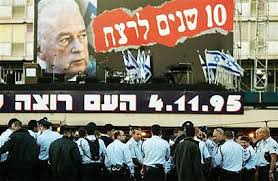
SINCE ITS establishment, those who arrogated to themselves the right to determine the nature of Yitzhak Rabin's memorial day have devoted it to inculcating hatred against a particular community within Israeli society. Last year, repeating a frequent theme, President Shimon Peres admonished the national-religious community for not joining in the commemoration of Rabin. How ironic. On this day, members of that community are expected to have no voice, other than the voice that those who despise them would put into their mouths. Like Jews in medieval Europe herded into churches on Christmas, their role is to confess in public the crime of unbelief in Rabin's agenda, and to affirm that unbelief is equivalent to culpability.
This of course serves a particular political agenda. But the real tragedy of Rabin's memorial day is that it has become the occasion for legitimizing a culture of hatred. This culture invokes a community of public enemies, treats them as collectively guilty and makes it easier to rationalize the denial of their fundamental rights. The way Rabin's memorial day is celebrated admits a breath of totalitarian culture into our public life.
Politically motivated hatred has practical political consequences. The hatred which finds its expression on Rabin's memorial day had such consequences four years ago, during disengagement, which violated the fundamental rights of hapless Israeli citizens and traduced Israel's civil compact.
It matters little what "security" arguments were deployed by those who legitimated this policy, or that the arguments turned out - indeed were known at the time - to be baseless. At root, the policy was motivated by causeless hatred, as some of its advocates have since acknowledged. The victims of disengagement are the objects of sympathy today, but not yet, as they should be, of repentance.
It has become habitual for those who have appropriated Rabin's memorial day to blame the spiritual ills of Israeli society on "the occupation." That is too easy and facile an explanation. Surely these people are inured against that particular source of spiritual contamination. Those who tolerate or encourage an element of totalitarian culture in the celebration of Rabin's memorial day ought to make the day an occasion for what they are ever eager to urge upon others - heshbon nefesh, taking a critical, reflective retrospective of one's soul.
The writer heads the Israel Policy Center.
Love of the Land: Our day of mourning... and hatred


 Posts
Posts


