Showing posts with label AKP. Show all posts

Tuesday, 1 December 2009

Love of the Land: Syria and Turkey: Walking Arm in Arm Down the Same Road?

Syria and Turkey: Walking Arm in Arm Down the Same Road?


David Schenker
Jerusalem Center for Public Affairs
Vol. 9, No. 13
01 December 09

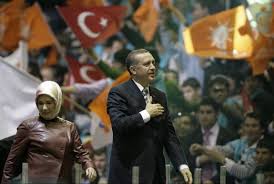
The rapprochement between Ankara and Damascus is only the culmination of the increasingly problematic policies pursued by the Islamist Justice and Development Party (AKP).

Two factors in particular seem to have led to Turkey's shift away from Israel and toward Syria. First, Turkey no longer needed Israeli assistance to pressure the Syrian government to change its policy of providing safe-haven to the terrorist Kurdish Worker's Organization (PKK). Second, in the past seven years, once secular Turkish politics have undergone a profound Islamist transformation.

At the same time, the dynamic between the Turkish military and the state's civilian leadership has changed. No longer does the military have the upper hand. Today, the Turkish military can do little to impact the policies of the Islamist AKP, which promote solidarity with Islamist, anti-Western regimes while dismissing secular, pro-Western Muslim governments.

As Ankara's politics under the AKP have shifted and Turkey has become seemingly less committed to Europe, the state has seen its star rise in the Middle East. Syria's Assad regime likely sees its bourgeoning relations with Turkey as an opportunity to shuffle the existing architecture of regional alliances.

Perhaps more worrisome is the prospect that Ankara may over time pursue a closer foreign policy alignment with Iran that would undermine U.S. and Israeli regional interests. Ankara's shift toward Damascus and Tehran makes it even more unlikely that Turkey will participate in "crippling sanctions" to help prevent Iran from attaining a nuclear weapon.

(Read full article)


Love of the Land: Syria and Turkey: Walking Arm in Arm Down the Same Road?

Thursday, 5 November 2009

Love of the Land: Turkey: Racism In, Ataturk Out

Turkey: Racism In, Ataturk Out


Anna Mahjar-Barducci
Hudson New York
05 November 09

The secular spirit of Kamal Ataturk that brought Turkey so close to the Western world is fading away.

But such a change seems to pass unnoticed. Anti-Semitism in Turkey seems to find hardly any room in the Western press.

Last year, when Turkey’s Supreme Court tried to dismantle the AKP for having trespassed Turkey’s secular constitution, EU officials sided with the Islamist government.

This constitutes a major turnabout not only for the stability of the region but also for Europe. Turkey is a NATO member, it aspires to become a EU member, has one of the strongest armies in the region, and is a key country for transporting gas to Europe through pipelines such as Nabucco and Blue Stream.

Recently, Turkey barred Israel from participating in NATO military manoeuvres; Prime Minister Tayyip Erdogan said the move was a result of public concerns over the Israeli military offensive in the Gaza Strip earlier this year. Erdogan called Israel's operations, launched with the aim of ending Hamas' cross-border rocket attacks, "a crime against humanity," and suggested that Israel be barred from the United Nations.

A study of the Israeli Intelligence and Terrorism Information Center shows that in recent years there has been a significant growth of anti-Semitic literature published in Turkey. Much of this literature has become best-seller books. Two categories of books can be established: 1) “Classical” anti-Semitic literature in Turkish translation, such as The Protocols of the Elders of Zion, Mein Kampf by Adolf Hitler, and The International Jew by Henry Ford; 2) Anti-Semitic books in the Turkish language, set in an internal Turkish context. These books are mostly written by radical Islamic elements in Turkey, which believe that the current Islamic government is not Islamist enough.

In addition to the anti-Semitic books, the Turkish press frequently publishes anti-Semitic articles which combine anti-Israeli incitement and “classical” anti- Semitic motifs. Even more disturbing was a blockbuster film called Valley of the Wolves Iraq, produced in Turkey, and based on a popular television series. Due to its anti-Semitic and anti-American character, the movie was pulled from theatres in the US, and triggered harsh criticism in Germany, where it was shown to the Turkish community. So far, the Turkish government has refused to take any action to prevent the distribution of such anti-Semitic agitprop.

“Separation,” a TV series aired on Turkey’s state-run TRT channel for the first time last week, contains several controversial scenes. In one, a Palestinian father holds his new-born baby above his head in front of Israeli soldiers at a checkpoint. A few moments later, one of the soldiers shoots the baby dead. In another scene, Israeli soldiers kick and beat elderly Palestinians on the streets and one soldier shoots a teenage Palestinian girl on her chest.

The drama outraged Israel. Israel summoned a Turkish diplomat to protest at what it called "state-sponsored incitement.” “Such a drama series, which doesn’t even have the slightest link to reality and which presents Israeli soldiers as murderers of innocent children, isn’t worthy of being broadcast even by enemy states and certainly not in a state which has full diplomatic relations with Israel,” Foreign Minister Avigdor Lieberman said in a statement.

A TV channel official responded that none of the scenes in the show was “imaginary” “and that photographs of what Israelis are doing to Palestinians are freely available on the Internet, whereas Turkish Foreign Minister Ahmet Davutoglu said that the Turkish government “has no right to comment on the quality of broadcasts or the opinions expressed in them.” Freedom of Expression is not what Turkey is most famous for in any event.
This is only one of the last incidents that are marring the relations between the two countries. Israel and Turkey, once stern allies, have been on a collision course ever since the AKP party took power; it looks as if the Turkish government is trying its best to enlarge the rift, casting a shadow over the future of the Middle East.

Some 24,000 Jews live in Turkey, making them one of the world's largest Jewish communities in a Muslim country; their relations with the state are becoming more and more strained. "I feel worried, sad and scared for myself and for my country's future, which is leaning towards racism," Turkish-Jewish academic Leyla Navaro wrote in a local newspaper. Many Jews are thinking of leaving the country.

An Islamist Turkey, winking at the Islamist regimes of the region and joining their anti-Israeli policies is bad news for the free world.


Love of the Land: Turkey: Racism In, Ataturk Out

Tuesday, 27 October 2009

Love of the Land: The vessel of Turkey's Muslim Brothers has surfaced in calm waters

The vessel of Turkey's Muslim Brothers has surfaced in calm waters


Soner Cagaptay
Daily Star
26 October 09

I am often asked these days why Turkey’s ruling Justice and Development Party (AKP) is so upset with Israel. “It’s so dramatic” people say, adding: “Why did the AKP uninvite Israel to Anatolian Eagle” (a NATO air force exercise held in Turkey)? “Is this the beginning of the end of Turkish-Israeli ties that go back to 1949 just as Israel is most worried about Iran?”

The AKP’s snub follows harsh anti-Israeli rhetoric by party leadership, and an incendiary television series on Turkey’s publicly funded TV network that depicts Israelis as cold-blooded and evil. So people ask: “Why is the AKP doing all this now?” My answer is simple: The AKP is doing and saying what it believes: the party, rooted in Turkey’s own Muslim Brotherhood movement, has always hated Israel, and now that the AKP is comfortably in charge in Turkey, it will oppose Israel with any means available as well as promote other aspects of the Turkish Muslim Brotherhood’s agenda.

The AKP was born out of the Welfare Party (RP), the motherboard of Turkish Islamists since the 1980s. Islamism in Turkey, though traditionally nonviolent, possesses six virulent characteristics; it is anti-Western, anti-Semitic, anti-Israeli, anti-European, anti-democratic and holds anti-secular sentiments, all of which are adopted from the Muslim Brotherhood.
When RP came to power in a coalition government in 1996 it attempted to implement this Turkish Muslim Brotherhood agenda, but was opposed by a secular, pro-western bloc, which included various media outlets, opposition parties, NGOs, businesses and the military. When massive demonstrations and a well-coordinated public relations campaign brought the party down in 1997, the EU and the US stood aside.

The Islamists drew a valuable lesson from this experience as they rebranded themselves, turning away from the six-pronged Muslim Brotherhood agenda to become more likeable and gain popular support. The AKP emerged out of this rebranding in 2001 as it declared that it had jettisoned the six elements of the Turkish Muslim Brotherhood ideology.

In 2002, when the AKP came to power, the world and Turks alike celebrated the victory as a first instance of the Islamists’ moderation. But far from harboring a genuine desire to moderate, the Turkish Islamists simply caved to external pressures, including the courts, media outlets, businesses and the military, as well as the US and EU, which forced the AKP to abandon the Muslim Brotherhood ideology.

Yet the AKP did not forget its roots: once in power, it followed a two-pronged strategy to eliminate the domestic and external pressures that drove the RP from power in 1997. The party promoted EU accession while simultaneously cracking down on internal checks and balances, and maintained good ties with the West while nurturing anti-Western sentiments at home.

In due course the party successfully neutered the domestic forces that had forced its predecessor to step down from power. It used legal loopholes to pass the media into the hands of its supporters, resulting in half of the Turkish media falling into the hands of pro-AKP businesses and the rest facing massive putative tax fines. Large, secular Turkish businesses fear the AKP’s financial police and tax audits, while judges and generals have been targeted in the Ergenekon case for allegedly planning a coup against the AKP government. Illegal and legal wiretaps are now common, justified as necessary for collecting evidence for the Ergenekon case. Whether there was actually a coup plot, Turkey’s judges, opinion makers, generals, businessmen, political leaders and plain citizens are fearful of opposing the government because they worry that their private conversations will be wiretapped or they will be arrested for association with the alleged coup.

Just as it has nearly eliminated domestic checks, the AKP has also paralyzed external checks to its power. Although the party maintained amiable ties with Israel and the United States and even pushed for EU accession after coming to power, in reality the AKP’s rhetoric has demonized the EU, US and Israel. The party has labeled US and Israeli policies as “genocidal” and bashed the West for “being immoral.” Even though those who promoted the idea of the Islamists’ moderation dismissed such rhetoric as harmless domestic politicking, the rhetoric has had devastating consequences: today, few in Turkey care for the West, most people oppose EU accession, many Turks hate America and almost no one likes Israel.

Fast forward to the Anatolian Eagle incident. After paralyzing domestic opposition and planting the seeds of anti-western sentiments in Turkish society, the AKP now feels free from the checks and balances that have traditionally forced Turkey’s Islamists to behave. If the AKP is a political submarine that has cruised underwater, spotted by its rhetorical periscope, now this submarine is surfacing: the party is re-embracing the ideology of the Turkish Muslim Brotherhood.

We are witnessing the Muslim Brotherhood’s take on foreign policy, highlighted by its approach to Turkish-Israeli ties. After seven years of vehement anti-Israeli rhetoric, the Turkish public has now embraced the AKP’s position against Israel and the party is comfortably chipping away at the foundations of Turkish-Israeli ties, something it has always wanted to do. Today, it is Israel; tomorrow it is EU accession and cooperation with the United States, for instance on Iran. At this stage, the US, the EU and Israel have little leverage and few allies left in Turkey, and AKP policies, promoting the agenda of the Turkish Muslim Brotherhood and countering the US, EU and Israel, will find little resistance and much support inside Turkey. Turkey’s Muslim Brothers have played a smart game indeed, changing the color of their vessel, then sailing deep and surfacing only when the waters were calm and clear.

Soner Cagaptay is a senior fellow at the Washington Institute for Near East Policy and the author of “Islam, Secularism and Nationalism in Modern Turkey: Who Is a Turk?” This commentary first appeared on bitterlemons-international.org, an online newsletter.

Love of the Land: The vessel of Turkey's Muslim Brothers has surfaced in calm waters

Tuesday, 20 October 2009

Love of the Land: TV Movie Jihad: Turkish Government Tries to Foment Islamist Hatred of Israel and Jews

TV Movie Jihad: Turkish Government Tries to Foment Islamist Hatred of Israel and Jews


Barry Rubin
The Rubin Report
20 October 09

You know that the Islamist-oriented Turkish government has cancelled a military exercise with Israel, made a military cooperation alignment with Syria, and aired an antisemitic film. Here’s what you don’t know about the film.

Entitled “Separation – Love and War in Palestine,” the expensively made film was aired in prime time on a state-owned television network. Previews of it were shown in the Istanbul’s small subway system.

The ultimate hypocrisy is that while the government excuses its anti-Israel policy by saying, in the prime minister’s words, “ We cannot be oblivious to the feelings of the Turkish public,” it is doing everything possible to stir up passionate hatred on the part of that public which wasn’t there beforehand. The film is, in a real sense, a hate crime, the kind of thing that goes on daily in the Arabic-speaking world and for which there is absolutely no equivalent in Israel or the West.

When the film opens there is a street battle between Israeli soldiers and Palestinian gunmen. A Palestinian boy is killed as the two sides fire at one another. So far, this is possible. But what happens next is that a beautiful young girl then is shown walking down an empty street and an Israeli soldier just shoots her for no reason at all. There is no evidence that any such event has taken place ever.

A group of elderly Muslims wanting to go on the pilgrimage to Mecca is shown being stopped at a checkpoint by Israeli soldiers and their papers are thrown in their faces. In fact, Israel has facilitated Palestinians going on the pilgrimage for many years.

So why didn’t Gazans get to go in the real world? Because the Palestinian Authority didn’t want to let Hamas, which rules Gaza, issue the papers and the Saudis refused to accept them. Israel had nothing to do with it. But for an audience of Turkish Muslims, such an act is a basic attack on Islam that would justify Jihad by themselves in response.

In another fictional event made to stir hatred—though Palestinians testifying at the Goldstone hearings made such claims without providing a single example—a husband and his pregnant wife are prevented at a checkpoint from going to a hospital. When she gives birth an Israeli soldier shoots dead the one-minute-old baby. Oh, and the wife dies from bleeding and the husband is killed by another soldier.

Interspersed with such scenes are those of Jews praying and an Israeli soldier is portrayed as saying this is a war of religion not one over territory.

So aside from their humanitarian impulses, Turks are being told by their government that Israelis are murdering and warring on Muslims. What should be their response? Why to hate Israel but also—at least this is how some Turks are likely to interpret it--to kill Jews.

In another scene, viewers are told that their Ottoman ancestors ruled this land for 400 years and there were no problems back then. In another country, this would be seen as a prelude to trying to seize control of that land once again but the Turkish government isn’t interested in that, nor in the Palestinian Authority (PA) taking over, but only in an Islamist regime ruled by Hamas there. (The Turkish government never talks about events on the West Bank because it views Hamas and not the PA as its ally. By the same token, it shows that it doesn't care about the Palestinians but only Islamist-ruled ones.)

By acting to provoke such hatred and possibly even an anti-Jewish pogrom within Turkey—the first time a Turkish government has behaved this way since the republic began—the current regime has taken one more step to bash Israel while still seeking its tourists and trade, as well as a diplomatic role as diplomatic mediator between Israel and Syria .

Turkish Jews--who have always believed that keeping a low profile and waiting out any problems--are taking the hint. Some are leaving; most are thinking about it.

The policy toward Israel or this particular film are not isolated events. They are parts of the regime strategy to do three things:

--Impose the maximum possible Islamist program on Turkey (how far they will get is unclear).

--Create a political and institutional basis for never yielding power. This is being done by a takeover of media, transformation of large elements in the educational system, promoting pro-AKP businesses or intimidating those in the opposition in order to give the regime a powerful economic base, revising the constitution, and taking other such steps. It hopes to become an institutionalized government party like the Republican People’s Party was during the first three decades of the republic. This doesn't mean that the AKP will declare an open dictatorship and cancel elections. Rather, the goal is to be sure it always wins the elections.

--Reorient Turkey’s foreign policy toward the Muslim-majority world, and building an alignment with Iran and Syria, while minimizing any cost in terms of its relations with the West. If forced to choose, however, it will pick the Muslim orientation, especially since the government assumes (though it is still trying) that it won’t get European Union membership any way while the Obama Administration smiles and nods at Turkish policy as more proof that the regime is a “model moderate Muslim democracy.”

Onlookers should have no illusions about what is going on. Nor should any U.S. policymakers—for plenty of other reasons as well—still view Turkey’s government as a reliable ally.


Love of the Land: TV Movie Jihad: Turkish Government Tries to Foment Islamist Hatred of Israel and Jews

Saturday, 17 October 2009

Love of the Land: How Turkey Was Lost

How Turkey Was Lost


Caroline Glick
Jewish World Review
16 October 09

Turkey's decision to betray the West holds general lessons for Israel and for the free world as a whole. These lessons should be learned and applied moving forward not only to Turkey, but to a whole host of regimes and sub-national groups in the region and throughout the world

Once the apotheosis of a pro-Western, dependable Muslim democracy, this week Turkey officially left the Western alliance and became a full member of the Iranian axis.

It isn't that Turkey's behavior changed fundamentally in recent days. There is nothing new in its massive hostility towards Israel and its effusive solicitousness towards the likes of Syria and Hamas. Since the Islamist AKP party first won control over the Turkish government in the 2002 elections, led by AKP chairman Recip Tayyip Erdogan, the Turks have incrementally and inexorably moved the formerly pro-Western Muslim democracy into the radical Islamist camp populated by the likes of Iran, Syria, Hizbullah, al Qaida and Hamas. What made Turkey's behavior this week different from its behavior in recent months and years is that its attacks were concentrated, unequivocal and undeniable for everyone outside of Israel's scandalously imbecilic and flagellant media.

Until this week, both Israel and the US were quick to make excuses for Ankara. When in 2003 the AKP-dominated Turkish parliament prohibited US forces from invading Iraq through Kurdistan, the US blamed itself. Rather than get angry at Turkey, the Bush administration argued that its senior officials had played the diplomatic game poorly.

In February 2006, when Erdogan became the first international figure to host Hamas leaders on an official state visit after the jihadist group won the Palestinian elections, Jerusalem sought to explain away his diplomatic aggression. Israeli leaders claimed that Erdogan's red carpet treatment for mass murderers who seek the physical destruction of Israel was not due to any inherent hostility on the part of the AKP regime towards Israel. Rather, it was argued that Ankara simply supported democracy and that the AKP, as a formerly outlawed Islamist party, felt an affinity towards Hamas as a Muslim underdog.

Jerusalem made similar excuses for Ankara when during the 2006 war with Hizbullah Turkey turned a blind eye to Iranian weapons convoys to Lebanon that traversed Turkey; when Turkey sided with Hamas against Israel during Operation Cast Lead, and called among other things for Israel to be expelled from the UN; and when Erdogan caused a diplomatic incident this past January by castigating President Shimon Peres during a joint appearance at the Davos conference. So too, Turkey's open support for Iran's nuclear weapons program and its galloping trade with Teheran and Damascus, as well as its embrace of al Qaida financiers have elicited nothing more than grumbles from Israel and America.

Initially, this week Israel sought to continue its policy of making excuses for Turkish aggression against it. On Sunday, after Turkey disinvited the IAF from the Anatolian Eagle joint air exercise with Turkey, and NATO, senior officials like Deputy Foreign Minister Danny Ayalon and Opposition leader Tzipi Livni tried to make light of the incident claiming that Turkey remains Israel's strategic ally.

But Turkey wasted no time in making fools of them. On Monday eleven Turkish government ministers descended on Syria to sign a pile of cooperation agreements with Iran's Arab lackey. The Foreign Ministry didn't even have a chance to write apologetic talking points explaining that brazen move before Syria announced it was entering a military alliance with Turkey and would be holding a joint military exercise with the Turkish military. Speechless in the wake of Turkey's move to hold military maneuvers with its enemy just two days after it cancelled joint training with Israel, Jerusalem could think of no mitigating explanation for the move.

Tuesday was characterized by escalating verbal assaults on the Jewish state. First Erdogan renewed his libelous allegations that Israel deliberately killed children in Gaza. Then he called on Turks to learn how to make money like Jews do.

Erdogan's anti-Israel and anti-Semitic blows were followed Tuesday evening by Turkey's government-controlled TRT1 television network's launch of a new prime-time series portraying IDF forces as baby and little girl killers who force Palestinian women to deliver stillborn babies at roadblocks and line up groups of Palestinians against walls to execute them by firing squad.

The TRT1 broadcast forced Israel's hand. Late Tuesday, the Foreign Ministry announced it was launching an official protest with the Turkish embassy. Unfortunately, it was unclear who would be coming to the Foreign Ministry to receive the demarche since Turkey hasn't had an ambassador in Israel for three weeks.
(Full Article)


Love of the Land: How Turkey Was Lost
Related Posts Plugin for WordPress, Blogger...