Thursday, 5 November 2009

Donald Duck Covers


Israel Matzav: Warped thinking

Warped thinking

On the Congressional blog, Dennis Kucinich decries the (surprisingly) overwhelming approval of the House resolution against the Goldstone Report on Tuesday (Hat Tip: Red Tulips).

The resolution before us today, which would reject all attempts of the Goldstone Report to fix responsibility of all parties to war crimes, including both Hamas and Israel, may as well be called the "Down is Up, Night is Day, Wrong is Right" resolution.

Because if this Congress votes to condemn a report it has not read, concerning events it has totally ignored, about violations of law of which it is unaware, it will have brought shame to this great institution.

How can we ever expect there to be peace in the Middle East if we tacitly approve of violations of international law and international human rights, if we look the other way, or if we close our eyes to the heartbreak of people on both sides by white-washing a legitimate investigation?

How can we protect the people of Israel from existential threats if we hold no concern for the protection of the Palestinians, for their physical security, their right to land, their right to their own homes, their right to water, their right to sustenance, their right to freedom of movement, their right to the human security of jobs, education and health care?
Maybe Kucinich hasn't read the Goldstone Report, but Howard Berman obviously did.

By the way Dennis, are you going to read Nancy Pelosi's Obamacare bill (which is four times as long) before you vote in favor? Just wondering....

As to the 'Palestinians,' they have made their own mess and now they can lie in it. Protecting them will bring no protection to Israel - just the opposite.


Israel Matzav: Warped thinking

Israel Matzav: Israel Navy intercepts cargo ship of Iranian arms bound for Hezbullah

Israel Matzav: Israel Navy intercepts cargo ship of Iranian arms bound for Hezbullah

UNIVERSAL TORAH: VAYERA

UNIVERSAL TORAH: VAYERA


By Rabbi Avraham Greenbaum

Torah Reading: Gen. 18.1-22.24. Haftara II Kings 4.1-37 (Sephardi ritual: II Kings 4.1-23).

G-d's Covenant with Abraham, marked by the sign of circumcision, brought Abraham to an entirely new level, making him worthy of fathering Isaac, the descendants of whose son Jacob have been the guardians of G-d's Torah and a "light to the nations" throughout history. While the Covenant is a unique bond between G-d and the Children of Israel, it is of significance for the entire world, and our parshah, which shows Abraham recovering from his circumcision and the ensuing events, is replete with teachings that apply to all humanity.

* * *

HOSPITALITY

The simple, beautiful narrative of Abraham's hospitality to seeming wayfarers with which the parshah begins is in counterpoint with the later accounts of the "hospitality" of the Sodomites and of Avimelech king of Gerar.

Hospitality -- treating strangers and visitors kindly -- is one of the foundations of a civilized world and a defining trait of true Bney Adam. For man's existential situation on this earth is that he himself is but a stranger subject to the mercy of G-d. As Abraham says before G-d, the BAAL HABAYIT ("Owner of the House") in our parshah: "I am dust and ashes" (Gen. 18:27). Abraham says to the children of Ches (Gen. 23:4): "I am a stranger and a resident with you." I. with you. we are all in the same situation! Essentially we are all visitors on G-d's earth, and He provides for all of us.

Through the simple human act of showing hospitality to strangers and visitors even under difficult circumstances (Abraham was in the wilderness -- we are not talking about "entertaining" friends for dinner) man imitates his Maker, the Owner of the House. Man himself becomes the "host", providing his guests not only with their physical needs but also with spiritual nourishment. Abraham gave his visitors the waters of spirituality with which to "wash their feet" of false ideas. He brought them in to "rest under the tree" -- the Tree of Life. These are the ways of peace. When we sit down to talk peacefully with visitors and strangers about Torah and the purpose of life, this brings the Divine Presence to dwell with us. Pursuing such ways of peace made Abraham worthy of miracles -- the miracle of the birth of Isaac, a worthy successor.

* * *

THE WAY OF G-D

G-d Himself testifies of Abraham that "he will instruct his sons and his house after him and they will guard the way of HaShem to practice righteousness and justice." (Gen. 18:19). The sign of the covenant is inscribed upon man's organ of procreation in order to teach him that he must elevate his sexual power above the pursuit of selfish gratification. He is to dedicate his strength to the breeding and raising of future generations who will be G-d's torch-bearers in the world, practicing righteousness and justice. The purpose of the commandment to procreate, which was given to Adam, is to fill the world with sons and daughters who are true Bney Adam having TZURAT ADAM, the "essential form" of Adam not merely physically but spiritually. Only when the world will be filled with people who possess this form will it be possible to say that the world is truly civilized. (Likutey Moharan II:7).

It was because of Abraham's merit that G-d revealed to him the imminent destruction of Sodom, leading to Abraham's bold effort to save the place through prayer. Abraham clearly saw himself as the Baal HaBayis -- "house-owner" -- of the whole of the land he had been promised by G-d. Abraham took responsibility for the land and its problems, including it's moral problems (such as the degenerate civilization of Sodom). Abraham hoped there might be enough Tzaddikim to save Sodom. The boldness of his prayers contain a lesson for all of us to be bold and persistent in our prayers. Yet we must also accept that not all our prayers can be answered in the way we might think we want them answered. In the case of Sodom, the Defense (Abraham) could not prevail, and the Accuser went to destroy the place. Yet the Defender's prayers did accomplish something: the salvage of Abraham's nephew Lot and his family from the catastrophe that befell Sodom.

* * *

THE DESTRUCTION OF SODOM

Abraham's virtue as guardian of G-d's Covenant shines out in contrast to the wickedness of his generation in a "civilization" run amok. Those who are familiar with the stark, eerie desert mountain landscape of the YAM HAMELACH ("Salt" or "Dead Sea") area with its unique climate and colors may try to imagine it as the setting for one of the most sophisticated "civilizations" that ever was. For prior to the raining down of G-d's anger on Sodom and the neighboring towns in the form of fire and brimstone, that same area was once luxuriantly fertile "like G-d's garden" (Gen. 13:10). The desolate desert areas around the Yam HaMelach are gaunt, testimony to the fact that unless man repents, sin leads to destruction. Human immorality can destroy not only man himself but the very physical environment around him. (The same lesson is implicit later on in our Parshah in the illness that afflicted Avimelech and his household when he kidnapped Sarah.)

The destruction of the civilization of Sodom was an historical and ecological disaster that was deeply etched into the consciousness of antiquity. Numerous passages in the book of Job and elsewhere in the Bible contain allusions to the immorality and subsequent destruction of Sodom. The Midrash is rich in tales of Eliezer's encounters with the inhabitants of Sodom and of their ways. Eliezer as the son of Nimrod was, like the inhabitants of Sodom, descended from Ham, except that Eliezer submitted himself to the slavery decreed upon the children of Ham by attaching himself to Abraham. The inhabitants of Sodom, on the other hand, were so enslaved to human perversity that there was no remedy except to destroy them.

The inhabitants of Sodom enjoyed a fabulous, green watered spa in what is the world's lowest point. They turned "G-d's garden" into a center devoted purely to the worship of self to the exclusion of all others. This finds its ultimate expression in sodomy, which was the sin of Ham when he uncovered his father's nakedness (see Rashi on Gen. 9:22). Sodomy is an extreme violation of the Covenant, whcih decrees that human sexuality is to be elevated to serve as the bond that brings husband and wife together in procreating and raising holy souls. Instead of this, sodomy degrades and abuses man's highest creative power, his seed, throwing it into the very gutter, the part of the body designed to expel poisonous waste and filth. Sodomy degrades both the passive partner, who is subjugated and used, and the active partner, who is turned into a selfish, lustful animal.

Gang-rape of two apparent visiting strangers was the Sodomites idea of a "gay" evening. ["Gay" sex was also one of the things to which Ishmael later tried to submit Isaac -- see Rashi on Gen. 21:9 -- the other two being idolatry and murder.]

That Lot had chosen to live in a place with such moral standards and that he had, moreover, been appointed by them to be their judge (Rashi, Gen. 19:1) testifies to the weak flaw in the character of this classic waverer dressed up in the guise of liberalism. Lot's father Haran had wavered between Abraham and Nimrod when the latter threw Abraham into the fiery furnace. Only when Abraham emerged unscathed did Haran agree to be thrown in -- and died. The mountain of Abraham's virtue seemed to Lot so high that it appeared unattainable. Lot preferred the less spiritually demanding, more materially indulgent surroundings of Sodom. Yet even in Sodom, a spark of Lot's inherited moral decency remained: even he could not stand it when the locals demanded to rape his very guests -- though he was prepared to throw them his own virgin daughters instead.

The Sodomites typify methodical human nastiness in the guise of rights and laws. MIDAS SODOM -- characteristically Sodomite traits -- are typified in many places in the Talmud, such as in the concept of refusing a person some benefit even when one has nothing to loose, or "mine is mine and yours is yours" (Avos 5:10). The Sodomites rebelled against the law of G-d, making up their own merciless laws, rebelling against any effort to reform them, as when they reminded Lot that he was a stranger: "Shall someone come to dwell and make judgements?" (Gen. 19:9). Sodom was the very opposite of the civilization that Abraham sought to create, where residents invite strangers in and sit together to talk peace. In Sodom unwary strangers were grabbed and lynched. There was no remedy for the Sodomites except to overthrow and destroy their entire civilization.

The mystery of the story of Sodom is that out of the wreckage was salvaged Mashiach. For Lot the waverer was made up of two sides: the side that wanted to do good and the side that wavered. Lot's daughters did not waver. When they believed that the entire world was destroyed, they took responsibility to repopulate it even if it meant doing the unspeakable. Out of this holy intention was born the nation of Moab, from whom emerged the holy spark of the soul of one who did not waver for a moment. This was Ruth, who never wavered in her devotion to Naomi and her G-d, and whose great grandson was King David, Melech HaMashiach. Ruth became the archetypal Ger, the "visitor" who takes shelter under the Tree of Life.

* * *

THE KIDNAPPING OF SARAH

Sin need not lead to destruction -- if the sinner repents and makes amends. Like the behavior of the Sodomites, Avimelech's behavior in kidnapping a visiting woman he presumed to be single also fell far short of the standards of hospitality and treatment of strangers G-d wants in the world. There was no fear of G-d in Gerar -- it was a place where if they had thought Abraham was Sarah's husband, they would have killed him to get her. However, unlike the Sodomites, Avimelech was willing to accept rebuke. The story of Avimelech's dream teaches that people of all nations may be worthy of dreams and visions from G-d. As Elijah the Prophet stated: "I testify that anyone, Israelite or gentile, freeman or slave, man or woman can attain holy spirit" (Tanna devei Eliyahu). We must be willing to hear and heed the voice of G-d's rebuke, and to see the hand of G-d in the things that afflict us in this world, just as Avimelech learned that the mysterious disease afflicting his entire household was caused by immorality.

Abraham's prayer for Avimelech's healing is the first recorded prayer for healing in the Torah, teaching us the power of altruistic prayer to bring healing and rectification (Likutey Moharan II:1, see Wings of the Sun.)

* * *

ISAAC: SUBMISSION

The reward for Abraham's acceptance of the Covenant was the miraculous birth of a son born in purity -- a worthy successor. Abraham's uniqueness lay in his originality: he rebelled against his childhood homeland culture to become a Baal Teshuvah. On the other hand, Isaac's uniqueness, as the second generation, one "born into" the faith, lay in his willingness to submit to a discipline imposed upon him from childhood without rebelling. Only through such submission can the faith survive and be transmitted from generation to generation.

Rashi (Gen. 21:10) tells us that Ishmael contested Isaac's inheritance from Abraham, claiming priority as the firstborn. The descendants of Ishmael dispute Isaac's inheritance until today, claiming that the heritage of Abraham is theirs. Thus the concept of submission, which is central to the faith of Abraham, has a prominent place in Islam. According to the Moslems, Abraham's binding of his son -- the archetypal case of submission to G-d -- was performed on Ishmael on a mountain in Arabia. In this way a tradition that is little more than 1300 years old mirrors a far more ancient tradition that has been preserved faithfully in writing and by word of mouth from generation to generation for over three thousand five hundred years.

The mountain where Abraham and Isaac performed the supreme act of submission, each in his own way, is none other than Mount Moriah, the Temple Mount in Jerusalem.

The Torah testifies in our parshah that this is the mountain where G-d will be seen and revealed (Gen. 22:14).

Shabbat Shalom!

Avraham Yehoshua Greenbaum


--
AZAMRA INSTITUTE
PO Box 50037 Jerusalem 91500 Israel
Website: www.azamra.org

Love of the Land: The post-sovereign era

The post-sovereign era

Goldstone, Turkey and others expose our fear of Jewish sovereignty


Yoaz Hendel
Ynet/Israel Opinion
04 November 09

Just when it’s calm around here and when we see no suicide bombers exploding in Israel’s cities or emergency reserve call-ups, we are witnessing for some reason wrinkles of fatigue emerging on the State of Israel’s young face. The Jewish sovereignty that appears in the platform of most Zionist parties never seemed so perturbing and elusive.

Post-Zionism has turned into Post-Sovereignty, while the national fatigue in the face of conflicts has turned into policy.

Ranging from Turkey to Temple Mount and from the October 2000 Riots to the Goldstone Report, the State of Israel allows anyone to lead it and tows the line with the new Zionist ideal – keeping the flames low.

Turkey is behaving like an bull in a china shop and voices anti-Israel slogans, yet here we respond by waiting for it to pass. Jerusalem’s Old City (which for now remains under Israeli sovereignty) has been taken over by a phony incitement campaign that seems to belong in the Middle Ages, yet the legal establishment treats it as though it was a childish prank.

Meanwhile, the same Israel that looked into the events of October 2000 without filing indictments against any security officials is now showing signs of regret and offering compensation to the relatives of rioters.

Finally, the probe into the Gaza operation that Israel never accepted (the famous Goldstone Report) may eventually prompt the establishment of a commission of inquiry that seemingly (and this “seemingly” is bad enough) shows that officials in Israel are also not fully satisfied with previous army inquiries.

The common denominator of the above examples is the Israeli renunciation of rights that accompany sovereignty and the aspiration to put an end to the story in line with what appears to be the desire of critics. Good people here are urging us to strip ourselves of any kind of national will or display of determination. Even without being a prophet, one can already realize that these gestures will end up adding more fuel to the fire. Nobody will be applauding us.
(
Read full article)

Love of the Land: The post-sovereign era

Love of the Land: Between Conscientious Objection and Anarchy

Between Conscientious Objection and Anarchy


Moshe Feiglin
Manhigut Yehudit
14 Cheshvan, 5770

Translated from the Hebrew article on the NRG website

When the recent conscientious objection letter of high school students was publicized, I wrote a press release in support of their right to refuse – even though the conscientious objectors were from the left side of the political spectrum. When the Shimshon soldiers from the right side of the political spectrum announced that they would not carry out orders to expel Jews from their homes, I once again wrote a press release in their support. Obviously, my heart is with the Shimshon soldiers and not with the conscientious objectors of the left. But in principle, I support every act of conscientious objection.

The only problem is that the Shimshon soldiers - who, in my opinion, performed an indispensable service for the IDF and the State of Israel – did not receive serious punishment. Twenty days in prison is not intimidating. They should have received at least 200 days.

Confused? Let's make some order of this issue.

The main claim against the conscientious objectors is that their refusal will lead to anarchy, threatening the very foundations of the State. Today I refuse to obey my orders, tomorrow you refuse to obey your orders and chaos ensues.
(Read in full)


Love of the Land: Between Conscientious Objection and Anarchy

Wednesday, 4 November 2009

DoubleTapper: Israeli Airport Security Technology

DoubleTapper: Israeli Airport Security Technology

Love of the Land: Israel Navy Intercepts Iranian Weapons en route to Hezbollah, 4 Nov 2009

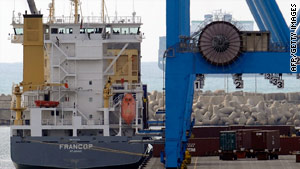
Israel Navy Intercepts Iranian Weapons en route to Hezbollah, 4 Nov 2009


The Israel Navy intercepted the "Francop" cargo ship, which was laden with roughly 500 tons of weapons hidden amongst civilian cargo. The 36 weapons containers were sent from Iran and meant for the Hezbollah terrorist organization in Lebanon. For further information on how the interception occurred and what was uncovered.


Love of the Land: Israel Navy Intercepts Iranian Weapons en route to Hezbollah, 4 Nov 2009

Love of the Land: The New Karine A

The New Karine A


Noah Pollak
Contentions/Commentary
04 November 09

Israeli Navy commandos seized a cargo ship last night en route from Iran to Syria. It contained 10 times the arms that the Karine A attempted to deliver from Iran to the Palestinians in 2002, enough weapons, according to the head of the Israeli Navy, to keep Hezbollah supplied in a hot war for a month. Along with 3,000 rockets, the ship contained:

107-millimeter rockets, 60-millimeter mortars, 7.62-rifle Kalashnikov-ammunition, F-1 grenades and 122-millimeter Katyusha rockets. On the side of some of the cases inside the containers the words “parts of bulldozers” was written.

The Syrian foreign minister, Walid Moallem, soared to Baghdad Bob levels of hilarity by trying to deny the reality of what the Israelis discovered.

“Unfortunately there are official pirates disrupting the movement of goods between Iran and Syria,” he told reporters on a visit to Teheran. “I stress, the ship was not carrying Iranian arms bound for Syria, nor was it carrying material for manufacturing weapons in Syria. It was carrying [commercial] goods from Syria to Iran.”

Moallem says there were no arms on board. The IDF has released a video of the ship’s weapons being unloaded in the port of Ashdod — rows and rows of mortar shells, rockets, and crates filled with grenades.

What will Obama say about all this? Being that evidence of Iranian-Syrian hostile intent complicates the administration’s desire for “engagement,” whatever that means anymore, the answer is: probably nothing.

What will the human-rights hustlers say? Where is Judge Goldstone? Where is the flurry of outraged press releases from Human Rights Watch? These weapons are intended for one purpose only — to terrorize Israeli civilians and drag the region into war. Shouldn’t this be an easy call for peace-loving human-rights activists? HRW has condemned Israel for violating international law over the way it funds public schools. I would bet a large sum that HRW will say nothing about the 500 tons of arms Iran just tried to send to Hezbollah. Priorities, you see.

And where is the UN Security Council? The arms ship violates numerous UNSC resolutions banning Iran from exporting weapons and forbidding the arming of Hezbollah. Don’t expect any leadership from the Obama administration on this score, either; to make a big deal out of Iranian bad faith would be tantamount to admitting that the engagement policy is the stuff of fantasy.


Love of the Land: The New Karine A

Love of the Land: Analyzing Human Rights Watch’s Defensive Response to Robert Bernstein

Analyzing Human Rights Watch’s Defensive Response to Robert Bernstein


NGO Monitor
04 November 09

Human Rights Watch founder Robert Bernstein’s highly critical op-ed in the New York Times (Rights Watchdog, Lost in the Mideast, October 19, 2009; see also Robert Bernstein’s rebuttal to HRW's response) led to a defensive campaign by Human Rights Watch (HRW) officials and supporters. Many of the press releases, opinion pieces, letters to the editor, and media interviews (14 to date, as listed in Appendix 1) use identical language and format, repeating claims made by executive director Ken Roth in Ha’aretz.

As shown below, the three main themes repeated by HRW’s defenders are: balance, methodology, and “open” and “closed” societies. These responses are misleading and do not address Bernstein’s most serious claims, including HRW’s role in “turn[ing] Israel into a pariah state” and its loss of “critical perspective” on Iran’s support for Hamas and Hezbollah.

1) “They say we disproportionately focus on Israel, and neglect other countries in the Middle East... Israel is a small fraction of what we do.” [1]

This response from HRW greatly distorts Bernstein’s statement that “in recent years Human Rights Watch has written far more condemnations of Israel for violations of international law than of any other country in the region.” Bernstein specifically discusses Israel within the context of the Middle East, where even HRW’s misleading response admits a disproportionate focus.

HRW claims that “Israel accounts for about 15 percent of our published output on the region.” [2]

Assuming this were correct, it would mean that HRW’s Middle East division, which covers 17 countries, focuses significantly more than the proportionate level of resources (6 percent) on Israel.

But the data show that this claim of 15 percent is highly misleading. In 2009 (through November 2), HRW has published 284 documents on the Middle East and North Africa. 88 (31 percent) of these documents have dealt with Israel, the Palestinian Authority, and Gaza. In comparison, only 39 documents focus on Iran. Of the 88 documents on Israel, the Palestinian Authority, and Gaza, 5 are full-length reports, versus only 3 on Saudi Arabia, 2 on the United Arab Emirates, and 1 each for seven other countries. ( HRW had completed and planned to publish yet another report, on “wanton destruction” by Israel in Gaza, in parallel to the Goldstone report. But the publication was shelved following the growing criticism. This is a tacit admission that the level of resources targeting Israel is excessive and unjustified.)

(Read full report)


Love of the Land: Analyzing Human Rights Watch’s Defensive Response to Robert Bernstein

Love of the Land: More Swedish Blood Libels

More Swedish Blood Libels


Honest Reporting/Backspin
04 November 09

Not only has Donald Bostrom reiterated his bodysnatching charge against the IDF, Sunday's Aftonbladet reported (and Haaretz picked up on) that the Swedish daily has been in contact with


"a woman in Geneva whom, together with a lawyer, is preparing a letter to the UN concerning 15 illegally autopsied Palestinians, of whom eight have been proven to have missing organs - as late as in 2008."


Haaretz elaborates:


The piece, written by culture section editor Åsa Linderborg, claims that the material has not yet been disclosed as the Palestinian families in question are scared to death of Israeli reprisals.


Linderborg referred to a recent organ trafficking case in Haifa, in which two men were jailed, and the case of Yehuda Hiss, Israel's chief state pathologist and former director of the Abu Kabir forensic institute, who admitted to have taken tissue from a deceased Israeli soldier in 2001.


"Two months after the publication by Aftonbladet, the first verdict hits [in the Israeli organ affair]. There will be more," said the piece.


The Haifa incident was indeed shameful, and the case of Yehuda Hiss even more so. But Aftonbladet's attempt to link them (and the New Jersey scandal) to the IDF is based on no evidence.


The same Haaretz report also describes a telling exchange between Bostrom and one of his Swedish critics:


Economist Anna Vider also attacked Boström's working methods, citing his use of witness reports solely from Palestinians, his failure to follow up with the Israeli authorities, the lack of interviews, and research. She also slammed him for linking a 1992 incident to allegations of organ trafficking in New Jersey in 2009.


"It takes a lot of research, it´s not just something you do in a week," Vider said: "As a journalist, he [Boström] should have taken it further. I think it's dishonest."


Boström rebuffed the criticism by saying: "I'm a reporter, not an investigator."


"He links the events, but refuses to discuss the connection," Vider continued. "It is indecent to wait for the scandal in New Jersey before publishing it. Why didn't he do it in 1992? This article has great impact on how Israelis look on Sweden and our involvement in the conflict."


Whoa! Bostrom's shirking off a reporter's basic responsibility of fact checking. As every student learns in Journalism 101: "If your mother says she loves you, check it out."


Related: Anatomy of a Swedish Blood Libel


Love of the Land: More Swedish Blood Libels

Love of the Land: U.S.-Syria Relations: Syrian Dictator Bashar al-Assad Complains that America isn’t Giving Him Enough Concessions in Exchange for Nothing

U.S.-Syria Relations: Syrian Dictator Bashar al-Assad Complains that America isn’t Giving Him Enough Concessions in Exchange for Nothing


Barry Rubin
The Rubin Report
04 November 09

As I’ve previously reported, policy toward Syria has been the best-run aspect of Obama Administration foreign policy. That’s largely because it has been left in the hands of State Department officials who have no illusions about that radical dictatorship which is Iran’s closest ally and is determined to remain that way.

Now Syrian dictator President Bashar al-Assad has complained to the country’s official news agency, November 1, that while the U.S. government is talking instead of “commanding” nothing much has changed with the Obama Administration. "It is hard to say that big steps have been taken in bilateral relations," Assad said.

More American official delegations are going to Damascus but they’re not being converted by the trip. One topic they are pressing is better Syrian control over its border with Iraq, a euphemism for: stopping helping terrorism in Iraq.

More than four months after the U.S. government announced it would send an ambassador to Syria for the first time in years, nobody has been named.

Now, the problem with tough diplomacy can be that it does not “work” immediately or seemingly not at all. This is a persistent Obama Administration criticism of its predecessors: they were tough on Iran and other radicals but the problems didn’t go away. Right! But what’s better:

--To be tough on enemies in order to weaken them, isolate them, put them on notice to change their behavior, and reinforce the determination of those being attacked by them in the region (in this case, Iraq, Israel, Jordan, Lebanon, and Saudi Arabia) OR

--To be soft on enemies, persuading them you are weak so they will be more aggressive, giving them concessions all the better to eat you with, and demoralizing the radicals’ victims by acting as if you are on the side of the “bad guys?”

After all, Syria continues to:

Arm, finance, transport, and encourage terrorists murdering American soldiers and Iraqi civilians; oppose peace with Israel; try to seize control over Lebanon; sponsor terrorism against Israel, Lebanon, and Jordan; refuse to cooperate with the international tribunal investigating past Syrian terrorism in Lebanon; deny human rights at home and torture peaceful dissidents; and a long list of other such things.

The main criticism I have toward Obama Administration policy on this issue is the failure to support Iraqi government complaints against Syria for sponsoring terrorism and giving safe haven to its leadership, a failure you can read about
here and here. Remember that these groups are openly part of al-Qaida and even the Obama Administration says that the United States is at war with al-Qaida.

Love of the Land: U.S.-Syria Relations: Syrian Dictator Bashar al-Assad Complains that America isn’t Giving Him Enough Concessions in Exchange for Nothing

Love of the Land: Britain and France continue dance of deception as Goldstone Report goes to UN General Assembly

Britain and France continue dance of deception as Goldstone Report goes to UN General Assembly


Robin Shepherd
Robin Shepherd Online
04 November 09


If you want a comparison that illustrates the difference between the United States and Europe on attitudes to Israel in particular and basic standards of moral clarity in general, consider the following. Yesterday, the US House of Representatives passed a resolution deriding the Goldstone Report on Gaza as “biased and unworthy of further consideration” by 344 to 36, not much short of a 10-1 margin. That’s moral clarity.


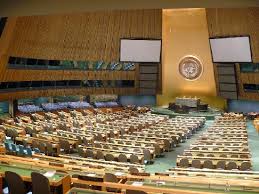
Representing the European Union, Britain and France by contrast will be dancing through hoops at the United Nations General Assembly today with assorted dictatorships and tyrannies in a desperate attempt to massage and amend a motion based on the odious UN Human Rights Council’s (HRC) October 16 resolution endorsing the Goldstone Report and effectively throwing Israel’s right to self-defence out of the window. The French and the Brits could not even be bothered to turn up to vote at the HRC session in October, but under pressure from Israel and the United States now say they might possibly vote against the resolution in the General Assembly. Then again, they might vote in favour if they can get a couple of changes to the text. And then again (again) they might just abstain if they can’t make up their minds. That’s not moral clarity. It’s a moral dunghill.


But how quaint can I get? Moral clarity, Europe, and Israel all in the same sentence?

Read the rest of this entry »


Love of the Land: Britain and France continue dance of deception as Goldstone Report goes to UN General Assembly

Love of the Land: Meet the Machine

Meet the Machine


Dry Bones cartoon: the anti-Israel, anti-Zionist Machine.


Well gang, I'm back from my U.S. tour. I spoke for two important American organizations: the ZOA and CAMERA. I was also able to deliver my first presentation as a Yale Fellow at YIISA (the Yale Initiative for the Interdisciplinary Study of Antisemitism)YIISA is a lone, shinning light on the western Academic scene.

Today's cartoon covers some recent activities of the anti-israel machine.


Love of the Land: Meet the Machine

Love of the Land: How Iran Skirts Sanctions

How Iran Skirts Sanctions


Avi Jorisch
Wall Street Journal
04 November 09

With a financial mechanism reminiscent of the Oil For Food scam, it seems Iran is using a United Nations office headquartered in Tehran to skirt U.S. sanctions. Once again, a rogue regime appears to be abusing a U.N. body in obtaining access to hard currency. The White House and the Financial Action Task Force - set up by the G-7 to combat money laundering and terrorist financing - have so far failed to identify this threat.

The Asian Clearing Union was established in Iran in 1974 as a U.N. initiative to expand trade and forge closer banking relations among ACU members. The organization's primary goal is to "facilitate payments among member countries," which include the central banks of Iran, India, Bangladesh, Bhutan, Nepal, Pakistan, Sri Lanka, the Maldives and Burma.

Iran has used the organization to route over $13 billion overseas in 2008 and over $5.6 billion so far in 2009 to pay for many of its goods and services, according to the ACU's financial documentation.

The danger is that the ACU is potentially being used as a classic money laundering instrument. Iran might be using the U.N. body as a third party to circumvent the U.S. sanctions program, which prohibits with limited exceptions, such as for certain foodstuffs, textiles and medicine, American-Iranian business deals. The sanctions program does not only target domestic companies, however. Unless specifically allowed under the sanctions act, U.S. financial institutions are supposed to freeze all Iranian dollar transactions - including those involving Iran's non-American business partners.

The ACU mechanism is deceptively simple and described in detail on the ACU Web site (www.asianclearingunion.org). An Iranian company or government office initiates a transaction for the purchase of a foreign product or service by remitting Iranian rials via a local Iranian bank. The money is then transferred to the Central Bank of Iran, which then sends the funds to any ACU member using "Asian Monetary Units," the currency of the ACU. Each of these units is equal to either one U.S. dollar or euro, depending on the customer's preference. Once the Iranian money is in the ACU pot, it is difficult, if not impossible, for foreign banks to know whose money it is. Unlike the Iranian Central Bank, the other ACU members' central banks can transact freely with any U.S.-based correspondent bank.

Imagine the Iranian regime wants to buy machinery from an Indian company that insists on getting paid in dollars. A U.S. correspondent bank should theoretically be involved because the American government owns the greenback. Normally, the money would be sent from an Iranian bank via a U.S. correspondent bank to the company's account. But because this type of transaction is not specifically allowed under the sanctions regime, the U.S. correspondent bank would be obligated to freeze the money instead of sending it on to the company.

(Continue to full article)


Love of the Land: How Iran Skirts Sanctions

Love of the Land: Amnesty Water Report Falsehood #5

Amnesty Water Report Falsehood #5


CAMERA/Snapshots
03 November 09

Page 12 of Amnesty's "Troubled Water" report alleges that Israel has almost entirely frozen development of water infrastructure in the Palestinian areas. The report states:

Under the new Israeli military regime imposed in the OPT, Palestinians could no longer drill new wells or rehabilitate or even just repair existing ones, or carry out other any water-related projects (from pipes, networks, and reservoirs to wells and springs and even rainwater cisterns), without first obtaining a permit from the Israeli army. In theory such permits for drilling or rehabilitating wells could be obtained after a lengthy and complicated bureaucratic process; in practice, most applications for such permits were rejected. Only 13 permits were granted in the 29 years from 1967 to 1996 (when the PWA was established), but all of these were for projects for domestic use only and they were not sufficient to make up even for the replacement of wells that had dried up or fallen into disrepair since 1967. . . .

The regime put in place by the Israeli army not only prevented the development of new Palestinian wells and infrastructure, but also limited the use and upkeep of existing ones. It prevented the rehabilitation of old wells. . . (Emphasis added)

First, Amnesty ignores significant development in infrastructure since 1995. As the World Bank states:

The water and wastewater sector [in the West Bank and Gaza] has come a long way since 1995:

* A capable national institution, the Palestinian Water Authority (PWA), has been built.

* The foundations for policy and operational coordination with Israel have been established;

* Several existing municipal distribution networks have been rehabilitated, new networks developed, and supplies improved; and several new wells have been drilled and many rehabilitated.

* Backbone primary network of bulk-water carriers are under construction in the West Bank and ready to be launched in Gaza;

* In Gaza not only have municipal networks and systems have been significantly upgraded, under an internationally recruited management contractor, effective managerial and operational systems have been established. . .


To be sure, the World Bank goes on to list more work that still needs to be done.

Second, what about Amnesty's claim that only 13 new wells were drilled from 1967 to 1995? As reported earlier by CAMERA here, during this period Israel drilled or permitted the drilling of over 50 new wells for the Palestinian population, laid hundreds of kilometers of new water mains and connected hundreds of Palestinian villages and towns to the newly built water system (Background: Water, Israel and the Middle East, Israel Foreign Ministry 1991; Marcia Drezon-Tepler, "Contested Waters and the Prospects for Arab-Israeli Peace," Middle Eastern Studies, Vol 30, No. 2, April 1994)

Related: Amnesty Water Reports #1 #2 #3-4


Love of the Land: Amnesty Water Report Falsehood #5

Forever. Forever?

Forever. Forever?

Hillary Clinton is (or was) in Cairo. While there she clarified that

Washington does not accept the legitimacy of the West Bank enclaves and wants to see their construction halted "forever."

Forever can be a long time. Americans can remember a history of a few centuries. There have been people of European stock in America for a bit more than half a millennium. Latin was the main language in Europe for, what, a thousand years? Islam has been around for almost 1,500 years, and Christianity for 2,000. The European Union got into stride a few decades ago; there is reason to hope that the United Nations in its present form won't last even one century - though it probably will. But I wouldn't bank on 500 years.

There have been Jews in Eretz Yisrael, if you believe the archeological evidence, since at least 3,000 years ago. Seen in that context, settling or not settling "forever" is probably a bit of a stretch.
Originally posted by Yaacov Lozowick's Ruminations

Islamic and Nazi Antisemitism

Islamic and Nazi Antisemitism

Robert Wistrich is an archetypal professor. He knows a lot about his subject, by which I mean a lot. He speaks many languages, fluently (I've heard him sounding like a native in Hebrew, English, German, Russian and French, but there are more). He reads all the time, except when he's writing; he has published many books. He's the kind of fellow who encourages me not to be a full-time historian, since there's no way I could compete; better to dabble in many things and not have to be measured by success in one.

One of his more important books is to be published in America in January: A Lethal Obsession: Anti-Semitism from Antiquity to the Global Jihad. Amazon offers, among others, this review:

"A message of this remarkable work is that the Holocaust did not only discredit anti-Semitism. In a sinister way, the murder of six million Jews has also inspired fantasies of completing what the Third Reich had begun, and has led to widespread defamation of Israel by equating its policies with Nazism. The grim case that Robert Wistrich advances in A Lethal Obsession is overwhelming. In the awesome scale of its research, in its moral and literary force, and in its compelling political urgency, there is no book quite like it."—Stephen J. Whitfield, Professor of American Civilization, Brandeis University.


Yesterday Wistrich published an op-ed in Haaretz about the similarities between Nazi antisemitic propaganda and what's going on these days in the Muslim world, and the lack of recognition of the problem in the West. The column has the advantage of being about 1198 pages shorter than the book.
Originally posted by Yaacov Lozowick's Ruminations

Augean Stables on Goldstone

Augean Stables on Goldstone

Prof. Richard Landes, author of Augean Stables, has a long post about Goldstone's methodology, based upon lots and lots of quotations from the report itself. The thesis: the fact finding mission carefully chose what interested it in a way that would ensure the result it wanted to have.

How surprising.

The House voted yesterday for the anti-Goldstone resolution. As I said, it's non-binding and the administration can disregard it if they choose, but it's nice to have.
Originally posted by Yaacov Lozowick's Ruminations

Parashat Vayera: One Difference between Avraham Avinu and Lot

Parashat Vayera: One Difference between Avraham Avinu and Lot


03
Nov
2009

[Sichot Ha-Rav Tzvi Yehudah – Bereshit p. 171 – edited by Rav Aviner]

Both Avraham Avinu and Lot welcomed in guests in our parashah, but there is a major difference between them. There is a story about a great Rabbi who was delayed in his travels and was unable to find lodging at such a late hour. He knocked on the doors of the Jewish houses, but did not reveal that he was an important person. He knocked on the door of a wealthy person and the owner yelled at him: "This is not a hotel! This is a private home! No and no!" In the end, a simple Jew welcomed him in. His identity became known in no time and word quickly spread throughout the city that the famous Rabbi was there. Everyone came to visit him, including the wealthy man who had said that his house was not a hotel, and he jumped forward and said: "Rabbi, Rabbi, come with me. I will provide you with a spacious room." This is the difference between Avraham Avinu and Lot. Avraham Avinu welcomed in "men" (Bereshit 18:2), while Lot welcomed in "angels" (ibid. 19:1). It is certainly worthwhile to welcome in angels, they are important, but Avraham Avinu welcomed in men. We clearly see the humanity and righteousness that we must possess in relation to simple people. The incredible greatness Avraham Avinu possessed toward Hashem flowed directly into his humanity towards human beings.
Related Posts Plugin for WordPress, Blogger...