Sunday, 4 October 2009

Love of the Land: Prime Minister Salam Fayyad's Two-Year Path to Palestinian Statehood: Implications for the Palestinian Authority and Israel

Prime Minister Salam Fayyad's Two-Year Path to Palestinian Statehood: Implications for the Palestinian Authority and Israel


Dan Diker and Pinchas Inbari
JCPA
02 October 09

  • In August 2009, Palestinian Prime Minister Salam Fayyad announced a unilateral plan to establish a de facto Palestinian state in the West Bank and eastern Jerusalem following a two-year state-building process. Fayyad's plan is the first serious Palestinian outline of a state-building effort since the PLO was founded in 1964 and replaces the traditional PLO position of armed struggle to "liberate Palestine."
  • The Fayyad plan represents a bold anti-Fatah posture and is seen to pose a direct challenge to Fatah and its leader, Mahmoud Abbas. Fayyad enjoys only limited political backing and his political rivals, such as Tawfiq Tirawi, Abu Maher Gneim, and Mahmud al-Alul, who were recently elected to the new Fatah Central Committee, have already blasted Fayyad's plans.
  • Israel supports "bottom up" Palestinian state-building. However, Israeli leaders have voiced legal and security-based concerns over Fayyad's intention that the PLO would unilaterally declare Palestinian statehood in 2011 based on the June 4, 1967, lines. The one-sided establishment of a Palestinian state would contravene a key provision of the Oslo Interim Agreement, according to which: "Neither side shall initiate or take any step that will change the status of the West Bank and the Gaza Strip pending the outcome of the permanent status agreement."
  • Another direct challenge to Israel is that Fayyad's "blueprint" calls for massive Palestinian development in Area "C" of the disputed West Bank, which is under Israeli civil and security control, and which directly challenges the delicate, agreed-upon framework of the 1993 Oslo accords.
  • Israel's requirement of "defensible borders" involves its continuing control in Area "C," including the strategically vital Jordan Valley and the high ground surrounding Jerusalem and overlooking Israel's vulnerable cities along the Mediterranean coast. Hizbullah's 4,000 rocket attacks from the north in 2006 and Hamas' 10,000 rocket and mortar attacks from Gaza, culminating in the 2009 Gaza war, both underscore the potential rocket threat against Israel's cities that could emerge from a Palestinian state in the West Bank if Israel were to withdraw to the pre-1967 lines.

Introduction

In August 2009, Palestinian Prime Minister Salam Fayyad announced a unilateral plan to establish a de facto Palestinian state in the West Bank and eastern Jerusalem following a twenty-four-month state-building process. Fayyad's 54-page plan to build Palestinian infrastructure and establish Western-style public institutions is the first of its kind since the signing of the 1993 Oslo accords.

Fayyad's state-building vision has already elicited Western enthusiasm and financial and political support from the Obama administration and European countries. However, Western optimism may have underestimated the ominous political tensions which the plan has exacerbated among the fractured Palestinian leadership. Fayyad, as an unelected prime minister of the Palestinian Authority, has provoked some in the Palestinian leadership by announcing his far-reaching program without first seeking approval from the PA Legislative Council or the PLO governing bodies, without whose support such an initiative cannot be implemented.1

Israel supports "bottom up" Palestinian state-building. However, Israeli leaders have voiced legal and security-based concerns over Fayyad's intention that the PLO governing bodies will unilaterally declare Palestinian statehood in 2011 based on the June 4, 1967, lines. Such a move would be unacceptable to Israel, as it would contravene the internationally recognized principles of a negotiated settlement and secure and recognized boundaries - defensible borders - that were firmly established in UN Security Council Resolution 242 following the 1967 Six-Day War. This resolution, passed in November 1967, has governed all Arab-Israeli peace negotiations since then, including the Oslo process, the Roadmap, and Annapolis.

Israel would welcome the opportunity to share its vast experience in state-building to help Fayyad achieve his "bottom up," state-building vision within a strong Israeli-Palestinian partnership. However, any unilateral Palestinian declaration of statehood would preclude Israel's vital security requirements, its internationally-sanctioned legal rights, and could end up derailing the peace process and lead to armed conflict between PA forces and Israel.

The Fayyad Plan

Fayyad's plan is the first serious Palestinian outline of a state-building effort since the PLO was founded in 1964 and replaces the traditional PLO position of advocating a "struggle of every means" including armed struggle to "liberate Palestine," that was reaffirmed at the Sixth Fatah Congress in Bethlehem in August 2009.2 Fayyad's stated intention is to dedicate the next 24 months until 2011 to building physical infrastructure, public institutions, public services, and tax incentives for foreign investors.3 These state-building assets would anchor a viable de facto state throughout the West Bank including areas that, in line with signed agreements between Israel and the PLO at Oslo, fall under Israeli control, such as the hills that overlook Jerusalem and Israel's coastal cities to the west, as well as the strategically important Jordan Valley to the east.

Fayyad's intention is to create facts on the ground that will garner major international support and lead to pressure to transform recognition of a de facto Palestinian state in 2011 into a de jure state in the event that the Palestinian Authority and Israel fail to reach a negotiated solution.4 Fayyad said: "If occupation has not ended by then (2011) and the nations of the world from China to Chile to Africa and to Australia are looking at us, they will say that the Palestinian people have a ready state on the ground. The only problem is the Israeli occupation [the Israeli communities and security presence] that should end."5

(Full Article)


Love of the Land: Prime Minister Salam Fayyad's Two-Year Path to Palestinian Statehood: Implications for the Palestinian Authority and Israel

Israel Matzav: Learning Persian

Israel Matzav: Learning Persian

Israel Matzav: Israel knows exactly where Shalit is being held, but...

Israel knows exactly where Shalit is being held, but...

A report in the London-based Arabic daily al-Sharq al-Awsat claims that Israel knows exactly where kidnapped IDF corporal Gilad Shalit is being held, but cannot rescue him because the site is surrounded by explosives.

[T]he IDF knows "exactly" where kidnapped IDF soldier Gilad Shalit is being held, and ... the location is under constant Israeli surveillance. Hamas is aware that Israel knows where Shalit is being held, the report said, quoting an Israeli source.

The reason Israel has withheld from rescuing Shalit, the report said, is because of a fear that Hamas will kill the soldier if Israel attempts to rescue him. The site where Shalit is being held is surrounded by explosives, which will be set off remotely if IDF soldiers get too close....

All of which goes to show that the IDF probably could have rescued Shalit in 2006 (or at least had better conditions for an attempt) if we'd had a man (or a woman) as Prime Minister rather than a mouse.
Israel Matzav: Israel knows exactly where Shalit is being held, but...

Israel Matzav: Obama rehabilitates Ahmadinejad

Obama rehabilitates Ahmadinejad

Friday's Wall Street Journal editorial slams the Obama administration for releasing Iranian President Mahmoud Ahmadinejad from his predicament.

By yesterday, all that had changed. At the 18th-century Villa Le Saugy, Iran's representative sat among the world's powers as a respected equal. Responding to an overture from the Obama Administration, the Iranians even talked about the future of the U.N. and other nonnuclear issues. Meanwhile, Washington was "buzzing" (as one newspaper put it) that a one-day visit by Iran's foreign minister might signal more detente to come. Back in Tehran, Mr. Ahmadinejad floated a tete-a-tete with the U.S. President. In short, this engagement conferred a respectability on his regime that Mr. Ahmadinejad could only have imagined amid his vicious post-election crackdown.

The price of entry is surprisingly modest, too. Though cautious, the P5+1 (the veto-wielding Security Council members, plus Germany) welcomed signs of Iranian concessions: Inspectors at Qom, an openness to send low-enriched uranium outside Iran for enrichment, possibly suspending its own enrichment program. Mr. Ahmadinejad said the Geneva talks were "a unique opportunity" for the West.

Consider the Iranian offers in turn. Inspectors from the International Atomic Energy Agency won't find anything incriminating at the Qom facility. Having lied about it for years, the Iranians now have plenty of time to clean the place out. Iran's experience with the IAEA goes back to the first inspections starting in 1992, which somehow prevented the world from learning about Iran's bomb program for a decade and then only from an Iranian dissident group. A freeze on enrichment used to be the U.S. precondition for talks with Iran. Now the U.S. and Europeans say that in exchange merely for this enrichment promise, they'll freeze any additional sanctions.

Iran has timed its olive branch well. The Europeans are more frustrated with past Iranian stalling than is Washington and have started to hanker for tougher measures. Those demands will now be muted. For years, Iran has talked with the Europeans, using the time and diplomatic cover to make nuclear progress. The Obama ascendency offers the mullahs another chance, with an even more eager partner, to repeat the exercise with a far bigger potential payoff. Expect Iran to follow the North Korean model, stringing the West along, lying and wheedling, striking deals only to reneg and start over. In the end, North Korea tested a nuclear device.

On long evidence, the regime has no intention of stopping a nuclear program that would give it new power in the region, and new leverage against America. The Qom news reveals a more extensive, sophisticated and covert nuclear complex than many people, including the CIA, were willing to recognize. The facility is located on a Revolutionary Guard base, partly hidden underground and protected by air-defense missiles. Its capacity of 3,000 centrifuges is too small for civilian use but not for a weapons program. It's a good bet an archipelago of such small covert facilities is scattered around Iran.

The extent to which the Obama administration's naivete is allowing the Iranian regime to race back into the world of nations - in return for nothing - is simply astounding. It's only a question of time before the Obama 'strategy' leaves the entire West with egg on its face and a nuclear Iran... unless someone else bails the West out....

What could go wrong?

Read the whole thing.


Israel Matzav: Obama rehabilitates Ahmadinejad

Israel Matzav: 'When rockets hit us, you were silent'

'When rockets hit us, you were silent'

Sderot mayor David Buskila has sent a scathing letter to United Nationsl 'Human Rights Council' investigator Richard Goldstone.

"The world, and you in it, was silent. You were silent in the face of the dead bodies of our children, in the face of our children's frightened eyes, you were silent in the face of every one of the 8,000 Qassam rockets that hit our city," Buskila wrote.

"Your silence was frightening, and reminiscent of things forgotten," he added.

The letter began with the mention of three Sderot children who were killed in rocket attacks. "The blood of the children whose lives were cut short is screaming out from the earth, there is no redemption and no forgiveness for the blood of a little child whose short existence had not yet taught him that there is evil and that there are wars," Buskila wrote, attaching pictures of the three children "who will never grow up" to the letter.

The Sderot mayor also expressed his identification with the Palestinian people, writing that "I regret and am sorry for the death of every Palestinian child, I feel the pain of the Palestinian civilians, but let's not ignore the facts - the leaders of Hamas and other fundamental Islamic terror organizations are to blame for the suffering of Sderot residents and their children, as well as the suffering of Gaza's residents. These people, whose sole purpose in life are war crimes, and to whom the norms of the West do not apply, are to blame."

Buskila concluded his letter by expressing hope that "peace will prevail in our region, and I invite you to personally examine the suffering of the residents of Sderot, who represent the other part of the equation, the part you didn't bother understanding."

Unfortunately, there are an awful lot of 'Palestinians' in Gaza who identify with Hamas and its goals. Let's not kid ourselves.

Israel Matzav: 'When rockets hit us, you were silent'

Israel Matzav: End the Arab occupation of Israel

End the Arab occupation of Israel

This is simply excellent (Hat Tip: Sandmonkey via Twitter).

We would do well to recall that the PLO never changed its spots. It failed to do so when it signed for "peace" with the naive Yitzhak Rabin, who was lured into the trap sprung for him by the Osloites. And it failed to do so when it allegedly abrogated its charter. Even the recent Fatah conference and the statements by the "moderate" Holocaust denier, Palestinian President Mahmoud Abbas, can attest to this. The goal was and remains to this day: the liberation of the "occupied" territories from Israel, namely the State of Israel within the confines of the Green Line.

...

Most of the Arabs in the Land of Israel immigrated here after our waves of aliyah. In other words, Zionism and the prosperity it engendered spawned "the Palestinian people." Since the Arab occupation of the Land of Israel in the seventh century, and throughout the centuries of Muslim occupation, not one of the occupiers viewed this land as anything more than a distant imperial outpost.

The demand to grant a state to Arab immigrants to this country and their army, which is stationed here thanks to the blindness of certain Jews and the nations of the world, is without foundation. It is tantamount to legitimizing a reality that was created here after the criminal act that allowed an occupying army to enter this country.

The critics' responses are predictable: What do you propose, that the Arabs just evaporate into thin air? In contrast with the critics who espouse a racist transfer of Jews from Judea and Samaria, I reject any forcible transfer of any population group. Perhaps there is no solution to the problem. There is certainly no solution at this point. But this is no reason to commit suicide or sacrifice the Zionist vision on the altar of "peace."


Israel Matzav: End the Arab occupation of Israel

Israel Matzav: The 'road map' gutted

The 'road map' gutted

Last Saturday night, I noted a statement by the 'quartet' (the United States, the European Union, Russia and the United Nations) that effectively gutted the reciprocity requirement contained in the 2003 'road map' to a 'Palestinian state.' In Friday's JPost, former Israeli ambassador to the United Nations Dore Gold, who is a close Netanyahu adviser, elaborated on the 'quartet's action, which did much more than gut the reciprocity requirement.

In general, the Quartet wanted to provide its own multilateral stamp of approval on President Barack Obama's UN address from September 22. It is to be remembered that Obama's remarks were unusual in their exceptionally long and detailed treatment of the Arab-Israel conflict: Roughly one-tenth of the speech was devoted to the issue of Israel and the Palestinians - far more than any other conflict in the world. He specifically proposed the establishment of "a viable, independent Palestinian state with contiguous territory that ends the occupation that began in 1967."

In doing so, Obama adopted language that was not balanced out by an equal reference to UN Security Council Resolution 242, which appears in the Quartet road map and did not call for a full Israeli withdrawal to the 1967 lines.

OBAMA'S PUSH for the 1967 lines is also evident in his language during his UN address that "America does not accept the legitimacy of continued Israeli settlements."

...

The Quartet statement also goes out of its way to back the Palestinian Authority's new plan for building the institutions of a Palestinian state over the next 24 months - which was drafted by Palestinian Prime Minister Salaam Fayad. On the one hand, the Fayad Plan appears to address Israel's call for bottom-up peacemaking by tackling head-on the lack of sufficient self-governing bodies on the Palestinian side. On the other hand, it is a program that leads the Palestinian Authority seven-eighths of the way to an independent Palestinian state, leaving ambiguous how the Palestinians get to the finish line. What it leaves open is the possibility of a unilateral declaration of statehood by the Palestinians or by someone else.

...

ISRAELI DIPLOMACY is heading for unchartered waters, having to balance between negotiations with the Palestinians and the possibility of a new muscular multilateralism at the UN, led by the Quartet. What is clear is that if the Palestinians understand that they will receive a Palestinian state on a silver platter in two years time - that will additionally be based on the 1967 lines - then why should Mahmoud Abbas bother to negotiate or make a single concession?

Under such conditions, the Palestinians are likely to prefer advancing the campaign to delegitimize Israel, by increasingly turning to the International Criminal Court and other UN bodies. At the same time they will insist that the Obama administration put its own peace plan on the table that prejudges the outcome of negotiations by detailing future borders. An alternative that has been raised is an Obama side-letter to the Palestinians on borders that neutralizes Bush's past guarantees.

The only way to block this drift in diplomacy is for Israel to be very firm about its positions. It cannot accept any negotiating process with Abbas that allows the Palestinians to multilateralize Israeli-Palestinian differences while negotiators sit across from one another.

Read the whole thing.

We may as well come right out and say it: Israel has an enemy in the White House.
Israel Matzav: The 'road map' gutted

Israel Matzav: Stupid Jews

Israel Matzav: Stupid Jews

Israel Matzav: The uncut version of Michelle Obama's appearance on Sesame Street

Israel Matzav: The uncut version of Michelle Obama's appearance on Sesame Street

Israel Matzav: Israel names Russians helping Iran?

Israel Matzav: Israel names Russians helping Iran?

Israel Matzav: Temple Mount: 'Palestinians' riot, dumb Jews close it down

Israel Matzav: Temple Mount: 'Palestinians' riot, dumb Jews close it down

Israel Matzav: Where's my Olympic bid?

Israel Matzav: Where's my Olympic bid?

Freudian Slips at Amnesty International

Freudian Slips at Amnesty International

Two weeks ago a press officer at Amnesty International, Niel Durkir, posted to their blog about how the Israelis and the Palestinains aren't taking the Goldstone report seriously. So I sent him a letter:

Sir,

In your blogpost of September 16th you made a number of revealing comments.

Israel rejects the 575 pages of the Goldstone report (presumably without reading any of them) because the UN fact-finding mission was a UN Human Rights Council investigation, a body that Israel considers to be biased against it.


Well, not really. As you note, the report is 574 pages long, and it took a moment for the lawyers of the Israeli Foreign Ministry to read it all carefully. However, as soon as they had, they issued a 24-page detailed rebuttal of the Goldstone report. You ought to read it. I await a correcting post on your blog once you have.

Your sentiment is patronizing, of course. What precisely did you mean when you "presumed" the opposite of the truth, and what does it tell us about you and your organization that you see the world in such terms?

Most revealing of all was your comment that an Israeli official used a "florid, biblical phrase – “born in sin”. You may not be aware that this phrase is a perfectly reasonable term in Hebrew; the fact that it's biblical is, of course, fundamental to the matter. The Israelis are, after all, using the language of the Bible, in the land of the Bible, because this has always been their language and their land. At the end of the day, that's what the conflict is all about, isn't it? Your comment clarifies your position - rejection of the Jewish right to determine their own destiny - better than any long and verbose analysis ever could.

I look forward to hearing your thoughts,

Dr. Yaacov Lozowick
Jerusalem

I don't expect him to respond, but shold he surprise me with anyting interesting, I'll come back and report.
Originally posted by Yaacov Lozowick's Ruminations

Marek Edelman, RIP

Marek Edelman, RIP

Marek Edelman, one of the top commanders of the Warsaw Ghetto uprising of 1943, has passed away at the age of 90. Edelman was a member of the Bund movement, a far left movement of Yiddish-speaking Jews in Poland and Russia that was founded in the same year as Zionism (1897) and competed with it ferociously, but was effectively destroyed in the Shoah (it limped on for a while in places like Melbourne Australia, but merely as a shadow of its former self). Part of the story of the Underground in Warsaw was how rival movements came together to face the Nazi foe; Edelman's position in the Underground, which was mostly led by Zionists, was part of this. After the war he remained in Poland, and even after the wave of official antisemitism in 1968, when most of the last few thousands of Jews left Poland, he stayed on.

In 1976, when he was a prominent cardiologist in Lodz, he gave a long interview to a local journalist, Hanna Krall. The English translation is titled Shielding the Flame: An Intimate Conversation With Dr. Marek Edelman, the Last Surviving Leader of the Warsaw Ghetto Uprising. It's a fascinating read. As you might expect from a hard-bitten Bundist, he had no patience for the Zionist mythologizing of the uprising which had been so important in the 1950s and 1960s. He then went on to live long enough to see most Israeli thought on the subject come closer to his perspective, even while never embracing any of the Bundist elements.
Originally posted by Yaacov Lozowick's Ruminations

LIfe in Sderot

LIfe in Sderot

The mayor of Sderot, David Buskila, is peeved at Richard Goldstone and has sent him an irate letter.

Acording to a notice in The Marker (that's the financial part of Haaretz) over the weekend, the prices of homes in Sderot has risen by 20% this year. True, the starting point for that rise was rather abysmally low, but it looks like we may have done something right.

If you assume that people kvetching about the Jews are a permanent fixture of life as we know it, you'll appreciate that it's possible for the Jews to thrive irrespective of the kvetching (which may even be a function of the insistence on thriving).
Originally posted by Yaacov Lozowick's Ruminations

When did Baghdad Start?

When did Baghdad Start?

Here's a nice little mystery.

According to the Columbia Encyclopedia (which I prefer to Wikepedia for reliability), Baghdad was founded by the Caliph Mansur, in 762. This was a while ago, but by the standards of the region it's actually almost modern; by the 8th century the recorded history of this part of the world already had a couple millennia under its belt.

In our Talmud study group we yesterday noted in passing the appearance in a duscussion of one Rav Hanna of Baghdat. One of our group, who knows a lot, commented that this is the first and only mention of Baghdad he's aware of in the Talmud, most of which took place in older Babylonian cities such as Sura, Pompedita, and Nahardea.

Except that the passage seems to be talking about the early Amoraitic period, say, third or fourth century at the latest, and in any case not the eighth.

Bava Batra 142b.
Originally posted by Yaacov Lozowick's Ruminations

The Torah Revolution: Arabs riot on our Temple Mount

Arabs riot on our Temple Mount

B"H

Just because they [the Muslims] habitually build on other people's holy sites, doesn't mean they [the Muslims] become the rightful owners of the sites. The Temple Mount is Judaism holiest site and Jerusalem is not even mentioned once in the Quran. Therefore it is reasonable to say that the thesis according to which the Jewish Temple Mount is holy to the Muslims too is faulty and they are claiming this only in order to harass the Jews. Xtians have exclusive rights to their Vatican City, Muslims have exclusive rights to their Mecca, only religious Jews have exclusive right to zero, to nothing: not right!

- This is talkback # 14 on "Police close Temple Mount, Arabs riot"


The Torah Revolution: Arabs riot on our Temple Mount

Arab Threats Close Temple Mount - Defense/Middle East - Israel News - Israel National News

Arab Threats Close Temple Mount - Defense/Middle East - Israel News - Israel National News
Shared via
AddThis

US: 'Don't Go to Jerusalem's Old City During Sukkot!' - Politics & Government - Israel News - Israel National News

US: 'Don't Go to Jerusalem's Old City During Sukkot!' - Politics & Government - Israel News - Israel National News
Shared via
AddThis

'Israel Knows Exactly Where Shalit is Held' - Defense/Middle East - Israel News - Israel National News

'Israel Knows Exactly Where Shalit is Held' - Defense/Middle East - Israel News - Israel National News
Shared via
AddThis

Israel Responds to Attack, Demolishes Gaza Weapons Plant - Defense/Middle East - Israel News - Israel National News

Israel Responds to Attack, Demolishes Gaza Weapons Plant - Defense/Middle East - Israel News - Israel National News
Shared via
AddThis

Sderot Mayor to Goldstone: You Were Silent for Eight Years - Inside Israel - Israel News - Israel National News

Sderot Mayor to Goldstone: You Were Silent for Eight Years - Inside Israel - Israel News - Israel National News
Shared via
AddThis

Last of the Warsaw Ghetto Rebels Dies at 90 - Jewish World - Israel News - Israel National News

Last of the Warsaw Ghetto Rebels Dies at 90 - Jewish World - Israel News - Israel National News
Shared via
AddThis

RubinReports: Life in a Ninth Grade American Classroom: Military Victory is Nothing to Celebrate

Life in a Ninth Grade American Classroom: Military Victory is Nothing to Celebrate

By Barry Rubin

As some of you know, I’ve been writing about my ten-year-old son in fourth grade in a Maryland public school. But now it’s time for my fourteen-year-old daughter who is ninth grade to get into the act.

Since she is going to a Jewish day school, I’d expect less of a problem with Political Correctness. For example her school, unlike the public school, had a commemoration for the September 11 victims.

But some weirdness is afoot there also. In her Jewish religion class, the teacher asked why the rabbis had built up the story of the miracle on Chanukah, when a lamp in the Temple burned for eight days despite the fact that there was only oil for one. For those of you who don’t know, Chanukah commemorates the victory of the Maccabees in revolting against the Selucid kingdom which tried to ban Judaism. After a heroic war, they won and reestablished the independent kingdom of Israel.

Compared to most Jewish holidays, the strictly religious part seems pretty much an afterthought and a secondary factor.

My daughter answered with what she learned in Israel—and is clearly the correct answer. Since Chanukah as the victory of the Maccabees did not involve much of a theological nature—it is really more of a national event though the rebellion was to preserve Judaism—the rabbis tacked on or built up the lamp story to inject a religious element.

The teacher said, in what sounds like an insulting tone from my reliable reporter who was there, that this was completely wrong. The correct answer, she explained, was that they didn’t want to have a holiday that commemorated a war.

This is utter nonsense and if anyone said such a thing even a few years ago they would be laughed at. It was certainly, too, a just and defensive war—the Selucids killed Jews who did not bow down to idols—and Jews have always been proud of that victory.

Today, of course, you cannot be proud of any war (perhaps World War Two, which was against right-wingers, and of course was especially important for Jews, is an exception.) Religion--or at least Western religion--must be seen as equivalent to pacifism in order to have any legitimacy. So a teacher can make up something that has nothing to do with history but everything to do with contemporary ideology.

This seems like a small point but it is irksome precisely because it is so dishonest and has absolutely no basis in any historical or religious source. It is wrongful to misinform young people, presenting some newly minted theory derived from current political fashion as the incontrovertibly, traditional, and only right answer.

Actually, this may be a good point at which to mention something interesting. It is admittedly only marginally related to the specific anecdotes above but has a lot to do with how teachers behave in classrooms nowadays.

Many years ago, I became interested in a historical question: Did American professors who were members or supporters of the Communist Party in the 1930s and 1940s use their classrooms to preach their politics to students? I did a huge amount of research and wrote a journal article on it.

My conclusion was that this almost never happened. While to some extent one could argue they were scared of possible punishment for doing so, in the pre-McCarthy era this was far less true than people think today. The main reason professors kept their ideology out of the classroom as much as possible was simply that they believed in a professional ethic which said it was wrong to bring their politics into the classroom and use their position as teachers to intimidate or indoctrinate their students. In their Marxist views they may have been cynical about such things yet they couldn't shake their professionalism.

Can you imagine anyone acting that way today? Indeed, I’m confident in asserting that in the social sciences and humanities it is harder for someone who doesn’t toe the hegemonic political line in academia today to get a job or tenure than it was for a Communist in pre-1950 America.


RubinReports: Life in a Ninth Grade American Classroom: Military Victory is Nothing to Celebrate

The Torah Revolution: There is a simple explanation at hand

The Torah Revolution: There is a simple explanation at hand

Israel Matzav: Ahmadinejad Jewish?

Ahmadinejad Jewish?

I'm sure you'll all be shocked - just shocked - to hear that London's Daily Telegraph is reporting that Iranian President Mahmoud Ahmadinejad was born Jewish and that his family converted to Islam after his birth.

A photograph of the Iranian president holding up his identity card during elections in March 2008 clearly shows his family has Jewish roots.

A close-up of the document reveals he was previously known as Sabourjian – a Jewish name meaning cloth weaver.

The short note scrawled on the card suggests his family changed its name to Ahmadinejad when they converted to embrace Islam after his birth.

The Sabourjians traditionally hail from Aradan, Mr Ahmadinejad's birthplace, and the name derives from "weaver of the Sabour", the name for the Jewish Tallit shawl in Persia. The name is even on the list of reserved names for Iranian Jews compiled by Iran's Ministry of the Interior.

Experts last night suggested Mr Ahmadinejad's track record for hate-filled attacks on Jews could be an overcompensation to hide his past.
The Telegraph also notes that a blogger who called for investigating Ahamdinejad's family roots during last summer's election campaign has been arrested.

None of this will come as a surprise to Jews (and in fact, I vaguely recall hearing rumors about this in the past). Isaiah warned hundreds of years ago that those who would destroy us will come from among us.

Read the whole thing.
Israel Matzav: Ahmadinejad Jewish?

Israel Matzav: Simchas Beis HaShoeva

Israel Matzav: Simchas Beis HaShoeva

Israel Matzav: Eli Lake: US confirmed 'secret understanding' with Israel on nukes

Eli Lake: US confirmed 'secret understanding' with Israel on nukes

Eli Lake reported in Friday's Washington Times that the Obama administration has confirmed a 'secret understanding' with Israel - first reached by Golda Meir and Richard Nixon in 1969 - that allows Israel to keep an alleged nuclear arsenal outside the framework of the Nuclear Proliferation Treaty.

Mr. Netanyahu let the news of the continued U.S.-Israeli accord slip last week in a remark that attracted little notice. He was asked by Israel's Channel 2 whether he was worried that Mr. Obama's speech at the U.N. General Assembly, calling for a world without nuclear weapons, would apply to Israel.

"It was utterly clear from the context of the speech that he was speaking about North Korea and Iran," the Israeli leader said. "But I want to remind you that in my first meeting with President Obama in Washington I received from him, and I asked to receive from him, an itemized list of the strategic understandings that have existed for many years between Israel and the United States on that issue. It was not for naught that I requested, and it was not for naught that I received [that document]."

The chief nuclear understanding was reached at a summit between President Nixon and Israeli Prime Minister Golda Meir that began on Sept. 25, 1969. Avner Cohen, author of "Israel and the Bomb" and the leading authority outside the Israeli government on the history of Israel's nuclear program, said the accord amounts to "the United States passively accepting Israel's nuclear weapons status as long as Israel does not unveil publicly its capability or test a weapon."

There is no formal record of the agreement nor have Israeli nor American governments ever publicly acknowledged it. In 2007, however, the Nixon library declassified a July 19, 1969, memo from national security adviser Henry Kissinger that comes closest to articulating U.S. policy on the issue. That memo says, "While we might ideally like to halt actual Israeli possession, what we really want at a minimum may be just to keep Israeli possession from becoming an established international fact."


Israel Matzav: Eli Lake: US confirmed 'secret understanding' with Israel on nukes

Love of the Land: How Israel Must Talk

How Israel Must Talk


FresnoZionism.org
02 October 09

I recently wrote two posts — part I and part II of “How Israel must fight” — discussing the special situation of Israel fighting asymmetric wars, in a hostile political and media environment, and with the ever-present threat of intervention by outside powers.

My conclusion was this:

The primary goal, therefore, in future wars must be as complete a victory as possible: the enemy’s army must be shattered, its leadership killed or captured, its arms and installations destroyed. Victory must obtained as quickly as possible, before outside powers intervene; and it must be achieved with overwhelming force, to multiply the psychological effect. Humanitarian concerns will necessarily take a back seat.

But this same philosophy should be applied to the less-violent arena of diplomacy. Sometimes it seems as though Israeli policy is driven by so many forces other than the national interest: the desire to prove to the world how civilized Israel is, the need to mollify the US administration, and of course domestic political considerations.

For example, take the outrageous prisoner exchange demanded by Hamas for Gilad Schalit — 1000 or more terrorists including multiple murderers. Israel seems to have chosen to negotiate about which and how many prisoners will be freed in exchange; but the negotiations should be based on which and how many Hamas leaders will be executed if Schalit is not released!

The futility of the current approach was demonstrated today by Hamas leader Khaled Meshaal:

Those who were able to capture Schalit and hold him safely for more than three years are capable of capturing “Schalit and Schalit and Schalit until there was not even one prisoner in the enemy’s jails,” Mashaal said.

Another example of self-defeating policy is the suggestion by some that Israel should launch an official investigation of the charges in the Goldstone report. Is it not a forgone conclusion that any exculpatory conclusions that such an investigation might produce will be either ignored by the anti-Israel media or be slammed as biased? So what advantage is to be gained by keeping the false accusations made in the report in the public eye?

Yet another is any tendency to take seriously the absurd demands of the PA. Israel should make crystal clear that negotiations will not progress until the PA unambiguously states — in Arabic and English — that it recognizes Israel as the state of the Jewish People, and that all demands for ‘right of return’ are forever off the table.

I think that the Netanyahu government has acted more or less correctly so far, although it may not be able to resist the demands to bring Schalit home at almost any cost.

I’m hopeful that it will be able to turn around the apologetic and defeatist attitude that has characterized Israel’s diplomacy in recent years, and present to the world a picture of a nation confident of its power and legitimacy.


Love of the Land: How Israel Must Talk

Israel Matzav: Gates to resign and be replaced by ... Chuck Hagel?

Gates to resign and be replaced by ... Chuck Hagel?

This is more bad news for supporters of Israel.

Power Line reports on a rumor that Defense Secretary Robert Gates - the one holdover in the Obama cabinet from the Bush administration - is on his way out. The problem is Gates' rumored replacement: Chuck Hagel. This is from a New York Sun editorial cited by Ed Lasky of The American Thinker last October.

One indicator came on July 24, 2001, when the Senate voted 96 to 2 to renew the Iran-Libya Sanctions Act. The act helps deny Iran and Libya money that they would spend on supporting terror or acquiring weapons of mass destruction. The two senators who opposed the measure? Messrs. Lugar and Hagel.

Another indicator came on November 11, 2003, when the Senate, by a vote of 89 to 4, passed the Syria Accountability Act authorizing sanctions on Syria for its support of terrorism and its occupation of Lebanon. Mr. Hagel - along with Mr. Kerry - didn't vote. Mr. Hagel met in Damascus in 1998 with the terror-sponsoring dictator, Hafez Al-Assad, and returned to tell a reporter about the meeting, "Peace comes through dealing with people. Peace doesn't come at the end of a bayonet or the end of a gun."

Feature, as well, the lineup on April 6, 2001, when 87 members of the Senate sent President Bush a letter saying Yasser Arafat should not be invited to meet with high-level officials in Washington. The letter also faulted the Palestinians for using violence against Israel. Messrs. Lugar and Hagel did not sign the letter. When, on May 22, 1998, the Senate, by a vote of 90 to 4, passed the Iran Missile Proliferation Sanctions Act, imposing sanctions on foreigners who help Iran's missile program, Mr. Lugar fetched up among the four senators who voted against the measure.

These columns, in a July 10, 2003, editorial headlined "Ayatollah Lugar," have already reported on how Mr. Lugar watered down the Iran Democracy Act that was introduced by Senators Brownback, Schumer, Kyl, Inouye, and others. On April 18, 2002, when the Senate, by 88 to 10, voted to ban the import to America of Iraqi oil until Iraq stopped compensating the families of Palestinian Arab suicide bombers, Messrs. Lugar and Hagel were among the handful who voted to bring in the oil.

The bottom line is that Messrs. Hagel and Lugar (Hagar, is how their names can be contracted) want a weaker stance than most other senators against the terrorists in Iran and Syria and the West Bank and Gaza and against those who help the terrorists. They are more concerned than most other senators about upsetting our erstwhile allies in Europe - the French and Germans - who do business with the terrorists.

Chuck Hagel (pictured) is bad news. Lasky suggests googling "Chuck Hagel," Israel. I did. This is the top result.

Here is what the Jewish Democrats said about Hagel in March 2007:

As Senator Hagel sits around for six more months and tries to decide whether to launch a futile bid for the White House, he has a lot of questions to answer about his commitment to Israel. Consider this:

# In August 2006, Hagel was one of only 12 Senators who refused to write the EU asking them to declare Hezbollah a terrorist organization.

# In October 2000, Hagel was one of only 4 Senators who refused to sign a Senate letter in support of Israel.

# In November 2001, Hagel was one of only 11 Senators who refused to sign a letter urging President Bush not to meet with the late Yassir Arafat until his forces ended the violence against Israel.

# In December 2005, Hagel was one of only 27 who refused to sign a letter to President Bush to pressure the Palestinian Authority to ban terrorist groups from participating in Palestinian legislative elections.

# In June 2004, Hagel refused to sign a letter urging President Bush to highlight Iran's nuclear program at the G-8 summit.

Here's what the National Review wrote about Hagel's stance on Israel in 2002:

"There's nothing Hagel likes less than talking about right and wrong in the context of foreign policy. Pro-Israeli groups view him almost uniformly as a problem. 'He doesn't always cast bad votes, but he always says the wrong thing,' comments an Israel supporter who watches Congress. An April speech is a case in point. 'We will need a wider lens to grasp the complex nature and consequences of terrorism,' said Hagel. He went on to cite a few examples of terrorism: FARC in Colombia, Abu Sayyaf in the Philippines, and the Palestinian suicide bombers. Then he continued, 'Arabs and Palestinians view the civilian casualties resulting from Israeli military occupation as terrorism.' He didn't exactly say he shares this view - but he also failed to reject it."

And here's what the anti-Israel group, CAIR, wrote in praise of Hagel:

"Potential presidential candidates for 2008, like Hillary Clinton, John McCain, Joe Biden and Newt Gingrich, were falling all over themselves to express their support for Israel. The only exception to that rule was Senator Chuck Hagel ?" [Council on American-Islamic Relations, 8/28/06]

What could go wrong?


Israel Matzav: Gates to resign and be replaced by ... Chuck Hagel?

Israel Matzav: Video: Gilad Shalit

Israel Matzav: Video: Gilad Shalit

Israel Matzav: Former Iraq commander blasts Goldstone

Former Iraq commander blasts Goldstone

In Friday's Australian, retired General Jim Molan, who was the chief of operations of the multinational force in Iraq in 2004-05, blasts the Goldstone Commission (Hat Tip: Barry Rubin).

With experience of having to tread through this legal and moral minefield while acting as an agent of the statesman who has an obligation to act, I was looking forward to how Goldstone was going to react to questions such as: How much discrimination is enough? How much of the inevitable killing of innocents is too much? How do we equate our complex war aims with the use of military force against a terrorist organisation that flouts the rule of law? How do you assess in legal terms the proportionality of a war between a terrorist force and one of the world's most advanced militaries? If one side uses backyard rockets is the other side not allowed to use precision-guided missiles? Do three Israelis killed and hundreds wounded by backyard rockets equal 1000 Gazans killed by Israeli actions? Given the legal regime recognises the difficulty of military decision-making amid the fog of war, and thus obligates planners and commanders to base decisions on information reasonably available at the time, how did the report handle this issue?

On these and many other questions, the Goldstone report is strangely silent, a luxury that I did not have in Iraq, and a luxury that the Israeli commanders probably did not have in Gaza.

The Goldstone report is an opinion by one group of people putting forward their judgments, with limited access to the facts, and reflecting their own prejudices. The difference in tone and attitude in the report when discussing Israeli and Hamas actions is surprising.

I probably do not need to state for most readers that as a soldier who has run a war against an opponent not dissimilar to Hamas, facing problems perhaps similar to those faced by Israeli commanders, my sympathies tend to lie with the Israelis. I can hold and openly declare those prejudices even while I acknowledge that within institutions that may be overall just and moral, there can be individuals or small groups who act outside the law. They must be dealt with, and in my war, they were.

But having stated my prejudice, I think I may be more honest than Goldstone, who seems to pass off his prejudices in a report that cannot be based on fact, and uses judicial language and credibility to do so. It comes down to equality of scepticism: if you refuse to believe anything the Israelis say, then you have no right to unquestioningly accept what Hamas says.


Israel Matzav: Former Iraq commander blasts Goldstone

Israel Matzav: EMail from an old friend

EMail from an old friend

Moadim l'Simcha - a good holiday to everyone.

If anyone is wondering how I am online tonight, it's because I live in Israel and therefore I only have one day on which work is forbidden at the beginning of the holiday rather than two.

Tom Gross makes public (at her request) an email that was sent to Richard Goldstone by an old friend of Goldstone's. In it, the old friend lambastes Goldstone for the Commission report he recently issued about Operation Cast Lead.

The Goldstone Commission bears your name. One would expect the mandate of any report to be objective so that your name could be respected and a legacy ensured. Instead your committee ignored the facts, embraced bias and rendered the report bearing your name, illegitimate.

You tried to defend yourself in the New York Times but it was transparent and not effective. You could have resigned from the commission and retained your integrity. You knew that Israel faced 12000 Grads and Kassams from its Iran backed terror base of Gaza, 8000 irreversibly traumatizing the families and children of Sderot. You knew that the U.N. never passed one resolution condemning these deadly missiles. You knew that before and during Operation Cast Lead Israel made thousands of cell phone calls to warn civilians. You knew that Israel sent thousands of texts to warn civilians. You knew that Israel dropped hundreds of thousands of leaflets in Arabic (I managed to obtain one of these as evidence) to warn civilians. You knew that Israel aborted operations to avoid civilian deaths. You knew that Israel set up medical facilities on the edge of Gaza to treat civilians. You knew that Israel dropped supplies of food into Gaza to feed civilians.

You also knew that Hamas operatives are not “civilians”. You knew that not only were they not civilians but that they hid behind their own civilians to fire on Israeli civilians. You knew that they misused ambulances for military purposes. You knew that mosques and schools were used for Hamas depots and launching pads. You knew that Hamas operatives kill or shoot at the legs of any Gazans refusing to target Israel.

The video footage and U-tube sequences are still available for any and all of us to witness.

You clearly knew that one of your team members had condemned Israel in a published letter even before the conclusion of the incursion or the beginning of your investigation. But you did not resign or distance yourself from the hypocrisy of this illegitimate report. Instead a tedious 500-page report of the 3 week battle was padded with pages from the tainted U.N. mockery of Israel’s security barrier (misnamed the “wall”). What a sad indictment of the charter of the United Nations.

Richard, you were indeed a respected legal giant in Johannesburg. This report did not arise from ignorance or naivete. I am trying so hard to resist the conclusion that your role and report might represent a self-serving desire to ingratiate yourself for a more senior position in the kangaroo court called the United Nations. But if true-and one hopes that this is not the case-at what price? Association with the infamous U.N. garners no respect in the USA so why would anyone seek to be head inmate at the U.N. Asylum?

Read the whole thing (it's item 17 towards the bottom).


Israel Matzav: EMail from an old friend

Saturday, 3 October 2009

RADICAL ISLAMS PLANS FOR WESTERN CIVILIZATION

Radical Islams Plans for Western Civilization


Posted by B'NAI ELIM (Sons of the Mighty)

Love of the Land: Another Tack: If Ahmadinejad had attended Harvard

Another Tack: If Ahmadinejad had attended Harvard


Sarah Honig
JPost
01 October 09

To avoid being mistaken for a white sellout, I chose my friends carefully. The more politically active black students. The foreign students. The Chicanos. The Marxist professors and structural feminists and punk-rock performance poets." - Barack Obama, Dreams of My Father

You can hardly blame Obama. Most folks are prisoners of their upbringing. They cannot escape the mind-set that took shape in their youth. Breaking through the bounds of early instruction/indoctrination requires a plucky character. Even then, intellectual integrity doesn't always overcome the expediency of exploiting superficial truisms and old associations for ulterior motives and political ends.

It's hard to judge precisely into which subcategory Obama fits. Does he simply lack the knack to unfetter himself from what was inculcated into him, or does he by now merely use platitudes and affiliations to further personal vested interests?

But whether it's conformity or cynicism (or a convenient combination of both), the bottom line is that Obama seems to expect all global arena players to abide by Harvard conventions - to broad-mindedly tolerate adversarial viewpoints, to submit a priori that no cause is unavoidably more just than any other, and to effectively prefer ostensible Third-World underdogs with a peeve.

My country, Obama was taught at Harvard, isn't necessarily more right, democracy isn't necessarily democratic or superior, and belligerents can be soothed with sufficient sympathy, flattery and concessions. Obama's tour de force at Cairo University epitomized the ethos of post-hippie-era Harvard.

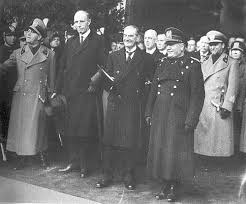
EVERY BIT as crucially formative was the enlightenment gained by Neville Chamberlain's foreign secretary, Lord Halifax (Edward Frederick Lindley Wood), at aristocratic Christ Church, Oxford. Halifax would go on to become one of the prime architects of appeasement. After hobnobbing with Hitler, Goering and Goebbels in 1937, Halifax noted in his diary that "although there was much in the Nazi system that profoundly offended British opinion, I was not blind to what he [Hitler] had done for Germany, and to the achievement from his point of view of keeping communism out of his country." Hitler's feat involved banning the Communist Party and banishing its leaders and accused members to concentration camps.

Halifax signaled Hitler that German designs on Austria, chunks of Czechoslovakia and Poland weren't altogether illegitimate in British eyes, so long as German territorial expansion was "peaceful." And Halifax, of course, proclaimed unwavering faith in Hitler's professions of peace. Old attitudes die hard. Once reputations are staked on policies, no matter how misconstrued, it's not easy to acknowledge error.

Only after the Axis bully began misbehaving with particular impudence following 1938's Munich pact did Halifax finally figure out that this wasn't quite cricket. But to his credit Halifax did agonize, even if belatedly, and he did draw some extremely cogent conclusions. "I often think how much easier the world would have been to manage," he mused, "if Herr Hitler and Signor Mussolini had been at Oxford."
(Continue)


Love of the Land: Another Tack: If Ahmadinejad had attended Harvard

Love of the Land: Ahmadinejad And My Sukkah

Ahmadinejad And My Sukkah


Media Backspin/Honest Reporting
01 October 09

While the US meets with the Iranians who want to reduce my neighbhorhood to glow-in-the-dark ash, I'm spending the week in an unsealed, anything-but-reinforced sukkah I built with my five-year-old son.

The hut's as high-tech as any extension cord, 60 watt lightbulb and electric timer can be on a dusty Jerusalem driveway.

One favorite sukkah activity is when the light's off and the kids asleep. Glass of wine in hand, I sit in the cool, quiet, night air and gaze up through the roof at the stars above. There's hardly a thought of arrogant messianic Persian autocrats, Western apologists, or fickle international opinion.

I'll be back and blogging with a vengeance after Sukkot, which for me is Sunday, October 11. A happy holiday to our readers.


Love of the Land: Ahmadinejad And My Sukkah

Love of the Land: A Universe Apart

A Universe Apart


Jennifer Rubin
Contentions/Commentary
02 October 09


Discussing Obama’s failed Mideast-peace strategy, Michael Gerson focuses on an increasingly critical ramification (aside from the soured U.S.-Israeli relations, the humiliating rebuff to the U.S., and the encouragement of Palestinian rejectionism) of the president’s decision to put “daylight” between America and Israel:

Obama has injected considerable suspicion into the American-Israeli relationship, picking public fights on issues such as settlements and adopting a tone of neutrality in other controversies. If Israel thinks America is an increasingly unreliable partner, Israel will be more likely to depend on itself alone — and let the bombers fly.

As Gerson points out, the Israelis (along with the French) have every reason to doubt U.S. resolve. Anyone who’s listened to Obama’s rhetoric from Cairo to Pittsburgh can discern that this is not a man who draws lines in the sand and not someone willing to take decisive action (unless it’s to capitulate unilaterally, as he did on missile defense). So we find ourselves in the not unexpected situation brought about by American weakness and procrastination: ”If the Israelis were confident that America would act decisively against the Iranian nuclear threat in the greatest extremity, they would be far less likely to act themselves.”

Indeed, one senses that Bibi Netanyahu and Barack Obama are on a rhetorical seesaw. The higher Obama’s rhetoric becomes and the less grounded in reality he appears (as was the case at the UN), the more blunt and steely-eyed Netanyahu becomes (as was the case with his UN speech). Obama ignores Iran’s genocidal threats, so Netanyahu must remind us of them. Obama loves to speak of a “process,” so Netanyahu warns we must have results. Obama clings to the security blanket of “multilateralism,” while Netanyahu emphasizes that the UN is no better than a low-rent circus. Obama obscures and conceals the Iranian nuclear operations, whereas Netanyahu highlights them. There is not simply “daylight” between the two leaders but a vast expanse that separates them.

Gerson is right: the Israelis will do what they must, in no small part because the American president does not view the world as they do. And they in turn are not about to put their fate in the hands of someone who lacks both the understanding and the will to keep nuclear arms out of the hands of butchers whose fondest hope is to eradicate the Jewish state.


Love of the Land: A Universe Apart

Love of the Land: Springtime for Mullahs

Springtime for Mullahs


The Geneva talks rehabilitate Iran's beleaguered regime.

Wall St. Journal
02 October 09

From Geneva yesterday come all kinds of good diplomatic vibrations. Iran may allow U.N. inspectors into a recently unveiled uranium-enrichment plant "within two weeks." Another meeting will be held before month's end. A "freeze" on sanctions was bruited about. In an appearance at the White House, President Obama sounded sober but hopeful, calling the direct American talks with the Islamic Republic "a constructive beginning" toward "serious and meaningful engagement."

Mahmoud Ahmadinejad was presumably in even better spirits at his remarkable change of fortune. A month ago, Iran's president was struggling to cement his grip on power after stealing an election and repressing nationwide protests. A week ago, the disclosure of the secret facility near Qom highlighted Iran's chronic prevarication and raised calls for more sanctions.

By yesterday, all that had changed. At the 18th-century Villa Le Saugy, Iran's representative sat among the world's powers as a respected equal. Responding to an overture from the Obama Administration, the Iranians even talked about the future of the U.N. and other nonnuclear issues. Meanwhile, Washington was "buzzing" (as one newspaper put it) that a one-day visit by Iran's foreign minister might signal more detente to come. Back in Tehran, Mr. Ahmadinejad floated a tete-a-tete with the U.S. President. In short, this engagement conferred a respectability on his regime that Mr. Ahmadinejad could only have imagined amid his vicious post-election crackdown.

The price of entry is surprisingly modest, too. Though cautious, the P5+1 (the veto-wielding Security Council members, plus Germany) welcomed signs of Iranian concessions: Inspectors at Qom, an openness to send low-enriched uranium outside Iran for enrichment, possibly suspending its own enrichment program. Mr. Ahmadinejad said the Geneva talks were "a unique opportunity" for the West.

Consider the Iranian offers in turn. Inspectors from the International Atomic Energy Agency won't find anything incriminating at the Qom facility. Having lied about it for years, the Iranians now have plenty of time to clean the place out. Iran's experience with the IAEA goes back to the first inspections starting in 1992, which somehow prevented the world from learning about Iran's bomb program for a decade and then only from an Iranian dissident group. A freeze on enrichment used to be the U.S. precondition for talks with Iran. Now the U.S. and Europeans say that in exchange merely for this enrichment promise, they'll freeze any additional sanctions.

Iran has timed its olive branch well. The Europeans are more frustrated with past Iranian stalling than is Washington and have started to hanker for tougher measures. Those demands will now be muted. For years, Iran has talked with the Europeans, using the time and diplomatic cover to make nuclear progress. The Obama ascendency offers the mullahs another chance, with an even more eager partner, to repeat the exercise with a far bigger potential payoff. Expect Iran to follow the North Korean model, stringing the West along, lying and wheedling, striking deals only to reneg and start over. In the end, North Korea tested a nuclear device.

On long evidence, the regime has no intention of stopping a nuclear program that would give it new power in the region, and new leverage against America. The Qom news reveals a more extensive, sophisticated and covert nuclear complex than many people, including the CIA, were willing to recognize. The facility is located on a Revolutionary Guard base, partly hidden underground and protected by air-defense missiles. Its capacity of 3,000 centrifuges is too small for civilian use but not for a weapons program. It's a good bet an archipelago of such small covert facilities is scattered around Iran.

Meanwhile, news reports this week say German and British intelligence believe Iran never stopped clandestine efforts to design a nuclear warhead. Their assumptions contradict the U.S. National Intelligence Estimate in 2007 that Iran had stopped its nuclear weapons program in 2003 and kept it frozen.

The evidence is overwhelming that the window to stop the world's leading sponsor of terrorism from acquiring a bomb is closing fast. If we are serious about doing so, the proper model isn't North Korea, but Libya. The Gadhafi regime agreed to disarm after the fall of Saddam Hussein convinced its leaders that their survival was better assured without nuclear weapons. Mr. Ahmadinejad and Iran's mullahs will only concede if they see their future the same way.

This supposed fresh start in Geneva only gives them new legitimacy, and new hope that they can have their bomb and enhanced global standing too.

Love of the Land: Springtime for Mullahs

RubinReports: Iranian Regime’s Charm Plus Western Credulity Equals "Diplomatic Success" in Geneva

Iranian Regime’s Charm Plus Western Credulity Equals "Diplomatic Success" in Geneva

By Barry Rubin

The United States--along with Russia, China, France, Britain and Germany--met with Iran in Geneva and officials, media, and experts proclaim it a success. Was its nuclear program what Iran defused or merely Western pressure?

It is widely claimed that the meeting in Geneva obtained three great achievements toward ending the long-running Iran nuclear arms’ campaign.

The first point is that the talks were conducted in a polite and civil manner. The Iranian delegates did not shout slogans and throw shoes at the Americans.

This is absurd. With typically short memories, observers forget that Iran conducted years of serious talks with all the participants except the United States. But of course these talks were used to stall for time and divide the foreign opposition. Any commitments made were promptly broken.

What is amusing about this point is that it reveals how behind the screen of Political Correctness and respect for all peoples, it is considered a revelation if Iranians don’t act like stereotyped savages. In fact, Iran has a long and successful history of diplomacy imbued in its political culture.

And of course the regime has a strong vested interest in not engaging in furniture-throwing at the meeting. After all, in every other venue it can continue its ideological extremism, repression, sponsorship of terrorism, and so on merely in exchange for a few hours of making nice in Geneva.

The second claimed success is equally hollow. Iran agreed to allow inspections of its hitherto hidden enrichment facility. Again, memories are short. In fact, the Iranian government announced that it would do so before the meeting in the same statement where it admitted the facility existed.

Let’s take a step back and consider the situation. For four years, Iran built and kept hidden the Qom enrichment plant. This is in complete violation of Iran’s treaty commitments and is one more definitive proof—as if one was needed? Well apparently it is—that the Tehran regime is seeking nuclear weapons as fast as possible.

At last, though, Iran got caught. So it basically said: in exchange for keeping this facility and for no punishment for building it we will allow you to do inspections. This is a clever maneuver, not a huge concession. Indeed, it is a victory for Iran.

The third point is the most significant and interesting. Iran has agreed in principle—note that since this implies that once details are discussed the promises will either be less attractive or not implemented at all—to send much of its nuclear fuel from the Natanz enrichment plant—the one we’ve known about--to Russia where it will be further enriched and then sent to France to be converted into fuel, making it far less suitable for making into weapons.

But guess what? And this is so important I'm going to put it in bold: Iran's ambassador to Britain has denied that Iran agreed to turn over the nuclear fuel. And this has not even been reported in the Iranian media yet.

Get it? Iran is getting credit for a concession that it has not even made yet and probably doesn't intend to make!

And so when I say: The account we are getting of the meeting's significance is too good to be true there's a lot of evidence for that conclusion.

It’s hard to believe otherwise. After all, one must take into context the nature, history, ideology, policies, and leadership of the Tehran regime as well as its immediate need to consolidate power at home and defuse pressure from abroad. If ever there was a situation that seemed ripe for trickery this is it.

But here’s the best argument: To believe that Iran is ready to act sincerely in giving up its nuclear fuel which can be used to make atomic weapons, you have to conclude that the regime’s goal all along has just been to build nuclear energy power plants, not weapons of mass destruction.

From Tehran’s viewpoint, in just about seven hours of talks it made the threat of sanctions go away for months without taking any actual action of significance. Indeed, Iran and those it met with have a common interest: to make the public and confrontational aspects of the problem go away.

U.S. officials said that the issue of repression in Iran was raised at the meeting—probably very much in passing—but that sanctions were barely mentioned. Of course, the Iranians knew all about the sanctions already but the point here is that the tone of the meeting was to downplay pressure and to give the Iranian regime a chance to “go straight.”

The responses of President Barack Obama show clearly his strategy. He will support Iran doing reprocessing in exchange for the regime pursuing only a peaceful nuclear energy option. Remember that this is what Iran has insisted it has been doing all the time and will go on insisting until the day that nuclear weapons are obtained. In a sense, Obama—to use current jargon—is empowering the Iranian narrative.

But consider this. Let's say that the United States, the Europeans, and Iran agree that Tehran is just seeking peaceful nuclear energy and should get it. What happens when some time in 2010 it becomes clear the regime was lying and that it's made dramatic progress toward getting atomic bombs? Won't this make Obama look to be about the most fooled world leader since Nevil Chamberlain waved that piece of paper saying Hitler only wanted western Czechoslovakia and should get it? How would the administration react in that event?

At any rate, what this may well amount to is a plea: Please fool us better. Do a more persuasive job of hiding your true intentions.

That’s not, of course, what Obama and other Western leaders intend. Here’s what Obama says: He created a framework for resolving the issue by affirming that all nations have the right to peaceful nuclear power as long as they stick by the rules of the Nuclear Non-Proliferation Treaty. By making clear his commitment for all countries in the world to get rid of nuclear weapons he united the international community behind him. That is what made possible the Geneva meeting.

Obama then presented three demands. First, Iran must allow inspections of the Qom facility, which it already has agreed to do. Second, it must build confidence that it is only seeking peaceful nuclear energy. This is to be done by the transfer of uranium to Russia for reprocessing.

He is thus giving Iran a face-saving way out: keep your program but don’t build nuclear weapons.

Meanwhile, sanctions are put off and Iran will be able to talk for months about the details of the Russia reprocessing deal. In a separate but related story, the Iranian automaker Khodro announced a deal with the French company Peugeot to make cars for export. Khodro also has such deals with Mercedes-Benz and the Japanese Suzuki company. It doesn’t sound like they are worried about being isolated internationally.

After the Geneva meeting, they don’t need to be.

Here's a good article by Jackson Diehl of the Washington Post who seems to be the best journalist in the mainstream media writing on U.S. Middle East policy. Most of what you are reading elsewhere in the mass media is nonsense. Diehl's appropriate headline: "The Coming Failure in Iran."


RubinReports: Iranian Regime’s Charm Plus Western Credulity Equals "Diplomatic Success" in Geneva
Related Posts Plugin for WordPress, Blogger...