Showing posts with label Tomb of Rachel. Show all posts

Thursday, 4 March 2010

Love of the Land: Tell me what your heritage sites are...

Tell me what your heritage sites are...


Israel Harel
Haaretz
04 March '10

(You'll have to read the full piece to get to the punch line, but it's got punch. Y.)

Everyone expected Benjamin Netanyahu to surprise us once again by distancing himself from the Likud platform, just as he did when he adopted the two-state "vision" in his speech at Bar-Ilan University. But at last month's Herzliya Conference, the prime minister surprised us from a different direction. Israel's existence, he declared, "depends first and foremost ... on our ability to explain the justness of our path and demonstrate our affinity for our land. ... If our feeling of serving a higher purpose dissipates, if our sources of spiritual strength grow weak, then - as Yigal Allon said - our future will also be opaque."

Less than a month after that speech, the cabinet members went to Tel Hai, a foundational site in the pioneering Zionist ethos, and decided during a festive meeting to "rehabilitate and strengthen the infrastructure of our national heritage, which expresses the national heritage of the nation of Israel in its land." In accordance with this decision, two maps will be "branded and rooted" in the public consciousness: "the map of the historical Jewish story" and "the map of the Israeli-Zionist experience."

The map of the "historical story" will include foundational sites such as Al-Kanatir, Dir Aziz, Hamam Midya, El-Umdan, Qeiyafa, Anim and Madras. It will not include - doubtless because they truly are the "historical Jewish story" - the Tomb of the Patriarchs in Hebron, Rachel's Tomb, Mount Gerizim and Mount Ebal, Tel Shilo (which was the capital of the ancient Israelite polity for 300 years before it moved to Hebron), Givon, Tel Jericho, the ancient Shema Yisrael mosaic in Jericho, or many other sites located in the heart of the land of the Bible.

Heletz, Beit Haya'aran and the Timna mines are three sites on the second map, that of the "Israeli-Zionist experience." And they, no less than the sites chosen for the map of the "historical Jewish story in the Land of Israel," faithfully reflect the best of the Zionist experience, as chosen by a task force comprising more than 100 people, led by Cabinet Secretary Zvi Hauser. According to the task force's concluding report, the choices were "based on criteria that reflect our vision."

(Read full article)

Love of the Land: Tell me what your heritage sites are...

Wednesday, 24 February 2010

Love of the Land: The Palestinian Authority and the Jewish Holy Sites in the West Bank: Rachel's Tomb as a Test Case

The Palestinian Authority and the Jewish Holy Sites in the West Bank: Rachel's Tomb as a Test Case


Nadav Shragai
Jerusalem Center for Public Affairs
Originally published
22 Kislev 5768 / 2 December '07

HEBRON, February 22, 2010 (WAFA- PLO news agency) - Palestine Liberation Organization (PLO) condemned an Israeli decision to add the holy sites Ibrahimi Mosque in the West Bank city of Hebron and Bilal Ben Rabah Mosque (Rachel's Tomb) in Bethlehem to the list of Israeli heritage sites.

Rachel's Tomb lies on the northern outskirts of Bethlehem, about 460 meters (about 500 yards) south of the Jerusalem municipal border, and for more than 1,700 years has been identified as the tomb of the matriarch Rachel. "The building with the dome and olive tree" became a Jewish symbol, appearing in thousands of drawings, photographs, and works of art and depicted on the covers of Jewish holy books. However, today the little domed structure has been encased in a sleeve of reinforced concrete with firing holes and defensive trenches, and covered with camouflage netting.

According to the armistice agreement signed on April 3, 1949, Jordan was to allow Israel "free access to the Holy Places and cultural institutions and use of the cemetery on the Mount of Olives." In practice, Jordan did not allow Jews free access to their holy places, and for 19 years, until 1967, Jews could not go to the Western Wall, Rachel's Tomb, the Tomb of the Patriarchs in Hebron, Joseph's Tomb in Shechem (Nablus), or other sites sacred to Jews which remained in Jordanian hands.

The Gaza-Jericho Agreement signed in May 1994 stated: "The Palestinian Authority shall ensure free access to all holy sites in the Gaza Strip and the Jericho Area." The Israeli-Palestinian Interim Agreement, signed on the White House lawn on September 28, 1995, dealt with the status of 23 places holy to Jews. The Palestinians promised to assure freedom of access to those places. However, the Palestinians either made access extremely difficult or prevented it entirely.

In October 2000, Joseph's Tomb in Nablus was attacked, set ablaze and desecrated. Druze Border Police Corporal Yusef Madhat bled to death on October 4 because Palestinians refused to allow his evacuation. The "Shalom al Israel" synagogue in Jericho was also attacked. Holy books and relics were burned, and the synagogue's ancient mosaic was damaged.

In 2000, after hundreds of years of recognizing the site as Rachel's Tomb, Muslims began calling it the "Bilal ibn Rabah mosque" - a name that has since entered the national Palestinian discourse. The Palestinian claim ignored the fact that Ottoman firmans (decrees) gave Jews in the Land of Israel the right of access to the site at the beginning of the nineteenth century. Israel's experience since the Oslo agreements has shown that the responsibility for Jewish holy sites or the roads leading to them should remain in Israeli hands.

(Read full article)

Love of the Land: The Palestinian Authority and the Jewish Holy Sites in the West Bank: Rachel's Tomb as a Test Case

Wednesday, 20 January 2010

Love of the Land: Rachel’s tomb and the protection of Jewish holy sites

Rachel’s tomb and the protection of Jewish holy sites


Meryl Yourish
Yourish.com
19 January '10

Protocol Additional to the Geneva Conventions of 12 August 1949, and relating to the Protection of Victims of International Armed Conflicts (Protocol I), 8 June 1977.

Part IV : Civilian population #Section I — General protection against effects of hostilities #Chapter III — Civilian objects

Article 53 — Protection of cultural objects and of places of worship
Without prejudice to the provisions of the Hague Convention for the Protection of Cultural Property in the Event of Armed Conflict of 14 May 1954, and of other relevant international instruments, it is prohibited:

(a) to commit any acts of hostility directed against the historic monuments, works of art or places of worship which constitute the cultural or spiritual heritage of peoples;

(b) to use such objects in support of the military effort;

(c) to make such objects the object of reprisals.

If, as Dickens wrote, “The law is a ass …” then, pardon the crudity, international law is donkey crap. Once upon a time, Rachel’s Tomb – where, according to tradition, the Matriarch, Rachel is buried in Bethlehem – was, as depicted in the mural below, located in an open area.

(Read full article)

Love of the Land: Rachel’s tomb and the protection of Jewish holy sites

Tuesday, 15 December 2009

Love of the Land: What if a Synagogue Were Burned and Other Silly Questions

What if a Synagogue Were Burned and Other Silly Questions


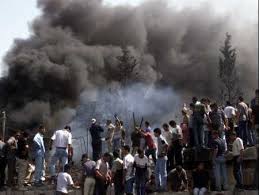
Arab mob burning Tomb of Joseph, October 2000

Jonathan Tobin
Contentions/Commentary
14 December 09


The New York Times reports that the “West Bank Is Tense After Arson at Mosque,” which is believed to be the work of Jewish extremists. Palestinian Arabs are rightly upset at this crime. So are Israelis. And therein hangs the tale of Middle East peace.

The fire at the mosque in the village of Yasuf appears to have been set last week by some Jewish settlers demonstrating their anger toward Israeli Prime Minister Benjamin Netanyahu’s plan to temporarily freeze building in Jewish communities in the West Bank. Extremists have vowed to counter such moves by increasing tensions with the Arabs. This is clearly madness and is rejected not only by the overwhelming majority of the people of Israel but also by the overwhelming majority of the approximately 300,000 Jews who live in the settlements. Local Jewish religious leaders attempted to visit Yasuf to express their condolences, but they were prevented from going there. So instead they met with Munir Abbushi, the Palestinian Authority’s regional governor, and presented him with new Korans. Abbushi accepted the Korans but then stated that Palestinian independence would mean that all Jews would have to be removed from the region. The Palestinians reject the right of Jews to live in their midst under any circumstances and regardless of who has or has not committed crimes.

But if you really wanted to get a feel for how differently the two communities think about these things, ask yourself what would happen if, instead of a mosque, a synagogue had been burned down. But this is not a hypothetical question.


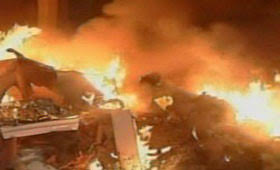
Arab mobs burning synagogue, Gush Katif 2005

In October 2000, at the start of the Palestinians’ second intifada, the Tomb of Joseph, a Jewish holy site in Nablus that served as a synagogue and religious school, was literally torn to pieces by an Arab mob. As Palestinian Authority “police” looked on, the mob destroyed the building and burned the sacred texts inside. But instead of treating the crime as an embarrassment to the national cause, among Palestinians it was treated as a cause for celebration. Another ancient synagogue in Jericho was also burned down that month. And even before the intifada, the Tomb of Rachel, a Jewish shrine near Bethlehem, was subjected to continual attacks. It had to be surrounded by fortifications to keep both the building and worshipers from harm.

(Continue reading)


Love of the Land: What if a Synagogue Were Burned and Other Silly Questions
Related Posts Plugin for WordPress, Blogger...