Showing posts with label Tehran. Show all posts

Wednesday, 30 December 2009

Love of the Land: Iran in 2010

Iran in 2010


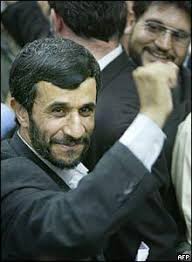
The world watches as the Iranians battle against the illegitimate Ahmadinejad regime that stole the last election and set up show trials of the opposition. The Iranians are fighting the nasty regime that tortured, raped, and murdered demonstrators and dissenters.
Interesting to note that, as Ahmadinejad threatens the world, he himself is threatened by "the will of the people".

Love of the Land: Iran in 2010

Monday, 14 December 2009

Love of the Land: Tractors?

Tractors?


Michael Zebulon
American Thinker
13 December 09

In unmistakably peace-loving Tehran, Western observers have beheld street processions of missiles - conspicuously emblazoned with clearly stenciled words evoking all the charm and grace of a greeting card: "To Jerusalem."

Late in the 1960s, shortly after Israel's spectacular military victory in the Six-Day War, its then-newly elected Prime Minister: the Russian-born, Milwaukee-raised and Denver-educated, former U.S. citizen, Golda Meir -- was asked if she were not afraid that, because of Israel's need for defense, the country might become "militaristic." "I can only answer," replied the lady, "that I don't want a fine, liberal, anticolonial, antimilitaristic, dead Jewish People."

Those words were spoken some 41 years back. Here's my "report," as it were, in the matter-- four decades hence:

I was in the city of Jerusalem a couple of years ago for "Yom Yerushalayim," that's Jerusalem Day, May 22 this year, which, on the Jewish (lunar) calendar, annually commemorates Israel's responsive and successful unification of the City when the aforesaid Six-Day War was forced upon her in June of 1967. On second thought, let me tinker just ever-so-slightly with the first part of that statement: I wasn't actually in the city "for" Jerusalem Day -- but I was, as fate would have it, in the city on Jerusalem Day. Yes, that's better.

As a matter of fact, I had spent quite a bit of the merry month of May in Israel that year. It was the occasion of my niece's wedding - and then, having completed a rigorous four-year course of study there, she graduated from medical school in Israel, as well, the following week. But this particular narrative isn't about family stuff. Not as such.


Love of the Land: Tractors?

Thursday, 10 December 2009

Love of the Land: A Question

A Question


According to the MEMRI Iranian Media Blog:

"Iranian expatriate human rights activists report that 4,000 students demonstrated in Tehran to mark Students Day today, shouting "Death to (Iranian Supreme Leader Ali) Khamenei " and "Khamenei is a Murderer and His Religious Authority Is Null and Void," as well as "Death to the Government That Deceives the People."

At Amir Kabir University in Tehran, 1,500 students shouted for the "coup government" to step down, and chanted "Death to the Dictator" (referring to Iranian President Mahmoud Ahmadinejad)." -more

To see a video of this week's Iranian student anti-Ahmadinejad demonstrations click on Tehran Video

Love of the Land: A Question

Sunday, 6 December 2009

Love of the Land: Iran…and Political Hallucination!

Iran…and Political Hallucination!


TY Stephen E Hughes for graphic

Tariq Alhomayed
Asharq Al-Awsat
06 December 09

In one of his speeches in Isfahan, the Iranian President Mahmoud Ahmadinejad says that the attacks launched by America and it’s military allies over the past few years on some countries in the [Middle East] region are based on religious grounds and that “their motive for carrying out these attacks that they did not make public is that they know that there will come a day when a man descended from Prophet Mohammed, may peace be upon him, will appear in this region and he will eliminate all the wrong-doers in the world. The Iranian nation will be among the supporters of this divine man.” Ahmadinejad continued and confirmed that “Iran has the documents to prove this.” And of course that’s not all; Ahmadinejad added, “The first task for Iranian officials is to build [up] Iran and their second task is represented in preparing to enter the administration of world affairs.”

Is there a better example of political hallucination? The question here is that if talk such as this works on the supporters of the Iranian regime and its president, how can Tehran’s ideas and political projects be marketed in the Arab world? [How was it sold to] some of the cultural and political elites, especially those that engage in politics and particularly Arab nationalists who used to describe some Arab regimes as backward? How have they i.e. some nationalists today become theorists of the Iranian hallucinations?

(Full article)

Tariq Alhomayed is the Editor-in-Chief of Asharq Al-Awsat, the youngest person to be appointed that position. Mr. Alhomayed has an acclaimed and distinguished career as a Journalist and has held many key positions in the field.

Love of the Land: Iran…and Political Hallucination!

Sunday, 22 November 2009

Love of the Land: When it Comes to Iran, President Obama Won’t Hear “No” For an Answer

When it Comes to Iran, President Obama Won’t Hear “No” For an Answer


Barry Rubin
The Rubin Report
20 November 09

Question: What does Iran have to do to get across the fact that it isn’t making a deal on its nuclear program?

Secretary of State Hilary Clinton
says she doesn’t consider the Iranian foreign minister’s statement that they aren’t making the deal to be “the final word.” The Obama Administration will give Tehran a few more chances—and probably a few more months—to stall in order to race ahead in their atom bomb program and to build up ways of overcoming any sanctions that are some day applied.

Indeed, the United States and five other powers are holding still another meeting to, in the words of EU foreign policy chief Javier Solana's spokeswoman "review the latest developments on the Iran nuclear issue." But since no one is concluding Iran is saying no, they won’t take one step toward higher sanctions.

Higher sanctions, you might remember, were supposed to come about in September 2009 under the Obama Administration's own original time table. You know when the deadline was for the multi-year European negotiations with Iran was? September 2007.

Now at the earliest sanctions probably wouldn’t come before, what, March 2010? Victory for the Iran regime.

Another great power
statement says that Iran has "not responded positively" to the plan, "We are disappointed by the lack of follow-up," and "Iran has not engaged in an intensified dialogue and in particular has not accepted to have a new meeting."

I think Iran is trying to tell you something, guys. But since it isn’t in writing yet, well, they claim they can’t do anything. And of course the Iranian regime will--with U.S. government cooperation--draw this out as long as possible.

Memo to world leaders: Do you think they might be stalling for time?

Note something important here. It isn’t as if the minute they declare that Iran rejects any compromise or serious negotiations there will be stronger sanctions. Oh, no. At that point, the United States and Europeans will start meeting to figure out what sanctions to put on. Of course, they will disagree, the Russians and Chinese will water it down. The plan is also to bring in the entire EU which means, for example, that Spain or Sweden could slow down the process or force a reduction in the planned pressures on Tehran.

Now what is the president of the United States's
response to all this? Hold onto your syntax:

(Continue to full article)


Love of the Land: When it Comes to Iran, President Obama Won’t Hear “No” For an Answer

Saturday, 7 November 2009

Love of the Land: All It Takes

All It Takes


Democracy in Iran, opposition demonstrations in Tehran are crushed by Ahmadinejad : Dry Bones cartoon.


"All it takes . . ." is a reference to the often quoted and more often ignored piece of folk wisdom "All it takes for evil to triumph is for good men to do nothing".

* * *

Below is an editorial from yesterday's (Nov.5, 09) Wall Street Journal about Obama's response to the pro-Democracy protests in Iranian cities:

Obama on Tehran's Democrats:
"We do not interfere in Iran's internal affairs"

Tens of thousands of protesters yesterday braved police batons and tear gas canisters in the streets of Iranian cities to denounce their theocratic rulers and call for a change of regime. In spite of repression by the Basiji thugs and the West's short attention span, the Green Revolution lives on.

On this, the 30th anniversary of the hostage taking at the U.S. Embassy, their message was to a large degree intended for America and President Obama. The opposition hijacked the day, usually an occasion to denounce the Great Satan, to declare their desire to break with that past and build a free Iran. They marched alongside state-sanctioned rallies, before their protests were broken up violently.

For this broad coalition of democrats, America is a beacon of hope and the Iran of the street arguably the most pro-American place in the world. Earlier this year, before the huge demonstrations in the wake of Mahmoud Ahmadinejad's brazen theft of the June presidential election, one popular opposition chant was, "O ba ma!"—in Farsi a play on the new American President's last name that translates as, "He with us!"

But the opposition's dreams of American support, moral as much as anything, have been dashed. Mr. Obama was slow and reluctant to speak out on their behalf and eager to engage the Iranian regime in nuclear talks as soon as the summer of protest tapered off. Iran's democrats are now letting their disappointment show. The new chant passed around in Internet chat rooms and heard in the streets yesterday was, "Obama, Obama—either you're with them or with us." -more


Love of the Land: All It Takes

Wednesday, 4 November 2009

Love of the Land: Who Killed Engagement with Iran?

Who Killed Engagement with Iran?


Jonathan Tobin
Contentions/Commentary
03 November 09

The collapse of President Obama’s daft strategy for “engaging” with the tyrants of Tehran has left his cheering section with some terrible questions. After spending months soft-pedaling Iran’s stolen election, abuse of dissidents, as well as the danger from its funding of terrorists and, of course, the threat from its drive for nuclear weapons, the administration thought it had fixed the problem with the deal it negotiated to have the Iranians ship their enriched uranium out of the country for processing. It was doubtful that the deal would have worked or that the Iranians wouldn’t have cheated. But Tehran’s rejection of the pact that its representatives had negotiated has the Obama camp thoroughly perplexed.

Their problem is that they can’t accept the obvious answer to the question as to why their solution has been sunk. Having been warned by skeptics of engagement that the Iranians’ only objective in negotiations was to prevaricate, the administration now finds itself scrambling for an explanation as to why their goodwill and generous offers have gotten them exactly nowhere. But ready as always with an explanation for their dilemma is the New York Times, which served up a healthy serving of excuses today in an article designed to rationalize both Iran’s stalling and Washington’s failed strategy. The piece, titled “Iran’s Politics Stand in the Way of a Nuclear Deal With the West,” claims that left to his own devices, Iranian President Mahmoud Ahmadinejad would love to ratify the pact and fulfill its requirements. But he can’t, says author Michael Slackman, because Iranian dissidents as well as a pesky school of “pragmatic conservatives” won’t let him get away with it. According to Slackman, liberal foes of the regime such as former presidential candidate Mir Hussein Moussavi, are trying to score points with the public by hammering Ahmadinejad as insufficiently nationalist, while the “pragmatists” to the right of him think he is betraying the Islamist cause by allowing the West to “cheat” Iran.

(Read full article)


Love of the Land: Who Killed Engagement with Iran?

Saturday, 31 October 2009

Love of the Land: Iran Rejects Deal on Nuclear Weapons’ Issue: Engagement is Dead but the Obama Administration Won't Admit It

Iran Rejects Deal on Nuclear Weapons’ Issue: Engagement is Dead but the Obama Administration Won't Admit It


Barry Rubin
The Rubin Report
30 October 09


The great experiment of engaging Iran seems to be over but the Obama Administration refuses to admit it.

This shouldn't be a surprise. As the Iranian regime's record shows, it stalls, maneuvers, gives vague promises and then doesn’t deliver, but only after they’ve taken your concessions. Do you know how many years the talks with Iran have gone on without yielding fruit and letting Tehran develop nuclear weapons every day? Answer: Seven.

Do you know when the “deadline” originally was for Iran to stop its nuclear program “or else”? Answer: Approximately September 2007.

But the Obama Administration doesn't want to admit that the new Iranian counter-offer is unacceptable because it would have to give up its dreams of a deal and actually do something in response.

Even the New York Times headlines its story: Iran Rejects Nuclear Accord, Officials Report

Here’s the best article on the subject of the current deal/no deal from the sober Financial Times. The headline is “Tehran seeks big changes to nuclear deal.”

It concerns Iran’s response to questions about whether it would transfer two-thirds of its enriched uranium outside the country to make into a special non-weapons material that can only be used for medical purposes. (Note: it can be changed back into weapons-usable uranium in about four months or so.)

After interviewing officials, the newspaper concludes that the Europeans are ready to reject Iran’s demands now as “unacceptable” but the United States isn’t. It writes:

“The comments indicate the US remains more willing to show patience than either Britain and [sic] France. While London and Paris have at times made known their reservations about the agreement, it is seen in the US as a test of President Barack Obama's policy of engagement.”

In other words, the U.S. government is now lagging behind Britain, France, and presumably Germany on this issue. So who is the United States trying to keep on board if the key European allies are all saying: forget this nonsense, we have to put on more pressure!

I suggest there are three answers:

--President Barack Obama’s world view which insists that all problems are resolvable by talking and making concessions, and which fears confrontation.

--The president’s domestic constituency and colleagues (not all of them) who simply don’t comprehend that Iran and radical Islamism are threats.

I am positive, given some of her public statements, that Secretary of State Hilary Clinton knows this is all sheer nonsense. And just as the U.S. government has fallen behind its European counterparts, the White House has fallen behind the State Department.

--Someone else. Here’s the hint:

"We remain unified with our Russian and French partners in support of the IAEA draft agreement - it is a good and balanced agreement," said the US, signaling Washington's hope that Iran could yet agree to the original deal.”

That’s right, Russia. But we know that Russia won’t ever agree to sanctions and serious pressure on Iran. For one thing, everyone in the world but the Obama Administration knows that the Russian leadership wants America to fail internationally. And for another thing, Russia is Iran’s ally.

So America’s policy is being held hostage by a president with no experience or understanding of international affairs, a set of ideas that makes failure inevitable, trying to please a country which is an ally of the adversary, and a dictatorial regime whose president believes that his country is going to conquer the whole Middle East (and on some days, the world).

And here’s a good joke: It was only--what?--four years ago that U.S. officials under the Bush Administration were making fun of Europe as wimpy and incapable of taking a tough stance on international issues. Now the goo is on the other foot!

What a mess. BUT how long into 2010 can they spin this before Washington is going to have to recognize the talks are going nowhere?

Love of the Land: Iran Rejects Deal on Nuclear Weapons’ Issue: Engagement is Dead but the Obama Administration Won't Admit It

Wednesday, 30 September 2009

Love of the Land: Talking Iran Down The Nuclear Road

Talking Iran Down The Nuclear Road


Obama's outstretched hand encourages Iran's quest for the bomb.


Amir Taheri
Wall St. Journal
29 September 09

The way the Obama administration portrays them, this week's talks between Iran and the so-called 5+1 group of nations represent a diplomatic breakthrough. Indeed they do—for Iran, that is.

The group, consisting of the five permanent members of the United Nations Security Council plus Germany, talked to the Islamic Republic for almost five years with no results. The U.S. played a key part throughout—first indirectly, then with a high-level presence. Until Mr. Obama entered the scene, the talks had a clear purpose: First, to persuade the Islamic Republic to stop uranium enrichment, or to face additional U.N. measures. Second, to offer Tehran inducements to abandon its nuclear ambition. Mr. Obama's policy of the "outstretched hand" has changed all that. Using what diplomats term "creative ambiguity," the new administration has tried to circumvent U.N. resolutions by offering unconditional talks.

Sources in Tehran say neither of the two letters that Mr. Obama has written to Supreme Leader Ayatollah Ali Khamenei demands compliance with U.N. resolutions. The view from Tehran is that Mr. Obama has already accepted Iran's nuclear program as fait accompli.

As Iran's official news agency, IRNA, put it in an analysis on Sept. 14, "Based on real indicators of its national interests and possible threats, America has no problem with Iran's nuclear project."

It went to note that "[America's] extensive problems originate in that country's military presence in the Middle East. And, since Iran is the most powerful nation in the region, America will have to cooperate with it under any circumstances."

Iran's clarity going into the talks contrasts with Mr. Obama's uncertainty.

"Iran wants its regional supremacy to be recognized by America and the West," says Hussein Pour-Ahmadi, an advisor to the Iranian foreign ministry. "Once Iran's regional dominance is acknowledged, Iran would be ready to help with regional security."

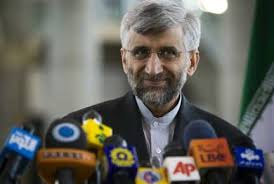
President Mahmoud Ahmadinejad has repeatedly claimed that Iran's nuclear program is non-negotiable. Iran enters the talks assuming that the negotiations that began five years ago have ended, and that a new process is about to start. The mandate in Geneva for Saeed Jalili, Iran's top negotiator, now is to assert Iran's claim of a share in global leadership. The Islamic Republic resents that some small Third World nations are invited to the G-20 summit while Iran, the self-proclaimed regional superpower, is excluded.

"Our package covers a range of issues such as energy security, reducing poverty, economic development, nuclear disarmament, fighting terrorism and protecting the environment," Mr. Jalili told reporters in Tehran on Wednesday.

Confident that the nuclear issue is off the table, the Tehran leadership has just revealed the existence of a hitherto secret plant for uranium enrichment. In a letter to the International Atomic Energy Agency or IAEA, the Islamic Republic last week told of a new facility, built in a mountain stronghold southwest of Tehran. This could operate 3000 centrifuges.

Earlier, the man in charge of Iran's nuclear project, Ali-Akbar Salehi, had made another startling revelation. In a 5,000-word press release, the nuclear czar reported the existence of "a generation of new and much more efficient centrifuges." He offered no details and, more significantly perhaps, did not say why these superior machines were not being used to enrich uranium instead of the old and inefficient ones operating in Natanz.

The two revelations reinforce suspicions that Tehran may be running a parallel nuclear program of which the IAEA has no knowledge. And yet, Mr. Jalili's brief is to talk about everything except Iran's nuclear program. Iran analysts dub this the "Bikini Strategy"—showing everything except the most interesting parts.

Paradoxically, Mr. Obama's outstretched hand may have made a negotiated resolution of the Iranian nuclear problem more difficult. The perception in Tehran is that Mr. Obama, who has apologized for America's unspecified misdeeds against Iran, is acting from a position of weakness mixed with a desire to score points against his predecessor.

Over the past months, Iranian think tanks have organized a number of seminars on the coming talks. The participants have been divided into two camps, the first advising that Iran go for full victory over the American "Great Satan". Their argument is that the world has already entered a post-American era and that Mr. Obama's weakness and naïveté offer an opportunity for driving the U.S. out of the Middle East.

Last week, advocates of that view published a collection of essays under the title "America Is Coming to an End". The book, published by Ahmadinejad's office, claims that Mr. Obama's election indicated American popular support for a "strategic global retreat". They claim that the world is looking for "an alternative vision" that only Iran can offer.

Or, as Hamid Mowlana, former American University professor and current advisor to Ahmadinejad, says: "Today, only two men count: Ahmadinejad and Obama. As American influence fades, Iran must assert leadership with Ahmadinejad's message of justice."

To persuade the Islamic Republic to climb off its high horses was never easy. If the "End of America" camp wins the debate in Tehran, that task could become even more difficult.

The other view in Tehran says the Islamic Republic should not press its advantage too far. According to Manuchehr Muhammadi, a foreign ministry advisor, Mr. Obama has already acknowledged the Islamic Republic's regional power status.

Therefore, it would be counter-productive to inflict diplomatic humiliation on Washington. The Khomeinist regime committed such a mistake with President Jimmy Carter in 1979, after Mr. Carter went out of his way to give Khomeini everything he wanted. Mr. Carter's humiliation was a factor in Ronald Reagan's election victory. Advocates of this view argue that Iran should offer Mr. Obama a fig leaf to let him claim success where George W. Bush failed, though without conceding an inch on Iran's nuclear ambitions.

Tehran's reading of Mr. Obama's intentions may be off the mark. For the time being, however, the outstretched hand, far from persuading the regime to consider changing its trajectory, has encouraged its nuclear quest.

Mr. Obama may have encouraged those in Tehran who urge an even faster pace in developing a nuclear arsenal, and all with the best of intentions.

Mr. Taheri's new book, "The Persian Night: Iran Under the Khomeinist Revolution," is published by Encounter Books.


Love of the Land: Talking Iran Down The Nuclear Road

Tuesday, 15 September 2009

Love of the Land: Synchronicity, Tehran-style

Synchronicity, Tehran-style


J. E. Dyer
Contentions/Commentary
13 September 09

Two factors in the timing of Iran’s new offer of negotiations have been largely ignored in the U.S. media. These factors have substantial explanatory value. One is an Iranian-sponsored initiative of the Non-Aligned Movement (NAM) nations to obtain a new UN ban on military strikes against nuclear facilities. The other is the ongoing internal dissent in Iran, which is expected to crescendo on Friday, September 19, with a mass demonstration by reform supporters.

Iran has been working the NAM proposal for some time now, and with official support from more than 100 NAM members, it intends to submit it to the IAEA, as the UN’s cognizant body, when the IAEA’s membership convenes for a general conference on September 14. (The NAM letter of support submitted to the IAEA is here.) Tehran’s official protestations aside, the proposal is an obvious bid to trigger a UN showdown—pitting NAM nations against the U.S., UK, and France on the Security Council—over any strike on Iranian nuclear facilities by Israel or the United States. The offer of negotiations from Iran is timed to present the appearance of a cooperative attitude as IAEA takes up the strike-ban initiative.

Meanwhile, Iran’s reformers continue to protest the June election and the regime’s handling of its aftermath, from Basiji brutality to the show trials and torture decried by dissenters and Western pundits. Michael Ledeen reports that all references to opposition leaders Mousavi and Karoubi were banned in the Iranian press as of September 12, a Soviet-style measure that seems thus far to be performing contrary to the spirit of its intention, if not the letter. Scheduled on September 19, “Qods (Jerusalem) Day” is a “monster demonstration” against the regime by reform supporters, which observers expect to represent a decisive, showdown-level event.

September is thus a big month for Tehran’s mullahs. The regime would like to retrieve the political initiative, internally as well as abroad, with a string of diplomatic successes: blunting the West’s strategic focus on Iran’s nuclear program with a new round of negotiations; getting IAEA to endorse the strike-ban proposal; and showcasing Ahmadinejad’s visit to the UN General Assembly this month with, as Emanuele points out, an impression of Iranian initiative and global leadership. The timing of Tehran’s offer of negotiations is neither random nor, as Jennifer drily observes, a response to toughness from the Obama administration. It is part of a comprehensive strategy.

The objective of the strategy remains the same: developing nuclear weapons with which to wield deterrent power and hold Israel and other American allies at risk in the Middle East. Iran wants to negotiate today because that is the best means of forestalling action (including tougher sanctions) against its nuclear program, an interim goal that all Iran’s policies are oriented to. We can assume Netanyahu and Russia’s leadership had their discussion last Monday with full understanding of that reality. We may wonder, however, if that understanding extends to Obama, his advisers, and the U.S. State Department

Love of the Land: Synchronicity, Tehran-style

Friday, 4 September 2009

Love of the Land: Column One: Time's up on Iran


Caroline Glick
JPost
04 September 09

Over the past few weeks evidence has piled up that Iran is not years away from being capable of building nuclear bombs at will. It is months away. As the latest report by the International Atomic Energy Agency on Teheran's nuclear program makes clear, at its present rate of uranium enrichment, Iran will have sufficient quantities of enriched uranium to build two atomic bombs by February.

What is most notable about this IAEA finding is that it comes in a report that does everything possible to cover up Iran's progress and intentions.

Israel responded angrily to the report, alleging that the agency's outgoing director, Mohamed ElBaradei, suppressed information that confirms the military nature of Iran's program. In a statement released last Saturday, the Foreign Ministry alleged that the report "does not reflect the entirety of the information the IAEA holds on Iran's efforts to advance their military program, nor their continued efforts to conceal and deceive and their refusal to cooperate with the IAEA and the international community."

Two weeks before the IAEA released its report, the US State Department published its assessment that Iran won't have the wherewithal to develop a bomb until 2013. According The Washington Post, this conclusion is based on the State Department's analysis of Iran's "technical capability."

For all its failures, the latest IAEA report puts the lie to this State Department assessment.

Read All at :

Love of the Land: Column One: Time's up on Iran
Related Posts Plugin for WordPress, Blogger...