Showing posts with label Sarkozy. Show all posts

Wednesday, 17 March 2010

Love of the Land: Allies Be Wary

Allies Be Wary


Jennifer Rubin
Contentions/Commentary
17 March '10

Robert Kagan says Israel shouldn’t take it personally:

Israelis shouldn’t feel that they have been singled out. In Britain, people are talking about the end of the “special relationship” with America and worrying that Obama has no great regard for the British, despite their ongoing sacrifices in Afghanistan. In France, President Nicolas Sarkozy has openly criticized Obama for months (and is finally being rewarded with a private dinner, presumably to mend fences). In Eastern and Central Europe, there has been fear since the administration canceled long-planned missile defense installations in Poland and the Czech Republic that the United States may no longer be a reliable guarantor of security.

And that’s just the beginning of the scorned-ally list. As Kagan notes, the Obami are infatuated with engaging foes — Iran, China, Russia, and a hodge-podge of despotic regimes. He explains:

The president has shown seemingly limitless patience with the Russians as they stall an arms-control deal that could have been done in December. He accepted a year of Iranian insults and refusal to negotiate before hesitantly moving toward sanctions. The administration continues to woo Syria and Burma without much sign of reciprocation in Damascus or Rangoon. Yet Obama angrily orders a near-rupture of relations with Israel for a minor infraction like the recent settlement dispute — and after the Israeli prime minister publicly apologized.

This may be the one great innovation of Obama foreign policy. While displaying more continuity than discontinuity in his policies toward Afghanistan, Iraq and the war against terrorism, and garnering as a result considerable bipartisan support for those policies, Obama appears to be departing from a 60-year-old American grand strategy when it comes to allies.


It is therefore not purely a matter of Middle East policy when Obama kicks Israel in the shins.

(Read full post)


Love of the Land: Allies Be Wary

Sunday, 22 November 2009

Love of the Land: Analysis: Virtual diplomacy, real damage

Analysis: Virtual diplomacy, real damage


Jonathan Spyer
Mideast/JPost
22 November 09

The statement by French President Nicolas Sarkozy in Riyadh last week expressing French willingness to mediate talks between Syria and Israel is the latest indication of Syria's emergence from diplomatic isolation.

Damascus has largely rebuilt its links with Europe and the Arab world. There is now a real possibility of a revival of indirect talks between Israel and Syria. Such talks, if they take place, are almost certain to get nowhere.

Still, the near guarantee of failure of any talks does not render Sarkozy's offer insignificant. It is to be hoped that the Netanyahu government resists the temptation to reopen the Syrian track.

Why might the government be tempted to enter indirect negotiations with Syria at this point? It is an article of faith among European countries and in the current US administration that a peace process between Israel and one or other of its enemies is essential. Israel's international diplomatic position currently leaves a lot to be desired. The perceived US distancing from Israel has emboldened those very considerable elements in Europe who would like to see increased pressure on the Jewish state.

There appears to be little hope of substantive movement in stalled talks between Israel and the troubled, perhaps moribund Palestinian Authority. Talks with Syria could provide the illusion of diplomatic motion which could help alleviate claims that Israel represents an intransigent barrier to progress toward regional stability.

(Read full article)

Love of the Land: Analysis: Virtual diplomacy, real damage

Saturday, 21 November 2009

Israel Matzav: 'Negotiations,' Syrian style

'Negotiations,' Syrian style

At a meeting in Paris with French President Nicolas Sarkozy, Syrian President Bashar al-Assad said that he is only willing to 'negotiate' with Israel if he is guaranteed in advance that the 'negotiations' would lead to Israel giving the entire Golan Heights to Syria. Earlier this week, Israeli Prime Minister Binyamin Netanyahu told Sarkozy that he wished to negotiate with the Syrians without preconditions.

Assad said that talks without preconditions were "unacceptable," and that he expected the full return of land and rights before he would begin any peace talks.

"This is where talks begin from. The result of the talks is peace; if you want peace then the result will be peace," Assad said.

...

During the meeting with Sarkozy, Assad questioned Israel's will to restart peace talks and suggested that a summit meeting between the two enemy states would be useless.

Assad welcomed renewed indirect discussions mediated by Turkey, but appeared to dismiss suggestions of a direct meeting with Prime Minister Benjamin Netanyahu.

"If Mr. Netanyahu is serious, he can send his teams of experts, we will send our teams of experts to Turkey. They can then talk, if they are really interested in peace," Assad said.

What does Assad propose to actually negotiate? The shape of the table?


Israel Matzav: 'Negotiations,' Syrian style

Wednesday, 18 November 2009

Love of the Land: Iran, Its Hostages and the West

Iran, Its Hostages and the West


The folly of expecting good faith from Iran's hostage-taking rulers.

Wall Street Journal
18 November 09

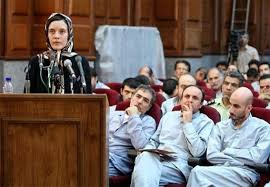
Iran's big news yesterday is that the government will formally kill five people who participated in June's pro-democracy rallies. Consider, though, the implications for the West's peace-brokers of the case of Frenchwoman Clotilde Reiss.

It is now 20 weeks since Ms. Reiss was arrested while trying to leave Iran and 12 weeks since she was released to the French Embassy "to await her return to France," in the words of President Sarkozy. She's still waiting.

This week, the Islamic Republic resumed legal proceedings against her. Iran has refused to let her leave the country, and the French have complied. But by delivering her to an Iranian court for proceedings this week, Mr. Sarkozy is gambling with the 24-year-old's life. Coming from a politician who has offered stern denunciations of Tehran's nuclear programs, one has to wonder how that decision was made.

In its 30 years, the Islamic Republic has used assassination squads, fatwas, terrorism and hostage-taking as tools of its war with the West. A nearly unbroken string of outrages connects the taking of the U.S. embassy in 1979 to the death sentence demanded for writer Salman Rushdie in 1989 to, more recently, the grabbing of British sailors in 2007. Add to that the detention and trial of Iranian-American journalist Roxana Saberi earlier this year, the 12-year prison sentence meted last month to Iranian-American scholar Kian Tajbakshsh and, most recently, the charges of espionage leveled against the three American backpackers who stumbled across the Iranian border in July.

Ms. Reiss's ordeal is merely of a piece of this. But it ought to be an instructive piece, particularly as Iran's nuclear ambitions come closer to realization. That's the real significance of this week's report by the International Atomic Energy Agency about Iran's formerly secret uranium enrichment facility near Qom, which the agency concluded had no possible relevance to any purported civilian power program. Once Iran goes nuclear, the whole world becomes its hostage.

For too long the West has responded to these various outrages by offering Iran little more than meek compliance, plus a clean slate the moment any one crisis is resolved. Now President Barack Obama is again beseeching Iran to take the nuclear deal offered to it last month. Nobody should expect Iran's leaders to show good faith. Not when their days are spent executing protestors and abusing the likes of Clotilde Reiss.


Love of the Land: Iran, Its Hostages and the West
Related Posts Plugin for WordPress, Blogger...