Showing posts with label Israel Antiquities Authority. Show all posts

Friday, 19 February 2010

Love of the Land: The 1,800 Year Old High-Level Aqueduct of Jerusalem was Exposed Next to Jaffa Gate in the Old City

The 1,800 Year Old High-Level Aqueduct of Jerusalem was Exposed Next to Jaffa Gate in the Old City


Israel Antiquities Authority
18 February '10
Posted before Shabbat

A beautiful aqueduct, standing 1.50 meters high and built of large stones, has been situated for almost two millennia right under one of the most familiar and traveled places in Jerusalem – beneath the road that leads from Jaffa Gate toward the David Citadel Museum and the shops on David Street.

The High-Level Aqueduct of Jerusalem, which dates from the second-third century CE, was exposed in excavations the Israel Antiquities Authority is conducting, with funding provided by the Jerusalem Development Authority for the purpose of replacing the infrastructure in the region.

According to Dr. Ofer Sion, excavation director on behalf of the Israel Antiquities Authority, “The side of the aqueduct was discovered during the course of the excavation. When we removed the stones in its side and peeked into it we saw a splendidly built aqueduct covered with stone slabs where one can walk crouched down for a distance of approximately 40 meters. It is very exciting to think that no one has set foot there for many hundreds of years”. According to Sion, “The noted Land of Israel scholar, Dr. Conrad Schick, described a specific section of the aqueduct in a survey he conducted at the end of the nineteenth century. In 1898 a building was erected in this area which afterward became what we know of today as the Imperial Hotel. Schick’s documentation provided us with the clue that led to exposing this section of the aqueduct”.

The aqueduct is c. 60 centimeters wide and 1.5 meters high. Shafts were exposed at fifteen meter intervals or so that allowed the ancients to check the state of the aqueduct from what was the surface level in those days.

Up until the end of the Second Temple period, in the first century BCE, Jerusalem’s water supply was derived from the Gihon Spring; however, as the number of residents steadily increased, the city’s water resources proved insufficient.

(Read full story)

Love of the Land: The 1,800 Year Old High-Level Aqueduct of Jerusalem was Exposed Next to Jaffa Gate in the Old City

Wednesday, 23 September 2009

Love of the Land: [Defeat for Radical Left] Supreme Court rules: Archaeological Research in the City of David is in the Public Interest

[Defeat for Radical Left] Supreme Court rules: Archaeological Research in the City of David is in the Public Interest


Press Release
Wednesday, September 23, 2009


In a Decision the High Court of Justice Handed Down Yesterday:
The Archaeological Research in the City of David is in the Public Interest


In the past week the Supreme Court, replying as the High Court of Justice,
dismissed two petitions that were submitted against the Israel Antiquities
Authority concerning the excavations the IAA is conducting within the
precincts of the "Walls Around the Old City" national park, at the City of
David in Jerusalem.


The petitions were submitted by residents who live near the place where the
excavations are being carried out, when in the opinion of the Israel
Antiquities Authority these residents are being incited by other factors
whose considerations are political and improbable.


One of the excavations is being conducted in an area known as the "Givati
Car Park", which is located south of the Old City's southern wall, adjacent
to Ophel Road. Numerous layers of antiquities were revealed in this
excavation. Among other things, a very impressive structure was found that
is probably a public building and dates to the Late Roman period. Remains
from the Early Islamic period were uncovered, as well as extraordinary
remains from the Second Temple period. All of the remains were
scientifically excavated, in meticulous work, whilst photographing and
documenting everything.


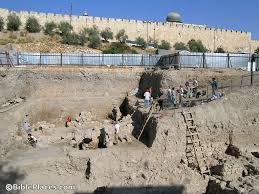
In the second excavation - for which a decision was handed down yesterday
(Monday) - a drainage channel structure from the Second Temple period was
exposed that extends over a distance of many dozens of meters. The drainage
structure is surprisingly well-preserved and one can walk through it
upright, for most of its length. The excavators were aware of the structure's
existence; nevertheless, the segment that was excavated was only recently
exposed.


The archaeological excavations that the Israel Antiquities Authority is
conducting in the City of David are exposing Jerusalem's magnificent past,
in all of the periods. These finds are of utmost importance to the Jewish
people in particular and world culture in general. The high court accepted
the position of the Israel Antiquities Authority pertaining to the great
importance of the excavations and the general public interest in uncovering
the antiquities.


Below is the concluding paragraph from the court's ruling issued by Justice
Edna Arbel: "The picture that was presented to us shows that the damage to
the property rights of the petitioners - as much as such damage does indeed
exist - is minor. As stated, the petitioners did not argue that any damage
was caused to their houses and the respondents explained that the activity
on the land is indeed underground, but does not extend as far as the houses
of the petitioners. Contrasting the asserted damage is the important public
interest in carrying out the work. Surely, revealing the secrets of the
past, which have been hidden for hundreds and thousands of years in the
bowels of the earth, is an essential part of the archaeologist's research.
From the standpoint of public interest, conducting this research is
multi-faceted, whether because of the contribution there is in understanding
the history of the country and the history of the Jewish people or because
of the contribution there is in understanding historic events that have
importance that is not just limited to the Jewish people and its history. In
this context I will refer to what I have already said in High Court decision
3702/05 - Ma'oz vs. Israel Antiquities Authority (unpublished, 11.106). It
is the legal position in the case that conducting an archaeological
excavation in a place where it benefits developing the infrastructure in the
region and improving the welfare of the residents is in the public interest.
This being the case, when the petitioners failed to point out real damage to
their property, it seems that there is no justification in harming or
restricting the public interest in conducting the excavation work on the
land. If my opinion will be heard, I will recommend to my colleagues that
the petition be rejected and the petitioners be required to pay the attorney
fees of each of the respondents for the sum of 10,000 NIS and court
expenses."


Love of the Land: [Defeat for Radical Left] Supreme Court rules: Archaeological Research in the City of David is in the Public Interest
Related Posts Plugin for WordPress, Blogger...