Showing posts with label El-Baradi. Show all posts

Monday, 30 November 2009

Love of the Land: 500,000 Iranian Centrifuges

500,000 Iranian Centrifuges


Tehran ups the ante again as diplomacy goes nowhere.

Wall Street Journal
30 November 09

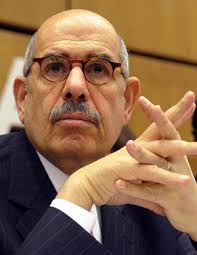
Mohamed ElBaradei caps his contentious and ultimately failed 12-year stint as head of the International Atomic Energy Agency today, having spent many years enabling Iran's nuclear bids only to condemn them in his final days in office. Mr. ElBaradei combined his rebuke of Iran with his familiar calls for more negotiation, but we'll take his belated realism about Iran as his tacit admission that Dick Cheney and John Bolton have been right all along. Let's hope the education of the Obama Administration doesn't take as long.

As if to underscore the point, yesterday the Iranian government ordered up 10 additional uranium enrichment plants on the scale of its already operational facility in Natanz, which has a planned capacity of 54,000 centrifuges. That could mean an eventual total of more than 500,000 centrifuges, or enough to enrich about 160 bombs worth of uranium each year. Whether it can ever do that is an open question, but it does give a sense of the scale of the regime's ambitions.

The decision is also a reminder of how unchastened Iran has been by President Obama's revelation in September that Iran had been building a secret 3,000 centrifuge facility near the city of Qom. The IAEA's governing board finally got around on Friday to rebuking Iran for that deception, a vote the Administration trumpeted because both Russia and China voted with the United States. But perhaps only within the Obama Administration can a symbolic gesture by the IAEA be considered a diplomatic triumph.

(Full article)

Love of the Land: 500,000 Iranian Centrifuges

Wednesday, 18 November 2009

Love of the Land: How the IAEA Encourages Proliferation

How the IAEA Encourages Proliferation


Evelyn Gordon
Contentions/Commentary
18 November 09

The International Atomic Energy Agency is, as Jonathan noted, deeply disturbed by its latest findings on Iran. It is also deeply disturbed by its latest findings on Syria, which it detailed in another report released this week. Syria’s explanation of the uranium traces found at a Damascus research reactor did not fit the facts, the report said, nor did these traces match Syria’s declared uranium inventory. Moreover, Syria is still refusing IAEA requests for both a return visit to Dair Alzour, the site Israel bombed in September 2007, and initial visits to three military sites whose appearance was altered after inspectors asked to see them.

“Essentially, no progress has been made since the last report to clarify any of the outstanding issues,” the agency concluded.

The real mystery, however, is why the IAEA seems to find this behavior eternally surprising — because its own behavior positively demands such stonewalling.

The IAEA has been investigating Syria for more than two years now. During this time, it has issued numerous reports expressing its concern over suspicious findings that Damascus failed to adequately explain and over Syria’s refusal to let it make the inspections necessary to answer its questions. Yet it has refused to refer the case to the Security Council for sanctions, because, says agency director Mohamed ElBaradei, there is no proof of Syrian wrongdoing.

Well, of course there isn’t. That’s the whole point of Syria’s stonewalling — to prevent the agency from getting such proof!

Damascus, needless to say, is merely copying the lessons learned from the agency’s handling of Iran. After discovering in 2003 that Tehran had been lying about its nuclear program for 18 years, the agency spent the next three years refusing to turn the file over to the Security Council, saying there was no proof Iran’s secret nuclear program was aimed at producing weapons. And when the case finally did reach the Security Council, El-Baradei lobbied vehemently against sanctions, citing the lack of a “smoking gun” that would justify punishment.

Thus all Iran had to do was ensure that there never would be a smoking gun — by steadfastly refusing to comply with inspectors’ requests.

ElBaradei thereby made noncooperation the optimum strategy. Had either Syria or Iran cooperated, the agency might have obtained sufficient evidence to justify severe sanctions. But as long as they refuse to cooperate, the agency has little chance of obtaining such proof, ensuring that any repercussions will be mild. Therefore, they are free to develop nuclear weapons with impunity.

To be effective, IAEA policy would have to be the exact opposite — one of imposing stringent penalties for noncooperation, to encourage suspect countries to “come clean” and prove their innocence. And that, of course, would require suspect regimes to actuallybe innocent, creating a strong disincentive to secret weapons programs.

In short, under ElBaradei, the IAEA has brilliantly hit on the strategy most likely to facilitate nuclear proliferation. Is it any wonder he and the agency won the Nobel Peace Prize in 2005?


Love of the Land: How the IAEA Encourages Proliferation
Related Posts Plugin for WordPress, Blogger...