Showing posts with label Aliyah. Show all posts

Wednesday, 5 May 2010

Love of the Land: The historical Jewish Dream

The historical Jewish Dream


Rafi G.
Life In Israel
04 May '10

I was at a bris this morning and the baal simcha (the father, not the baby) said something very poignant. Afterwords, as I was saying mazel tov before leaving, someone else pointed out how that same line had struck him as very powerful, so I have decided to share it with you.

The father was explaining how they had chosen the name. He said, and I am not quoting precisely because I do not remember the exact words he used, that they looked back on all the branches of their family trees, and as far as they could figure out, this is the first baby born in their families in Israel in at least 1800 years.

That one line expresses everything about Jews, our desire to return to Zion, and our ability to return to Zion today. People have good reasons for not coming, there are delays, life gets in the way, and all that. But at the end of the day it is so much easier today to fulfill this dream, the dream that Jews for centuries have held and largely were unable to achieve, today it is possible.

After 1800 years, the children are finally able to return. The dream was kept alive, and the dream stays alive. It is upon us to seize the day, seize the opportunity, and finally fulfill the Jewish dream that stayed with us through the centuries of exile. We are able to, and we are doing it.


Love of the Land: The historical Jewish Dream

Friday, 5 March 2010

Love of the Land: Eight Aliyah Fairs to be Held in North America

Eight Aliyah Fairs to be Held in North America


News Staff
Shalomlife.com
04 March '10

Nefesh B'Nefesh has decided to accelerate and deepen its activities in North America, in order to realize the potential increase in the number of immigrants to Israel during 2010. In cooperation with the Jewish Agency and government offices, the organization will hold next week, between March 7 and 14, 8 large fairs in major cities in the U.S. and Canada, in order to give hundreds of potential immigrants reliable information, guidance and inspiration on immigration to Israel.


More than 1,500 North American Jews are expected to participate in the fairs. They will be able to meet representatives from government ministries, tax authorities, social security, health maintenance organizations, hospitals and transport. In addition, a series of consultation meetings is planned with the personal guidance of consultants from Nefesh B'Nefesh and the Jewish Agency. All advisors participating in the fairs are being especially flown in from Israel.

Immigration fairs will be held in the following cities: New York (March 7), Baltimore (March 8), Los Angeles (March 9), Montreal (March 10), Toronto (March 10), San Francisco (March 10), Chicago (March 11.3), South Florida (March 14). The first fair in New York will open in the presence of Minister Silvan Shalom, PMO General Manager Eyal Gabbay, and Israel's consul in New York, Asi Shariv.

(Read full story)


Love of the Land: Eight Aliyah Fairs to be Held in North America

Love of the Land: Coming home to Zion

Coming home to Zion


Michael Freund
Israelnationalnews.com
26 February '10

(Beautifully written, captures the feeling. Plus a bit of music for accompaniment. Y.)

Fifteen years ago this week, my wife and I, together with our young son, embarked on a fateful journey. Leaving behind friends and family in New York, we boarded a flight and fulfilled our dream, along with that of our ancestors, by making aliyah and settling in the Land of Israel.

I still remember the heady feeling that I had, walking through the streets of Jerusalem in the initial days after our arrival. As much as I had enjoyed visiting the country as a tourist over the years and seeing the sites, there was nothing quite like the emotion that gripped me as I took in my surroundings as a proud new resident of the reborn Jewish state.


From waking up to the sounds of Hebrew on the radio, to catching a glimpse of the walls of the Old City at sunset, I could sense my soul stir in a way I had never experienced before. Yes, I thought to myself, I have indeed truly come home.

(Read full story)


Love of the Land: Coming home to Zion

Wednesday, 20 January 2010

Love of the Land: Members of Bnei Menashe to make aliyah

Members of Bnei Menashe to make aliyah


Group claiming lineage to Lost Tribes of Israel set to immigrate to Israel after undergoing conversion in Nepal by teams from Rabbinical Court

Itamar Eichner
Jewish World/Ynet
08 January '10

(As our community may be the largest current grouping of Bnei Menashe in Israel, we consider ourselves to have been very fortunate, for their having chosen to live here. Y)

Some 7,200 members of Bnei Menashe ("Children of Menasseh"), a group of people hailing from north-eastern India who claim lineage to one of the Lost Tribes of Israel, will make aliyah after converting to Judaism in Nepal.

According to a tradition that has been passed along for generations, the members of Bnei Menashe identify themselves as descendents of the Menashe tribe – one of the 10 tribes that exiled from Land of Israel at the end of the First Temple period.

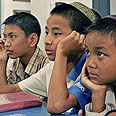
For the past decade, Shavei Israel Organization, which help Jewish people across the world immigrate to Israel, has been working with Bnei Menashe communities in India and building education centers where they can learn Hebrew and Judaism to help strengthen their Jewish identity and aid those who wish to immigrate to Israel.

The organization, headed by Michael Freund, has also been working with the government in order to convince it to allow all the group members to immigrate to Israel.

(Read full article)


Love of the Land: Members of Bnei Menashe to make aliyah

For Zion's Sake: The Curse of Exile

The Curse of Exile


Dedicated to the refuah sheleima of Tamar Dina bat Smadar


על נהרות בבל שם ישבנו גם בכינו בזכרינו את ציון. על ערבים בתוכה תלינו כינורותינו כי שאלונו שובינו דיברי שיר ותוללינו שמחה. איך נשיר את שיר ה' על אדמת נכר

"By the river of Babylon - and Monsey, and Toronto, and Boca Raton, and London and Paris- we sat down and wept when we remembered Zion. Upon willows we hung our harps because our captors asked of us words of song, and our tormentors joy. How shall we sing HaShem's song on foreign soil?" (Tehillim 137)

Whenever a Jew has finished eating a meal, he sits down and reminds himself that he is a stranger in a strange land. He reminds himself that he was exiled so long ago forcibly from his home. He thanks G-d for the "the desirable, good and spacious Land" that He gave his forefathers. Three times a day, he turns in longing and fervent prayer to Jerusalem and pleads with G-d that "his eyes should behold in mercy [G-d's] return to Zion".

The Jewish people were chosen by G-d to be a holy people living in a holy land. We were chosen in order to bring light, goodness and G-dliness into the world, as evident by Israel's incredible Sanctification of G-d's Name in Haiti. Unfortunately, many Jews do not understand the greatness or the loftiness of our role. They do not know the Jewish people's mission or task. Throughout the long and harsh years of exile, many have forgotten or do not know what it means to be Jewish. They believe that being Jewish is simply a matter of personal conscience comparable to being a Christian or a Buddhist. They do not realize that to be Jewish is to be part of a nation.

In G-d's infinite mercy, He returned sovereignty to the Jewish people over 60 years ago and has begun the process of our Redemption. In His eternal kindness, He has brought the masses of the Jewish people back home. Entire communities en masse have made aliyah and have returned to the Land of Israel. Eastern Europe, Yemen, Morocco, Egypt, Iraq, Iran, Russia, practically all of the Jews of the Islamic world, have come back to Israel. The remaining Jews in many small and isolated communities are joining their brethren in Israel. As anti-semitism rises in France and the rest of Europe, many are beginning to come back.

And yet despite 62 years of Jewish independence, a free and prosperous Jewish state boasting one of the world's most flourishing and resilient economy, booming enterprises, a powerful army and plenty of opportunity, close to half of the world's Jews choose to live in exile. When the Jews were trapped and prevented by their gentile persecutors from making aliyah, they wrote songs of longing for Eretz Yisrael. In cellars and dark rooms, in secret, hiding in fear from Romans, Crusaders, the Inquisition, Nazis or Soviets, they declared with complete confidence and faith "Next Year in Jerusalem!". At every Jewish wedding, they crushed a glass (and continue to crush a glass) and pledged: "If I forget thee, O Jerusalem..." Now, however, that the doors of aliyah are wide open and the Land is calling out, ready to take in her long-lost sons and daughters, only a trickle decide to return home.

The Jewish people's destiny is in the Land of Israel. Only in the Land of Israel can the People of Israel achieve their true potential, to live completely Jewish lives, free from interference or insecurity. Many of the Torah's commandments can only be performed there. It is only there where a Jew does not have to live in the unnatural role of minority, with all of the insecurities that accompany it. There he is free of self-consciousness, of the ever nagging "What will the goyim think?" It is there that the Jewish people can build a Jewish society based on Jewish values. It is there that Redemption is not just a dream but a living reality.

In this week's Parsha, G-d brings upon the Plague of Darkness upon the Egyptians. Rashi explains that in that generation there were wicked Jews who did not wish to leave Egypt and that they died during the Plague of Darkness. What is the reason that these Jews did not want to escape the torment and affliction of Egypt? The Midrash Tanchuma provides us the answer: they had Egyptian friends and enjoyed honour and fortune in Egypt. These Jews felt properly at home in the idolatrous and perverse Egyptian culture and did not wish to leave in order to receive G-d's Torah and to settle in the Land of Israel. In our own generation, we see the same phenomenon repeating itself. Many otherwise good Jews, many of whom stringently keep the Torah, are simply too comfortable in the lands of their dispersions. They have their synagogues, schools and communities in Toronto, New York or Los Angeles. They are content to stay in exile and have exchanged Miami for Jerusalem.

The Jewish people must open its eyes and remember that its home is in the Land of Israel. Only there can we fulfill the prophecy that "out of Zion shall come forth Torah, and the Word of G-d from Jerusalem". No matter how comfortable exile is, it is nonetheless a punishment and a curse. A Jew should never be content living as a minority in a strange country. He must remember the lament of the Jews being taken captive to Babylon: "How shall we sing HaShem's song on foreign soil?" May Hashem open the eyes of His people that they return to their own soil, speedily in our days.


For Zion's Sake: The Curse of Exile

Thursday, 31 December 2009

Love of the Land: In defiance of demographic fatalism

In defiance of demographic fatalism


Yoram Ettinger
Opinion/JPost
30 December 09

In 1948, prime minister David Ben-Gurion declared independence in defiance of demographic fatalism, which was perpetrated by the country's leading demographers. He rejected their assumptions that Jews were doomed to be a minority between the Jordan River and the Mediterranean, that a massive aliya wave was not feasible, that the Jewish fertility rate was declining to below reproduction levels and that the Arab fertility rate would remain the highest in the world, irrespective of modernity.

Instead, Ben-Gurion highlighted demographic optimism and aliya as top national priorities, coalesced a solid Jewish majority and planted the seeds that catapulted Israel to a Middle East power, highly respected for its civilian and military achievements.

In 2005, in capitulation to demographic fatalism, prime minister Ariel Sharon retreated from Palestinian terrorism, uprooting 10,000 Jews from Gaza and Samaria. Sharon abandoned his lifelong ideology of defiance, subordinating long-term strategy and security concerns to doomsday demography. Thus, he facilitated Hamas's takeover of Gaza and its ripple effects: slackened posture of deterrence, intensified shelling of southern Israel, the 2006 Second Lebanon War, 2008's Operation Cast Lead, the Goldstone Report and the exacerbated global pressure on Israel.

DEMOGRAPHIC ASSUMPTIONS have played an increasing role in shaping national security policy since 1992. But what if these assumptions are dramatically wrong? For example, since the beginning of annual aliya in 1882 - and in contradiction to demographic projections - the Jewish population between the Jordan River and the Mediterranean has grown 238-fold, while the Arab population increased only sixfold. Since 1948, the Jewish population has increased almost tenfold, and the Arab population has expanded threefold.

(Read full article)

Love of the Land: In defiance of demographic fatalism

Thursday, 12 November 2009

Love of the Land: What Prevents Aliyah?

What Prevents Aliyah?


Batya Medad
Shilo Musings
12 November 09

This post is inspired by a poll on Arutz 7.

Poll: What's the biggest obstacle to Aliyah?

1. Finding a good job

2. Leaving family behind

3. Security concerns

4. Not knowing Hebrew

The answer I wanted to give isn't one of the choices. I think that most people fear change. That's the key, and everything else is just an excuse. The next biggest difficulty is conquering Hebrew, the fear of making mistakes, sounding stupid.

With good Hebrew, you can get a good job, not one limited to those for "English speakers." With good Hebrew, you can become part of Israeli society and not restricted to being friends with fellow anglo (English speaking) olim, immigrants.

There is no intellectual linguistic reason to think that learning Hebrew, or any other language, is impossible. Immigrants from all different countries to all different countries manage to learn the new language and function.

And for those Jews who have graduated from a life time of Jewish schooling, it's criminal that they're not totally fluent in Hebrew. Jews were once, until the mid-twentieth century, known as multilingual experts. That's why there were Jews on the ships which sailed to the new land, America. The same students whose parents would tell me that their family is incapable of learning English would later admit that their grandparents were fluent in three or four languages.

What changed was expectations. It used to be that immigrants expected, demanded from themselves a few months to immerse themselves in the new language and culture and then be as fluent as anyone else. Today this is harder. Immigrants come with their old language DVD's, ipods filled with their old music and quickly set up cable or a dish to receive television from the old country.

As I've already written, "...most people fear change." And to make aliyah successfully, you have to change more than your address.

Love of the Land: What Prevents Aliyah?

Sunday, 1 November 2009

ESSER AGAROTH - THE JEWISH IDEA

The Jewish Idea

"Without a new, profound sense of purpose, Israel’s days are numbered"

Yoel Meltzer
14 Marheshwan 5770/November 1, 2009

Most people are barely cognizant of the fact that many of their actions are a result of ideas that have seeped into the collective mindset of their community or society. A simple and clear example of this can be seen in clothing. In the world of fashion, some guru sitting in Paris develops an idea of a certain type of shirt that should be worn by a particular age group in the coming year. The actual physical shirt is then designed and produced, and then afterwards is cleverly marketed towards the target audience. Unsuspectingly, this audience falls in line and starts proudly wearing the latest "in" shirt. Then the following year, the same guru changes direction and promotes a previous "in" shirt with the not surprising result that once again the target audience follows suit.

While this is an oversimplified example, many societal behaviors and thought patterns can be traced back to ideas that have been implanted into the individual and collective mindset of the society. Frequently this is the result of a cleverly designed marketing campaign, especially when financial or political gains are the goal, although many times it's just a result of ideas that happened to appear at the right time and in the right place and connected to inner feelings and thoughts of the society. Such ideas, which are usually more altruistic by nature, answer to certain needs of the society, be it emotional, psychological, or spiritual.

Anyone somewhat familiar with the state of Israel today, be it a veteran or new immigrant, cannot help but be aware of the many problems that are plaguing the country. From the threat of Iranian missiles to increasing violence, the list goes on and on. Of all the problems, however, perhaps the most pressing for the long-term survival of the nation is the lack of a shared sense of purpose. Whatever held the nation together years ago, mainly the idea of coming together to physically build the country, has long since faded away. In its place, nothing has appeared which has been able to unite the country around a new shared sense of purpose.

Of course there are moments, especially during times of warfare, when the county comes together, but these are just passing moments that have no sustaining power after the cessation of hostilities.

Inspiring the nation
Moreover, parallel to the disappearance of the shared sense of purpose has been a constantly growing feeling of societal cynicism and disgust with many of the state's institutions. It is therefore clear that this country from top to bottom desperately needs to be provided with a new, profound, and lasting sense of purpose. Without it, its days are numbered.

This then is the need, both on an individual and societal level, which must be addressed. What is required, therefore, is the idea to answer this unmet need. Not just any old idea that comes and goes like the wind but rather, something of depth that can affect and inspire an entire nation. Of course the only idea that can possibly satisfy this need of the Jewish people is not surprisingly the old-new Jewish idea.

The intention here is not the watered down "religious idea," an oversimplified system of "dos and don'ts", but rather, the authentic and infinitely more profound "Jewish idea." Although it does include the standard religious aspect, the intention here is to something much broader and deeper which provides a clear sense of purpose and direction for both the individual Jew and the larger Jewish nation. Such a profound idea, based upon a deep understanding of the Jewish sources, history and life, has the potential to literally create a revolution. The Jewish people, and the rest of humanity with them, have the ability to soar to such heights if only the idea would be properly understood and internalized, since ideas are ultimately what cause actions and change societies.

The time is right for the reemergence of the true Jewish idea, the authentic Jewish dream, since the county has never been more in need of a renewed sense of purpose and direction. All that is needed then is the way to disseminate the idea.

Yoel Meltzer has an MA in Middle Eastern Studies and lives in Israel.
The Jewish Idea

Saturday, 12 September 2009

Love of the Land: The Human Spirit: In Their Merit

The Human Spirit: In Their Merit


Barabara Sofer
JPost
11 September 09

That old cliche "everyone is replaceable" is wrong. No one is replaceable, not to his family or in this world. In this Hebrew month of Elul, when we traditionally engage in heightened retrospection and personal reckoning, we are exquisitely aware of the uniqueness of each person.

Still, we cannot help but rejoice as new life replenishes the old.

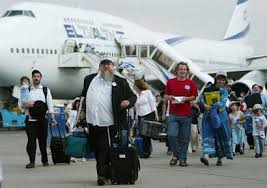
The final summer flight of Nefesh B'Nefesh, the organization founded in 2001, during the nadir of the intifada, landed at Ben-Gurion Airport last week. The number of immigrants this organization has brought is indeed impressive. This summer NBN reports 3,000 immigrants, among them 40 doctors and 32 families moving to the North through the new "Go North" program. Nefesh B'Nefesh has come up with bureaucracy-busting technology and human support to ease the aliya process so that if it's not exactly a glide path, at least it's a rose garden with most of the thorns removed.

NEFESH B'NEFESH means "soul for soul." In his grief over the murder of a relative in a terrorist bombing, Rabbi Yehoshua Fass conceived the idea of an organization that would streamline the aliya process and encourage more Jews to move to Israel.

The numbers tell only a small part of that soulful story. Let's take, for example, the story of two immigrant families who arrived this summer. Two years ago, Sabrina and Lloyd Ziff were living in Edgware, London. They were concerned for Israel, but they'd never brought their three daughters here for a visit. Sabrina was running a successful property management company and her husband Lloyd worked as a kosher poultry grower and distributor. Their daughters attended an excellent Jewish day school.

Then on July 2, 2008, a Palestinian terrorist driving a bulldozer plowed into cars and pedestrians on Jerusalem's Jaffa Road. Jean Relevy, 68, of Jerusalem was one of three persons murdered in that terror attack.

He was Sabrina's uncle.

Sabrina remembered him fondly, but she hadn't seen him for at least 15 years. He was the youngest of her father's siblings, one of seven children who'd fled with their family from Persia to India, and then eventually to Israel. Sabrina's parents had moved to England, where she grew up.

"I'm close with my father," said Sabrina, "And when I saw him weeping for the first time, something happened inside me." Like a seed germinating, an idea began to grow.

"I was always a Zionist, but I'd read the community news first in the Jewish Chronicle. Something shifted. Suddenly, I was on-line constantly at The Jerusalem Post site." The "oh, so you're Jewish" of people trying to figure out where her Mediterranean looks came from began to grate on her. The anti-Israel reaction in England to Operation Cast Lead began to sicken her. She marched in the pro-Israel rally in Trafalgar Square.

"I followed with great despair the failed efforts to free Gilad Schalit even though Israel was offering so much. Even though we lived far away, we always had a feeling in our family that we would be there for each other no matter what. I began asking myself what I was doing in England. Lloyd and I decided it was time to make a move." They wanted to come this summer. They phoned Nefesh B'Nefesh.

IN STATEN Island, New York, Yehudah and Aviva Zuller's family were undergoing a similar process. Three years ago, Yehudah was running a busy printing company and also collecting funds for terror victims in Israel. Aviva was pregnant with their fourth child. Then, on June 25, 2006 Gilad Schalit was kidnapped.

"I was caught up in the details of the story, checking the Web constantly," said Aviva. On July 1 their fourth child, a son, was born. In the delivery room, the doctor asked what they'd call their baby. Their older son Binyamin had been named for a grandfather who survived Auschwitz. "I have to consult with my wife, but I have a name in mind," Yehudah said. Aviva nodded to him. She'd guessed that he wanted to call their dark-haired baby Gilad. She liked the idea. Their baby, like the kidnapped soldier, would be Gilad ben Aviva.

Zuller sent Noam and Aviva Schalit an e-mail telling them of Gilad's birth, stressing that they'd named their son "in Gilad's honor, not his memory." "I was afraid he'd think - here's this guy from America who doesn't know me. What's he naming his son Gilad for?" But the Schalits wrote back warmly and the families have met numerous times since, both in the US and in Israel. "The strength of the connection intensified our back-burner desire to move to Israel." They wanted to come this summer. They, too, phoned Nefesh B'Nefesh.

The Zullers have settled in Ma'aleh Adumim. Their three older children have started school there. Gilad, three, is in nursery school, learning Hebrew fast. He tells other little kids that he was named "in honor of Gilad Schalit." "Each of his birthdays is bittersweet," said Yehudah. "We're delighted he's growing up so nicely, but increasingly sad that so much time has gone by since Gilad Schalit was kidnapped."

The Ziffs have set up home in Ra'anana. Daughters Natalya, nine, Tamara, six, and Stephanie, four, have begun the school year in a country they never visited until this summer.

"It's a bit of a challenge to be there by 8 a.m. and we're just getting used to school on Sundays," said Ziff. "But in my bubble back in England, I didn't realize people were living this incredible life here. I feel I'm living the Torah every day.

"When I landed I burst into tears, thinking that my parents had made a mistake by living in the Diaspora, and feeling I was fixing it by coming home. I looked up and said a few words to Uncle Jean. They killed you, Dear Uncle, but we're here now - all five of us, to replace you. More and more of us will come. It's in your merit."

Nefesh by nefesh, truly a soul for a soul.

Love of the Land: The Human Spirit: In Their Merit

Friday, 5 June 2009

Esser Agaroth - Towards a Jewish Mindset


There are no shortcuts.

Yoel Meltzer
11 Sivan 5769/June 3, 2009

For more than 15 years Israel has been plagued by the "Oslo mindset". This way of thinking, which did not appear out of a vacuum but slowly evolved over the course of years, is still alive and kicking despite all that has transpired. Its current outward manifestation, the much talked about "two-state solution", is gaining momentum every day despite the obvious danger that undertaking such a measure would entail to the state of Israel.

Although the "Oslo mindset" has had many opponents, most have invested their energy in opposing the various outward manifestations of the mindset, rather than focusing on the faulty mindset itself. The result of this has been that Oslo opponents simply gained a reputation of always "opposing", like a group of pessimistic naysayers, without ever proffering any alternative of their own. Moreover, by constantly focusing on the outward manifestation, they repeatedly engaged the Oslo proponents in a battle they were sure to lose, since who can appear victorious when arguing against measures allegedly designed to bring "peace" or "improved security"?

Unfortunately, the Oslo opponents continue to make the same mistake. The real battle should have been, and still needs to be, against the mindset. Moreover, rather than simply wasting negative energy attacking a certain way of thinking, positive energy should be invested in promulgating a different way of thinking. This point is crucial, since changes in the way one thinks, be it as an individual or a nation, are frequently the catalyst for changes in the physical realm. Obviously, it would have been preferable if such an approach had begun 15 years ago, but nonetheless it's never too late to start. Therefore, I would like to briefly present some key points of what can hopefully become the cornerstone of a proper and healthy "Jewish mindset".

Although the following is certainly not an all-encompassing list and many of the points are not new, it is my firm belief that these ideas need to first be outlined in a clear and concise manner in order for them to be easily disseminated, discussed and internalized by as many Jews as possible.

The 18-point list, the basics for a healthy "Jewish mindset", is as follows:
Read All at :

Esser Agaroth - Towards a Jewish Mindset

Friday, 22 May 2009

Esser Agaroth: The Writing On The Wall

The Writing On The Wall

Yom Yerushalayim 5769

After the failed plot to bomb the Riverdale Jewish Center, I really don't understand why my fellow Jews in the U. S. don't see the writing on the wall, and get out already.

This is not the first, and it won't be the last. Right now, attacks in Los Angeles (1999), Seattle (2006), and San Francisco (2006) seem like ancient history, don't they? They seem few and far between. There doesn't seem to be much of a pattern here, does there?

How long will that last?

Read All at :


Esser Agaroth: The Writing On The Wall

Tuesday, 5 May 2009

Waiting for the magic carpet - Haaretz - Israel News


Waiting for the magic carpet

By Natasha Mozgovaya

CHURACHANDPUR, India - When Asher Kipgen is asked the Hebrew name of his father, who immigrated to Israel six years ago from a village in the northeastern Indian state of Manipur, he blurts out "Netanyahu" without thinking twice. The real name of his father, who lives in Kiryat Arba, is Natan, but the mention of Prime Minister Benjamin Netanyahu's name is no coincidence. Many of the 7,232 members of the Kuki, Mizo, Lushai and Shin tribes carefully followed the elections in Israel, in the hope that the new prime minister of Israel would bring them to the country.

That's because they consider themselves Bnei Menashe, residents of northeastern India, along the border with Burma and Bangladesh, who claim descent from one of the Ten Lost Tribes of Israel, who were sent into exile by the Assyrian Empire more than 27 centuries ago.
Since hearing rumors last summer that the Israeli government planned to bring the Bnei Menashe to Israel, Kipgen and his family have been waiting - though they aren't concerned about what to bring with them.
Read All at :


Waiting for the magic carpet - Haaretz - Israel News

Wednesday, 29 April 2009

Yom HaAtzmaut - - Israel is 61 !

On the 5th of Iyar, 5708 (1948), G-d's Name was sanctified. For the first time in two thousand year, the Jewish people had a state in their homeland. Two millenium after the Roman emperor Hadrian burnt our Temple, razed Jerusalem, sold the Jews into slavery and arrogantly declared 'Judea capta! (Judea is captured), the Third Jewish Commonwealth was established. After centuries of oppression and persecution, Crusades and pogroms, Inquisitions and Holocausts, the Jewish people had finally returned home to the land of their forefathers


When the Romans crushed the Jewish rebellion in 70 CE and destroyed the Temple, they carried out the majority of the Jews into exile. They built a huge victory arch in Rome showing the Temple utensils being taken as spoil. The Romans minted coins depicting a conquered a mourning Jewess, along with the words 'Judea capta'. In their minds, the Jewish people had been crushed. The Roman Catholic Church, which became the official religion of Rome, taught as doctrine that the Jews had been replaced and rejected by G-d, never to return to Israel. The Church, along with the scholars of Islam, mocked the Jews and taunted them over their abasement, claiming that their continued exile was proof of their replacement in G-d's eyes. Incredibly, while the Roman empire today is nothing but dust, Jews are once again living in the Jerusalem, the city of King David, in Judea and Samaria, where the Patriarchs lived and in the Galilee, where Bar Kochba and his brave Zionist rebels fought for liberty.

"A song of ascents. When the Lord returned the captivity of Zion, we were like dreamers. Then our mouths were with laughter and our tongues with songs of praise; then they will say among the nations, "The Lord has done great things with these."" (Tehillim 126) Truly, we were like dreamers. Is there any clearer proof of G-d's sovereignty and majesty, of His guiding hand in history, than in the survival of the Jewish people in graveyards of the exile and in our return to the Land of Israel? Has there ever been such a thing in the entire annals of mankind, for a nation to have survived the sword and the stake, the racks of the Inquisition and the Crusading lance, the Cross and the Crescent, the killing fields and the gas chambers, to be returned home? Only by the might and mercy of G-d, through the brave pioneers and committed Zionist leaders, were we able to revive our ancient language, Hebrew, to re-settle the desolate cities, drain the swamps and make the deserts bloom. "For the Lord shall console Zion, He shall console all its ruins, and He shall make its desert like a paradise and its wasteland like the garden of the Lord; joy and happiness shall be found therein, thanksgiving and a voice of song." (Yishayahu 51:3) The land, empty and desolate, bereft of her children, which called out longingly for them for over two thousand years, now blossoms and is settled. For too long did Zion cry out for her sons and daughters in captivity, trampled on by a foreign oppressor.

From the four corners of the Earth, the Jews have begun to return home. "Fear not for I am with you; from the east I will bring your seed, and from the west I will gather you. I will say to the north, "Give," and to the south, "Do not refrain"; bring My sons from afar and My daughters from the end of the earth."" (Yishayahu 43:5-6) Out of the mellahs of Morocco and Tunisia and the shtetls of Russia and Poland, Jews came home. The same Jews who declared year after year their fervent hope and desire of 'Next Year in Jerusalem!' were privileged to see their dream become a reality. From the farthest and most remote reaches, the Land of Israel beckoned Jews home. Jews from Yemen and Ethiopia walked thousands of miles, trekked through dangerous deserts and hazardous terrain, braved intense dangers because they senses the impeding Redemption. When the Iron Curtain fell, the cry of 'Let my people go!' saw fruition as millions of Russian Jews fled the prison that was the Soviet Union and came to Israel to live lives of dignity and freedom. The Ingathering of the Exiles has begun as Jews from Iran and Turkey, Greece and Lithuania, Ukraine and Hungary, India and Afghanistan now live, mix and mingle, in peace together in the State of Israel.


In fire and blood Judea fell and in fire and blood Judea arose. In 1948, and again in six spectacular days in 1967, the myth of the passive Jew whose life was cheap and blood was the gentile's for the taking, was forever crushed. The nation that for so long had been associated with sheep to the slaughter, with massacres and weakness, had arisen like a lion and fought for its life. In 1948, one million crack Arab soldiers, dedicated to driving the Jews into the sea and destroying the fledgling state, were attacked the 600 000 inhabitants of the Jewish yishuv. Just as in the days of David and Goliath, the defenders drove the enemy out. The defenders were outnumbered, farmers and citymen, Holocaust survivors given a rifle as they got off the boat. Some come with horses and some come with chariots but we invoke the name of HaShem our G-d! As the ovens and furnaces of Europe were still giving off their horrible stench, as the smoke was still emerging from the chimneys of Auschwitz, the Jewish state had arise with strength and power. The dry bones that had been murdered and annihilated in Europe had been reborn in the Land of Israel. ""Son of man, these bones are all the house of Israel. Behold they say, 'Our bones have become dried up, our hope is lost, we are clean cut off to ourselves.' Therefore, prophesy and say to them, So says the Lord God: Lo! I open your graves and cause you to come up out of your graves as My people, and bring you home to the land of Israel. Then you shall know that I am the Lord, when I open your graves and lead you up out of your graves as My people. And I will put My spirit into you, and you shall live, and I will set you on your land, and you shall know that I, the Lord, have spoken it and have performed it," says the Lord." (Yechezkel 37:11-14

61 years after the awesome day in Tel-Aviv, we can sit back and feel pride over our many accomplishments. The Jewish language, Hebrew was revived, a feat never before accomplished. Cities and settlements were created. A vibrant and modern democratic state was built. Israel has one of the best and most powerful armies in the world. Close to half of the world's Jewish population now lives in the Jewish state. Israel is a world leader in science and technology and contributed a disproportionate amount to high-tech, medicine and science worldwide. Despite all of Israel's many problems, it has accomplished more in its mere 61 years of existence than most other countries around the world. The State of Israel is far from the fulfillment of the Prophets and there is a long journey to the Ultimate Redemption. Yet, in the words of Herzl: "If you will it, it is no dream." Just as it seemed impossible for there to be a sovereign Jewish state, as it seemed impossible for Jerusalem to be reunited as the capital of the Jewish people, so too will we reach all of our goals. A nation that waited two thousand years to return home is not afraid of a long and difficult struggle.

"Behold days are coming, says the Lord, that the plowman shall meet the reaper and the treader of the grapes the one who carries the seed, and the mountains shall drip sweet wine, and all the hills shall melt. And I will return the captivity of My people Israel, and they shall rebuild desolate cities and inhabit [them], and they shall plant vineyards and drink their wine, and they shall make gardens and eat their produce. And I will plant them on their land, and they shall no longer be uprooted from upon their land, that I have given them, said the Lord your God." (Amos 9:13-15) May we see the complete fulfillment of the Jewish Dream, of the Prophets of Israel, of a world where "out of Zion will go forth Torah, and the word of HaShem from Jerusalem", very soon. May we merit the day when "nations will not lift up swords against each other, neither shall they learn war anymore". May the Complete and Final Redemption come speedily in our days, in mercy and love, amen!


Posted by Bar Kochba at 4:32 PM

This text was originally posted by Bar Kochba in the blog For Zion's Sake . To him my thankfulness.

Friday, 20 February 2009

YEMENITE FAMILY MAKES ALIYA

Yemenite family makes aliya in secret op


By ABE SELIG
(Cafe Oleh.jpost.com)


Stepping off their plane and into the bright lights of Ben Gurion Airport on Thursday afternoon, the Ben-Yisrael family was on the final leg of its journey from one world to the next.


The latest immigrants from the Yemenite community of Raida - a town fraught with tension between its Jewish and Muslim residents in recent months - the Ben-Yisraels, accompanied by another young man from their community, arrived in a special aliya operation, shrouded in secrecy, organized by the Jewish Agency and Yemenite Jewish Federation of America.


As they stepped into the arrivals hall, the Ben-Yisraels looked as if they had walked through a time warp. "Thank God, I'm happy to be here," said family patriarch Said Ben-Yisrael, clad in a felt yarmulke and long black side curls as he stood in front of his wife and seven children.


Greeted by a Yemenite rabbi who lives in Israel, Ben-Yisrael recited the "Sheheheyanu" prayer, which is said upon arriving at a particularly festive or joyous occasion. The crowd of reporters and cameramen who swarmed around the family as they entered the arrival terminal answered "Amen!"


But the transition from old-world Yemen to the modern and fast-paced Israel proved to be daunting for the family, even in their first moments on the ground.


The plane ride had been the family's first, and the shiny marble floors and bright fluorescent lights of the airport were no doubt a stark contrast to their former life in the developing Muslim country.


Ben-Yisrael's wife and young children - the girls clad in traditional Islamic clothing and the boys in suits and ties - milled around, smiling nervously as reporters attempted to speak to them in Arabic.

"We just locked up our house and left," said one of Ben-Yisrael's daughters, Esther, as she marveled at the flashing cameras and jostling news crews in front of her.

Several weeks ago, Islamic extremists threw a hand grenade into the Ben-Yisraels' courtyard, which exploded but caused no injuries. Said hurriedly took his family and went to live in the Yemeni capital city of Sana'a, before departing the country for Israel.

"I don't have much to say," Ben-Yisrael said, smiling. "We're tired, but it's good to finally be here, it's good to be home."

When the family left the airport - bound for Beit Shemesh, accompanied by a Jewish Agency team - the young children sat outside on a bench as their parents loaded luggage into a waiting taxi van.

Passersby, intrigued by the new arrivals, began to inquire about their trip.

"Can you sing a Shabbat song?" David Girafi, a cab driver from Herzliya, asked the children in Arabic. Girafi explained that his parents had immigrated from Yemen before he was born, and after witnessing the scene that unfolded at Ben Gurion Airport on Thursday, Girafi said it brought him back to the photographs that had once hung on the walls of his family's home.

"They remind me of my parents," he said, before breaking into song, as Esther, clad in her black hijab, joined him in a Yemenite rendition of "Ki Eshmarei Shabbat".
"It's very emotional," Girafi said.

While Yemenite Jews enjoy the special protection of Yemen's president, Ali Abdullah Salah, there has been an increase in the harassment of Jews by Islamic extremists in recent years.

The tension boiled over last December when Moshe Yaish Nahari, a father of nine, was murdered by a local Arab. Threats against Yemen's Jewish community also rose following the recent military operation in the Gaza Strip.

The Ben-Yisrael family are the first Yemenite Jews to leave for Israel since Nahari's murder.
Jewish Agency officials on hand Thursday were all smiles, beaming at the family as they entered the terminal, and reflected on months of hard work against a backdrop of secrecy.

"It's very exciting," said Moshe Vigdor, the Jewish Agency's director-general, as he stood in the background, watching the family arrive.

"But we also hope that this is the beginning of more to come. We're following the situation of the community in Yemen very closely, and this is in no way the end of our work there."

Eli Cohen, the director-general of the Jewish Agency's Aliya and Absorption Department, said that his agency was constantly working to help the Yemenite Jewish community and hoped to bring to Israel most of the Jews in Yemen who wished to immigrate.

The new immigrants will receive special assistance from the JA, including a grant of NIS 40,000 per family.

"This was a delicate operation, both because of the situation in Yemen and because of the family's special [religious and cultural] needs," Cohen said.

"But when I first saw them, I'll tell you, my heart was pounding. This is what we do, this is our goal, and once again, we've brought Jews to live in Israel."

About 280 Jews currently reside in Yemen, 230 of whom live in Raida in the Omran province, with the other 50 in Sana'a. The Jews now in Sana'a fled there from their homes in Sa'ade province about a year ago due to harassment by the Huthi, a terrorist group connected to al-Qaida.

Most of the Jews of Yemen immigrated to Israel during Operation Magic Carpet in 1950. Several hundred Jews immigrated in two subsequent smaller waves - in the mid 1960s and in the beginning of the 1990s.

Dozens of Yemenite Jews have moved to the US and London in recent years, brought there by Satmar Chassidim who object to their immigration to Israel due to concerns that they might abandon their religious observance.

The Satmar are ideologically opposed to the formation of a Jewish state before the Messiah's arrival. When representatives of the sect initially entered Yemen, their message was welcomed by the anti-Israel Yemenite government.

The Satmar sect has expressed its concern for preserving the ancient Jewish community, and recently its leader, the Satmar Rebbe, wrote a letter to US President Barack Obama asking for assistance to enable Yemenite Jews to emigrate to the United States.

Wednesday, 18 February 2009

NO PEACE WITHOUT JUSTICE


Speaking at a convention for American Jewish leaders, Tzippi Livni said that "we need to give up half of the Land of Israel". She claims that in the interest of peace, Israel must surrender Judea and Samaria to the Arabs. For the sake of a peace, it is necessary to create a Palestinian state in the heart of the Land of Israel.


The Left is fond of saying that there is no peace without justice. There is no greater truth to that statement that in this case. An unjust peace is no peace at all. Peace is valuable yet it cannot come at an unreasonable price. Uprooting Jews from their land is too high a price to pay for peace.


To make Judea and Samaria jundenrein is the greatest perversion of history. These lands form the homeland of the Jewish people, where our ancestors, Patriarchs, prophets and kings dwelled. To uproot hundreds of thousands of Jews from their rightful homes and destroy flourishing communities is a betrayal of history and of the generations of Jews who yearned for the dream of Zion. Although we were forcibly removed from our land, we never vacated it in our hearts and souls. We continued to look longingly to the day when "our eyes will behold Your return to Zion in mercy", despite the oppression and degradation of exile. The Land of Israel belongs to the Jewish people by every conceivable historical, religious and political right. The Jewish people are the only nation to have roots in that land. Abraham is buried in Hebron, Jacob lived in Beit El and Joseph tended his sheep in Shechem (Nablus). When a certain prophet had his first revelation in Arabia, the Jewish people already had thousands of years of roots in the Land of Israel.


The Land of Israel is the inheritance of every single Jew around the world, and only the Jews. Every nation has its own land and no one would demand that it carve itself up to appease those who covet it. It would be unreasonable to expect the United States to offer Texas or Massachusetts to al-Qaeda in the hopes of peace. The United Kingdoms would never surrender London and France would never give away Paris. Similarly, Israel can never give away parts of Jerusalem. Jerusalem was, is and always will be a uniquely Jewish city. Catholicism is centered in Rome, Islam in Mecca and Judaism in Jerusalem. Jerusalem forms the basis of our national psyche. 3 times a day, looking eastward, a Jew pleads for the rebuilding of Jerusalem, as well as after he has had a meal and says Grace. We have ended our Passover seders and Yom Kippur fasts for 2000 years with the fervent prayer of "Next Year in Jerusalem!" At every Jewish wedding, the groom breaks a cup to remember the destruction of Jerusalem and pledges "if I forget thee, O Jerusalem, may my right hand forget its cunning."


The early Zionist pioneers had a slogan: "With fire Judea fell, and with fire Judea will arise." The dream of Zion could only be realized through the sweat and toil of the pioneers and settlers. The Jewish state only exists by virtue of the over 20 000 Jews who made the ultimate sacrifice in defense of their people. Thousands of good Jews fell defending and liberating Jerusalem, Judea and Samaria. Only 40 years ago, tears streamed down the cheeks of even the most alienated and assimilated Jews as we were reunited with our Holy Temple Mount, with the Western Wall and with the Old City of Jerusalem. A nation that held faith for two millenia does not forget so quickly the pain that we felt when we were denied access to our most holy sites. We have not forgotten how the Jordanians forbade us access to the Western Wall, desecrated synagogues and study halls and used ancient Jewish cemeteries as latrines. Only a lunatic would advocate a return to this terrible and dark time.


The basis of peace is self-respect. A Jew with a modicum of Jewish pride would never part with his homeland for anything in the world. Jerusalem, Judea, Samaria, Gaza, the Golan, Galilee, Negev and coastal plain all are an integral part of the Jewish homeland. A condition for peace cannot be the amputation of half of the Land of Israel and denial of the right of the Jewish to settle freely in their country. What is being challenged is the basic Jewish right to their own land as the world tries to herd the Jews of Israel into the Greater Tel-Aviv ghetto. What we fail to understand is that our right to Tel-Aviv, to Herzliah, to Be'er Shevah, is our right to Jerusalem, to Hebron, to Shechem, to every inch of the Land of Israel.


The Arabs have more than enough land for themselves. They occupy 99.5% of the Middle-East, and no one is challenging their claim to it. Yet Jews must stand up and assert our right to less than a percent of the land in the Middle-East. This is not a conflict over land as much as ideology. The Islamic supremacist ideology which demands that Jews be second-class citizens opposes Zionism, the most basic desire for a Jew to control his own destiny in his own sovereign state. If Tzippi or the Left were able to carry out their nefarious plans, G-d forbid, to expel the Jews of Judea and Samaria, it would mean the virtual end of the Zionist enterprise, of the building and settling, of the Ingathering of the Exiles, of the return of the Jewish people to its home and the hope for the Ultimate Redemption, may it be speedily in our days. I could think of no greater tragedy than for the Jews to come home after such a long exile and re-establish themselves only to be uprooted by corrupt leaders at the behest of anti-semitic governments.


This is a struggle of an indigenous people against the forces of a cruel occupation. Islamic imperialism cannot succeed in driving the Jews from our soil. The Jewish nation has survived far more powerful empires and powers. A nation with such deep roots cannot surrender before a non-entity, a pseudo-nation bent on its destruction. Peace will come one day in the Middle-East, but only when Arabs and Jews respect each other and each other's boundaries and borders. There are 22 Arabs countries and one Jewish country. That Jewish country exists and survives only by resting on the shoulders of our grandparents, good Jews who, in the ghettos and shtetls of Eastern Europe, in the mellahs of Morocco, exiled in Arab countries or under Christian rule, never forget that one day they would return to their home. To betray them would be a travesty, the height of injustice and cruelty. Every people is entitled to its own country, not least of which are the Jewish people, who have felt the pain and burn of being guests in a foreign land. There can be no negotiations, no compromise, no surrender on this most elementary point, our national aspirations and dreams. Such injustice cannot be tolerated. I hope for peace, but not for the fake "peace" promised by the Left, bathed in the blood of Jews. Peace will only come when the Jewish people are firmly planted in their land, as a Light unto the Nations. May that day come speedily in our days, amen.
taken from: For Zion's Sake
Related Posts Plugin for WordPress, Blogger...